

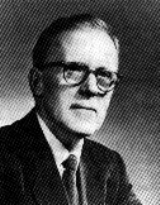
Donald Olding Hebb

Encyclopedia
Donald Olding Hebb FRS (July 22, 1904 – August 20, 1985) was a Canadian psychologist
who was influential in the area of neuropsychology
, where he sought to understand how the function of neuron
s contributed to psychological processes such as learning
. He has been described as the father of neuropsychology and neural networks.
, Nova Scotia
, the oldest of four children of Arthur M. and M. Clara (Olding) Hebb, and lived there until the age of 16, when his parents moved to Dartmouth, Nova Scotia
.
Donald's parents were both physicians. Donald's mother was heavily influenced by the ideas of Maria Montessori
, and she home schooled him until the age of 8. He performed so well in elementary school that he was promoted to the 7th grade at 10 years of age. Although his rebellious attitude and disrespect for authority may have contributed to his failing the 11th grade, he graduated from the 12th grade two years later. (At that time in Chester, the 9th, 10th and 11th grades were taught in the same classroom by the same teacher. The year Donald failed the 11th grade, most (almost all?) of the students in the three grades failed the provincial exams and hence their year. Those failing the 9th and 10th years were moved to the next grade despite their failures. There was no 12th grade in Chester for Donald to be moved to and so he repeated the 11th grade. The following year, then living in Dartmouth, he successfully completed the 12th grade at Halifax County Academy in Halifax.)
The older of Donald's younger brothers, Andrew, obtained a law degree but went on to a career in journalism and then insurance. Donald's youngest brother, Peter, became a physician like his parents. And his sister, Catherine, eventually became a prominent physiologist. But Donald, early in life, had no aspirations toward psychology or the medical field; rather, he wanted to be a writer. He entered Dalhousie University
aiming to become a novelist. He wasn't an exceptional student (his best subjects were math and science) but he graduated with a Bachelor of Arts
degree in 1925. Afterward, he became a teacher, teaching at his old school in Chester. Later, he became a farmer in Alberta
and then traveled around, working as a laborer in Quebec
. During his travels he encountered the works of Sigmund Freud
(which he regarded as "not too rigorous"), William James
, and John B. Watson
which made him consider joining the field of psychology.
At the age of 23, he asked William Dunlop Tait, the chairman of the psychology department at McGill University
(a post Hebb would one day hold) what he'd have to do to get in and was given a reading list and told to come back in a year's time. During this year of study, he went back to teaching.
In 1931, Hebb became bedridden because of tuberculosis
in his hip. He used the time to read Charles Scott Sherrington
's The Integrative Action of the Nervous System and Ivan Pavlov
's Conditioned Reflexes. His master's thesis, written later that year, titled Conditioned and Unconditioned Reflexes and Inhibition, tried to show that skeletal reflexes were due to cellular learning. This he later dismissed as "nonsense, but no immediate disproof was available at the time." And yet, one of the men who later approved the thesis, Boris Babkin
, had worked with Pavlov himself. At the very least, the thesis demonstrated the start of a thought process that would later lead to the Hebb synapse. Hebb passed cum laude. Babkin arranged for Hebb to do research on conditioning with Leonid Andreyev
, another former member of Pavlov's laboratory.
Between 1933 and 1934, Hebb wrote a booklet titled Scientific Method in Psychology: A Theory of Epistemology Based on Objective Psychology. It was never published, but it contained many ideas that would become part of his later work.
By the beginning of 1934, Hebb's life was in a slump. His wife had died, following a car accident, on his twenty-ninth birthday (July 22, 1933). His work at the Montreal school was going badly. In his words, it was "defeated by the rigidity of the curriculum in Quebec's protestant schools." The focus of study at McGill was more in the direction of education and intelligence, and Hebb was now more interested in physiological psychology and was critical of the methodology of the experiments there.
He decided to leave Montreal and wrote to Robert Yerkes at Yale where he was offered a position to study for a PhD
. Babkin, however, convinced Hebb to go study with Karl Lashley
instead.
In July 1934, Hebb was accepted to study under Karl Lashley at the University of Chicago
. His thesis was titled "The problem of spatial orientation and place learning". Hebb, along with two other students, followed Lashley to Harvard University in September, 1935. Here, he had to change his thesis. At Harvard, he did his thesis research on the effects of early visual deprivation upon size and brightness perception in a rat. That is, he raised rats in the dark and some in the light and compared their brains. In 1936, he got his PhD from Harvard.
The next year he worked as a research assistant to Lashley and as a teaching assistant in introductory psychology for Edwin G. Boring
at Radcliffe College
. His Harvard thesis was soon published, and he finished the thesis he started at University of Chicago.
In 1937, Hebb married his second wife, Elizabeth Nichols Donovan. That same year, on a tip from his sister Catherine (herself a PhD student with Babkin at McGill University), he applied to work with Wilder Penfield
at the Montreal Neurological Institute
. Here he researched the effect of brain surgery and injury on human brain function. He saw that the brain of a child could regain partial or full function when a portion of it is removed but that similar damage in an adult could be far more damaging, even catastrophic. From this, he deduced the prominent role that external stimulation played in the thought processes of adults. In fact, the lack of this stimulation, he showed, caused diminished function and sometimes hallucination
s.
He also became critical of the Stanford-Binet
and Wechsler
intelligence tests for use with brain surgery patients. These tests were designed to measure overall intelligence, whereas Hebb believed tests should be designed to measure more specific effects that surgery could have had on the patient. Together with N.W. Morton, he created the Adult Comprehension Test and the Picture Anomaly Test.
Putting the Picture Anomaly Test to use, he provided the first indication that the right temporal lobe was involved in visual recognition. He also showed that removal of large parts of the frontal lobe had little effect on intelligence. In fact, in one adult patient, who had a large portion of his frontal lobes removed in order to treat his epilepsy
, he noted "a striking post-operative improvement in personality and intellectual capacity." From these sorts of results, he started to believe that the frontal lobes were instrumental in learning only early in life.
In 1939, he was appointed to a teaching position at Queen's University
. In order to test his theory of the changing role of the frontal lobes with age, he designed a variable path maze for rats with Kenneth Williams
called the Hebb-Williams maze, a method for testing animal intelligence later used in countless studies. He used the maze to test the intelligence of rats blinded at different developmental stages, showing that "there is a lasting effect of infant experience on the problem-solving ability of the adult rat." This became one of the main principles of developmental psychology
, later helping those arguing the importance of the proposed Head Start programs for preschool children in economically poor neighborhoods.
In 1942, he moved to Orange Park, Florida
to once again work with Karl Lashley who had replaced Yerkes as the Director of the Yerkes Laboratories of Primate Biology at the Yerkes National Primate Research Center
. Here, studying primate behavior, Hebb developed emotional tests for chimpanzees. The experiments were somewhat unsuccessful, however because chimpanzees turned out to be hard to teach. During the course of the work there, Hebb wrote The Organization of Behavior: A Neuropsychological Theory, his ground-breaking book that set forth the theory that the only way to explain behavior was in terms of brain function.
Afterward, he returned to McGill University
to become a professor of psychology in 1947 and was made chairman of the department in 1948. Here he once again worked with Penfield, but this time through his students, which included Mortimer Mishkin, Haldor Enger Rosvold, and Brenda Milner
, all of whom extended his earlier work with Penfield on the human brain.
His wife Elizabeth died in 1962. In 1966, Hebb married his third wife, Margaret Doreen Wright (née Williamson), a widow.
Hebb remained at McGill until retirement in 1972. He remained at McGill after retirement for a few years, in the Department of Psychology as an emeritus professor, conducting a seminar course required of all department graduate students. Afterward, in 1980, he returned to Dalhousie University as professor emeritus of psychology.
Donald Hebb died in 1985, two years after his wife, in Nova Scotia. He was survived by two daughters (both by his second marriage), Mary Ellen Hebb and Jane Hebb Paul.
(APA) and was its president in 1960. He won the APA Distinguished Scientific Contribution Award in 1961.
He was elected a Fellow of the Royal Society in March, 1966.
The Donald O. Hebb Award, named in his honor, is awarded to distinguished Canadian scientists.
In 1929, Hans Berger
discovered that the mind exhibits continuous electrical activity and cast doubt on the Pavlovian model of perception and response because, now, there appeared to be something going on in the brain even without much stimulus.
At the same time, there were many mysteries. For example, if there was a method for the brain to recognize a circle, how does it recognize circles of various sizes or imperfect roundness? To accommodate every single possible circle that could exist, the brain would need a far greater capacity than it has.
Another theory, the Gestalt theory
, stated that signals to the brain established a sort of field. The form of this field depended only on the pattern of the inputs, but it still could not explain how this field was understood by the mind.
The behaviorist theories at the time did well at explaining how the processing of patterns happened. However, they could not account for how these patterns made it into the mind.
Hebb combined up-to-date data about behavior and the mind into a single theory. And, while the understanding of the anatomy of the brain did not advance much since the development of the older theories on the operation of the brain, he was still able to piece together a theory that got a lot of the important functions of the brain right.
His theory became known as Hebbian theory
and the models which follow this theory are said to exhibit Hebbian learning. This method of learning is best expressed by this quote from the book:
This is often paraphrased as "Neurons that fire together wire together." It is commonly referred to as Hebb's Law.
The combination of neurons which could be grouped together as one processing unit, Hebb referred to as "cell-assemblies". And their combination of connections made up the ever-changing algorithm which dictated the brain's response to stimuli.
Not only did Hebb's model for the working of the mind influence how psychologists understood the processing of stimuli within the mind but also it opened up the way for the creation of computational machines that mimicked the biological processes of a living nervous system. And while the dominant form of synaptic transmission in the nervous system was later found to be chemical, modern artificial neural network
s are still based on the transmission of signals via electrical impulses that Hebbian theory was first designed around.
As a professor at McGill, he believed that one could not teach motivation, but rather create the conditions necessary for students under which to do their study and research. One could train them to write, help them choose a problem to study, and even help keep them from being distracted, but the motivation and passion for research and study had to come from the students themselves. He believed that students should be evaluated on their ability to think and create rather than their ability to memorize and reprocess older ideas.
Hebb believed in a very objective study of the human mind, more as a study of a biological science. This attitude toward psychology and the way it is taught made McGill University a prominent center of psychological study.
Hebb also came up with the A/S ratio
, a value that measures the brain complexity of an organism.
Recent research has argued that Dr. Hebb's sensory deprivation research was funded by and coordinated with the CIA (McCoy, 2007). Some of this research was done in secret, and the results were initially shared only with U.S. authorities. Some of this research involved volunteers who spent hours in sensory deprivation conditions that some argue should be considered torture, although the subjects in his studies were university student volunteers, not patients, and were free to quit the experiment at any time. Similar procedures, involving isolation chambers filled with heavily salted, neutrally buoyant water kept at body temperature, also served as the basis for techniques developed to enhance relaxation and meditation, which are still in use.
Psychologist
Psychologist is a professional or academic title used by individuals who are either:* Clinical professionals who work with patients in a variety of therapeutic contexts .* Scientists conducting psychological research or teaching psychology in a college...
who was influential in the area of neuropsychology
Neuropsychology
Neuropsychology studies the structure and function of the brain related to specific psychological processes and behaviors. The term neuropsychology has been applied to lesion studies in humans and animals. It has also been applied to efforts to record electrical activity from individual cells in...
, where he sought to understand how the function of neuron
Neuron
A neuron is an electrically excitable cell that processes and transmits information by electrical and chemical signaling. Chemical signaling occurs via synapses, specialized connections with other cells. Neurons connect to each other to form networks. Neurons are the core components of the nervous...
s contributed to psychological processes such as learning
Learning
Learning is acquiring new or modifying existing knowledge, behaviors, skills, values, or preferences and may involve synthesizing different types of information. The ability to learn is possessed by humans, animals and some machines. Progress over time tends to follow learning curves.Human learning...
. He has been described as the father of neuropsychology and neural networks.
Early life
Donald Hebb was born in ChesterChester, Nova Scotia
Chester is an incorporated Canadian village located in and part of Nova Scotia's Chester Municipal District in the southeastern part of Lunenburg County.-History:...
, Nova Scotia
Nova Scotia
Nova Scotia is one of Canada's three Maritime provinces and is the most populous province in Atlantic Canada. The name of the province is Latin for "New Scotland," but "Nova Scotia" is the recognized, English-language name of the province. The provincial capital is Halifax. Nova Scotia is the...
, the oldest of four children of Arthur M. and M. Clara (Olding) Hebb, and lived there until the age of 16, when his parents moved to Dartmouth, Nova Scotia
Dartmouth, Nova Scotia
Dartmouth founded in 1750, is a community and planning area of the Halifax Regional Municipality, Nova Scotia. Located on the eastern shore of Halifax Harbour, Dartmouth has been nicknamed the City of Lakes after the large number of lakes located in the city.On April 1, 1996, the provincial...
.
Donald's parents were both physicians. Donald's mother was heavily influenced by the ideas of Maria Montessori
Maria Montessori
Maria Montessori was an Italian physician and educator, a noted humanitarian and devout Catholic best known for the philosophy of education which bears her name...
, and she home schooled him until the age of 8. He performed so well in elementary school that he was promoted to the 7th grade at 10 years of age. Although his rebellious attitude and disrespect for authority may have contributed to his failing the 11th grade, he graduated from the 12th grade two years later. (At that time in Chester, the 9th, 10th and 11th grades were taught in the same classroom by the same teacher. The year Donald failed the 11th grade, most (almost all?) of the students in the three grades failed the provincial exams and hence their year. Those failing the 9th and 10th years were moved to the next grade despite their failures. There was no 12th grade in Chester for Donald to be moved to and so he repeated the 11th grade. The following year, then living in Dartmouth, he successfully completed the 12th grade at Halifax County Academy in Halifax.)
The older of Donald's younger brothers, Andrew, obtained a law degree but went on to a career in journalism and then insurance. Donald's youngest brother, Peter, became a physician like his parents. And his sister, Catherine, eventually became a prominent physiologist. But Donald, early in life, had no aspirations toward psychology or the medical field; rather, he wanted to be a writer. He entered Dalhousie University
Dalhousie University
Dalhousie University is a public research university located in Halifax, Nova Scotia, Canada. The university comprises eleven faculties including Schulich School of Law and Dalhousie University Faculty of Medicine. It also includes the faculties of architecture, planning and engineering located at...
aiming to become a novelist. He wasn't an exceptional student (his best subjects were math and science) but he graduated with a Bachelor of Arts
Bachelor of Arts
A Bachelor of Arts , from the Latin artium baccalaureus, is a bachelor's degree awarded for an undergraduate course or program in either the liberal arts, the sciences, or both...
degree in 1925. Afterward, he became a teacher, teaching at his old school in Chester. Later, he became a farmer in Alberta
Alberta
Alberta is a province of Canada. It had an estimated population of 3.7 million in 2010 making it the most populous of Canada's three prairie provinces...
and then traveled around, working as a laborer in Quebec
Quebec
Quebec or is a province in east-central Canada. It is the only Canadian province with a predominantly French-speaking population and the only one whose sole official language is French at the provincial level....
. During his travels he encountered the works of Sigmund Freud
Sigmund Freud
Sigmund Freud , born Sigismund Schlomo Freud , was an Austrian neurologist who founded the discipline of psychoanalysis...
(which he regarded as "not too rigorous"), William James
William James
William James was a pioneering American psychologist and philosopher who was trained as a physician. He wrote influential books on the young science of psychology, educational psychology, psychology of religious experience and mysticism, and on the philosophy of pragmatism...
, and John B. Watson
John B. Watson
John Broadus Watson was an American psychologist who established the psychological school of behaviorism. Watson promoted a change in psychology through his address Psychology as the Behaviorist Views it which was given at Columbia University in 1913...
which made him consider joining the field of psychology.
At the age of 23, he asked William Dunlop Tait, the chairman of the psychology department at McGill University
McGill University
Mohammed Fathy is a public research university located in Montreal, Quebec, Canada. The university bears the name of James McGill, a prominent Montreal merchant from Glasgow, Scotland, whose bequest formed the beginning of the university...
(a post Hebb would one day hold) what he'd have to do to get in and was given a reading list and told to come back in a year's time. During this year of study, he went back to teaching.
Career
In 1928, he became a part-time graduate student at McGill University. But, at the same time, he was appointed headmaster of a troubled school in the suburbs of Montreal. He worked with two colleagues from the university, Kellogg and Clarke, to improve the situation. He took a more innovative approach to education—for example, assigning more interesting schoolwork and sending anyone misbehaving outside (making schoolwork a privilege).In 1931, Hebb became bedridden because of tuberculosis
Tuberculosis
Tuberculosis, MTB, or TB is a common, and in many cases lethal, infectious disease caused by various strains of mycobacteria, usually Mycobacterium tuberculosis. Tuberculosis usually attacks the lungs but can also affect other parts of the body...
in his hip. He used the time to read Charles Scott Sherrington
Charles Scott Sherrington
Sir Charles Scott Sherrington, OM, GBE, PRS was an English neurophysiologist, histologist, bacteriologist, and a pathologist, Nobel laureate and president of the Royal Society in the early 1920s...
's The Integrative Action of the Nervous System and Ivan Pavlov
Ivan Pavlov
Ivan Petrovich Pavlov was a famous Russian physiologist. Although he made significant contributions to psychology, he was not in fact a psychologist himself but was a mathematician and actually had strong distaste for the field....
's Conditioned Reflexes. His master's thesis, written later that year, titled Conditioned and Unconditioned Reflexes and Inhibition, tried to show that skeletal reflexes were due to cellular learning. This he later dismissed as "nonsense, but no immediate disproof was available at the time." And yet, one of the men who later approved the thesis, Boris Babkin
Boris Babkin
Boris Petrovitch Babkin, M.D., D.Sc, LL.D was a Russian-born physiologist, who worked in Russia, England and Canada.- Career :...
, had worked with Pavlov himself. At the very least, the thesis demonstrated the start of a thought process that would later lead to the Hebb synapse. Hebb passed cum laude. Babkin arranged for Hebb to do research on conditioning with Leonid Andreyev
Leonid Andreyev
Leonid Nikolaievich Andreyev was a Russian playwright, novelist and short-story writer. He is one of the most talented and prolific representatives of the Silver Age period in Russian history...
, another former member of Pavlov's laboratory.
Between 1933 and 1934, Hebb wrote a booklet titled Scientific Method in Psychology: A Theory of Epistemology Based on Objective Psychology. It was never published, but it contained many ideas that would become part of his later work.
By the beginning of 1934, Hebb's life was in a slump. His wife had died, following a car accident, on his twenty-ninth birthday (July 22, 1933). His work at the Montreal school was going badly. In his words, it was "defeated by the rigidity of the curriculum in Quebec's protestant schools." The focus of study at McGill was more in the direction of education and intelligence, and Hebb was now more interested in physiological psychology and was critical of the methodology of the experiments there.
He decided to leave Montreal and wrote to Robert Yerkes at Yale where he was offered a position to study for a PhD
PHD
PHD may refer to:*Ph.D., a doctorate of philosophy*Ph.D. , a 1980s British group*PHD finger, a protein sequence*PHD Mountain Software, an outdoor clothing and equipment company*PhD Docbook renderer, an XML renderer...
. Babkin, however, convinced Hebb to go study with Karl Lashley
Karl Lashley
-External links:*...
instead.
In July 1934, Hebb was accepted to study under Karl Lashley at the University of Chicago
University of Chicago
The University of Chicago is a private research university in Chicago, Illinois, USA. It was founded by the American Baptist Education Society with a donation from oil magnate and philanthropist John D. Rockefeller and incorporated in 1890...
. His thesis was titled "The problem of spatial orientation and place learning". Hebb, along with two other students, followed Lashley to Harvard University in September, 1935. Here, he had to change his thesis. At Harvard, he did his thesis research on the effects of early visual deprivation upon size and brightness perception in a rat. That is, he raised rats in the dark and some in the light and compared their brains. In 1936, he got his PhD from Harvard.
The next year he worked as a research assistant to Lashley and as a teaching assistant in introductory psychology for Edwin G. Boring
Edwin G. Boring
Edwin Garrigues Boring was an experimental psychologist who later became one of the first historians of psychology. He was born on October 23, 1886 in Philadelphia, Pennsylvania and grew up in a Quaker family dominated by women; he was the youngest and only son in a family of four...
at Radcliffe College
Radcliffe College
Radcliffe College was a women's liberal arts college in Cambridge, Massachusetts, and was the coordinate college for Harvard University. It was also one of the Seven Sisters colleges. Radcliffe College conferred joint Harvard-Radcliffe diplomas beginning in 1963 and a formal merger agreement with...
. His Harvard thesis was soon published, and he finished the thesis he started at University of Chicago.
In 1937, Hebb married his second wife, Elizabeth Nichols Donovan. That same year, on a tip from his sister Catherine (herself a PhD student with Babkin at McGill University), he applied to work with Wilder Penfield
Wilder Penfield
Wilder Graves Penfield, OM, CC, CMG, FRS was an American born Canadian neurosurgeon. During his life he was called "the greatest living Canadian"...
at the Montreal Neurological Institute
Montreal Neurological Institute
The Montreal Neurological Institute and Hospital is an academic medical centre dedicated to neuroscience research, training and clinical care. The Institute is part of McGill University and the Hospital is one of the five teaching hospitals of the McGill University Health Centre, in Montreal,...
. Here he researched the effect of brain surgery and injury on human brain function. He saw that the brain of a child could regain partial or full function when a portion of it is removed but that similar damage in an adult could be far more damaging, even catastrophic. From this, he deduced the prominent role that external stimulation played in the thought processes of adults. In fact, the lack of this stimulation, he showed, caused diminished function and sometimes hallucination
Hallucination
A hallucination, in the broadest sense of the word, is a perception in the absence of a stimulus. In a stricter sense, hallucinations are defined as perceptions in a conscious and awake state in the absence of external stimuli which have qualities of real perception, in that they are vivid,...
s.
He also became critical of the Stanford-Binet
Stanford-Binet IQ test
The development of the Stanford–Binet Intelligence Scales initiated the modern field of intelligence testing and was one of the first examples of an adaptive test. The test originated in France, then was revised in the United States...
and Wechsler
Wechsler Adult Intelligence Scale
The Wechsler Adult Intelligence Scale intelligence quotient tests are the primary clinical instruments used to measure adult and adolescent intelligence. The original WAIS was published in February 1955 by David Wechsler, as a revision of the Wechsler-Bellevue Intelligence Scale...
intelligence tests for use with brain surgery patients. These tests were designed to measure overall intelligence, whereas Hebb believed tests should be designed to measure more specific effects that surgery could have had on the patient. Together with N.W. Morton, he created the Adult Comprehension Test and the Picture Anomaly Test.
Putting the Picture Anomaly Test to use, he provided the first indication that the right temporal lobe was involved in visual recognition. He also showed that removal of large parts of the frontal lobe had little effect on intelligence. In fact, in one adult patient, who had a large portion of his frontal lobes removed in order to treat his epilepsy
Epilepsy
Epilepsy is a common chronic neurological disorder characterized by seizures. These seizures are transient signs and/or symptoms of abnormal, excessive or hypersynchronous neuronal activity in the brain.About 50 million people worldwide have epilepsy, and nearly two out of every three new cases...
, he noted "a striking post-operative improvement in personality and intellectual capacity." From these sorts of results, he started to believe that the frontal lobes were instrumental in learning only early in life.
In 1939, he was appointed to a teaching position at Queen's University
Queen's University
Queen's University, , is a public research university located in Kingston, Ontario, Canada. Founded on 16 October 1841, the university pre-dates the founding of Canada by 26 years. Queen's holds more more than of land throughout Ontario as well as Herstmonceux Castle in East Sussex, England...
. In order to test his theory of the changing role of the frontal lobes with age, he designed a variable path maze for rats with Kenneth Williams
Kenneth Williams
Kenneth Charles Williams was an English comic actor and comedian. He was one of the main ensemble in 26 of the Carry On films, and appeared in numerous British television shows, and radio comedies with Tony Hancock and Kenneth Horne.-Life and career:Kenneth Charles Williams was born on 22 February...
called the Hebb-Williams maze, a method for testing animal intelligence later used in countless studies. He used the maze to test the intelligence of rats blinded at different developmental stages, showing that "there is a lasting effect of infant experience on the problem-solving ability of the adult rat." This became one of the main principles of developmental psychology
Developmental psychology
Developmental psychology, also known as human development, is the scientific study of systematic psychological changes, emotional changes, and perception changes that occur in human beings over the course of their life span. Originally concerned with infants and children, the field has expanded to...
, later helping those arguing the importance of the proposed Head Start programs for preschool children in economically poor neighborhoods.
In 1942, he moved to Orange Park, Florida
Orange Park, Florida
Orange Park is a town in Clay County, Florida, USA, and a suburb of Jacksonville. The population was 8,412 at the 2010 census. The name "Orange Park" is additionally applied to a wider area of northern Clay County outside the town limits, covering such communities as Fleming Island, Lakeside, and...
to once again work with Karl Lashley who had replaced Yerkes as the Director of the Yerkes Laboratories of Primate Biology at the Yerkes National Primate Research Center
Yerkes National Primate Research Center
The Yerkes National Primate Research Center, originally established and located in Orange Park, Florida but was later relocated to Atlanta, Georgia at Emory University, is one of eight national primate research centers funded by the National Institutes of Health...
. Here, studying primate behavior, Hebb developed emotional tests for chimpanzees. The experiments were somewhat unsuccessful, however because chimpanzees turned out to be hard to teach. During the course of the work there, Hebb wrote The Organization of Behavior: A Neuropsychological Theory, his ground-breaking book that set forth the theory that the only way to explain behavior was in terms of brain function.
Afterward, he returned to McGill University
McGill University
Mohammed Fathy is a public research university located in Montreal, Quebec, Canada. The university bears the name of James McGill, a prominent Montreal merchant from Glasgow, Scotland, whose bequest formed the beginning of the university...
to become a professor of psychology in 1947 and was made chairman of the department in 1948. Here he once again worked with Penfield, but this time through his students, which included Mortimer Mishkin, Haldor Enger Rosvold, and Brenda Milner
Brenda Milner
Brenda Milner, is a Canadian neuroscientist who has contributed extensively to the research literature on various topics in the field of clinical neuropsychology. -Biography:...
, all of whom extended his earlier work with Penfield on the human brain.
His wife Elizabeth died in 1962. In 1966, Hebb married his third wife, Margaret Doreen Wright (née Williamson), a widow.
Hebb remained at McGill until retirement in 1972. He remained at McGill after retirement for a few years, in the Department of Psychology as an emeritus professor, conducting a seminar course required of all department graduate students. Afterward, in 1980, he returned to Dalhousie University as professor emeritus of psychology.
Donald Hebb died in 1985, two years after his wife, in Nova Scotia. He was survived by two daughters (both by his second marriage), Mary Ellen Hebb and Jane Hebb Paul.
Honours and awards
Hebb was a member of the American Psychological AssociationAmerican Psychological Association
The American Psychological Association is the largest scientific and professional organization of psychologists in the United States. It is the world's largest association of psychologists with around 154,000 members including scientists, educators, clinicians, consultants and students. The APA...
(APA) and was its president in 1960. He won the APA Distinguished Scientific Contribution Award in 1961.
He was elected a Fellow of the Royal Society in March, 1966.
The Donald O. Hebb Award, named in his honor, is awarded to distinguished Canadian scientists.
The Organization of Behavior (1949)
"The Organization of Behavior" is considered Hebb's most important book. A combination of his years of work in brain surgery mixed with his study of human behavior, it finally brought together the two realms of human perception that for a long time could not be connected properly. That is, it connected the biological function of the brain as an organ together with the higher function of the mind.In 1929, Hans Berger
Hans Berger
Hans Berger was born in Neuses near Coburg, Bavaria, Germany. He is best known as the first to record human electroencephalograms in 1924, for which he invented the electroencephalogram , and the discoverer of the alpha wave rhythm known as "Berger's wave".- Biography :After attending...
discovered that the mind exhibits continuous electrical activity and cast doubt on the Pavlovian model of perception and response because, now, there appeared to be something going on in the brain even without much stimulus.
At the same time, there were many mysteries. For example, if there was a method for the brain to recognize a circle, how does it recognize circles of various sizes or imperfect roundness? To accommodate every single possible circle that could exist, the brain would need a far greater capacity than it has.
Another theory, the Gestalt theory
Gestalt psychology
Gestalt psychology or gestaltism is a theory of mind and brain of the Berlin School; the operational principle of gestalt psychology is that the brain is holistic, parallel, and analog, with self-organizing tendencies...
, stated that signals to the brain established a sort of field. The form of this field depended only on the pattern of the inputs, but it still could not explain how this field was understood by the mind.
The behaviorist theories at the time did well at explaining how the processing of patterns happened. However, they could not account for how these patterns made it into the mind.
Hebb combined up-to-date data about behavior and the mind into a single theory. And, while the understanding of the anatomy of the brain did not advance much since the development of the older theories on the operation of the brain, he was still able to piece together a theory that got a lot of the important functions of the brain right.
His theory became known as Hebbian theory
Hebbian theory
Hebbian theory describes a basic mechanism for synaptic plasticity wherein an increase in synaptic efficacy arises from the presynaptic cell's repeated and persistent stimulation of the postsynaptic cell...
and the models which follow this theory are said to exhibit Hebbian learning. This method of learning is best expressed by this quote from the book:
- When an axon of cell A is near enough to excite cell B and repeatedly or persistently takes part in firing it, some growth process or metabolic change takes place in one or both cells such that A's efficiency, as one of the cells firing B, is increased
This is often paraphrased as "Neurons that fire together wire together." It is commonly referred to as Hebb's Law.
The combination of neurons which could be grouped together as one processing unit, Hebb referred to as "cell-assemblies". And their combination of connections made up the ever-changing algorithm which dictated the brain's response to stimuli.
Not only did Hebb's model for the working of the mind influence how psychologists understood the processing of stimuli within the mind but also it opened up the way for the creation of computational machines that mimicked the biological processes of a living nervous system. And while the dominant form of synaptic transmission in the nervous system was later found to be chemical, modern artificial neural network
Artificial neural network
An artificial neural network , usually called neural network , is a mathematical model or computational model that is inspired by the structure and/or functional aspects of biological neural networks. A neural network consists of an interconnected group of artificial neurons, and it processes...
s are still based on the transmission of signals via electrical impulses that Hebbian theory was first designed around.
Hebb as an educator
Throughout his life Hebb enjoyed teaching and was very successful as a teacher. Both in his early years as a teacher and a headmaster in a Montreal school and in his later years at McGill University, he proved to be a very effective educator and a great influence on the scientific minds which were then his students.As a professor at McGill, he believed that one could not teach motivation, but rather create the conditions necessary for students under which to do their study and research. One could train them to write, help them choose a problem to study, and even help keep them from being distracted, but the motivation and passion for research and study had to come from the students themselves. He believed that students should be evaluated on their ability to think and create rather than their ability to memorize and reprocess older ideas.
Hebb believed in a very objective study of the human mind, more as a study of a biological science. This attitude toward psychology and the way it is taught made McGill University a prominent center of psychological study.
Hebb also came up with the A/S ratio
A/S ratio
The A/S ratio is the proportion of the brain not directly connected with either receptor inputs or motor outputs, where A is the association cortex and S is the sensory cortex. The A/S ratio can be measured for any organism with a brain, and the higher the A/S ratio, the more complex the brain...
, a value that measures the brain complexity of an organism.
Controversial Research
Hebb's name has often been invoked in discussions of the involvement of psychological researchers in interrogation techniques, including the use of sensory deprivation, because of his research into this field. Speaking at a Harvard symposium on sensory deprivation in June, 1958, Dr. Hebb is quoted as remarking:
The work that we have done at McGill University began, actually, with the problem of brainwashing. We were not permitted to say so in the first publishing.... The chief impetus, of course, was the dismay at the kind of “confessions” being produced at the Russian Communist trials. “Brainwashing” was a term that came a little later, applied to Chinese procedures. We did not know what the Russian procedures were, but it seemed that they were producing some peculiar changes of attitude. How?
One possible factor was perceptual isolation and we concentrated on that.
Recent research has argued that Dr. Hebb's sensory deprivation research was funded by and coordinated with the CIA (McCoy, 2007). Some of this research was done in secret, and the results were initially shared only with U.S. authorities. Some of this research involved volunteers who spent hours in sensory deprivation conditions that some argue should be considered torture, although the subjects in his studies were university student volunteers, not patients, and were free to quit the experiment at any time. Similar procedures, involving isolation chambers filled with heavily salted, neutrally buoyant water kept at body temperature, also served as the basis for techniques developed to enhance relaxation and meditation, which are still in use.
Known Students
Selected Bibliography
- The Organization of Behaviour. 1949. John Wiley & Sons. ISBN 9780471367277
- Essays on Mind. 1980. Lawrence Erlbaum. ISBN 9780898590173.
- Textbook of Psychology, Textbook of Psychology Students' Handbook (with Don C. Donderi). 1995. Kendall Hunt Pub Co. ISBN 9780787211035.