


Ribbon cable

Encyclopedia
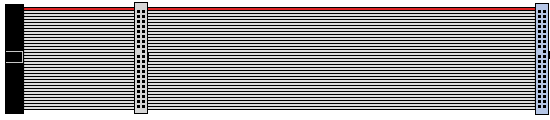
A ribbon cable is a cable with many conducting wires running parallel to each other on the same flat plane. As a result the cable is wide and flat. Its name comes from the resemblance of the cable to a piece of ribbon
.
Ribbon cables are usually seen for internal peripherals in computer
s, such as hard drives, CD drives and floppy drives. On some older computer systems (such as the BBC Micro
and Apple II series
) they were used for external connections as well. Unfortunately the ribbon-like shape interferes with computer cooling by disrupting airflow within the case and also makes the cables awkward to handle, especially when there are a lot of them; round cables have almost entirely replaced ribbon cables for external connections and are increasingly being used internally as well.
To make it easier to identify individual conductors in a cable; ribbon-cable manufacturers introduced rainbow ribbon cable, which uses a repeating pattern of colors borrowed from the standard resistor color code (Brown is pin 1 or pin 11 or pin 21, etc. Red is pin 2 or pin 12 or pin 22, etc). It is often known affectionately to its users as "hippie cable" due to its distinct appearance. However, this has remained a specialized and relatively expensive product.
 Ribbon cables are usually specified by two numbers: the spacing or pitch of the conductors, and the number of conductors or ways. A spacing of 0.05 inch (1.27 mm) is the most usual, allowing for a two-row connector with a pin spacing of 0.1 inch (2.54 mm). These types are used for many types of equipment, in particular for interconnections within an enclosure. For personal computer
s, this size is used today in floppy-disk-drive cables and older or custom Parallel ATA cables.
Based on availability of standard connectors, the number of conductors is usually restricted to a few values,
These include 4, 6, 8, 9, 10, 14, 15, 16, 18, 20, 24, 25, 26, 34, 37, 40, 50, 60, 64 and 80. The wire is usually stranded copper wire, usually either 0.32, 0.20, or 0.13 mm2 (22, 24, or 26 AWG
).
Finer and coarser pitch cables are also available. For instance, the high-speed ATA
interface cable used for computer hard disk interfaces ULTRA-ATA has 0.025-inch (0.64-mm) pitch. Finer pitches, as small as 0.3 mm, are found in portable electronic equipment, such as laptops; however, portable electronic equipment usually uses flexible flat cables (FFC).
s (IDC) in which the ribbon cable is forced onto a row of sharp forked contacts. (The phrase "IDC connector" is widely used, even though it is redundant—an example of RAS syndrome
.) Most commonly termination is done at both ends of the cable, although sometimes (for example, when making a lead that needs to change wiring between the two connectors) only one end will be IDC terminated, with the other end being terminated in a regular crimp
or solder-bucket connection. Although it is sometimes possible to dismantle and re-use IDC connectors, they are not designed to allow this to be done easily.
Popular types of connectors available with IDC termination suitable for ribbon cable include
When electronics hobbyists are working on their computers or digital musical keyboard
s to "mod" (modify) or "hack" them, they sometimes have to solder ribbon cables. Soldering ribbon cables can present a challenge to a hobbyist who has not been trained as an electronics technician. In some cases, hobbyists strip off the wire with a fine razor, and then separate the wires before soldering them. Some hobbyists use fine sandpaper to wear away the plastic insulation from the wires. The sanding also primes the copper tracks. Then when the "tinned" soldering iron is touched onto the bare wire, the solder is guided into the track.
(FCC) discovered that ribbon cables were highly efficient antennas
, broadcasting essentially random signals across a wide band of the electromagnetic spectrum
. These unintended signals could interfere with domestic TV reception, putting "snow" on the screen. The FCC issued edicts and injunctions to the personal-computer industry, restricting the use of ribbon cables to connect devices together. "Naked" ribbon cable could be used inside the case
of a computer or peripheral device, but any ribbon cable connecting two boxes together had to be grounded
. This rule led to solutions such as ribbon cables covered by a copper-braid shield, which made it impossible to see or separate the individual connectors. On the Apple II
, these cables passed through the holes on the back of the computer that were grounded to the power supply. Eventually, ribbon connectors were replaced, for inter-connect purposes, by a wide profusion of custom-designed round cables with molded connectors.
Ribbon
A ribbon or riband is a thin band of material, typically cloth but also plastic or sometimes metal, used primarily for binding and tying. Cloth ribbons, most commonly silk, are often used in connection with clothing, but are also applied for innumerable useful, ornamental and symbolic purposes...
.
Ribbon cables are usually seen for internal peripherals in computer
Computer
A computer is a programmable machine designed to sequentially and automatically carry out a sequence of arithmetic or logical operations. The particular sequence of operations can be changed readily, allowing the computer to solve more than one kind of problem...
s, such as hard drives, CD drives and floppy drives. On some older computer systems (such as the BBC Micro
BBC Micro
The BBC Microcomputer System, or BBC Micro, was a series of microcomputers and associated peripherals designed and built by Acorn Computers for the BBC Computer Literacy Project, operated by the British Broadcasting Corporation...
and Apple II series
Apple II series
The Apple II series is a set of 8-bit home computers, one of the first highly successful mass-produced microcomputer products, designed primarily by Steve Wozniak, manufactured by Apple Computer and introduced in 1977 with the original Apple II...
) they were used for external connections as well. Unfortunately the ribbon-like shape interferes with computer cooling by disrupting airflow within the case and also makes the cables awkward to handle, especially when there are a lot of them; round cables have almost entirely replaced ribbon cables for external connections and are increasingly being used internally as well.
Color-coding
To reduce the risk of reversed connections—which could potentially damage hardware—either when making a cable or when using a cable with unpolarized connectors, one edge of the cable is usually marked with a red stripe. By convention the edge with the stripe is connected to pin 1 on the connector. This method of identification is fine for cables that just consist of two or more IDC connectors with every connector connecting to every wire, but is somewhat less helpful when individual wires or small groups of wires must be terminated separately.To make it easier to identify individual conductors in a cable; ribbon-cable manufacturers introduced rainbow ribbon cable, which uses a repeating pattern of colors borrowed from the standard resistor color code (Brown is pin 1 or pin 11 or pin 21, etc. Red is pin 2 or pin 12 or pin 22, etc). It is often known affectionately to its users as "hippie cable" due to its distinct appearance. However, this has remained a specialized and relatively expensive product.
Sizes
Personal computer
A personal computer is any general-purpose computer whose size, capabilities, and original sales price make it useful for individuals, and which is intended to be operated directly by an end-user with no intervening computer operator...
s, this size is used today in floppy-disk-drive cables and older or custom Parallel ATA cables.
Based on availability of standard connectors, the number of conductors is usually restricted to a few values,
These include 4, 6, 8, 9, 10, 14, 15, 16, 18, 20, 24, 25, 26, 34, 37, 40, 50, 60, 64 and 80. The wire is usually stranded copper wire, usually either 0.32, 0.20, or 0.13 mm2 (22, 24, or 26 AWG
American wire gauge
American wire gauge , also known as the Brown & Sharpe wire gauge, is a standardized wire gauge system used since 1857 predominantly in the United States and Canada for the diameters of round, solid, nonferrous, electrically conducting wire...
).
Finer and coarser pitch cables are also available. For instance, the high-speed ATA
ATA
ATA or Ata may refer to:* Ata , people with the first name or family name-Education:* Ashcroft Technology Academy, Wandsworth, London, England* Advanced Technologies Academy, a high school in Las Vegas, Nevada, USA...
interface cable used for computer hard disk interfaces ULTRA-ATA has 0.025-inch (0.64-mm) pitch. Finer pitches, as small as 0.3 mm, are found in portable electronic equipment, such as laptops; however, portable electronic equipment usually uses flexible flat cables (FFC).
Connectors
The main point of ribbon cables is to allow mass termination to specially designed insulation-displacement connectorInsulation-displacement connector
An Insulation-displacement connector, insulation-displacement technology/termination or insulation-piercing connector is an electrical connector designed to be connected to the conductor of an insulated wire or cable by a connection process which forces a selectively sharpened blade or blades...
s (IDC) in which the ribbon cable is forced onto a row of sharp forked contacts. (The phrase "IDC connector" is widely used, even though it is redundant—an example of RAS syndrome
RAS syndrome
RAS syndrome , also known as PNS syndrome or RAP phrases , refers to the use of one or more of the words that make up an acronym or initialism in conjunction with the abbreviated form, thus in effect repeating one or more words...
.) Most commonly termination is done at both ends of the cable, although sometimes (for example, when making a lead that needs to change wiring between the two connectors) only one end will be IDC terminated, with the other end being terminated in a regular crimp
Crimp connection
A crimp connection is achieved with a type of solderless electrical connector.Crimp connectors are typically used to terminate stranded wire. They fulfill numerous uses, including allowing the wires to be easily terminated to screw terminals, fast-on / quick-disconnect / spade-foot type terminals,...
or solder-bucket connection. Although it is sometimes possible to dismantle and re-use IDC connectors, they are not designed to allow this to be done easily.
Popular types of connectors available with IDC termination suitable for ribbon cable include
- BT224 connector – also defined by BS9525-F0023, DIN41651, MIL-C-83503 standards; these are the type used on ATA cables and are often simply called "IDC connectors". They mate with either a purpose-made plug or a two-row grid of header pins with 0.1 inch (2.54 mm) spacing.
- D-subminiatureD-subminiatureThe D-subminiature or D-sub is a common type of electrical connector. They are named for their characteristic D-shaped metal shield. When they were introduced, D-subs were among the smaller connectors used on computer systems....
connector – used for serial ports and printer ports (however IDC D connectors are far less common than crimp and solder bucket types). - DIN 41612DIN 41612DIN 41612 is a DIN standard for electrical connectors that are widely used in rack based electrical systems. Standardisation of the connectors is a pre-requisite for open systems, where users expect components from different suppliers to operate together. The mostly widely known use of DIN 41612...
connector – used for EurocardEurocardEurocard is a European standard format for PCB cards, which can be plugged together into a standardized subrack. The subrack consists of a series of slotted card guides on the top and bottom, into which the cards are slid so they stand on end, like books on a shelf...
buses. - PCB transition headers – has two rows of pins with the same spacings as BT244 connectors. Intended to be soldered directly into a PCB.
- DIL headers – Has pins with the same spacings as standard DILDual in-line packageIn microelectronics, a dual in-line package is an electronic device package with a rectangular housing and two parallel rows of electrical connecting pins. The package may be through-hole mounted to a printed circuit board or inserted in a socket.A DIP is usually referred to as a DIPn, where n is...
ICs. Generally used where for some reason it is desired to replace an IC with a connection to an external device (e.g., in-circuit emulatorIn-circuit emulatorAn in-circuit emulator is a hardware device used to debug the software of an embedded system. It was historically in the form of bond-out processor which has many internal signals brought out for the purpose of debugging...
s). Can also be used like a PCB transition header, especially on stripboardStripboardStripboard is a widely-used type of electronics prototyping board characterized by a 0.1 inch regular grid of holes, with wide parallel strips of copper cladding running in one direction all the way across one side of the board...
. (Fitting a standard-spacing header to stripboard is tricky, because you have to cut the tracks between two holes rather than on a hole.)
When electronics hobbyists are working on their computers or digital musical keyboard
Musical keyboard
A musical keyboard is the set of adjacent depressible levers or keys on a musical instrument, particularly the piano. Keyboards typically contain keys for playing the twelve notes of the Western musical scale, with a combination of larger, longer keys and smaller, shorter keys that repeats at the...
s to "mod" (modify) or "hack" them, they sometimes have to solder ribbon cables. Soldering ribbon cables can present a challenge to a hobbyist who has not been trained as an electronics technician. In some cases, hobbyists strip off the wire with a fine razor, and then separate the wires before soldering them. Some hobbyists use fine sandpaper to wear away the plastic insulation from the wires. The sanding also primes the copper tracks. Then when the "tinned" soldering iron is touched onto the bare wire, the solder is guided into the track.
Interference
From a digital point of view, ribbon cable is an ideal way to connect two devices. However, from an analog point of view, these cables are problematic. Around 1980, the U.S. Federal Communications CommissionFederal Communications Commission
The Federal Communications Commission is an independent agency of the United States government, created, Congressional statute , and with the majority of its commissioners appointed by the current President. The FCC works towards six goals in the areas of broadband, competition, the spectrum, the...
(FCC) discovered that ribbon cables were highly efficient antennas
Antenna (radio)
An antenna is an electrical device which converts electric currents into radio waves, and vice versa. It is usually used with a radio transmitter or radio receiver...
, broadcasting essentially random signals across a wide band of the electromagnetic spectrum
Electromagnetic spectrum
The electromagnetic spectrum is the range of all possible frequencies of electromagnetic radiation. The "electromagnetic spectrum" of an object is the characteristic distribution of electromagnetic radiation emitted or absorbed by that particular object....
. These unintended signals could interfere with domestic TV reception, putting "snow" on the screen. The FCC issued edicts and injunctions to the personal-computer industry, restricting the use of ribbon cables to connect devices together. "Naked" ribbon cable could be used inside the case
Computer case
A computer case is the enclosure that contains most of the components of a computer...
of a computer or peripheral device, but any ribbon cable connecting two boxes together had to be grounded
Grounding
Grounding or grounded may refer to:* Ground * Grounding , about the collapse of the airline Swissair* Grounding , restrictions placed on movement or privileges...
. This rule led to solutions such as ribbon cables covered by a copper-braid shield, which made it impossible to see or separate the individual connectors. On the Apple II
Apple II
The Apple II is an 8-bit home computer, one of the first highly successful mass-produced microcomputer products, designed primarily by Steve Wozniak, manufactured by Apple Computer and introduced in 1977...
, these cables passed through the holes on the back of the computer that were grounded to the power supply. Eventually, ribbon connectors were replaced, for inter-connect purposes, by a wide profusion of custom-designed round cables with molded connectors.