

Dilwara Temples

Encyclopedia
Jainism
Jainism is an Indian religion that prescribes a path of non-violence towards all living beings. Its philosophy and practice emphasize the necessity of self-effort to move the soul towards divine consciousness and liberation. Any soul that has conquered its own inner enemies and achieved the state...
Dilwara temples of India
India
India , officially the Republic of India , is a country in South Asia. It is the seventh-largest country by geographical area, the second-most populous country with over 1.2 billion people, and the most populous democracy in the world...
are located about 2½ kilometers from Mount Abu, Rajasthan's
Rajasthan
Rājasthān the land of Rajasthanis, , is the largest state of the Republic of India by area. It is located in the northwest of India. It encompasses most of the area of the large, inhospitable Great Indian Desert , which has an edge paralleling the Sutlej-Indus river valley along its border with...
only hill station. These temple
Temple
A temple is a structure reserved for religious or spiritual activities, such as prayer and sacrifice, or analogous rites. A templum constituted a sacred precinct as defined by a priest, or augur. It has the same root as the word "template," a plan in preparation of the building that was marked out...
s built by Chalukya between the 11th and 13th centuries AD are world famous for their stunning use of marble
Marble
Marble is a metamorphic rock composed of recrystallized carbonate minerals, most commonly calcite or dolomite.Geologists use the term "marble" to refer to metamorphosed limestone; however stonemasons use the term more broadly to encompass unmetamorphosed limestone.Marble is commonly used for...
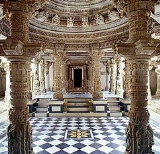
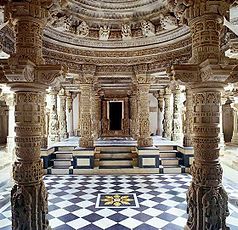
. The five legendary marble temples of Dilwara are a sacred pilgrimage place of the Jains. Some consider them to be one of the most beautiful Jain pilgrimage sites in the world. The marble temples have an opulent entranceway, the simplicity in architecture reflecting Jain values like honesty and frugality. The temples are in the midst of a range of forested hills. A high wall shrouds the temple complex.
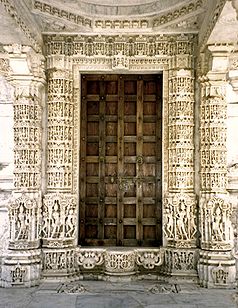
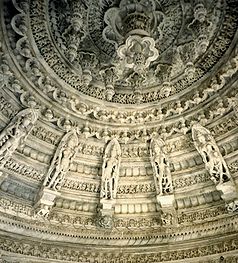
Although the Jains built some beautiful temples at other places in Rajasthan, some believe that none come close to these in terms of architectural perfection. The ornamental detail spreading over the minutely carved ceilings, doorways, pillars and panels is simply marvellous.
For the people who come to perform puja here, there are facilities to bathe and get ready. The facilities use passive solar power to heat up the water for bathing and other things. Guided tour hours for tourists are posted outside the temple. You might see occasional monkeys looking for food outside the temple area.
Five Unique Temples of Dilwara
- Vimal Vasahi, dedicated to the first Jain Tirthankara, RishabhaRishabha (Jain tirthankar)In Jainism, R̥ṣabha or Ādinātha , also known as the "Lord of Kesariya") was the first of the 24 Tīrthaṅkaras. According to Jain beliefs, R̥ṣabha founded the Ikshvaku dynasty and was the first Tīrthaṅkara of the present age...
. - Luna Vasahi, dedicated to the 22nd Jain Tirthankara, Neminatha.
- Pithalhar, dedicated to the first Jain Tirthankar, Rishabha
- Khartar Vasahi, dedicated to the 23rd Jain Tirthankara, ParshvaParshvaPārśva or Paras was the twenty-third Tirthankara "Ford-Maker" in Jainism . He is the earliest Jain leader generally accepted as a historical figure. Pārśva was a nobleman belonging to the Kshatriya varna....
. - Mahavir Swami, dedicated to the last Jain Tirthankara, MahaviraMahaviraMahāvīra is the name most commonly used to refer to the Indian sage Vardhamāna who established what are today considered to be the central tenets of Jainism. According to Jain tradition, he was the 24th and the last Tirthankara. In Tamil, he is referred to as Arukaṉ or Arukadevan...
.
The most famous of these are the Vimal Vasahi
Basadi
Basadi is a Jain shrine or temple.The word is generally used in South India, including Maharashtra. Its historical use in North is preserved in the names of the Vimala Vasahi and Luna Vasahi temples of Mount Abu...
and Luna Vasahi temples.
Vimal Vasahi Temple
This temple carved entirely out of white marble was built in 1021 by Vimal Shah, a minister of Bhimidev I, the Chalukya King (SolankiSolanki
The Solanki was a royal Hindu Indian dynasty that ruled parts of western and central India between the 10th to 13th centuries. A number of scholars including V. A. Smith assign them Gurjar origin....
Maharaja
Maharaja
Mahārāja is a Sanskrit title for a "great king" or "high king". The female equivalent title Maharani denotes either the wife of a Maharaja or, in states where that was customary, a woman ruling in her own right. The widow of a Maharaja is known as a Rajamata...
) of Gujarat. The temple is dedicated to Rishabha. The temple stands in an open courtyard surrounded by a corridor, which has numerous cells containing smaller idols of the Tirthankaras. The richly carved corridors, pillars, arches, and 'mandaps
Mandapa
A mandapa in Indian architecture is a pillared outdoor hall or pavilion for public rituals.-Temple architecture:...
' or porticoes of the temple are simply amazing. The ceilings feature engraved designs of lotus-buds, petals, flowers and scenes from Jain and Hindu mythology.
The Rang manda is a grand hall supported by 12 decorated pillars and nicely carved out arches with a breathtaking central dome. On the pillars are carved female figurines playing musical instruments and 16 Vidhyadevis, or the goddesses of knowledge, each one holding her own symbol which is believed to be memorial of victorious Brahma Kumaris follower from last Kalpa
Kalpa
Kalpa is a small town in the Sutlej river valley, above Recong Peo in the Kinnaur district of Himachal Pradesh, Northern India, in the Indian Himalaya. Inhabited by Kinnauri people and famous for its apple orchards. Apples are a major cash-crop for the region...
.
The Navchowki is a collection of nine rectangular ceilings, each one containing beautiful carvings of different designs supported on ornate pillars. The Gudh mandap is a simple hall once you step inside its heavily decorated doorway. Installed here is the idol of Adi Nath or Lord Rishabdev, as he is also known. The mandap is meant for Aarti
Aarti
Aarti , also spelled arathi, aarthi is a Hindu religious ritual of worship, a form of puja, in which light from wicks soaked in ghee or camphor is offered to one or more deities...
to the deity
Deity
A deity is a recognized preternatural or supernatural immortal being, who may be thought of as holy, divine, or sacred, held in high regard, and respected by believers....
. The Hastishala (Elephant Cell) was constructed by Prithvipal, a descendant of Vimal Shah in 1147-49 and features a row of elephants in sculpture.
Luna Vasahi
The Luna Vashi temple is dedicated to Neminath. This magnificent temple was built in 1230 by two PorwadPorwad
·Porvad , also called Porwad / Porwal, are an ancient Jain community that originated from southern Rajasthan. In Sanskrit inscriptions it is called Pragvata ....
brothers - Vastupal and Tejpal - both ministers of a Virdhaval, the Vaghela ruler of Gujarat. The temple built in memory of their late brother Luna was designed after the Vimal Vashi temple. The main hall or Rang mandap features a central dome from which hangs a big ornamental pendent featuring elaborate carving. Arranged in a circular band are 72 figures of Tirthankars in sitting posture and just below this band are 360 small figures of Jain monks in another circular band. The Hathishala or elephant cell features 10 beautiful marble elephants neatly polished and realistically modelled.
The Navchowki features some of the most magnificent and delicate marble stone cutting work of the temple. Each of the nine ceilings here seems to exceed the others in beauty and grace. The Gudh mandap features a black marble idol of the 22nd Jain Tirthankar Neminatha. The Kirthi Stambha is a big black stone pillar that stands on the left side of the temple. The pillar was constructed by Maharana Kumbha of Mewar
Mewar
Mewar is a region of south-central Rajasthan state in western India. It includes the present-day districts of Pratapgarh, Bhilwara, Chittorgarh, Rajsamand, Udaipur, Dungarpur, Banswara and some of the part of Gujarat and Madhya Pradesh. The region was for centuries a Rajput kingdom that later...
. The remaining three temples of Dilwara are smaller but just as elegant as the other two.
Pittalhar Temple
This temple was built by Bhima Shah, a minister of Sultan Begada of AhmedabadAhmedabad
Ahmedabad also known as Karnavati is the largest city in Gujarat, India. It is the former capital of Gujarat and is also the judicial capital of Gujarat as the Gujarat High Court has its seat in Ahmedabad...
. A massive metal statue of first Jain Tirthankara Rishabha Dev (Adinath), cast in five metals, is installed in the temple. The main metal used in this statue is 'Pital' (brass), hence the name 'Pittalhar'. The Shrine consists of a main Garbhagriha
Garbhagriha
Garbhagriha or Garbha griha is the small unlit shrine of a Hindu temple.Garbhagriha or ' is a Sanskrit word meaning the interior of the sanctum sanctorum, the innermost sanctum of a Hindu temple where resides the murti of the primary deity of the temple...
, Gudh mandap and Navchowki. It seems that the construction of Rangmandap and the corridor was left unfinished. The old mutilated idol was replaced and installed in 1468-69 AD weighing 108 maunds (about 40 quintals or four metric tons) according to the inscription on it. The image was cast by an artist 'Deta' which is 8 ft (2.4 m). high, 5.5 ft (1.7 m). broad and the figure is 41 inches (1,041.4 mm) in height. In Gudh Mandap on one side, a big marble Panch-Tirthi sculpture of Adinath is installed.
Parshvanatha Temple
This temple, dedicated to Parshva, was built by Mandlik and his family in 1458-59 It consists of a three storied building, the tallest of all the shrines at Dilwara. On all the four faces of the sanctum on the ground floor are four big mandaps. The outer walls of the sanctum comprise beautiful sculptures in gray sandstone, depicting Dikpals, Vidhyadevis, Yakshinis, Shalabhanjikas and other decorative sculptures comparable to the ones in KhajurahoKhajuraho
The Khajuraho Group of Monuments in Khajuraho , a town in the Indian state of Madhya Pradesh, located in Chhatarpur District, about southeast of New Delhi, are one of the most popular tourist destinations in India. Khajuraho has the largest group of medieval Hindu and Jain temples, famous for...
and Konarak
Konarak
Konarak may refer to:*Konarak, Iran, a city in the Sistan va Baluchestan Province of Iran*Konarak County, an administrative subdivision of Iran*Konarak, an alternative spelling for the Indian city of Konark...
.
Mahavir Swami Temple
This is a small structure constructed in 1582 and dedicated to Mahavira. There are pictures on the upper walls of the porch painted in 1764 by the artists of SirohiSirohi
Sirohi is a city in southern Rajasthan state in western India. It is the administrative headquarters of Sirohi District, and was formerly the capital of the princely state of the same name. Nearest railway station to Sirohi is Sirohi Road station.-Geography:...
.
External links
- Dilwara Temples ( Mount Abu )
- The Delwara Temples at Mount Abu Jaina Architecture in India, ch.1
- Delware Jain Temples : Mount Abu