

Derivative work

Encyclopedia
United States copyright law
The copyright law of the United States governs the legally enforceable rights of creative and artistic works under the laws of the United States.Copyright law in the United States is part of federal law, and is authorized by the U.S. Constitution...
, a derivative work is an expressive creation that includes major, copyright-protected elements of an original, previously created first work (the underlying work).
Definition
In the United States, the Copyright Act defines "derivative work" in :A “derivative work” is a work based upon one or more pre-existing works, such as a translation, musical arrangement, dramatization, fictionalization, motion picture version, sound recording, art reproduction, abridgment, condensation, or any other form in which a work may be recast, transformed, or adapted. A work consisting of editorial revisions, annotations, elaborations, or other modifications which, as a whole, represent an original work of authorship, is a “derivative work”.
Several other sections of the Copyright Act are relevant, also.
provides:
Copyright protection subsists, in accordance with this title, in original works of authorship fixed in any tangible medium of expression, now known or later developed, from which they can be perceived, reproduced, or otherwise communicated, either directly or with the aid of a machine or device.
provides:
The copyright in a compilation or derivative work extends only to the material contributed by the author of such work, as distinguished from the preexisting material employed in the work, and does not imply any exclusive right in the preexisting material. The copyright in such work is independent of, and does not affect or enlarge the scope, duration, ownership, or subsistence of, any copyright protection in the preexisting material.
provides:
Subject to sections 107 through 122, the owner of copyright under this title has the exclusive rights to do and to authorize any of the following:
(1) to reproduce the copyrighted work in copies...;
(2) to prepare derivative works based upon the copyrighted work;
(3) to distribute copies...of the copyrighted work to the public by sale or other transfer of ownership, or by rental, lease, or lending....
US Copyright Office Circular 14: Derivative Works notes that:
A typical example of a derivative work received for registration in the Copyright Office is one that is primarily a new work but incorporates some previously published material. This previously published material makes the work a derivative work under the copyright law.
To be copyrightable, a derivative work must be different enough from the original to be regarded as a "new work" or must contain a substantial amount of new material. Making minor changes or additions of little substance to a preexisting work will not qualify the work as a new version for copyright purposes. The new material must be original and copyrightable in itself. Titles, short phrases, and format, for example, are not copyrightable.
The statutory definition is incomplete and the concept of derivative work must be understood with reference to explanatory case law
Case law
In law, case law is the set of reported judicial decisions of selected appellate courts and other courts of first instance which make new interpretations of the law and, therefore, can be cited as precedents in a process known as stare decisis...
. Three major copyright law issues arise concerning derivative works: (1) what acts are sufficient to cause a copyright-protected derivative work to come into existence; (2) what acts constitute copyright infringement of a copyright in a copyright-protected work; and (3) in what circumstances is a person otherwise liable for infringement of copyright in a copyright-protected derivative work excused from liability by an affirmative defense, such as first sale or fair use
Fair use
Fair use is a limitation and exception to the exclusive right granted by copyright law to the author of a creative work. In United States copyright law, fair use is a doctrine that permits limited use of copyrighted material without acquiring permission from the rights holders...
?
When does derivative-work copyright exist?
For copyright protection to attach to a later, allegedly derivative work, it must display some originality of its own. It cannot be a rote, uncreative variation on the earlier, underlying work. The latter work must contain sufficient new expression, over and above that embodied in the earlier work for the latter work to satisfy copyright law’s requirement of originalityOriginality
Originality is the aspect of created or invented works by as being new or novel, and thus can be distinguished from reproductions, clones, forgeries, or derivative works....
.
Although serious emphasis on originality, at least so designated, began with the Supreme Court’s 1991 decision in Feist v. Rural, some pre-Feist lower court decisions addressed this requirement in relation to derivative works. In Durham Industries, Inc. v. Tomy Corp. and earlier in L. Batlin & Son, Inc. v. Snyder. the Second Circuit held that a derivative work must be original relative to the underlying work on which it is based. Otherwise, it cannot enjoy copyright protection and copying it will not be copyright infringement.
In the Batlin case, one maker of "Uncle Sam" toy banks sued another for copying its coin-operated bank, which was based on toy banks sold in the United States since at least the 1880s. (These toys have Uncle Sam's extended arm and outstretched hand adapted to receive a coin; when the user presses a lever, Uncle Sam appears to put the coin into a carpet bag.) The plaintiff's bank was so similar to the 19th Century toys, differing from them only in the changes needed to permit a plastic molding to be made, that it lacked any original expression. Therefore, even though the defendant's bank was very similar to the plaintiff's, the plaintiff's was not entitled to any copyright protection. "To extend copyrightability to minuscule variations would simply put a weapon for harassment in the hands of mischievous copiers intent on appropriating and monopolizing public domain work."
In the subsequent Durham case, the court applied the same principle in a suit between two different Disney toy licensees in which one licensee claimed that the other had pirated his Mickey Mouse, Donald Duck and Pluto. Durham conceded that in making these toys it used Tomy's Disney figures as models. That was not determinative. The court said that "the only aspects of Tomy's Disney figures entitled to copyright protection are the non-trivial, original features, if any, contributed by the author or creator of these derivative works." But Tomy's toys reflected "no independent creation, no distinguishable variation from preexisting works, nothing recognizably the author's own contribution that sets Tomy's figures apart from the prototypical Mickey, Donald, and Pluto, authored by Disney and subsequently represented by Disney or its licensees in a seemingly limitless variety of forms and media." Because the court considered that "it is clear that the originality requirement imposed by the Constitution and the Copyright Act has particular significance in the case of derivative works based on copyrighted preexisting works," it denied relief and dismissed the claim. Thus the law is clear that a derivative work is protectable only to the extent that it embodies original expression. Its non-original aspects are not copyright-protectable (what is loosely called "uncopyrightable").
In both of these cases, the defendants were held not to be liable for copyright infringement, even though they presumably copied a considerable amount from the plaintiff's work. They were not liable because the plaintiff did not enjoy copyright protection. The plaintiffs' works lacked enough originality to acquire copyright protection of their own. They were too close to the original works on which they were based.
When does derivative-work liability exist?
Copyright infringement liability for a later work arises only if the later work embodies a substantial amount of protected expression taken from the earlier, underlying work. The later work must take enough protected expression (it does not matter how much unprotected material is taken, for the latter is open to the public) for the later work to be "substantially similar" to the earlier work.This issue arises, typically, in the context of the defendant purchasing a copy of a picture or some other work from the copyright owner or a licensee, and then modifying it. For example, pictures from greeting cards might be affixed to tiles or one kind of textile product might be turned into another that can be sold at a higher price. In Lee v. A.R.T. Co. (the Annie Lee case), when the defendant affixed the copyright owner’s copyright-protected note cards and small lithographs to tiles and then resold them, “[t]he art was bonded to a slab of ceramic, but it was not changed in the process.” Therefore the defendant’s conduct did not give rise to copyright infringement liability. The court held that the defendant's tile-plus-card was too unoriginal to rise to the level of a derivative work, and therefore it could not be a derivative work at all, much less an infringing one.
When the defendant's modification of the plaintiff's work is too insubstantial to "count," there is no infringing preparation of a derivative work. At the same time, the first sale doctrine permits the defendant to operate with immunity, although the affirmative defense is largely redundant in such cases. So long as there is no derivative work, there is no infringement—since no conduct that the Copyright Act forbids has occurred.
Fixation requirement
In a House Report, Congress said:
The exclusive right to prepare derivative works, specified separately in clause (2) of section 106, overlaps the exclusive right of reproduction to some extent. It is broader than that right, however, in the sense that reproduction requires fixation in copies or phonorecords, whereas the preparation of a derivative work, such as a ballet, pantomime, or improvised performance, may be an infringement even though nothing is ever fixed in tangible form.
The 9th Circuit, however, has resisted this expansive view of liability for derivative works by imposing its own quasi-fixation requirement. In Micro Star v. FormGen Inc.
Micro Star v. FormGen Inc.
The case Micro Star v. FormGen Inc. 154 F.3d 1107 is a California court case in which United States Court of Appeals for the Ninth Circuit overruled the district court's decision in favor of the plaintiff, FormGen Inc...
Judge Kozinski wrote:
To narrow the statute to a manageable level, we have developed certain criteria a work must satisfy in order to qualify as a derivative work. One of these is that a derivative work must exist in a "concrete or permanent form,"....The requirement that a derivative work must assume a concrete or permanent form was recognized without much discussion in Galoob.
The fair use defense in derivative work cases
Even if a work is found to be an unauthorized derivative work, an alleged infringer can escape liability via the defense of fair use. For example, in Campbell v. Acuff-Rose Music, Inc.Campbell v. Acuff-Rose Music, Inc.
Campbell v. Acuff-Rose Music, 510 U.S. 569 was a United States Supreme Court copyright law case that established that a commercial parody can qualify as fair use...
, the Supreme Court found that although a parody of the song "Oh, Pretty Woman
Oh, Pretty Woman
"Oh, Pretty Woman" is a song, released in August 1964, which was a worldwide success for Roy Orbison. Recorded on the Monument Records label in Nashville, Tennessee, it was written by Roy Orbison and Bill Dees. The song spent three weeks at number one on the Billboard Hot 100...
" by 2 Live Crew
2 Live Crew
2 Live Crew was a hip hop group from Miami, Florida. They caused considerable controversy with the sexual themes in their work, particularly on their 1989 album As Nasty As They Wanna Be.- Early career :...
was an unauthorized derivative work, fair use was still available as a complete defense. This case marked the Supreme Court's pointing to transformativeness
Transformativeness
Transformativeness is a concept used in United States copyright law to describe a characteristic of some derivative works that makes them transcend or place in a new light the underlying works on which they are based...
as a major clue to application of the fair use defense to derivative works.
The defense of fair use has become very important in computer- and Internet-related works. Two 1992 Ninth Circuit decisions are illustrative.
In Lewis Galoob Toys, Inc. v. Nintendo of America, Inc.
Lewis Galoob Toys, Inc. v. Nintendo of America, Inc.
Lewis Galoob Toys, Inc. v. Nintendo of America, Inc. was a court case which established the rights of users to modify copyrighted works for their own use....
, the appellate court held that it was a fair use for owners of copies of video games, such as Super Mario Bros.
Super Mario Bros.
is a 1985 platform video game developed by Nintendo, published for the Nintendo Entertainment System as a sequel to the 1983 game Mario Bros. In Super Mario Bros., the player controls Mario as he travels through the Mushroom Kingdom in order to rescue Princess Toadstool from the antagonist...
, to use Galoob's product the Game Genie
Game Genie
The Game Genie is a series of cheat systems designed by Codemasters and sold by Camerica and Galoob for the Nintendo Entertainment System, Super Nintendo Entertainment System, Game Boy, Mega Drive/Genesis, and Sega Game Gear that modifies game data, allowing the player to cheat, manipulate various...
to customize the difficulty or other characteristics of the game by granting a character more strength, speed, or endurance. Nintendo strongly opposed Galoob's product, allegedly because it interfered with the maintenance of the "Nintendo Culture," which Nintendo claimed was important to its marketing program. The court held, among other things, that the fair use defense shielded Galoob's conduct. The court said that "a party who distributes a copyrighted work cannot dictate how that work is to be enjoyed. Consumers may use ... a Game Genie to enhance a Nintendo Game cartridge’s audiovisual display in such a way as to make the experience more enjoyable."
In Sega Enterprises, Ltd. v. Accolade, Inc., the court excused Accolade from copyright infringement liability on fair use grounds. Nintendo and Sega produced video game consoles for playing video games. Each stored the games in plastic cartridges that provided game data to the consoles. By way of analogy, the Sega hardware console's “platform” differed from Nintendo's, as a Macintosh
Macintosh
The Macintosh , or Mac, is a series of several lines of personal computers designed, developed, and marketed by Apple Inc. The first Macintosh was introduced by Apple's then-chairman Steve Jobs on January 24, 1984; it was the first commercially successful personal computer to feature a mouse and a...
platform differs from that of a PC
IBM PC compatible
IBM PC compatible computers are those generally similar to the original IBM PC, XT, and AT. Such computers used to be referred to as PC clones, or IBM clones since they almost exactly duplicated all the significant features of the PC architecture, facilitated by various manufacturers' ability to...
. Hence, a video game cartridge that works on one system does not work on the other. Sega and Nintendo sought to “license” access to their hardware platforms, and each company developed software "locks" to keep out cartridges that did not have the proper "key." Accolade sought a license from Sega for its key, but negotiations broke down over price. Accolade then decided to reverse engineer Sega's lock and key system. To do so, it had to download (copy) all of the computer code from Sega's product and disassemble it (translate it from 1s and 0s to a human-intelligible format). Accolade succeeded and began to market new video games that it independently wrote, which were capable of being operated in Sega consoles. This led to copyright infringement litigation, in which Sega alleged that the downloading was improper copying (reproduction) of Sega's code. The court held that Sega was trying to use the copyright in its computer code to maintain a monopoly over the sale of video games, to which it was not legally entitled. Accolade downloaded the computer code only to ascertain how the lock worked, so that it could make a key that would permit its games to work in Sega consoles. The court held that such a use was fair use: "We conclude that where disassembly is the only way to gain access to the ideas and functional elements embodied in a copyrighted computer program and where there is a legitimate reason for seeking such access, disassembly is a fair use of the copyrighted work, as a matter of law."
Transformativeness
A crucial factor in current legal analysis of derivative works is transformativeness, largely as a result of the Supreme Court's 1994 decision in Campbell v. Acuff-Rose Music, Inc.Campbell v. Acuff-Rose Music, Inc.
Campbell v. Acuff-Rose Music, 510 U.S. 569 was a United States Supreme Court copyright law case that established that a commercial parody can qualify as fair use...
The Court's opinion emphasized the importance of transformativeness in its fair use analysis of the parody of "Oh, Pretty Woman
Oh, Pretty Woman
"Oh, Pretty Woman" is a song, released in August 1964, which was a worldwide success for Roy Orbison. Recorded on the Monument Records label in Nashville, Tennessee, it was written by Roy Orbison and Bill Dees. The song spent three weeks at number one on the Billboard Hot 100...
" involved in the Campbell case. In parody, as the Court explained, the transformativeness is the new insight that readers, listeners, or viewers gain from the parodic treatment of the original work. As the Court pointed out, the words of the parody "derisively demonstrat[e] how bland and banal the Orbison [Pretty Woman] song" is.
The modern emphasis of transformativeness in fair use analysis stems from a 1990 article by Judge Pierre N. Leval
Pierre N. Leval
Pierre Nelson Leval is a judge on the United States Court of Appeals for the Second Circuit. At the time of his appointment by President Bill Clinton in 1993, he was a United States District Court Judge in the Southern District of New York....
in the Harvard Law Review
Harvard Law Review
The Harvard Law Review is a journal of legal scholarship published by an independent student group at Harvard Law School.-Overview:According to the 2008 Journal Citation Reports, the Review is the most cited law review and has the second-highest impact factor in the category "law" after the...
, "Toward a Fair Use Standard", which the Court quoted and cited extensively in its Campbell opinion. In his article, Leval explained the social importance of transformative use of another's work and what justifies such a taking:
I believe the answer to the question of justification turns primarily on whether, and to what extent, the challenged use is transformative. The use must be productive and must employ the quoted matter in a different manner or for a different purpose from the original. ...[If] the secondary use adds value to the original--if the quoted matter is used as raw material, transformed in the creation of new information, new aesthetics, new insights and understandings--this is the very type of activity that the fair use doctrine intends to protect for the enrichment of society.
Transformative uses may include criticizing the quoted work, exposing the character of the original author, proving a fact, or summarizing an idea argued in the original in order to defend or rebut it. They also may include parody, symbolism, aesthetic declarations, and innumerable other uses.
The concept, as Leval and the Campbell Court described it, developed in relation to fair use of traditional works: literary works, musical works, and pictorial works. But recently courts have extended this rationale to Internet and computer-related works. In such cases, as illustrated by Kelly v. Arriba Soft Corporation
Kelly v. Arriba Soft Corporation
Kelly v. Arriba Soft Corporation is a U.S. court case between a commercial photographer and a search engine company. During the case ownership of Arriba Soft changed to Sorceron, the operator of the Internet search engine Ditto.com...
and Perfect 10, Inc. v. Amazon.com, Inc.
Perfect 10, Inc. v. Amazon.com, Inc.
Perfect 10, Inc. v. Amazon.com, Inc., 508 F.3d 1146 was a case in the United States Court of Appeals for the Ninth Circuit involving Perfect 10, Inc., Amazon.com, Inc. and Google, Inc...
, the courts find a use (such as that of thumbnails in an image search engine, for indexing purposes) transformative because it provides an added benefit to the public, which was not previously available and might remain unavailable without the derivative or secondary use. The Ninth Circuit Court explained this in the Perfect 10 case:
Google’s use of thumbnails is highly transformative. In Kelly we concluded that Arriba’s use of thumbnails was transformative because “Arriba’s use of the images served a different function than Kelly’s use — improving access to information on the Internet versus artistic expression." Although an image may have been created originally to serve an entertainment, aesthetic, or informative function, a search engine transforms the image into a pointer directing a user to a source of information. Just as a “parody has an obvious claim to transformative value” because “it can provide social benefit, by shedding light on an earlier work, and, in the process, creating a new one,” a search engine provides social benefit by incorporating an original work into a new work, namely, an electronic reference tool. Indeed, a search engine may be more transformative than a parody because a search engine provides an entirely new use for the original work, while a parody typically has the same entertainment purpose as the original work.
…In conducting our case-specific analysis of fair use in light of the purposes of copyright, we must weigh Google’s superseding and commercial uses of thumbnail images against Google’s significant transformative use, as well as the extent to which Google’s search engine promotes the purposes of copyright and serves the interests of the public. Although the district court acknowledged the “truism that search engines such as Google Image SearchGoogle Image SearchGoogle Images is a search service created by Google that allows users to search the Web for image content. The feature was introduced in July 2001. The keywords for the image search are based on the filename of the image, the link text pointing to the image, and text adjacent to the image. When...
provide great value to the public,” the district court did not expressly consider whether this value outweighed the significance of Google’s superseding use or the commercial nature of Google’s use. The Supreme Court, however, has directed us to be mindful of the extent to which a use promotes the purposes of copyright and serves the interests of the public.
…We conclude that the significantly transformative nature of Google’s search engine, particularly in light of its public benefit, outweighs Google’s superseding and commercial uses of the thumbnails in this case. … We are also mindful of the Supreme Court’s direction that “the more transformative the new work, the less will be the significance of other factors, like commercialism, that may weigh against a finding of fair use.”
The Ninth Circuit's treatment of transformativeness and fair use in the Arriba Soft and Perfect 10 cases illustrates different data points on the copyright infringement spectrum, at least with respect to transformativeness and fair use. Arriba Soft was a relatively polar case. The harm to Kelly, the copyright owner, was negligible; it was hardly more than hurt feelings. Thus, the Ninth Circuit said in its opinion that "Arriba's creation and use of the thumbnails [the derivative work] does not harm the market for or value of Kelly' s images." On the other hand, the court found that Arriba's use benefited the public: "Arriba's use of the images serves a different function than Kelly's use — improving access to information on the internet versus artistic expression." The balance thus tilted strongly in Arriba's favor. This led the Ninth Circuit to be the first court to make the equation highly beneficial to public = transformative, and as the Supreme Court explained in Campbell, the more transformative a derivative use the more likely the use is to be a fair use.
The Campbell Court recognized that the balance may not always be one-sided, as it was in Campbell itself and in Arriba Soft. In the Perfect 10 case the interests were more evenly balanced, for the first time in a derivative work case involving new information technology. Both Google and Perfect 10 had legitimate interests at stake and support for their respective positions. Thus, there was a finding that "Google’s wide-ranging use of thumbnails is highly transformative: their creation and display is designed to, and does, display visual search results quickly and efficiently to users of Google Image Search." But Google's use had some commercial aspects and was claimed to impair P10's commercial interests. Yet, on balance the Ninth Circuit found that the transformativeness outweighed the other fair use factors because "Google has provided a significant benefit to the public" in facilitating image searches by means of thumbnail images.
Examples of derivative works under U.S. law
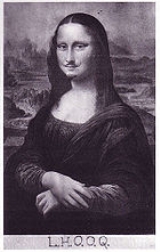
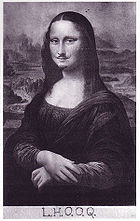
The most famous derivative work in the world has been said to be L.H.O.O.Q.L.H.O.O.Q.
L.H.O.O.Q. is a work of art by Marcel Duchamp first conceived in 1919. The work is one of what Duchamp referred to as readymades, or more specifically an assisted ready-made...
, also known as the Mona Lisa With a Moustache. Generations of US copyright law professors — since at least the 1950s — have used it as a paradigmatic example. Marcel Duchamp created the work by adding, among other things, a moustache, goatee, and the caption L.H.O.O.Q. (meaning “she has a hot tail”) to Leonardo’s iconic work. These few, seemingly insubstantial additions were highly transformative because they incensed contemporary French bourgeoisie, by mocking their cult of “Jocondisme,” at that time said to be “practically a secular religion of the French bourgeoisie and an important part of their self image.” Duchamp’s defacement of their icon was considered “a major stroke of epater le bourgeois." Thus, it has been said that the “transformation of a cult icon into an object of ridicule by adding a small quantum of additional material can readily be deemed preparation of a derivative work.” A parodic derivative work based on Duchamp's parodic derivative work is shown at http://docs.law.gwu.edu/facweb/claw/ch6c2.htm.
The mockery of “Oh, Pretty Woman,” discussed in Campbell v. Acuff-Rose Music, Inc.
Campbell v. Acuff-Rose Music, Inc.
Campbell v. Acuff-Rose Music, 510 U.S. 569 was a United States Supreme Court copyright law case that established that a commercial parody can qualify as fair use...
, is a similar example of transforming a work by showing it in a harsh new light or criticizing its underlying assumptions. Because of the parody's transformativeness, the Supreme Court found the derivative work a fair use.
Trivia books, based on TV shows, such as Seinfeld
Seinfeld
Seinfeld is an American television sitcom that originally aired on NBC from July 5, 1989, to May 14, 1998, lasting nine seasons, and is now in syndication. It was created by Larry David and Jerry Seinfeld, the latter starring as a fictionalized version of himself...
, are considered derivative works, for purposes of infringement liability, at least if they incorporate a substantial amount of copyright-protected content from the TV episodes. In Castle Rock the court found that any transformative purpose possessed in the derivative work was "slight to non-existent." Accordingly, the court held that defendants had prepared an infringing derivative work.
The musical, West Side Story
West Side Story
West Side Story is an American musical with a script by Arthur Laurents, music by Leonard Bernstein, lyrics by Stephen Sondheim, and choreographed by Jerome Robbins...
, is a derivative work based on Shakespeare's Romeo and Juliet
Romeo and Juliet
Romeo and Juliet is a tragedy written early in the career of playwright William Shakespeare about two young star-crossed lovers whose deaths ultimately unite their feuding families. It was among Shakespeare's most popular archetypal stories of young, teenage lovers.Romeo and Juliet belongs to a...
. However, Shakespeare's drama "Romeo and Juliet" is also a derivative work that draws heavily from Pyramus and Thisbe
Pyramus and Thisbe
Pyramus and Thisbe are two characters of Roman mythology, whose love story of ill-fated lovers is also a sentimental romance.The tale is told by Ovid in his Metamorphoses.-Plot:...
and other sources.
Pop-up ad
Pop-up ad
Pop-up ads or pop-ups are a form of online advertising on the World Wide Web intended to attract web traffic or capture email addresses. Pop-ups are generally new web browser windows to display advertisements...
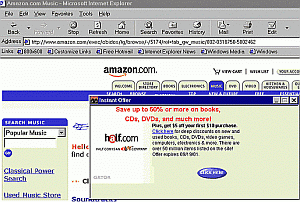
vertising provides derivative works that can be transformative, but they may also impair interests of the proprietors of Web pages subjected to them. For example, the Half.com
Half.com
Half.com is a subsidiary of eBay, in which sellers offer items at fixed prices, usually items that have a UPC, ISBN or other kind of SKU, rather than rare, old or collectible items...
pop-up ad shown above left informs the public as to price competition between Half.com and Amazon.com
Amazon.com
Amazon.com, Inc. is a multinational electronic commerce company headquartered in Seattle, Washington, United States. It is the world's largest online retailer. Amazon has separate websites for the following countries: United States, Canada, United Kingdom, Germany, France, Italy, Spain, Japan, and...
. But the derivative-work version of Amazon's web page partially covers up Amazon's advertising (at least temporarily) and adversely affects Amazon's investment interest in the preparation and maintenance of its web page. This may present a more difficult case of balancing interests than that which the court faced in Arriba Soft or Perfect 10.
The gif animation parody of Duchamp’s work, referred to above in this section, and pop-up advertising are examples of derivative works that became possible only with the advent of recent technology. The last sentence of section 101’s definition of derivative work (at the beginning of section 1.1 of this Article) defines annotations as derivative works. Annotations of other works have long existed, but new technology permits the creation of new forms of annotation. An illustration of such a new-technology annotation is provided in this example of an annotation of Chaucer’s Prologue to the Canterbury Tales in which a small pop-up window provides the definition of a difficult word when the cursor is moused over the word.
Canadian law
Though Canadian copyright law does not explicitly define "derivative work", the Copyright Act of CanadaCopyright Act of Canada
Copyright Act of Canada is Canada's federal statute governing copyright law in Canada. The Copyright Act of Canada which was first passed in 1921 and substantially amended in 1988 and 1997. In 2005 an attempt to amend the Canadian Copyright Act was made but Bill C-60 did not pass into law before...
does provide the following generally agreed-upon examples of what constitutes a derivative work in section 3:
"copyright"...includes the sole right
(a) to produce, reproduce, perform or publish any translation of the work,
(b) in the case of a dramatic work, to convert it into a novel or other non-dramatic work,
(c) in the case of a novel or other non-dramatic work, or of an artistic work, to convert it into a dramatic work, by way of performance in public or otherwise,
(d) in the case of a literary, dramatic or musical work, to make any sound recording, cinematograph film or other contrivance by means of which the work may be mechanically reproduced or performed,
(e) in the case of any literary, dramatic, musical or artistic work, to reproduce, adapt and publicly present the work as a cinematographic work
In Théberge v. Galerie d'Art du Petit Champlain Inc.
Théberge v. Galerie d'Art du Petit Champlain Inc.
Théberge v. Galerie d'Art du Petit Champlain Inc. is one of the Supreme Court of Canada's leading cases on copyright law. This case interprets the meaning of "reproduction" within the Copyright Act of Canada, and touches on the moral rights to copyrighted material and how much control an author...
, , the Supreme Court of Canada clarified the statutory recognition of derivative works extended only to circumstances where there was production and multiplication, i.e. reproduction. Where there is no derivation, reproduction, or production of a new and original work which incorporates the artist's work, there is no violation of the Copyright Act.
Example
Since many films are based on novels or scripts they are classed as derivative works. In cases where the film's copyright has lapsed but the underlying work is still covered, the film cannot be freely distributed without the permission of the original author on whose work the film was based. For example, the 1912 George Bernard ShawGeorge Bernard Shaw
George Bernard Shaw was an Irish playwright and a co-founder of the London School of Economics. Although his first profitable writing was music and literary criticism, in which capacity he wrote many highly articulate pieces of journalism, his main talent was for drama, and he wrote more than 60...
play Pygmalion
Pygmalion (play)
Pygmalion: A Romance in Five Acts is a play by Irish playwright George Bernard Shaw. Professor of phonetics Henry Higgins makes a bet that he can train a bedraggled Cockney flower girl, Eliza Doolittle, to pass for a duchess at an ambassador's garden party by teaching her to assume a veneer of...
was made into a film of the same name
Pygmalion (1938 film)
Pygmalion is a 1938 British film based on the George Bernard Shaw play of the same title, and adapted by him for the screen. It stars Leslie Howard and Wendy Hiller....
in 1938. The film's protection had lapsed and it was thus released into public domain
Public domain
Works are in the public domain if the intellectual property rights have expired, if the intellectual property rights are forfeited, or if they are not covered by intellectual property rights at all...
, but that of the original play was retained. After a third party released prints of the film they were challenged by the copyright-holders of the play, with a court ruling that releasing the prints was a copyright infringement.
See also
- Authorship
- Copyright Act of 1976Copyright Act of 1976The Copyright Act of 1976 is a United States copyright law and remains the primary basis of copyright law in the United States, as amended by several later enacted copyright provisions...
- Copyright aspects of hyperlinking and framingCopyright aspects of hyperlinking and framingIn copyright law, the legal status of hyperlinking and that of framing concern how courts address two different but related web technologies...
- Galoob v. Nintendo
- Intellectual propertyIntellectual propertyIntellectual property is a term referring to a number of distinct types of creations of the mind for which a set of exclusive rights are recognized—and the corresponding fields of law...
- MerchandisingMerchandisingMerchandising is the methods, practices, and operations used to promote and sustain certain categories of commercial activity. In the broadest sense, merchandising is any practice which contributes to the sale of products to a retail consumer...
- PatentPatentA patent is a form of intellectual property. It consists of a set of exclusive rights granted by a sovereign state to an inventor or their assignee for a limited period of time in exchange for the public disclosure of an invention....
- TrademarkTrademarkA trademark, trade mark, or trade-mark is a distinctive sign or indicator used by an individual, business organization, or other legal entity to identify that the products or services to consumers with which the trademark appears originate from a unique source, and to distinguish its products or...
- Tie-inTie-inA tie-in is an authorized product based on a media property a company is releasing, such as a movie or video/DVD, computer game, video game, television program/television series, board game, web site, role-playing game or literary property...
- Trade secretTrade secretA trade secret is a formula, practice, process, design, instrument, pattern, or compilation of information which is not generally known or reasonably ascertainable, by which a business can obtain an economic advantage over competitors or customers...
- Work for hireWork for hireA work made for hire is an exception to the general rule that the person who actually creates a work is the legally recognized author of that work...
- Creative CommonsCreative CommonsCreative Commons is a non-profit organization headquartered in Mountain View, California, United States devoted to expanding the range of creative works available for others to build upon legally and to share. The organization has released several copyright-licenses known as Creative Commons...
External links
- US Copyright Act (Hosted by the Copyright Office)
- US Copyright 'Derivative Works' (Hosted by the Copyright Office)
- Frequently Asked Questions (and Answers) about Derivative Works. Chillingeffects.org.
- Article "Geek Law: Derivative Works" by Lawrence RosenLawrence RosenLawrence Rosen is an attorney and computer specialist. He is a founding partner of Rosenlaw & Einschlag, a Californian technology law firm, specializing in intellectual property protection, licensing and business transactions for technology companies...
. Linuxjournal.com - Article "DERIVATIVE WORK RIGHTS" by David M. Spatt. Artslaw.org.
- Article "L.H.O.O.Q.--Internet-Related Derivative Works" by Richard H. SternRichard H. SternRichard H. Stern is an attorney and law professor.Born in New York City, Stern received an A.B. cum laude from Columbia College in 1953 and a B.S. in electrical engineering from Columbia University School of Engineering in 1954. He served in the U.S. Army from 1955 to 1956, then returned to...
- Article "Derivative Works" by Sarah Ovenall. Funnystrange.com.