

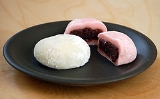
Daifuku

Encyclopedia
, or is a Japanese confection
consisting of a small round mochi (glutinous rice
cake) stuffed with sweet filling, most commonly anko
, sweetened red bean paste made from azuki bean
s.
Daifuku comes in many varieties. The most common is white-, pale green-, or pale pink-colored mochi filled with anko. These come in two sizes, one approximately the diameter of a half-dollar coin, the other palm-sized. Some versions contain whole pieces of fruit, mixtures of fruit and anko, or crushed melon
paste. Nearly all daifuku are covered in a fine layer of corn
or potato
starch to keep them from sticking to each other, or to the fingers. Some are covered with confectioner's sugar
or cocoa powder. Though mochitsuki is the traditional method of making mochi
and daifuku, they can also be cooked in the microwave. Mochi and daifuku are very popular in japan.
Wagashi
is a traditional Japanese confectionery which is often served with tea, especially the types made of mochi, azuki bean paste, and fruits.Wagashi is typically made from natural ingredients...
consisting of a small round mochi (glutinous rice
Glutinous rice
Glutinous rice is a type of short-grained Asian rice that is especially sticky when cooked. It is called glutinous Glutinous rice (Oryza sativa var. glutinosa or Oryza glutinosa; also called sticky rice, sweet rice, waxy rice, botan rice, biroin chal, mochi rice, and pearl rice, and pulut) is a...
cake) stuffed with sweet filling, most commonly anko
Red bean paste
Red bean paste or Azuki bean paste is a sweet, dark red bean paste originating from China. It is used in Chinese cuisine, Japanese confectionery, and Korean cuisine. It is prepared by boiling and mashing azuki beans and then sweetening the paste with sugar or honey...
, sweetened red bean paste made from azuki bean
Azuki bean
The is an annual vine, Vigna angularis, widely grown throughout East Asia and the Himalayas for its small bean. The cultivars most familiar in north-east Asia have a uniform red color, but white, black, gray and variously mottled varieties are also known. Scientists presume Vigna angularis var...
s.
Daifuku comes in many varieties. The most common is white-, pale green-, or pale pink-colored mochi filled with anko. These come in two sizes, one approximately the diameter of a half-dollar coin, the other palm-sized. Some versions contain whole pieces of fruit, mixtures of fruit and anko, or crushed melon
Melon
thumb|200px|Various types of melonsThis list of melons includes members of the plant family Cucurbitaceae with edible, fleshy fruit e.g. gourds or cucurbits. The word "melon" can refer to either the plant or specifically to the fruit...
paste. Nearly all daifuku are covered in a fine layer of corn
Maize
Maize known in many English-speaking countries as corn or mielie/mealie, is a grain domesticated by indigenous peoples in Mesoamerica in prehistoric times. The leafy stalk produces ears which contain seeds called kernels. Though technically a grain, maize kernels are used in cooking as a vegetable...
or potato
Potato
The potato is a starchy, tuberous crop from the perennial Solanum tuberosum of the Solanaceae family . The word potato may refer to the plant itself as well as the edible tuber. In the region of the Andes, there are some other closely related cultivated potato species...
starch to keep them from sticking to each other, or to the fingers. Some are covered with confectioner's sugar
Powdered sugar
Powdered sugar, also known as confectioners' sugar or icing sugar, is very fine sugar. When intended for home use, it typically contains a small amount of anti-caking agent....
or cocoa powder. Though mochitsuki is the traditional method of making mochi
Mochi
Mochi is a Japanese rice cake made of glutinous rice pounded into paste and molded into shape. In Japan it is traditionally made in a ceremony called mochitsuki. While also eaten year-round, mochi is a traditional food for the Japanese New Year and is commonly sold and eaten during that time...
and daifuku, they can also be cooked in the microwave. Mochi and daifuku are very popular in japan.
History
Daifuku was originally called (belly thick rice cake) because of its filling nature. Later, the name was changed to (big belly rice cake). Since the pronunciations of (belly) and (luck) are the same in Japanese, the name was further changed to (great luck rice cake), a bringer of good luck. By the end of the 18th century, Daifuku were gaining popularity and people began eating them toasted. They were also used for gifts in ceremonial occasions.Varieties
- A version made with , which is mochi flavored with mugwortArtemisia princepsArtemisia princeps, or Japanese mugwort, is a perennial, very vigorous plant that grows to 1.2 meters and is known as yomogi in Japan. This species spreads rapidly by means of underground stolons and can become invasive. It bears small, buff colored flowers from July to November which are...
.
- A variation containing strawberryStrawberryFragaria is a genus of flowering plants in the rose family, Rosaceae, commonly known as strawberries for their edible fruits. Although it is commonly thought that strawberries get their name from straw being used as a mulch in cultivating the plants, the etymology of the word is uncertain. There...
and sweet filling, most commonly anko, inside a small round mochi. Creams are sometimes used for sweet filling. Because it contains strawberry, it is usually eaten during the springtime. It was invented in the 1980s. Many patisseries claim to have invented the confection, so its exact origin is vague.
- A brand of mochi ice creamMochi ice creamMochi ice cream is a Japanese confection made from mochi with an ice cream filling.Originally created by Lotte, as Yukimi Daifuku in 1981, the company first made the product by using a rice starch instead of sticky rice and a type of ice milk instead of real ice cream. Mochi ice cream is now an...
made by the company LotteLotte (conglomerate)Lotte Co., Ltd. is a South Korean-Japanese Jaebeol and one of the largest food and shopping groups in South Korea and Japan. Lotte was established in June 1948, in Tokyo, by Japanese-educated, Korean businessman Shin Kyuk-Ho – also known as...
.