


Dabakan

Encyclopedia
The dabakan is a single-headed Philippine
drum
, primarily used as a supportive instrument in the kulintang ensemble
. Among the five main kulintang instruments, it is the only non-gong
element of the Maguindanao
ensemble.
in shape Normally, the dabakan is found having a length of more than two feet and a diameter of more than a foot about the widest part of the shell. The shell is carved from wood either out of the trunk of a coconut tree or the wood of a jackfruit tree
which is then hollowed out throughout its body and stem. The drumhead
that is stretched over the shell is made out of either goatskin
, carabao skin
, deer rawhide, or snake
/lizard
skin, with the last considered by many dabakan practitioners as the best material to use. The drumhead is then fastened to the shell first via small metal wire and then using two hoops of rattan
very tightly to allow the rattan sticks to bounce cleanly. Artists, especially the Maranao
, would then carve the outside of the shell with elaborate and decorative okkil patterns.
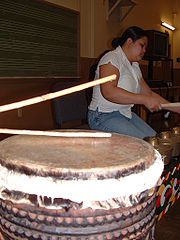
, or open stroke patterns upon its surface.
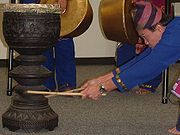 Thanks to the exposure of many artists to western culture, new styles of playing have emerged among the newer generation of players. These include playing rhythmic patterns for the dabakan not on the surface of the drumhead but on the sides of the shell and even at the edges of the drum’s mouth. These exhibition-style pieces are used to shift focus away from the melody instrument, the kulintang, and onto the other supportive instruments such as the dabakan.
and Maranao
society is as a supportive instrument in the kulintang ensemble
, keeping the tempo of the ensemble in check like the babendil
. On most rhythmic modes, such as sinulog and duyog , the dabakan enters after babandil but in tidto, where the babendil is absent, the dabakan always starts the piece. The Maguindanao and the Maranao usually position the dabakan to the right of the kulintang player, near the end of its frame, during a traditional performance.
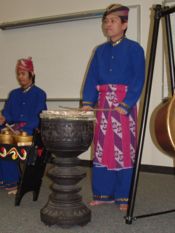 The dabakan could be used in other types of playing other than the ensemble. The dabakan could be used as the accompaniment for the kutiyapi
, a type of Philippine boat-lute
. The dabakan plays a major role in a type of playing known as Kasorondayong. In the Maranao version, which is in recognition of their prince hero, Prince Bantogen, two dbakan players face one another, standing behind their dabakans, striking them with two slender bamboo sticks while playing an interlocking rhythm.
Traditionally, the dabakan is considered a masculine instrument by the Maranao and a feminine instrument by the Maguindanao but as a sign of the times, one could see both men and women handling the dabakan. In wooden kulintang ensembles, the takemba, a bamboo zither of the Manobo, is usually substituted for the dabakan part.
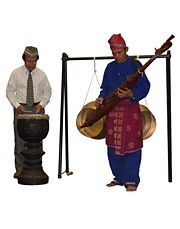 During older times, the bigger, longer double-headed dabakan, known as a dadabooan, would be hung horizontally in the mosque (See Kendang
, for smaller version of this drum). An imam
(spiritual leader) would hit the drum repeatedly announcing the beginning of prayer time throughout the outerlying areas. As a sign of the times, the dabakan in Mindanao have now been replaced by more modern equipment such as a speakerphone
but the practice still continues in places like Sulawesi
, where a mesigit, equivalent to the dabakan, would be used for the same purpose.
. Dabakan is derived from the word, dbak meaning to “hit, strike, or beat,” meaning that the dabakan is something upon which you hit. Scholars also suggest that another clue is that the dabakan may have been an adaptation and enlargement of a pan-Arabic goblet drum
, the dombak/tombak.
), dadabuan, dadaboon (Maranao
), libbit (Tausug), tibubu (Poso
) and a tiwal (Kulawi and Minahasa
).
Philippines
The Philippines , officially known as the Republic of the Philippines , is a country in Southeast Asia in the western Pacific Ocean. To its north across the Luzon Strait lies Taiwan. West across the South China Sea sits Vietnam...
drum
Drum
The drum is a member of the percussion group of musical instruments, which is technically classified as the membranophones. Drums consist of at least one membrane, called a drumhead or drum skin, that is stretched over a shell and struck, either directly with the player's hands, or with a...
, primarily used as a supportive instrument in the kulintang ensemble
Kulintang
Kulintang is a modern term for an ancient instrumental form of music composed on a row of small, horizontally-laid gongs that function melodically, accompanied by larger, suspended gongs and drums...
. Among the five main kulintang instruments, it is the only non-gong
Gong
A gong is an East and South East Asian musical percussion instrument that takes the form of a flat metal disc which is hit with a mallet....
element of the Maguindanao
Maguindanao people
The Maguindanao are part of the wider Moro ethnic group, who constitute the sixth largest Filipino ethnic group. Their name means “people of the plains”.-Pre-Spanish:...
ensemble.
Description
The dabakan is frequently described as either hour-glass, conical, tubular, or gobletGoblet drum
The goblet drum is a hand drum with a goblet shape used mostly in the Middle East, North Africa, and Eastern Europe....
in shape Normally, the dabakan is found having a length of more than two feet and a diameter of more than a foot about the widest part of the shell. The shell is carved from wood either out of the trunk of a coconut tree or the wood of a jackfruit tree
Jackfruit
The jackfruit is a species of tree in the Artocarpus genus of the mulberry family . It is native to parts of Southern and Southeast Asia. It is the national fruit of Bangladesh, . The jackfruit tree is believed to be indigenous to the southwestern rain forests of India...
which is then hollowed out throughout its body and stem. The drumhead
Drumhead
A drumhead is a membrane stretched over one or both of the open ends of a drum. The drumhead is struck with sticks, mallets, or hands so that it vibrates and the sound resonates through the drum.-History:...
that is stretched over the shell is made out of either goatskin
Goatskin
Goatskin may refer to:* Goatskin , the skin of a goat or the leather made from it* Goatskin , a container for wine...
, carabao skin
Carabao
The carabao or Bubalus bubalis carabanesis is a subspecies of the domesticated water buffalo found in the Philippines, Guam, Indonesia, Malaysia, and various parts of Southeast Asia...
, deer rawhide, or snake
Snake
Snakes are elongate, legless, carnivorous reptiles of the suborder Serpentes that can be distinguished from legless lizards by their lack of eyelids and external ears. Like all squamates, snakes are ectothermic, amniote vertebrates covered in overlapping scales...
/lizard
Lizard
Lizards are a widespread group of squamate reptiles, with nearly 3800 species, ranging across all continents except Antarctica as well as most oceanic island chains...
skin, with the last considered by many dabakan practitioners as the best material to use. The drumhead is then fastened to the shell first via small metal wire and then using two hoops of rattan
Rattan
Rattan is the name for the roughly 600 species of palms in the tribe Calameae, native to tropical regions of Africa, Asia and Australasia.- Structure :...
very tightly to allow the rattan sticks to bounce cleanly. Artists, especially the Maranao
Maranao
Maranao is the term used for the people of Lanao, a predominantly Muslim region in the Philippines island of Mindanao. They are famous for their artwork, sophisticated weaving, wood and metal craft, and their epic literature...
, would then carve the outside of the shell with elaborate and decorative okkil patterns.
Technique
The dabakan is normally played while standing with the player holding two sticks made either out of rattan or bamboo but the player could be sitting or kneeling instead. The rattan strips are held parallel to the surface of the drumhead and are then pivoted between the thumb and forefinger using the wrist to activate them to strike the drumhead’s surface along the entire length of its diameter. The sounds produced are normally quick and muted and thanks to the flexibility of the strips, one could employ dampening, rollDrum roll
A drum roll is a technique the percussionist employs to produce a sustained sound on a percussion instrument. Rolls are used by composers to sustain the sound and create other effects, the most common of which is using a roll to build anticipation.- Snare drum roll :The most common snare drum roll...
, or open stroke patterns upon its surface.
Uses
The main use for the dabakan in MaguindanaoMaguindanao people
The Maguindanao are part of the wider Moro ethnic group, who constitute the sixth largest Filipino ethnic group. Their name means “people of the plains”.-Pre-Spanish:...
and Maranao
Maranao
Maranao is the term used for the people of Lanao, a predominantly Muslim region in the Philippines island of Mindanao. They are famous for their artwork, sophisticated weaving, wood and metal craft, and their epic literature...
society is as a supportive instrument in the kulintang ensemble
Kulintang
Kulintang is a modern term for an ancient instrumental form of music composed on a row of small, horizontally-laid gongs that function melodically, accompanied by larger, suspended gongs and drums...
, keeping the tempo of the ensemble in check like the babendil
Babendil
The babandil is a single, narrow-rimmed Philippine gongused primary as the “timekeeper” of the Maguindanao kulintang ensemble.-Description:The babandil usually has a diameter of roughly one foot making it larger than the largest kulintang gong and comparable to the diameter of the agung or gandingan...
. On most rhythmic modes, such as sinulog and duyog , the dabakan enters after babandil but in tidto, where the babendil is absent, the dabakan always starts the piece. The Maguindanao and the Maranao usually position the dabakan to the right of the kulintang player, near the end of its frame, during a traditional performance.
Kutiyapi
The kudyapi, is a Philippine two-stringed, fretted boat-lute. It is the only stringed instrument among the Maguindanao people, and one of several among other groups such as the Maranao and Manobo. It is four to six feet long with nine frets made of hardened beeswax...
, a type of Philippine boat-lute
Lute
Lute can refer generally to any plucked string instrument with a neck and a deep round back, or more specifically to an instrument from the family of European lutes....
. The dabakan plays a major role in a type of playing known as Kasorondayong. In the Maranao version, which is in recognition of their prince hero, Prince Bantogen, two dbakan players face one another, standing behind their dabakans, striking them with two slender bamboo sticks while playing an interlocking rhythm.
Traditionally, the dabakan is considered a masculine instrument by the Maranao and a feminine instrument by the Maguindanao but as a sign of the times, one could see both men and women handling the dabakan. In wooden kulintang ensembles, the takemba, a bamboo zither of the Manobo, is usually substituted for the dabakan part.
Kendang
Kendhang is a two-headed drum used by peoples from Maritime Southeast Asia....
, for smaller version of this drum). An imam
Imam
An imam is an Islamic leadership position, often the worship leader of a mosque and the Muslim community. Similar to spiritual leaders, the imam is the one who leads Islamic worship services. More often, the community turns to the mosque imam if they have a religious question...
(spiritual leader) would hit the drum repeatedly announcing the beginning of prayer time throughout the outerlying areas. As a sign of the times, the dabakan in Mindanao have now been replaced by more modern equipment such as a speakerphone
Speakerphone
A speakerphone is a telephone with a microphone and loudspeaker provided separately from those in the handset. This device allows multiple persons to participate in a conversation...
but the practice still continues in places like Sulawesi
Sulawesi
Sulawesi is one of the four larger Sunda Islands of Indonesia and is situated between Borneo and the Maluku Islands. In Indonesia, only Sumatra, Borneo, and Papua are larger in territory, and only Java and Sumatra have larger Indonesian populations.- Etymology :The Portuguese were the first to...
, where a mesigit, equivalent to the dabakan, would be used for the same purpose.
Origin
The origin of the name “dabakan,” is said to have been borrowed and adapted from the Middle EastMiddle East
The Middle East is a region that encompasses Western Asia and Northern Africa. It is often used as a synonym for Near East, in opposition to Far East...
. Dabakan is derived from the word, dbak meaning to “hit, strike, or beat,” meaning that the dabakan is something upon which you hit. Scholars also suggest that another clue is that the dabakan may have been an adaptation and enlargement of a pan-Arabic goblet drum
Goblet drum
The goblet drum is a hand drum with a goblet shape used mostly in the Middle East, North Africa, and Eastern Europe....
, the dombak/tombak.
Other Derivative Names
Also called a dbakan, debakan (MaguindanaoMaguindanao
Maguindanao is a province of the Philippines located in the Autonomous Region in Muslim Mindanao . Its capital is Shariff Aguak. It borders Lanao del Sur to the north, Cotabato to the east, and Sultan Kudarat to the south....
), dadabuan, dadaboon (Maranao
Maranao
Maranao is the term used for the people of Lanao, a predominantly Muslim region in the Philippines island of Mindanao. They are famous for their artwork, sophisticated weaving, wood and metal craft, and their epic literature...
), libbit (Tausug), tibubu (Poso
Poso
Poso is the main port and transportation hub for the northeastern coast of Central Sulawesi, Indonesia. Its geographical location is .Poso is one of ten regencies in Central Sulawesi Province, located exactly in the middle of the province on the shore of the gulf of Tomini, right in the central...
) and a tiwal (Kulawi and Minahasa
Minahasa
The Minahasa are an ethnic group located in the North Sulawesi province of Indonesia, formerly known as North Celebes...
).