

Cuthbert Brodrick

Encyclopedia
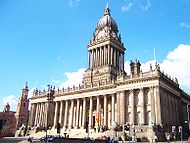
Cuthbert Brodrick FRIBA (1 December 1821 – 2 March 1905) was a British
architect
, whose most famous building is Leeds Town Hall
.
where his father was a well-to-do merchant and shipowner. Cuthbert was the sixth son of the ten children of John and Hannah Brodrick. The family lived at 39, George Street, in the best residential area of Hull.
whose premises were at 8, Dock Street. Brodrick stayed with Lockwoods from 1837 until he embarked on the Grand Tour
of Europe in May 1844, to continue his studies. He travelled through France and Italy, as far as Rome
. Whilst on this journey he studied the architecture of Second Empire
in Paris
. This style greatly influenced his later designs.
When Brodrick returned to Hull in 1846, he was offered a partnership in Lockwood’s firm. He refused this, and set up in practice on his own at 1, Savile Street in Hull. He designed a number of local buildings in Hull including the Hull Royal Institution building and the Hull Town Hall.
, for the design of Leeds Town Hall
. This, his most famous building, was opened in September 1858 by Queen Victoria
. Subsequently, Brodrick moved to an office at 30, Park Row, Leeds and acquired the nickname 'Town Hall, Leeds.' The iconic clock tower, which serves for many as a symbol of Leeds, was not part of Brodrick's initial design but he added it later when the civic leaders of Leeds sought to make an even grander architectural statement.
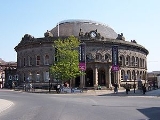
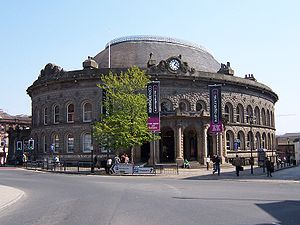
His other important buildings in Leeds were the Leeds Corn Exchange
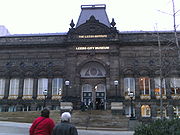
(1860-3) and the Mechanics' Institute
(1860-5). The latter building later became the Civic Theatre and in September 2008 became the new home of the Leeds City Museum
. He permanently altered the way central Leeds looked with just three buildings.
And on a smaller scale
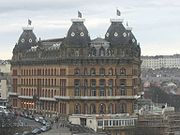 Brodrick also designed the Grand Hotel
, Scarborough.
He submitted unsuccessful architectural designs for the competitions for the building of Preston Town Hall, and the Exchange in Manchester
.
, St. Germain-en-Laye. He retired in 1875, and spent his time painting, exhibiting his work and gardening. In about 1898 he went to live with his niece in Jersey
, where he rented a house, La Colline, at Gorey
. Whilst living there he designed, and planted a garden. He died there on 2 March 1905, and is buried in St. Martin's Churchyard.
pub called the 'Cuthbert Brodrick' opened on Millennium Square in Leeds on 22 October 2007, situated opposite one of the buildings he designed (the Leeds City Museum) and not far from another (Leeds Town Hall). In addition, the pub is near the site on Cookridge Street of the Oriental Baths which were designed by Brodrick; they were built in 1866 and demolished in 1969. His nephew was F. S. Brodrick, also an architect, who worked with R. G. Smith.
Brodrick was the subject of a 2007 BBC2 television programme The Case of the Disappearing Architect by Jonathan Meades
.
United Kingdom
The United Kingdom of Great Britain and Northern IrelandIn the United Kingdom and Dependencies, other languages have been officially recognised as legitimate autochthonous languages under the European Charter for Regional or Minority Languages...
architect
Architect
An architect is a person trained in the planning, design and oversight of the construction of buildings. To practice architecture means to offer or render services in connection with the design and construction of a building, or group of buildings and the space within the site surrounding the...
, whose most famous building is Leeds Town Hall
Leeds Town Hall
Leeds Town Hall was built between 1853 and 1858 on Park Lane , Leeds, West Yorkshire, England to a design by architect Cuthbert Brodrick.-Background:...
.
Early life
Brodrick was born in the Yorkshire port of HullKingston upon Hull
Kingston upon Hull , usually referred to as Hull, is a city and unitary authority area in the ceremonial county of the East Riding of Yorkshire, England. It stands on the River Hull at its junction with the Humber estuary, 25 miles inland from the North Sea. Hull has a resident population of...
where his father was a well-to-do merchant and shipowner. Cuthbert was the sixth son of the ten children of John and Hannah Brodrick. The family lived at 39, George Street, in the best residential area of Hull.
Education and training
Brodrick attended Kingston College in Hull and, on leaving school, he became an articled pupil (a student of architecture) in the offices of Henry Francis LockwoodHenry Francis Lockwood
Henry Francis Lockwood was an influential architect, born at Doncaster on 18 September 1811. His father and grandfather were mayors of Doncaster. He married Emma Day whose great uncle, Charles Day , made a fortune through the Day and Martin company...
whose premises were at 8, Dock Street. Brodrick stayed with Lockwoods from 1837 until he embarked on the Grand Tour
Grand Tour
The Grand Tour was the traditional trip of Europe undertaken by mainly upper-class European young men of means. The custom flourished from about 1660 until the advent of large-scale rail transit in the 1840s, and was associated with a standard itinerary. It served as an educational rite of passage...
of Europe in May 1844, to continue his studies. He travelled through France and Italy, as far as Rome
Rome
Rome is the capital of Italy and the country's largest and most populated city and comune, with over 2.7 million residents in . The city is located in the central-western portion of the Italian Peninsula, on the Tiber River within the Lazio region of Italy.Rome's history spans two and a half...
. Whilst on this journey he studied the architecture of Second Empire
Second French Empire
The Second French Empire or French Empire was the Imperial Bonapartist regime of Napoleon III from 1852 to 1870, between the Second Republic and the Third Republic, in France.-Rule of Napoleon III:...
in Paris
Paris
Paris is the capital and largest city in France, situated on the river Seine, in northern France, at the heart of the Île-de-France region...
. This style greatly influenced his later designs.
When Brodrick returned to Hull in 1846, he was offered a partnership in Lockwood’s firm. He refused this, and set up in practice on his own at 1, Savile Street in Hull. He designed a number of local buildings in Hull including the Hull Royal Institution building and the Hull Town Hall.
Leeds
In 1852, at the age of only 29, Brodrick entered and won the competition, judged by Charles BarryCharles Barry
Sir Charles Barry FRS was an English architect, best known for his role in the rebuilding of the Palace of Westminster in London during the mid-19th century, but also responsible for numerous other buildings and gardens.- Background and training :Born on 23 May 1795 in Bridge Street, Westminster...
, for the design of Leeds Town Hall
Leeds Town Hall
Leeds Town Hall was built between 1853 and 1858 on Park Lane , Leeds, West Yorkshire, England to a design by architect Cuthbert Brodrick.-Background:...
. This, his most famous building, was opened in September 1858 by Queen Victoria
Victoria of the United Kingdom
Victoria was the monarch of the United Kingdom of Great Britain and Ireland from 20 June 1837 until her death. From 1 May 1876, she used the additional title of Empress of India....
. Subsequently, Brodrick moved to an office at 30, Park Row, Leeds and acquired the nickname 'Town Hall, Leeds.' The iconic clock tower, which serves for many as a symbol of Leeds, was not part of Brodrick's initial design but he added it later when the civic leaders of Leeds sought to make an even grander architectural statement.
His other important buildings in Leeds were the Leeds Corn Exchange
Leeds Corn Exchange
The Leeds Corn Exchange is a Victorian building in Leeds, West Yorkshire, England, which was designed by Cuthbert Brodrick and completed in 1864...
(1860-3) and the Mechanics' Institute
Mechanics' Institutes
Historically, Mechanics' Institutes were educational establishments formed to provide adult education, particularly in technical subjects, to working men...
(1860-5). The latter building later became the Civic Theatre and in September 2008 became the new home of the Leeds City Museum
Leeds City Museum
Leeds City Museum, originally established in 1819, re-opened on 13 September 2008 in Leeds, West Yorkshire, England. It is housed in the former Mechanics' Institute built by Cuthbert Brodrick, in Millennium Square, which has been redeveloped to a design by Austin-Smith:Lord architects and Buro...
. He permanently altered the way central Leeds looked with just three buildings.
Buildings in Leeds designed by Brodrick
- The Town HallLeeds Town HallLeeds Town Hall was built between 1853 and 1858 on Park Lane , Leeds, West Yorkshire, England to a design by architect Cuthbert Brodrick.-Background:...
, 1858 - The Corn ExchangeLeeds Corn ExchangeThe Leeds Corn Exchange is a Victorian building in Leeds, West Yorkshire, England, which was designed by Cuthbert Brodrick and completed in 1864...
, 1860 - The Mechanics Institute, 1860 (later Civic Theatre and now Leeds City MuseumLeeds City MuseumLeeds City Museum, originally established in 1819, re-opened on 13 September 2008 in Leeds, West Yorkshire, England. It is housed in the former Mechanics' Institute built by Cuthbert Brodrick, in Millennium Square, which has been redeveloped to a design by Austin-Smith:Lord architects and Buro...
) - The Oriental Baths in Cookridge Street, 1866 (demolished)
- King Street Warehouses, 1862 (demolished)
- Headingley Hill Congregational church, 1864 (now known as the Ashwood Centre and used by City Church Leeds)
And on a smaller scale
- Moorland Terrace, 1859 (demolished)
- 7 Alma Road, 1859
- 49-51 Cookridge Street, 1864
Other works
Grand Hotel (Scarborough)
The Grand Hotel is a large hotel in Scarborough, England, overlooking the town's South Bay. It is now a Grade II* listed building that is owned by Britannia Hotels, and has undergone a £7 million refurbishment....
, Scarborough.
He submitted unsuccessful architectural designs for the competitions for the building of Preston Town Hall, and the Exchange in Manchester
Manchester
Manchester is a city and metropolitan borough in Greater Manchester, England. According to the Office for National Statistics, the 2010 mid-year population estimate for Manchester was 498,800. Manchester lies within one of the UK's largest metropolitan areas, the metropolitan county of Greater...
.
Personal life
In 1870, Brodrick went to live in France, and in 1876 bought a house at Le VésinetLe Vésinet
Le Vésinet is a commune in the Yvelines department in the Île-de-France in north-central France. It is located in the western suburbs of Paris from the center....
, St. Germain-en-Laye. He retired in 1875, and spent his time painting, exhibiting his work and gardening. In about 1898 he went to live with his niece in Jersey
Jersey
Jersey, officially the Bailiwick of Jersey is a British Crown Dependency off the coast of Normandy, France. As well as the island of Jersey itself, the bailiwick includes two groups of small islands that are no longer permanently inhabited, the Minquiers and Écréhous, and the Pierres de Lecq and...
, where he rented a house, La Colline, at Gorey
Gorey, Jersey
Gorey is a village in the parishes of St. Martin and Grouville on the east coast of Jersey. It is one of the three main harbours of the island....
. Whilst living there he designed, and planted a garden. He died there on 2 March 1905, and is buried in St. Martin's Churchyard.
Legacy
A WetherspoonsWetherspoons
J D Wetherspoon plc is a British pub chain based in Watford. Founded as a single pub in 1979 by Tim Martin, the company now owns 815 outlets. The chain champions cask ale, low prices, long opening hours, and no music. The company also operates the Lloyds No...
pub called the 'Cuthbert Brodrick' opened on Millennium Square in Leeds on 22 October 2007, situated opposite one of the buildings he designed (the Leeds City Museum) and not far from another (Leeds Town Hall). In addition, the pub is near the site on Cookridge Street of the Oriental Baths which were designed by Brodrick; they were built in 1866 and demolished in 1969. His nephew was F. S. Brodrick, also an architect, who worked with R. G. Smith.
Brodrick was the subject of a 2007 BBC2 television programme The Case of the Disappearing Architect by Jonathan Meades
Jonathan Meades
Jonathan Turner Meades is a British writer on food, architecture, and culture, as well as an author and broadcaster. He is an Honorary Associate of the National Secular Society and a Distinguished Supporter of the British Humanist Association.-Education:Meades was born in Salisbury Wiltshire, and...
.