

Cruck

Encyclopedia
Lumber
Lumber or timber is wood in any of its stages from felling through readiness for use as structural material for construction, or wood pulp for paper production....
, one of a pair, which supports the roof
Roof
A roof is the covering on the uppermost part of a building. A roof protects the building and its contents from the effects of weather. Structures that require roofs range from a letter box to a cathedral or stadium, dwellings being the most numerous....
of a building
Building
In architecture, construction, engineering, real estate development and technology the word building may refer to one of the following:...
, used particularly in England
England
England is a country that is part of the United Kingdom. It shares land borders with Scotland to the north and Wales to the west; the Irish Sea is to the north west, the Celtic Sea to the south west, with the North Sea to the east and the English Channel to the south separating it from continental...
. This type of timber framing
Timber framing
Timber framing , or half-timbering, also called in North America "post-and-beam" construction, is the method of creating structures using heavy squared off and carefully fitted and joined timbers with joints secured by large wooden pegs . It is commonplace in large barns...
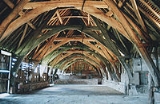
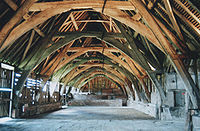
consists of long, generally bent, timber beams that lean inwards and form the ridge of the roof. These posts are then generally secured by a horizontal beam which then forms an "A" shape. Several of these "crooks" are constructed on the ground and then lifted into position. They are then joined together by either solid walls or cross beams which aid with preventing racking. Racking is the action of each individual frame going out of square with the rest of the frame, and thus risking collapse.
The term crook or cruck comes from Middle English
Middle English
Middle English is the stage in the history of the English language during the High and Late Middle Ages, or roughly during the four centuries between the late 11th and the late 15th century....
crok(e), from Old Norse
Old Norse
Old Norse is a North Germanic language that was spoken by inhabitants of Scandinavia and inhabitants of their overseas settlements during the Viking Age, until about 1300....
krāka, meaning "hook". This is also the origin of the word "crooked", meaning bent, twisted or deformed, and also the crook used by shepherd
Shepherd
A shepherd is a person who tends, feeds or guards flocks of sheep.- Origins :Shepherding is one of the oldest occupations, beginning some 6,000 years ago in Asia Minor. Sheep were kept for their milk, meat and especially their wool...
s and symbolically by bishops
Crosier
A crosier is the stylized staff of office carried by high-ranking Catholic, Eastern Orthodox, Anglican, and some Lutheran and Pentecostal prelates...
.
Crucks were chiefly in use in the medieval
Middle Ages
The Middle Ages is a periodization of European history from the 5th century to the 15th century. The Middle Ages follows the fall of the Western Roman Empire in 476 and precedes the Early Modern Era. It is the middle period of a three-period division of Western history: Classic, Medieval and Modern...
period for structures such as large tithe barn
Tithe barn
A tithe barn was a type of barn used in much of northern Europe in the Middle Ages for storing the tithes - a tenth of the farm's produce which had to be given to the church....
s. However, these bent timbers were comparatively rare as they were also in high demand for the ship building industry. Where naturally curved timbers were convenient and available, carpenters continued to use them at much later dates. For instance, base crucks are found in the roofs of the residential range of Staple Inn
Staple Inn
Staple Inn is a building on the south side of High Holborn in London, England. Located near Chancery Lane tube station, it is used as the London office of the Institute of Actuaries and is the last surviving Inn of Chancery and is a listed building....
Buildings, Nos. 337 - 338, High Holborn
High Holborn
High Holborn is a road in Holborn in central London, England. It starts in the west near St Giles Circus, then goes east, past the Kingsway and Southampton Row, and continues east. The road becomes Holborn at the junction with Gray's Inn Road....
, London. This is dated by documented records to 1586, with significant alterations in 1886 (under Alfred Waterhouse
Alfred Waterhouse
Alfred Waterhouse was a British architect, particularly associated with the Victorian Gothic Revival architecture. He is perhaps best known for his design for the Natural History Museum in London, and Manchester Town Hall, although he also built a wide variety of other buildings throughout the...
) and further restorations in 1936, and 1954-5. Despite these changes, an authority on English Historic Carpentry, Cecil Hewett, is stated that these 16th century crucks are original.
During the current revival of green oak framing for new building work, which has occurred mainly since approximately 1980 in the UK, genuine cruck frames have quite often been included in traditionally carpentered structures. There are also some fine, historically-authentic reconstructions. For instance, Tithe Barn, Pilton
Tithe Barn, Pilton
The Tithe Barn at Cumhill Farm in Pilton, Somerset, England was built in the 14th century as a tithe barn to hold produce for Glastonbury Abbey...
, Glastonbury
Glastonbury
Glastonbury is a small town in Somerset, England, situated at a dry point on the low lying Somerset Levels, south of Bristol. The town, which is in the Mendip district, had a population of 8,784 in the 2001 census...
, whose original roof was destroyed by lightning, has been carefully rebuilt in 2005 from curved oaks. The necessary trees were sought out, using special templates, in English woodlands.
The large main barn of the manor house Barlow Woodseats Hall
Barlow Woodseats Hall
Barlow Woodseats Hall is a Grade II* listed manor house situated at Barlow Woodseats, on the edge of the village of Barlow, in Derbyshire. It remains the only manor house in the Parish of Barlow, and the current house dates from the early 17th century, although there are much earlier origins.-...
features what is claimed to be the longest continuously roofed cruck barn in Derbyshire
Derbyshire
Derbyshire is a county in the East Midlands of England. A substantial portion of the Peak District National Park lies within Derbyshire. The northern part of Derbyshire overlaps with the Pennines, a famous chain of hills and mountains. The county contains within its boundary of approx...
, and possibly even in the United Kingdom.
An example of a Yorkshire cruck barn complete with a heather thatched roof can be found in Appletreewick: see http://www.craven-cruckbarn.co.uk/cruckbarn.htm. The crucks or cruck "blades" are a single oak tree riven (split) in two to form an equally shaped A frame.