


Crossness Pumping Station

Encyclopedia
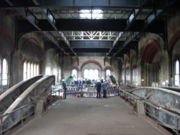
Pumping station
Pumping stations are facilities including pumps and equipment for pumping fluids from one place to another. They are used for a variety of infrastructure systems, such as the supply of water to canals, the drainage of low-lying land, and the removal of sewage to processing sites.A pumping station...
designed by engineer Sir Joseph Bazalgette
Joseph Bazalgette
Sir Joseph William Bazalgette, CB was an English civil engineer of the 19th century. As chief engineer of London's Metropolitan Board of Works his major achievement was the creation of a sewer network for central London which was instrumental in relieving the city from cholera epidemics, while...
and architect Charles Henry Driver
Charles Henry Driver
Charles Henry Driver was a significant British architect of the Victorian era, with a reputation for pioneering use of ornamental iron work for which he was seen as a leading authority. He was also an expert in its casting and manufacture. He consulted in this area for Joseph Paxton on The Crystal...
. It was constructed between 1859 and 1865 as part of his redevelopment of the London sewerage system
London sewerage system
The London sewerage system is part of the water infrastructure serving London. The modern system was developed during the late 19th century, and as London has grown the system has been expanded.-History:...
. It is located at Crossness
Crossness
Crossness is a place in south-east London. It is situated in the London Borough of Bexley, close to the southern bank of the River Thames, to the east of Thamesmead, west of Belvedere and north-west of Erith. The place takes its name from Cross Ness, a specific promontory on the southern bank of...
, southeast London
London
London is the capital city of :England and the :United Kingdom, the largest metropolitan area in the United Kingdom, and the largest urban zone in the European Union by most measures. Located on the River Thames, London has been a major settlement for two millennia, its history going back to its...
, England
England
England is a country that is part of the United Kingdom. It shares land borders with Scotland to the north and Wales to the west; the Irish Sea is to the north west, the Celtic Sea to the south west, with the North Sea to the east and the English Channel to the south separating it from continental...
, at the eastern end of the Southern Outfall Sewer
Southern Outfall Sewer
The Southern Outfall Sewer is a major sewer taking sewage from the southern area of central London to Crossness in south-east London. Flows from three interceptory sewers combine at Deptford and then run under Greenwich, Woolwich, Plumstead and across Erith marshes...
.
The sewage
Sewage
Sewage is water-carried waste, in solution or suspension, that is intended to be removed from a community. Also known as wastewater, it is more than 99% water and is characterized by volume or rate of flow, physical condition, chemical constituents and the bacteriological organisms that it contains...
was pumped up into a 27 million impgals (122,744.4 m³) reservoir, and was released into the Thames during the ebbing tide.
The station contains the four original pumping engines, which are thought to be the largest remaining rotative beam engines in the world, with 52 ton flywheel
Flywheel
A flywheel is a rotating mechanical device that is used to store rotational energy. Flywheels have a significant moment of inertia, and thus resist changes in rotational speed. The amount of energy stored in a flywheel is proportional to the square of its rotational speed...
s and 47 ton beams. The engines are named: Prince Consort, Victoria, Albert Edward, and Alexandra. Although the engines are original, they are not in their original 1864 configuration as all four engines were converted from single cylinder to the current triple expansion operation in 1901 and 1902. Prince Consort was returned to steam in 2003 and now runs on Trust Open Days. The other engines are not in working order, although work has begun on the restoration of Victoria.
It is adjacent to Erith Marshes
Erith Marshes
Erith Marshes is an area of grazing marsh beside the south bank of River Thames in London, England.It is located next to the Crossness Sewage Treatment Works and is owned by Thames Water. It is a site of metropolitan importance and situated at grid reference TQ483801, in the London Borough of Bexley...
, a grazing marsh, the northern part of which is designated as Crossness Nature Reserve. This provides a valuable habitat for creatures ranging from moth
Moth
A moth is an insect closely related to the butterfly, both being of the order Lepidoptera. Moths form the majority of this order; there are thought to be 150,000 to 250,000 different species of moth , with thousands of species yet to be described...
s to small amphibian
Amphibian
Amphibians , are a class of vertebrate animals including animals such as toads, frogs, caecilians, and salamanders. They are characterized as non-amniote ectothermic tetrapods...
s and water voles.
History
The Crossness Pumping Station was officially opened by Edward, Prince of WalesEdward VII of the United Kingdom
Edward VII was King of the United Kingdom and the British Dominions and Emperor of India from 22 January 1901 until his death in 1910...
in April 1865 and the Beam Engine House is now a Grade I listed building featuring spectacular ornamental cast ironwork – it has been described as "A masterpiece of engineering – a Victorian cathedral of ironwork" by Nikolaus Pevsner
Nikolaus Pevsner
Sir Nikolaus Bernhard Leon Pevsner, CBE, FBA was a German-born British scholar of history of art and, especially, of history of architecture...
.
The pumping station was decommisioned in the 1950s, and it was not considered economic to dismantle the engines as the cost of doing so far exceeded any scrap value. The more valuable metal items (made from brass) such as the engine oilers, much pipework and even the handrails from the stairs were removed. The remaining building and engines were left to suffer considerable vandalism and decay.
Today the pumping station is managed by the Crossness Engines Trust, a registered charity
Charitable organization
A charitable organization is a type of non-profit organization . It differs from other types of NPOs in that it centers on philanthropic goals A charitable organization is a type of non-profit organization (NPO). It differs from other types of NPOs in that it centers on philanthropic goals A...
set up in 1987 to oversee the restoration project. It is on the Buildings at Risk Register,
Restoration
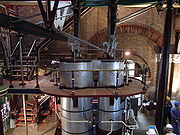

When the buildings were abandoned, the pumps and culverts below the Beam Engine House were filled with sand to reduce the risks from methane. This has meant that some 100 tons of this sand has had to be excavated from around and underneath the pumps before there was any hope of moving the beam and flywheel. Further, there was a considerable ingress of rain water which has resulted in serious rusting of the engine parts.
Museum
Having received funding from the Heritage Lottery FundHeritage Lottery Fund
The Heritage Lottery Fund is a fund established in the United Kingdom under the National Lottery etc. Act 1993. The Fund opened for applications in 1994. It uses money raised through the National Lottery to transform and sustain the UK’s heritage...
and other benefactors, work is currently progressing at the site to build an access road, protect the buildings and to develop a museum focusing on the Great Stink of 1858 and the role of Crossness in improving London's sewerage system. Re-opening to the public is planned for 2011.
The building was used extensively for the 2011 BBC
BBC
The British Broadcasting Corporation is a British public service broadcaster. Its headquarters is at Broadcasting House in the City of Westminster, London. It is the largest broadcaster in the world, with about 23,000 staff...
production of Michel Faber
Michel Faber
Michel Faber is a Dutch-born writer of fiction. He writes in English.Faber was born in The Hague, Netherlands. He and his parents emigrated to Australia in 1967...
's The Crimson Petal and the White
The Crimson Petal and the White (TV miniseries)
The Crimson Petal and the White is a 2011 four part television miniseries, adapted from Michel Faber's 2002 novel The Crimson Petal and the White. Starring Romola Garai as Sugar and Chris O'Dowd as William Rackham, the miniseries aired in the UK during April 2011 on BBC Two. The supporting cast...
.
See also
- Abbey Mills Pumping Stations – the equivalent pumping station for the Northern Outfall SewerNorthern Outfall SewerThe Northern Outfall Sewer is a major gravity sewer which runs from Wick Lane in Hackney to Beckton Sewage Works in east London ; most of it was designed by Joseph Bazalgette after an outbreak of cholera in 1853 and "The Big Stink" of 1858.Prior to this work, central London's drains were built...
, the "twin" of Crossness - Markfield Beam Engine and MuseumMarkfield Beam EngineThe Markfield Beam Engine is a 100 horsepower beam pumping engine, built in 1886 to transfer sewage from the Middlesex district of Tottenham into the London system for treatment at the Beckton works....