

Court of Queen's Bench for Saskatchewan

Encyclopedia
The Court of Queen's Bench of Saskatchewan is the superior trial court
for the Canadian
province
of Saskatchewan
. The Court hears civil
and criminal law
cases. It is a court of inherent jurisdiction
and there is no monetary limit on the claims which it may hear. It also has original jurisdiction over matters assigned to it by statute, such as adjudicating human rights complaints. As a superior court of original jurisdiction, it has supervisory jurisdiction over administrative tribunals, exercised by the prerogative writs
. It also has some appellate jurisdiction, hearing appeals from the Provincial Court of Saskatchewan
and some adminstrative bodies. Appeals may be taken from the Queen's Bench to the Court of Appeal for Saskatchewan
. A further appeal lies to the Supreme Court of Canada
.
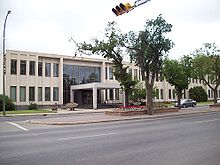 The Court consists of 32 full-time judge
s and a number of supernumerary
judges, all appointed by the federal government
under s.96 of the Constitution Act, 1867 and paid by the federal government under s.100. The court's Chief Justice, currently the Honourable R.D. Laing, is styled the Chief Justice of the Queens Bench. Both the Chief Justice and puisne justices are addressed as "My Lord" or "My Lady" and referred to as "His Lordship" or "Her Ladyship". This differs from the terminology used in the Provincial Court of Saskatchewan
, whose judges are "Your Honour", "His Honour" or "Her Honour."
The Court sits in eleven judicial centres. Actions are generally to be brought in the judicial centre closest to where the action arose, or the residence or place of business of the defendant. The court has a Family Law Division, which has exclusive jurisdiction over family law matters in the judicial centres of Saskatoon
, Regina
, and Prince Albert
, and concurrent jurisdiction (with the Provincial Court) over family law matters in all other areas of the Province.
of the Supreme Court of Saskatchewan (an ad hoc panel of judges).
During World War I, the province reorganized its courts. In 1915, the province passed legislation, the King’s Bench Act and Court of Appeal Act, for the purpose of creating a new court structure. Those acts came into effect on March 1, 1918, resulting in the abolishment of the Supreme Court of Saskatchewan and the creation of the trial-level Court of King’s Bench and the Court of Appeal.
In 1981, Saskatchewan merged its District Court into the Court of Queen's Bench. As part of that process, the judicial centres of the District Court became the judicial centres of the Court of Queen's Bench.
Superior court
In common law systems, a superior court is a court of general competence which typically has unlimited jurisdiction with regard to civil and criminal legal cases...
for the Canadian
Canada
Canada is a North American country consisting of ten provinces and three territories. Located in the northern part of the continent, it extends from the Atlantic Ocean in the east to the Pacific Ocean in the west, and northward into the Arctic Ocean...
province
Provinces and territories of Canada
The provinces and territories of Canada combine to make up the world's second-largest country by area. There are ten provinces and three territories...
of Saskatchewan
Saskatchewan
Saskatchewan is a prairie province in Canada, which has an area of . Saskatchewan is bordered on the west by Alberta, on the north by the Northwest Territories, on the east by Manitoba, and on the south by the U.S. states of Montana and North Dakota....
. The Court hears civil
Civil law (common law)
Civil law, as opposed to criminal law, is the branch of law dealing with disputes between individuals or organizations, in which compensation may be awarded to the victim...
and criminal law
Criminal law
Criminal law, is the body of law that relates to crime. It might be defined as the body of rules that defines conduct that is not allowed because it is held to threaten, harm or endanger the safety and welfare of people, and that sets out the punishment to be imposed on people who do not obey...
cases. It is a court of inherent jurisdiction
Inherent jurisdiction
Inherent jurisdiction is a doctrine of the English common law that a superior court has the jurisdiction to hear any matter that comes before it, unless a statute or rule limits that authority or grants exclusive jurisdiction to some other court or tribunal...
and there is no monetary limit on the claims which it may hear. It also has original jurisdiction over matters assigned to it by statute, such as adjudicating human rights complaints. As a superior court of original jurisdiction, it has supervisory jurisdiction over administrative tribunals, exercised by the prerogative writs
Prerogative writ
Prerogative writs are a class of writs which originate from English law. Originally they were available only to the Crown, but later they were made available to the monarch's subjects through the courts.The prerogative writs are:*certiorari...
. It also has some appellate jurisdiction, hearing appeals from the Provincial Court of Saskatchewan
Provincial Court of Saskatchewan
The Provincial Court of Saskatchewan is one of the courts in the judicial system of Saskatchewan. It is a court of limited jurisdiction, hearing criminal charges and civil claims up to $20,000.- Statutory Basis for the Provincial Court :...
and some adminstrative bodies. Appeals may be taken from the Queen's Bench to the Court of Appeal for Saskatchewan
Court of Appeal for Saskatchewan
The Court of Appeal for Saskatchewan is the highest superior appeal court in the province of Saskatchewan, Canada. It hears appeals from the Court of Queen's Bench for Saskatchewan as well as the Provincial Court of Saskatchewan and administrative tribunals...
. A further appeal lies to the Supreme Court of Canada
Supreme Court of Canada
The Supreme Court of Canada is the highest court of Canada and is the final court of appeals in the Canadian justice system. The court grants permission to between 40 and 75 litigants each year to appeal decisions rendered by provincial, territorial and federal appellate courts, and its decisions...
.
Structure and organization
Judge
A judge is a person who presides over court proceedings, either alone or as part of a panel of judges. The powers, functions, method of appointment, discipline, and training of judges vary widely across different jurisdictions. The judge is supposed to conduct the trial impartially and in an open...
s and a number of supernumerary
Supernumerary
A Supernumerary is an additional member of an organization. A supernumerary is also a non-regular member of a staff, a member of the staff or an employee who works in a public office who is not part of the manpower complement...
judges, all appointed by the federal government
Politics of Canada
The politics of Canada function within a framework of parliamentary democracy and a federal system of parliamentary government with strong democratic traditions. Canada is a constitutional monarchy, in which the Monarch is head of state...
under s.96 of the Constitution Act, 1867 and paid by the federal government under s.100. The court's Chief Justice, currently the Honourable R.D. Laing, is styled the Chief Justice of the Queens Bench. Both the Chief Justice and puisne justices are addressed as "My Lord" or "My Lady" and referred to as "His Lordship" or "Her Ladyship". This differs from the terminology used in the Provincial Court of Saskatchewan
Provincial Court of Saskatchewan
The Provincial Court of Saskatchewan is one of the courts in the judicial system of Saskatchewan. It is a court of limited jurisdiction, hearing criminal charges and civil claims up to $20,000.- Statutory Basis for the Provincial Court :...
, whose judges are "Your Honour", "His Honour" or "Her Honour."
The Court sits in eleven judicial centres. Actions are generally to be brought in the judicial centre closest to where the action arose, or the residence or place of business of the defendant. The court has a Family Law Division, which has exclusive jurisdiction over family law matters in the judicial centres of Saskatoon
Saskatoon
Saskatoon is a city in central Saskatchewan, Canada, on the South Saskatchewan River. Residents of the city of Saskatoon are called Saskatonians. The city is surrounded by the Rural Municipality of Corman Park No. 344....
, Regina
Regina, Saskatchewan
Regina is the capital city of the Canadian province of Saskatchewan. The city is the second-largest in the province and a cultural and commercial centre for southern Saskatchewan. It is governed by Regina City Council. Regina is the cathedral city of the Roman Catholic and Romanian Orthodox...
, and Prince Albert
Prince Albert, Saskatchewan
Prince Albert is the third-largest city in Saskatchewan, Canada. It is situated in the centre of the province on the banks of the North Saskatchewan River. The city is known as the "Gateway to the North" because it is the last major centre along the route to the resources of northern Saskatchewan...
, and concurrent jurisdiction (with the Provincial Court) over family law matters in all other areas of the Province.
History
Before Saskatchewan became a province in 1905, it was part of the North West Territories, as it existed at that time. Its judicial system was that of the territory. Despite becoming a province in 1905, Saskatchewan's provincial judicial system was not established until 1907. Its initial court structure consisted of three courts, the Supreme Court of Saskatchewan, the District Court (similar to the County Courts of other provinces), and the Surrogate Court. There was no appeal court; rather, appeals were conducted by the Full CourtFull Court
A Full Court refers to a court consisting of a greater-than-normal number of judges. Thus, in relation to a court usually presided over by a single judge, a Full Court would comprise a bench of three judges; for a court which, like many appellate courts, normally comprises three judges, a Full...
of the Supreme Court of Saskatchewan (an ad hoc panel of judges).
During World War I, the province reorganized its courts. In 1915, the province passed legislation, the King’s Bench Act and Court of Appeal Act, for the purpose of creating a new court structure. Those acts came into effect on March 1, 1918, resulting in the abolishment of the Supreme Court of Saskatchewan and the creation of the trial-level Court of King’s Bench and the Court of Appeal.
In 1981, Saskatchewan merged its District Court into the Court of Queen's Bench. As part of that process, the judicial centres of the District Court became the judicial centres of the Court of Queen's Bench.