


Copyright Term Extension Act

Encyclopedia
United States copyright law
The copyright law of the United States governs the legally enforceable rights of creative and artistic works under the laws of the United States.Copyright law in the United States is part of federal law, and is authorized by the U.S. Constitution...
terms in the United States
United States
The United States of America is a federal constitutional republic comprising fifty states and a federal district...
by 20 years. Since the Copyright Act of 1976
Copyright Act of 1976
The Copyright Act of 1976 is a United States copyright law and remains the primary basis of copyright law in the United States, as amended by several later enacted copyright provisions...
, copyright
Copyright
Copyright is a legal concept, enacted by most governments, giving the creator of an original work exclusive rights to it, usually for a limited time...
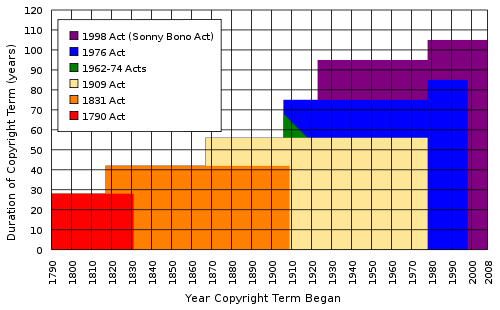
would last for the life of the author plus 50 years, or 75 years for a work of corporate authorship. The Act extended these terms to life of the author plus 70 years and for works of corporate authorship to 120 years after creation or 95 years after publication, whichever endpoint is earlier. Copyright protection for works published prior to January 1, 1978, was increased by 20 years to a total of 95 years from their publication date.
This law, also known as the Sonny Bono Copyright Term Extension Act, Sonny Bono Act, or as the Mickey Mouse Protection Act, effectively "froze" the advancement date of the public domain in the United States
Public domain in the United States
Works are in the public domain if they are not covered by intellectual property rights, such as copyright, at all, or if the intellectual property rights to the works has expired.- Public domain in copyrighted works in the United States :...
for works covered by the older fixed term copyright rules. Under this Act, additional works made in 1923 or afterwards that were still protected by copyright in 1998 will not enter the public domain until 2019 or afterward (depending on the date of the product) unless the owner of the copyright releases them into the public domain prior to that or if the copyright gets extended again. Unlike copyright extension legislation in the European Union
Copyright law of the European Union
The copyright law of the European Union has arisen in an attempt to harmonise the differing copyright laws of European Union member states. It consists of a number of directives, which the member states are obliged to enact into their national laws, and by the judgments of the Court of Justice of...
, the Sonny Bono Act did not revive copyrights that had already expired. The Act did extend the terms of protection set for works that were already copyrighted, and is retroactive in that sense. However, works created before January 1, 1978, but not published or registered for copyright until recently, are addressed in a special section and may remain protected until the end of 2047. The Act became on October 27, 1998.
Background
Under the Berne Convention for the Protection of Literary and Artistic WorksBerne Convention for the Protection of Literary and Artistic Works
The Berne Convention for the Protection of Literary and Artistic Works, usually known as the Berne Convention, is an international agreement governing copyright, which was first accepted in Berne, Switzerland in 1886.- Content :...
, the signatory states are required to provide copyright protection for a minimum term of the life of the author plus fifty years, but they are permitted to provide for a longer term of protection. Following the 1993 Directive on harmonising the term of copyright protection, member states of the European Union
European Union
The European Union is an economic and political union of 27 independent member states which are located primarily in Europe. The EU traces its origins from the European Coal and Steel Community and the European Economic Community , formed by six countries in 1958...
implemented protection for a term of the author's life plus seventy years. The United States
United States
The United States of America is a federal constitutional republic comprising fifty states and a federal district...
did not become a Berne signatory until 1988, but had previously provided for the minimum copyright term the convention required in the Copyright Act of 1976
Copyright Act of 1976
The Copyright Act of 1976 is a United States copyright law and remains the primary basis of copyright law in the United States, as amended by several later enacted copyright provisions...
.
After the United States' accession to the Berne convention, a number of copyright owners successfully lobbied
Lobbying
Lobbying is the act of attempting to influence decisions made by officials in the government, most often legislators or members of regulatory agencies. Lobbying is done by various people or groups, from private-sector individuals or corporations, fellow legislators or government officials, or...
the U.S. Congress for another extension of the term of copyright, to provide for the same term of protection that exists in Europe
Europe
Europe is, by convention, one of the world's seven continents. Comprising the westernmost peninsula of Eurasia, Europe is generally 'divided' from Asia to its east by the watershed divides of the Ural and Caucasus Mountains, the Ural River, the Caspian and Black Seas, and the waterways connecting...
. The act was named after the late Congressman Sonny Bono
Sonny Bono
Salvatore Phillip "Sonny" Bono was an American recording artist, record producer, actor, and politician whose career spanned over three decades.-Early life:...
, who died nine months before the act became law.
House members sympathetic to restaurant and bar owners, who were upset over ASCAP and BMI
Broadcast Music Incorporated
Broadcast Music, Inc. is one of three United States performing rights organizations, along with ASCAP and SESAC. It collects license fees on behalf of songwriters, composers, and music publishers and distributes them as royalties to those members whose works have been performed...
licensing practices, almost derailed the Act. As a result, the bill was amended to include the Fairness in Music Licensing Act
Fairness in Music Licensing Act of 1998
The Fairness in Music Licensing Act increased the number of bars and restaurants that were exempted from needing a public performance license to play music or television during business hours...
, which exempted smaller establishments from needing a public performance license to play music.
Both houses of the United States Congress passed the act as Public Law 105-298 with a voice vote
Voice vote
A voice vote is a voting method used by deliberative assemblies in which a vote is taken on a topic or motion by responding verbally....
,
making it impossible to determine who voted for or against. President Bill Clinton
Bill Clinton
William Jefferson "Bill" Clinton is an American politician who served as the 42nd President of the United States from 1993 to 2001. Inaugurated at age 46, he was the third-youngest president. He took office at the end of the Cold War, and was the first president of the baby boomer generation...
signed the Sonny Bono Copyright Term Extension Act of 1998 on October 27, 1998.
Senate Report 104-315
The Senate Report gave the official reasons for passing copyright extension laws and was originally written in the context of the Copyright Term Extension Act of 1995, .The authors of the report believed that extending copyright protection would help the United States by providing more protection for their works in foreign countries and by giving more incentive to digitize and preserve works since there was an exclusive right in them. The report also included minority opinions by Herb Kohl and Hank Brown
Hank Brown
George Hanks "Hank" Brown is a former Republican politician and U.S. Senator from Colorado who served as president of the University of Colorado system from April 2005 - January 2008.-Education:...
, who believed that the term extensions were a financial windfall to current owners of copyrighted material at the expense of the public's use of the material.
Support
In addition to the Walt Disney CompanyThe Walt Disney Company
The Walt Disney Company is the largest media conglomerate in the world in terms of revenue. Founded on October 16, 1923, by Walt and Roy Disney as the Disney Brothers Cartoon Studio, Walt Disney Productions established itself as a leader in the American animation industry before diversifying into...
(whose extensive lobbying efforts inspired the nickname "The Mickey Mouse Protection Act"), California congresswoman Mary Bono (Sonny Bono
Sonny Bono
Salvatore Phillip "Sonny" Bono was an American recording artist, record producer, actor, and politician whose career spanned over three decades.-Early life:...
's widow and Congressional successor) and the estate of composer George Gershwin
George Gershwin
George Gershwin was an American composer and pianist. Gershwin's compositions spanned both popular and classical genres, and his most popular melodies are widely known...
supported the act. Mary Bono, speaking on the floor of the United States House of Representatives
United States House of Representatives
The United States House of Representatives is one of the two Houses of the United States Congress, the bicameral legislature which also includes the Senate.The composition and powers of the House are established in Article One of the Constitution...
, said:
Proponents of the Bono Act argue that it is necessary given that the life expectancy
Life expectancy
Life expectancy is the expected number of years of life remaining at a given age. It is denoted by ex, which means the average number of subsequent years of life for someone now aged x, according to a particular mortality experience...
of humans has risen dramatically since Congress passed the original Copyright Act of 1790
Copyright Act of 1790
The Copyright Act of 1790 was the first federal copyright act to be instituted in the United States, though most of the states had passed various legislation securing copyrights in the years immediately following the Revolutionary War...
, that a difference in copyright terms between the United States and Europe would negatively affect the international operations of the entertainment industry, and that some works would be created under a longer copyright that would never be created under the existing copyright. They also claim that copyrighted works are an important source of income to the US and that media such as VHS
VHS
The Video Home System is a consumer-level analog recording videocassette standard developed by Victor Company of Japan ....
, DVD
DVD
A DVD is an optical disc storage media format, invented and developed by Philips, Sony, Toshiba, and Panasonic in 1995. DVDs offer higher storage capacity than Compact Discs while having the same dimensions....
, Cable
Cable television
Cable television is a system of providing television programs to consumers via radio frequency signals transmitted to televisions through coaxial cables or digital light pulses through fixed optical fibers located on the subscriber's property, much like the over-the-air method used in traditional...
and Satellite
Satellite
In the context of spaceflight, a satellite is an object which has been placed into orbit by human endeavour. Such objects are sometimes called artificial satellites to distinguish them from natural satellites such as the Moon....
have increased the value and commercial life of movies and television series.
Proponents contend that Congress has the power to pass whatever copyright term it wants because the language "To promote the progress of science and useful arts" in the United States Constitution is not a substantive limitation on the powers of Congress, leaving the sole restriction that copyrights must only last for "limited times." However, in what respect the granted time must be limited has never been determined, thus arguably even an absurdly long, yet finite, duration would still be a valid limited time according to the letter of the Constitution as long as Congress was ostensibly setting this limit to promote the progress of science and useful arts. This was one of the arguments that prevailed in the Eldred v. Ashcroft
Eldred v. Ashcroft
Eldred v. Ashcroft, was a court case in the United States challenging the constitutionality of the 1998 Sonny Bono Copyright Term Extension Act...
case, when the Supreme Court upheld the constitutionality of the CTEA. It is also pointed out by proponents that the extension did not prevent all works from going in the public domain. They note that the 1976 Copyright Act established that unpublished works created before 1978 would still begin entering the public domain January 1, 2003 (Known author: life of the author plus 70 years; anonymous/pseudoanonymous/unknown author/works-for-hire: 120 years from creation), and that the provision remained unaffected by the 1998 extension. They also claim that Congress has actually increased the scope of the public domain since, for the first time, unpublished works will enter the public domain.
Proponents believe that copyright encourages progress in the arts. With an extension of copyright, future artists have to create something original, rather than reuse old work. Proponents contend that it is more important to encourage all creators to make new works instead of just copyright holders.
Proponents say that copyright better preserves intellectual property like movies, music and television shows. One example given is the case of the classic film It's a Wonderful Life
It's a Wonderful Life
It's a Wonderful Life is a 1946 American Christmas drama film produced and directed by Frank Capra and based on the short story "The Greatest Gift" written by Philip Van Doren Stern....
. Before Republic Pictures
Republic Pictures
Republic Pictures was an independent film production-distribution corporation with studio facilities, operating from 1934 through 1959, and was best known for specializing in westerns, movie serials and B films emphasizing mystery and action....
and Spelling Entertainment (who owned the motion picture rights to the short story and the music even after the film itself became public domain) began to assert their rights to the film, various local TV stations and cable networks broadcast the film endlessly. As New York Times reporter Bill Carter put it: "the film's currency was being devalued."
Many different versions of the film were made and most if not all were in horrible condition. After underlying rights to the film were enforced, it was given a high quality restoration that was hailed by critics. In addition, proponents note that once a work falls into the public domain there is no guarantee that the work will be more widely available or cheaper. Suggesting that quality copies of public domain works are not widely available, they argue that one reason for a lack of availability may be due to publishers' reluctance to publish a work that is in the public domain for fear that they will not be able to recoup their investment or earn enough profit.
Proponents reject the idea that only works in the public domain can provide artistic inspiration. They note that opponents fail to take into account that copyright applies only to expressions of ideas and not the ideas themselves. Thus artists are free to get ideas from copyrighted works as long as they don't infringe
Copyright infringement
Copyright infringement is the unauthorized or prohibited use of works under copyright, infringing the copyright holder's exclusive rights, such as the right to reproduce or perform the copyrighted work, or to make derivative works.- "Piracy" :...
. Borrowing ideas and such are common in film, TV and music even with copyrighted works (see Scènes à faire
Scenes à faire
Scène à faire is a scene in a book or film which is almost obligatory for a genre of its type. In the U.S...
, Idea-expression divide
Idea-expression divide
The idea–expression divide or idea–expression dichotomy limits the scope of copyright protection by differentiating an idea from the expression or manifestation of that idea.The case of Baker v. Selden was the first U.S...
and stock character
Stock character
A Stock character is a fictional character based on a common literary or social stereotype. Stock characters rely heavily on cultural types or names for their personality, manner of speech, and other characteristics. In their most general form, stock characters are related to literary archetypes,...
). Works such as parody
Parody
A parody , in current usage, is an imitative work created to mock, comment on, or trivialise an original work, its subject, author, style, or some other target, by means of humorous, satiric or ironic imitation...
benefit from fair use
Fair use
Fair use is a limitation and exception to the exclusive right granted by copyright law to the author of a creative work. In United States copyright law, fair use is a doctrine that permits limited use of copyrighted material without acquiring permission from the rights holders...
.
Proponents also question the idea that extended copyright is "corporate welfare." They state that many opponents also have a stake in the case, claiming that those arguing against copyright term extension are mostly businesses that depend on distributing films and videos that have lost their copyright.
Opposition
Dennis S. Karjala, a law professor, led an effort to try to prevent the CTEA from being passed. He testified before the Committees on the Judiciary arguing "that extending the term of copyright protection would impose substantial costs on the United States general public without supplying any public benefit. The extension bills represent a fundamental departure from the United States philosophy that intellectual property legislation serve a public purpose." An Editorial in the New York Times argued against the copyright extension on February 21, 1998. The article stated "When Senator Hatch laments that George Gershwin's 'Rhapsody in Blue' will soon 'fall into the public domain,' he makes the public domain sound like a dark abyss where songs go, never to be heard again. In fact, when a work enters the public domain it means the public can afford to use it freely, to give it new currency."Opponents of the Bono Act consider the legislation to be corporate welfare
Corporate welfare
Corporate welfare is a pejorative term describing a government's bestowal of money grants, tax breaks, or other special favorable treatment on corporations or selected corporations. The term compares corporate subsidies and welfare payments to the poor, and implies that corporations are much less...
and have tried (but failed) to have it declared unconstitutional, claiming that such an act is not "necessary and proper" to accomplishing the Constitution's stated purpose of "promot[ing] the progress of science and useful arts". They argue that most works bring most of the profits during the first few years and are pushed off the market by the publishers thereafter. Thus there is little economic incentive in extending the terms of copyrights except for the few owners of franchises that are wildly successful, such as Disney. They also point out that the Tenth Amendment can be construed as placing limits on the powers that Congress can gain from a treaty. More directly, they see two successive terms of approximately 20 years each (the Copyright Act of 1976
Copyright Act of 1976
The Copyright Act of 1976 is a United States copyright law and remains the primary basis of copyright law in the United States, as amended by several later enacted copyright provisions...
and the Bono Act) as the beginning of a "slippery slope" toward a perpetual copyright term that nullifies the intended effect and violates the spirit of the "for limited times" language of the United States Constitution, Article I, section 8, clause 8.
They question the proponents' life expectancy argument, making the comparison between the growth of copyright terms and the term of patents in relation to the growth of life expectancies. Life expectancies have risen from about 35 years in 1800 to 77.6 years in 2002. Considering the increase in life expectancies during that period of time was a bit more than double but the copyright terms have increased threefold from only 28 years total (under the Copyright Act of 1790
Copyright Act of 1790
The Copyright Act of 1790 was the first federal copyright act to be instituted in the United States, though most of the states had passed various legislation securing copyrights in the years immediately following the Revolutionary War...
) presents an apparent discrepancy. While copyright terms have increased significantly since the 1790 act, terms of patent
Patent
A patent is a form of intellectual property. It consists of a set of exclusive rights granted by a sovereign state to an inventor or their assignee for a limited period of time in exchange for the public disclosure of an invention....
s have not been extended in parallel; patents adequately reward investment in the field with their mere 20-year term.
Opponents also argue that the Act encourages "offshore production." For example, derivative works could be created outside the United States in areas where copyright would have expired, such works advancing science or the useful arts, and that US law would prohibit these works to US residents. For example, a movie of Mickey Mouse playing with a computer could be legally created in Russia and children worldwide could possibly benefit from watching it, but the movie would be refused admission for importation by US Customs because of copyright, resulting in a deprivation to American children. Similarly, the first Winnie-the-Pooh
Winnie-the-Pooh
Winnie-the-Pooh, also called Pooh Bear, is a fictional anthropomorphic bear created by A. A. Milne. The first collection of stories about the character was the book Winnie-the-Pooh , and this was followed by The House at Pooh Corner...
book was published in 1926 and would have been public domain in 2001.
Opponents identify another possible harm from copyright extension: loss of productive value of private collections of copyrighted works. A person who collected copyrighted works that would soon "go out of copyright," intending to re-release them on copyright expiration, lost the use of his capital expenditures for an additional 20 years when the Bono Act passed. This is part of the underlying argument in Eldred v. Ashcroft
Eldred v. Ashcroft
Eldred v. Ashcroft, was a court case in the United States challenging the constitutionality of the 1998 Sonny Bono Copyright Term Extension Act...
. The Bono Act is thus perceived to add an instability to commerce and investment, areas which have a better legal theoretical basis than intellectual property, whose theory is of quite recent development and is often criticized as being a corporate chimera. Conceivably, if one had made such an investment and then produced a derivative work (or perhaps even re-released the work in ipse), he could counter a suit made by the copyright holder by declaring that Congress had unconstitutionally made, ex post facto, a restriction on the previously unrestricted.
Opponents also question the proponents' "new works would not be created" argument: the hidden presumption that the goal is to make the creation of new works possible. However, the authors of the United States Constitution evidently thought that unnecessary, instead restricting the goal of copyright to merely "promot[ing] the progress of science and useful arts". In fact, some works created under time-limited copyright would not be created under perpetual copyright because the creator of a distantly derivative work does not have the money and resources to find the owner of copyright in the original work and purchase a license, or the individual or privately held owner of copyright in the original work might refuse to license a use at any price (though a refusal to license may trigger a fair use safety valve). Thus they argue that a rich, continually replenished, public domain is necessary for continued artistic creation.
March 25th, 1998 House Debate
The House debated the Copyright Term Extension Act (House Resolution 390) on March 25, 1998. The term extension was almost completely supported, with only the mild criticism by Jim SensenbrennerJim Sensenbrenner
Frank James Sensenbrenner, Jr. is an American politician who has been a member of the Republican Party in the United States House of Representatives since 1979, representing . The district, the state's richest, includes many of Milwaukee's northern and western suburbs, and extends into rural...
(Wisconsin) of "H.R. 2589 provides a very generous windfall to the entertainment industry by extending the term of copyright for an additional 20 years." He suggested that it could be balanced by adding provisions from the Fairness in Music Licensing Act (H.R. 789). Lloyd Doggett
Lloyd Doggett
Lloyd Alton Doggett II is the U.S. Representative for , serving since 2005. He previously represented from 1995 to 2005. He is a member of the Democratic Party...
(Texas) called the Fairness in Music Licensing Act the Music Theft Act and claimed that it was a mechanism to "steal the intellectual property of thousands of small businesspeople who are song writers in this land." The majority of subsequent debate was over Sensenbrenner's House Amendment 532 to the CTEA. This amendment was over details of allowing music from radio and television broadcasts in small businesses to be played without licensing fees. An amendment to Sensenbrenner's amendment was proposed by Bill McCollum
Bill McCollum
Ira William "Bill" McCollum, Jr. is a former Florida Attorney General. A Republican, he was Florida's 36th attorney general, taking office in 2007...
,. The key differences between Sensenbrenner's proposal and McCollum's amendment were 1) local arbitration versus court lawsuits in rate disagreements, 2) all retail businesses versus only restaurants and bars, 3) 3500 square feet of general public area versus 3500 square feet (325.2 m²) of gross area, 4) which music licensing societies it applied to (all versus ASCAP and BMI), and 5) freedom from vicarious liability for landlords and others leasing space versus no such provision. After debate (and the first verse of American Pie) the McCollum Amendment was rejected in by 259 to 150 and the Sensenbrenner amendment was passed by 297 to 112. The Copyright Term Extenion Act H.R. 2589 was passed.
The term extension was supported for two key reasons. First, "copyright industries give us [(the United States)] one of our most significant trade surpluses." Second, the recently enacted legislation in the European Union had extended copyright there for 20 years, and so EU works would be protected for 20 years longer than US works if the US did not enact similar term extensions. Howard Coble
Howard Coble
John Howard Coble is the U.S. Representative for , serving since 1985. He is a member of the Republican Party.-Early life, education, and pre-political career:Coble was born in Greensboro, North Carolina...
also stated that it was good for consumers since "When works are protected by copyright, they attract investors who can exploit the work for profit." The term extension portion was supported by Songwriters Guild of America
Songwriters Guild of America
The Songwriters Guild of America is an organization founded in 1931, to help "advance, promote, and benefit" the profession of songwriters. It was founded as the "Songwriters Protective Association" by Billy Rose, George M. Meyer and Edgar Leslie...
, National Academy of Songwriters
National Academy of Songwriters
The National Academy of Songwriters, originally "Songwriters Resources and Services" was a music industry association which provided a support network for songwriters, and gave out awards in various categories. It was founded by Helen King, who was working as a secretarial/answering service for the...
, the Motion Picture Association of America
Motion Picture Association of America
The Motion Picture Association of America, Inc. , originally the Motion Picture Producers and Distributors of America , was founded in 1922 and is designed to advance the business interests of its members...
, the Intellectual Property Law Section of the American Bar Association, the Recording Industry Association of America
Recording Industry Association of America
The Recording Industry Association of America is a trade organization that represents the recording industry distributors in the United States...
, National Music Publishers Association
National Music Publishers Association
The National Music Publishers Association is the trade association representing American music publishers and their songwriting partners. The NMPA’s mandate is to protect and advance the interests of music publishers and songwriters in matters relating to the domestic and global protection of...
, the Information Technology Association of America
Information Technology Association of America
The Information Technology Association of America is a leading industry trade group for information technology companies. The Association's membership contains most all of the world's major ICT firms and accounts for over 90% of ICT goods and services sold in North America.Former Under Secretary...
and others.
Challenges
Publishers and librarians, among others, brought Eldred v. AshcroftEldred v. Ashcroft
Eldred v. Ashcroft, was a court case in the United States challenging the constitutionality of the 1998 Sonny Bono Copyright Term Extension Act...
to obtain an injunction on enforcement of the act. Oral arguments were heard by the U.S. Supreme Court
Supreme Court of the United States
The Supreme Court of the United States is the highest court in the United States. It has ultimate appellate jurisdiction over all state and federal courts, and original jurisdiction over a small range of cases...
on October 9, 2002, and on January 15, 2003 the court held the CTEA constitutional by a 7-2 decision.
The plaintiffs in the Eldred case have begun to shift their effort toward the U.S. Congress in support of a bill called the Public Domain Enhancement Act
Public Domain Enhancement Act
The Public Domain Enhancement Act , ) was a bill in the United States Congress which, if passed, would have added a tax for copyrighted works to retain their copyright status...
that would make the provisions of the Bono Act apply only to copyrights that had been registered with the Library of Congress
Library of Congress
The Library of Congress is the research library of the United States Congress, de facto national library of the United States, and the oldest federal cultural institution in the United States. Located in three buildings in Washington, D.C., it is the largest library in the world by shelf space and...
.
See also
- Anti-copyrightAnti-copyrightAnti-copyright refers to the complete or partial opposition to prevalent copyright laws. Copyright is known as the owner's right for copies to be only made by the owner or with his/her authorization in form of a license....
- CopyrightCopyrightCopyright is a legal concept, enacted by most governments, giving the creator of an original work exclusive rights to it, usually for a limited time...
- CopyleftCopyleftCopyleft is a play on the word copyright to describe the practice of using copyright law to offer the right to distribute copies and modified versions of a work and requiring that the same rights be preserved in modified versions of the work...
- Digital Millennium Copyright ActDigital Millennium Copyright ActThe Digital Millennium Copyright Act is a United States copyright law that implements two 1996 treaties of the World Intellectual Property Organization . It criminalizes production and dissemination of technology, devices, or services intended to circumvent measures that control access to...
- Ex post facto lawEx post facto lawAn ex post facto law or retroactive law is a law that retroactively changes the legal consequences of actions committed or relationships that existed prior to the enactment of the law...
- Intellectual propertyIntellectual propertyIntellectual property is a term referring to a number of distinct types of creations of the mind for which a set of exclusive rights are recognized—and the corresponding fields of law...
- List of countries' copyright length
- MPAA
- Public domainPublic domainWorks are in the public domain if the intellectual property rights have expired, if the intellectual property rights are forfeited, or if they are not covered by intellectual property rights at all...
- Rent seekingRent seekingIn economics, rent-seeking is an attempt to derive economic rent by manipulating the social or political environment in which economic activities occur, rather than by adding value...
- RIAA
- Software copyrightSoftware copyrightSoftware copyright is the extension of copyright law to machine-readable software. While many of the legal principles and policy debates concerning software copyright have close parallels in other domains of copyright law, there are a number of distinctive issues that arise with software...
- United States copyright lawUnited States copyright lawThe copyright law of the United States governs the legally enforceable rights of creative and artistic works under the laws of the United States.Copyright law in the United States is part of federal law, and is authorized by the U.S. Constitution...
Summary of copyright protection rules
Documentation from the United States government
- S.505: Sonny Bono Copyright Term Extension Act
- Senate Report No. 104-315
- Public Law 105-298
- Transcript of oral arguments in Eldred vs. Ashrcroft -(pdf)
Views of proponents
- Copyright Extension.com
- Mythology of the public domain: Exploring the myths behind attacks on the duration of copyright by Scott Martin
- The National Music Publishers' Association, Inc
- The American Society of Composers, Authors and Publishers
- Paper by Liebowitz and Margolis, archived at the Social Science Research NetworkSocial Science Research NetworkThe Social Science Research Network is a website devoted to the rapid dissemination of scholarly research in the social sciences and humanities. SSRN is viewed as particularly strong in the fields of economics, finance, accounting, management, and law. SSRN was founded in 1994 by Michael Jensen ...
website
Views of opponents
- The Eric Eldred Act
- Sonny Bono Copyright Extension Act opposition by Damian Yerrick.
- New York Times editorial, 4/30/2001, Let the Stories Go
- Litman Decries Overbroad Copyright Protection and Mouse Trapped by Mike GodwinMike GodwinMichael Wayne Godwin is an American attorney and author. He was the first staff counsel of the Electronic Frontier Foundation , and the creator of the Internet adage Godwin's Law of Nazi Analogies. From July 2007 to October 2010, he was general counsel for the Wikimedia Foundation...
- Discussion on Elvis Copyrights expiring in the UK
- Article in Findlaw's Writ by Chris Sprigman
- coverage of opposition by attorney Lawrence LessigLawrence LessigLawrence "Larry" Lessig is an American academic and political activist. He is best known as a proponent of reduced legal restrictions on copyright, trademark, and radio frequency spectrum, particularly in technology applications, and he has called for state-based activism to promote substantive...
- DIGITAL COPYRIGHT by Jessica LitmanJessica LitmanJessica Litman is a widely known expert on copyright law and author of Digital Copyright , which traces the history of lobbying that led to the passage of the Digital Millennium Copyright Act....
- Opposing Copyright Extension
- Thomas Maucalay on Copyright Law
- "Melancholy Elephants", from the Baen BooksBaen BooksBaen Books is an American publishing company established in 1983 by long time science fiction publisher and editor Jim Baen. It is a science fiction and fantasy publishing house that emphasizes space opera, hard science fiction, military science fiction, and fantasy...
Free Library – a cautionary story by Spider RobinsonSpider RobinsonSpider Robinson is an American-born Canadian Hugo and Nebula award winning science fiction author.- Biography :Born in the Bronx, New York City, Robinson attended Catholic high school, spending his junior year in a seminary, followed by two years in a Catholic college, and five years at the State...
. He later backed away from that position (while noting the irony) in a column collected in his 2004 The Crazy Years - http://www.boingboing.net/2006/02/21/copyright_office_hea.htmlQuotation from Marybeth PetersMarybeth PetersMarybeth Peters served as the 11th United States Register of Copyrights from August 7, 1994 to December 31, 2010...
]