

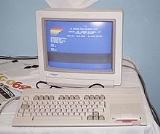
Commodore 65

Encyclopedia
Prototype
A prototype is an early sample or model built to test a concept or process or to act as a thing to be replicated or learned from.The word prototype derives from the Greek πρωτότυπον , "primitive form", neutral of πρωτότυπος , "original, primitive", from πρῶτος , "first" and τύπος ,...
computer created by Fred Bowen and others at Commodore Business Machines (CBM)
Commodore International
Commodore is the commonly used name for Commodore Business Machines , the U.S.-based home computer manufacturer and electronics manufacturer headquartered in West Chester, Pennsylvania, which also housed Commodore's corporate parent company, Commodore International Limited...
(part of Commodore International) in 1990–91. The project was cancelled by CEO Irving Gould
Irving Gould
Irving Gould was a Canadian businessperson credited with both saving and sinking Commodore. He gave the necessary funding to Jack Tramiel to keep Commodore running during several periods of financial problems...
.
The C65 was an improved version of the Commodore 64
Commodore 64
The Commodore 64 is an 8-bit home computer introduced by Commodore International in January 1982.Volume production started in the spring of 1982, with machines being released on to the market in August at a price of US$595...
, and it was meant to be backwards-compatible with the older computer, while still providing a number of advanced features close to those of the Amiga
Amiga
The Amiga is a family of personal computers that was sold by Commodore in the 1980s and 1990s. The first model was launched in 1985 as a high-end home computer and became popular for its graphical, audio and multi-tasking abilities...
. It can be regarded as a counterpart to the Apple IIgs
Apple IIGS
The Apple , the fifth and most powerful model in the Apple II series of personal computers produced by Apple Computer. The "GS" in the name stands for Graphics and Sound, referring to its enhanced graphics and sound capabilities, both of which greatly surpassed previous models of the line...
in providing 16-bit-equivalent technology on an 8-bit platform, though the IIgs used an 8/16 bit 65C816 processor. When Commodore International was liquidated in 1994, a number of prototype
Prototype
A prototype is an early sample or model built to test a concept or process or to act as a thing to be replicated or learned from.The word prototype derives from the Greek πρωτότυπον , "primitive form", neutral of πρωτότυπος , "original, primitive", from πρῶτος , "first" and τύπος ,...
s were sold on the open market, and thus a few people actually own a Commodore 65. Estimates as to the actual number of machines found on the open market range from 50 to 2000 units .
As the C65 project was cancelled, the final 8-bit
8-bit
The first widely adopted 8-bit microprocessor was the Intel 8080, being used in many hobbyist computers of the late 1970s and early 1980s, often running the CP/M operating system. The Zilog Z80 and the Motorola 6800 were also used in similar computers...
offering from CBM remained the triple-mode, 1–2 MHz, (expandable), C64-compatible Commodore 128
Commodore 128
The Commodore 128 home/personal computer was the last 8-bit machine commercially released by Commodore Business Machines...
of 1985.
Technical specifications
- The CPUCentral processing unitThe central processing unit is the portion of a computer system that carries out the instructions of a computer program, to perform the basic arithmetical, logical, and input/output operations of the system. The CPU plays a role somewhat analogous to the brain in the computer. The term has been in...
named CSG 4510MOS Technology 4510The MOS Technology 4510 was the MOS-manufactured microcomputer chip used in the Commodore 65 8-bit home/personal computer. The 4510 was essentially a 65CE02 CPU with two 6526 CIAs on-chip....
R3 (codenamed Victor) was a custom CSGMOS TechnologyMOS Technology, Inc., also known as CSG , was a semiconductor design and fabrication company based in Norristown, Pennsylvania, in the United States. It is most famous for its 6502 microprocessor, and various designs for Commodore International's range of home computers.-History:MOS Technology, Inc...
* 65CE02MOS Technology 65CE02The 65CE02 is a CPU core developed by Commodore Semiconductor Group that has been used in the CSG 4510 micro controller in the Commodore C64DX/C65....
(a MOS 6502MOS Technology 6502The MOS Technology 6502 is an 8-bit microprocessor that was designed by Chuck Peddle and Bill Mensch for MOS Technology in 1975. When it was introduced, it was the least expensive full-featured microprocessor on the market by a considerable margin, costing less than one-sixth the price of...
derivative), combined with two MOS 6526 complex interface adapters (CIAs) - A new VIC-III graphics chip named CSG* 4567 R5 (codenamed Bill), capable of producing 256 colors from a palette of 4096 colors; available modes include 320×200×256, 640×200×256, 640×400×16, 1280×200×16, and 1280×400×4 (X×Y×colordepth i.e. number of colors/bit planes)
- Two CSG* 8580R5 SIDMOS Technology SIDThe MOS Technology 6581/8580 SID is the built-in Programmable Sound Generator chip of Commodore's CBM-II, Commodore 64, Commodore 128 and Commodore MAX Machine home computers...
sound chipSound chipA sound chip is an integrated circuit designed to produce sound . It might be doing this through digital, analog or mixed-mode electronics...
s producing stereoStereophonic soundThe term Stereophonic, commonly called stereo, sound refers to any method of sound reproduction in which an attempt is made to create an illusion of directionality and audible perspective...
sound (the C64 had one SID) - 3.54 MHz clock frequency (the C64 ran at 1 MHz)
- 128 kBKilobyteThe kilobyte is a multiple of the unit byte for digital information. Although the prefix kilo- means 1000, the term kilobyte and symbol KB have historically been used to refer to either 1024 bytes or 1000 bytes, dependent upon context, in the fields of computer science and information...
RAMRandom-access memoryRandom access memory is a form of computer data storage. Today, it takes the form of integrated circuits that allow stored data to be accessed in any order with a worst case performance of constant time. Strictly speaking, modern types of DRAM are therefore not random access, as data is read in...
, expandable to 8 MBMegabyteThe megabyte is a multiple of the unit byte for digital information storage or transmission with two different values depending on context: bytes generally for computer memory; and one million bytes generally for computer storage. The IEEE Standards Board has decided that "Mega will mean 1 000...
using a RAM expansion port similar to that of the Commodore Amiga 500Amiga 500The Amiga 500 - also known as the A500 - was the first “low-end” Commodore Amiga 16/32-bit multimedia home/personal computer. It was announced at the winter Consumer Electronics Show in January 1987 - at the same time as the high-end Amiga 2000 - and competed directly against the Atari 520ST... - Heavily improved BASIC: Commodore BASIC 10.0Commodore BASICCommodore BASIC, also known as PET BASIC, is the dialect of the BASIC programming language used in Commodore International's 8-bit home computer line, stretching from the PET of 1977 to the C128 of 1985...
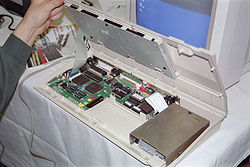
(the C64 had the relatively feature-weak BASIC 2.0, which was almost 10 years old by this time.) - one internal 3½" floppy diskFloppy diskA floppy disk is a disk storage medium composed of a disk of thin and flexible magnetic storage medium, sealed in a rectangular plastic carrier lined with fabric that removes dust particles...
drive
External links
- C65 page at 'The Secret Weapons of Commodore' website – By Cameron Kaiser and The Commodore Knowledge Base
- [ftp://ftp.zimmers.net/pub/cbm/c65 FTP directory for the C65 at ftp.zimmers.net]
- Andre Kaesmacher's C64DX Development Site
- C64DX System Specification document
- C65 System ROMs and Utility Software
- Commodore 65: Like The C64, But It's One Louder