


Color temperature

Encyclopedia
Temperature
Temperature is a physical property of matter that quantitatively expresses the common notions of hot and cold. Objects of low temperature are cold, while various degrees of higher temperatures are referred to as warm or hot...
of an ideal black-body radiator
Black body
A black body is an idealized physical body that absorbs all incident electromagnetic radiation. Because of this perfect absorptivity at all wavelengths, a black body is also the best possible emitter of thermal radiation, which it radiates incandescently in a characteristic, continuous spectrum...
that radiates light of comparable hue
Hue
Hue is one of the main properties of a color, defined technically , as "the degree to which a stimulus can be describedas similar to or different from stimuli that are described as red, green, blue, and yellow,"...
to that of the light source. Color temperature is conventionally stated in the unit of absolute temperature, the kelvin
Kelvin
The kelvin is a unit of measurement for temperature. It is one of the seven base units in the International System of Units and is assigned the unit symbol K. The Kelvin scale is an absolute, thermodynamic temperature scale using as its null point absolute zero, the temperature at which all...
, having the unit symbol K.
Color temperatures over are called cool colors (blueish white), while lower color temperatures (2,700–3,000 K) are called warm colors (yellowish white through red).
Categorizing different lighting
| Temperature | Source |
|---|---|
| 1,700 K | Match flame |
| 1,850 K | Candle flame, sunset/sunrise |
| 2,700–3,300 K | Incandescent light bulb |
| 3,200 K | Studio lamps, photofloods, etc. |
| 3,350 K | Studio "CP" light |
| 4,100–4,150 K | Moonlight, xenon arc lamp Xenon arc lamp A xenon arc lamp is a specialized type of gas discharge lamp, an electric light that produces light by passing electricity through ionized xenon gas at high pressure to produce a bright white light that closely mimics natural sunlight... |
| 5,000 K | Horizon daylight |
| 5,500–6,000 K | Vertical daylight, electronic flash |
| 6,500 K | Daylight, overcast |
| 6,500–9,300 K | LCD or CRT screen |
| These temperatures are merely characteristic; considerable variation may be present. |
|
The color temperature of the electromagnetic radiation emitted from an ideal black body
Black body
A black body is an idealized physical body that absorbs all incident electromagnetic radiation. Because of this perfect absorptivity at all wavelengths, a black body is also the best possible emitter of thermal radiation, which it radiates incandescently in a characteristic, continuous spectrum...
is defined as its surface temperature in kelvins, or alternatively in mired (micro-reciprocal Kelvin). This permits the definition of a standard by which light sources are compared.
To the extent that a hot surface emits thermal radiation
Thermal radiation
Thermal radiation is electromagnetic radiation generated by the thermal motion of charged particles in matter. All matter with a temperature greater than absolute zero emits thermal radiation....
but is not an ideal black-body radiator, the color temperature of the light is not the actual temperature of the surface. An incandescent light bulb
Incandescent light bulb
The incandescent light bulb, incandescent lamp or incandescent light globe makes light by heating a metal filament wire to a high temperature until it glows. The hot filament is protected from air by a glass bulb that is filled with inert gas or evacuated. In a halogen lamp, a chemical process...
's light is thermal radiation and the bulb approximates an ideal black-body radiator, so its color temperature is essentially the temperature of the filament.
Many other light sources, such as fluorescent lamp
Fluorescent lamp
A fluorescent lamp or fluorescent tube is a gas-discharge lamp that uses electricity to excite mercury vapor. The excited mercury atoms produce short-wave ultraviolet light that then causes a phosphor to fluoresce, producing visible light. A fluorescent lamp converts electrical power into useful...
s, emit light primarily by processes other than thermal radiation. This means the emitted radiation does not follow the form of a black-body spectrum. These sources are assigned what is known as a correlated color temperature (CCT). CCT is the color temperature of a black body radiator which to human color perception
Color vision
Color vision is the capacity of an organism or machine to distinguish objects based on the wavelengths of the light they reflect, emit, or transmit...
most closely matches the light from the lamp. Because such an approximation is not required for incandescent light, the CCT for an incandescent light is simply its unadjusted temperature, derived from the comparison to a black body radiator.
The Sun
As the Sun crosses the sky, it may appear to be red, orange, yellow or white depending on its position. The changing color of the sun over the course of the day is mainly a result of scatteringScattering
Scattering is a general physical process where some forms of radiation, such as light, sound, or moving particles, are forced to deviate from a straight trajectory by one or more localized non-uniformities in the medium through which they pass. In conventional use, this also includes deviation of...
of light, and is not due to changes in black-body radiation. The blue color of the sky is caused by Rayleigh scattering
Rayleigh scattering
Rayleigh scattering, named after the British physicist Lord Rayleigh, is the elastic scattering of light or other electromagnetic radiation by particles much smaller than the wavelength of the light. The particles may be individual atoms or molecules. It can occur when light travels through...
of the sunlight from the atmosphere, which tends to scatter blue light more than red light.
Daylight has a spectrum similar to that of a black body with a correlated color temperature of 6,500 K (D65 viewing standard) or 5,500 K (daylight-balanced photographic film standard).

Lighting
For lighting building interiors, it is often important to take into account the color temperature of illumination. For example, a warmer (i.e., lower color temperature) light is often used in public areas to promote relaxation, while a cooler (higher color temperature) light is used to enhance concentration in offices.Aquaculture
In fishkeeping, color temperature has different functions and foci, for different branches.- In freshwater aquaria, color temperature is generally of concern only for producing a more attractive display. Lights tend to be designed to produce an attractive spectrum, sometimes with secondary attention to keeping plants alive.
- In saltwater/reef aquaria, color temperatures are an essential part of tank health. Cooler temperatures are seen as getting through the water better, providing essential energy sources to the algae hosted in coral, that sustains it. Because coral receives intense, direct tropical sunlight, the focus was once on simulating this with 6,500 K lights. Higher temperature light sources have become more popular as their success became widely known...first 10,000 K, more recently 16,000 K and 20,000 K. Meanwhile, actinic lighting is used to make the somewhat fluorescent colors of many corals and fish "pop", creating brighter "display" tanks.
Digital photography
In digital photographyDigital photography
Digital photography is a form of photography that uses an array of light sensitive sensors to capture the image focused by the lens, as opposed to an exposure on light sensitive film...
, color temperature is sometimes used interchangeably with white balance, which allow a remapping of color values to simulate variations in ambient color temperature. Most digital cameras and RAW image software provide presets simulating specific ambient values (e.g., sunny, cloudy, tungsten, etc.) while others allow explicit entry of white balance values in kelvins. These settings vary color values along the blue–yellow axis, while some software includes additional controls (sometimes labeled tint) adding the magenta–green axis, and are to some extent arbitrary and subject to artistic interpretation.
Photographic film
Photographic emulsion film sometimes appears to exaggerate the color of the light, since it does not adapt to lighting color as human visual perception does. An object that appears to the eye to be white may turn out to look very blue or orange in a photograph. The color balanceColor balance
In photography and image processing, color balance is the global adjustment of the intensities of the colors . An important goal of this adjustment is to render specific colors – particularly neutral colors – correctly; hence, the general method is sometimes called gray balance, neutral balance,...
may need to be corrected while shooting or while printing to achieve a neutral color print.
Photographic film is made for specific light sources (most commonly daylight film and tungsten film
Tungsten Film
Tungsten film is photographic film designed to accurately represent colors as perceived by humans under tungsten light; the more usual color films are "daylight films", balanced to produce accurate colours under direct light from the sun or electronic flash...
), and used properly, will create a neutral color print. Matching the sensitivity of the film
Sensitometry
Sensitometry is the scientific study of light-sensitive materials, especially photographic film. The study has its origins in the work by Ferdinand Hurter and Vero Charles Driffield with early black-and-white emulsions...
to the color temperature of the light source is one way to balance color. If tungsten film is used indoors with incandescent lamps, the yellowish-orange light of the tungsten
Tungsten
Tungsten , also known as wolfram , is a chemical element with the chemical symbol W and atomic number 74.A hard, rare metal under standard conditions when uncombined, tungsten is found naturally on Earth only in chemical compounds. It was identified as a new element in 1781, and first isolated as...
incandescent bulbs will appear as white (3,200 K) in the photograph.
Filters on a camera lens, or color gel
Color gel
A color gel or color filter , also known as lighting gel or simply gel, is a transparent colored material that is used in theatre, event production, photography, videography and cinematography to color light and for color correction...
s over the light source(s) may also be used to correct color balance. When shooting with a bluish light (high color temperature) source such as on an overcast day, in the shade, in window light or if using tungsten film with white or blue light, a yellowish-orange filter will correct this. For shooting with daylight film (calibrated to 5,600 K) under warmer (low color temperature) light sources such as sunsets, candlelight or tungsten lighting, a bluish (e.g., #80A) filter may be used.
If there is more than one light source with varied color temperatures, one way to balance the color is to use daylight film and place color-correcting gel filters over each light source.
Photographers sometimes use color temperature meters. Color temperature meters are usually designed to read only two regions along the visible spectrum (red and blue); more expensive ones read three regions (red, green, and blue). However, they are ineffective with sources such as fluorescent or discharge lamps, whose light varies in color and may be harder to correct for. Because it is often greenish, a magenta filter may correct it. More sophisticated colorimetry
Colorimetry
Colorimetry is "the science and technology used to quantify and describe physically the human color perception."It is similar to spectrophotometry, but is distinguished by its interest in reducing spectra to the physical correlates of color perception, most often the CIE 1931 XYZ color space...
tools can be used where such meters are lacking.
Desktop publishing
In the desktop publishing industry, it is important to know a monitor’s color temperature. Color matching software, such as ColorSyncColorSync
ColorSync is Apple Inc's color management API for the Mac OS and Mac OS X.-Version history:Apple developed the original 1.0 version of ColorSync as a Mac-only architecture, which made it into an operating system release in 1993. In the same year, Apple co-founded the International Color Consortium...
will measure a monitor's color temperature and then adjust its settings accordingly. This enables on-screen color to more closely match printed color. Common monitor color temperatures, along with matching standard illuminant
Standard illuminant
A standard illuminant is a theoretical source of visible light with a profile which is published. Standard illuminants provide a basis for comparing images or colors recorded under different lighting.-CIE illuminants:...
s in parentheses, are as follows:
- 5,000 K (D50)
- 5,500 K (D55)
- 6,500 K (D65)
- 7,500 K (D75)
- 9,300 K.
Note: D50 is scientific shorthand for a Standard illuminant
Standard illuminant
A standard illuminant is a theoretical source of visible light with a profile which is published. Standard illuminants provide a basis for comparing images or colors recorded under different lighting.-CIE illuminants:...
: the daylight spectrum at a correlated color temperature of 5,000 K. (Similar definition for D55, D65 and D75.) Designations such as D50 are used to help classify color temperatures of light table
Light table
A light table is a viewing device that is used to review photographic film or artwork placed on top of it. It provides even illumination of the subject from below through a translucent cover and fluorescent lights that emit little heat. They can also be found mounted on the walls of hospitals and...
s and viewing booths. When viewing a color slide at a light table, it is important that the light be balanced properly so that the colors are not shifted towards the red or blue.
Digital camera
Digital camera
A digital camera is a camera that takes video or still photographs, or both, digitally by recording images via an electronic image sensor. It is the main device used in the field of digital photography...
s, web graphics, DVD
DVD
A DVD is an optical disc storage media format, invented and developed by Philips, Sony, Toshiba, and Panasonic in 1995. DVDs offer higher storage capacity than Compact Discs while having the same dimensions....
s, etc. are normally designed for a 6,500 K color temperature. The sRGB standard
SRGB color space
sRGB is a standard RGB color space created cooperatively by HP and Microsoft in 1996 for use on monitors, printers, and the Internet.sRGB uses the ITU-R BT.709 primaries, the same as are used in studio monitors and HDTV, and a transfer function typical of CRTs...
commonly used for images on the internet stipulates (among other things) a 6,500 K display whitepoint.
TV, video, and digital still cameras
The NTSCNTSC
NTSC, named for the National Television System Committee, is the analog television system that is used in most of North America, most of South America , Burma, South Korea, Taiwan, Japan, the Philippines, and some Pacific island nations and territories .Most countries using the NTSC standard, as...
and PAL
PAL
PAL, short for Phase Alternating Line, is an analogue television colour encoding system used in broadcast television systems in many countries. Other common analogue television systems are NTSC and SECAM. This page primarily discusses the PAL colour encoding system...
TV norms call for a compliant TV screen to display an electrically black and white signal (minimal color saturation) at a color temperature of 6,500 K. On many consumer-grade televisions, there is a very noticeable deviation from this requirement. However, higher-end consumer-grade televisions can have their color temperatures adjusted to 6,500 K by using a preprogrammed setting or a custom calibration. Current versions of ATSC explicitly call for the color temperature data to be included in the data stream, but old versions of ATSC allowed this data to be omitted. In this case, current versions of ATSC cite default colorimetry standards depending on the format. Both of the cited standards specify a 6,500 K color temperature.
Most video and digital still cameras can adjust for color temperature by zooming into a white or neutral colored object and setting the manual "white balance" (telling the camera that "this object is white"); the camera then shows true white as white and adjusts all the other colors accordingly. White-balancing is necessary especially when indoors under fluorescent lighting and when moving the camera from one lighting situation to another. Most cameras also have an automatic white balance function that attempts to determine the color of the light and correct accordingly. While these settings were once unreliable, they are much improved in today's digital cameras, and will produce an accurate white balance in a wide variety of lighting situations.
Artistic application via control of color temperature

Stanley Kubrick
Stanley Kubrick was an American film director, writer, producer, and photographer who lived in England during most of the last four decades of his career...
films; for instance in Eyes Wide Shut
Eyes Wide Shut
Eyes Wide Shut is a 1999 drama film based upon Arthur Schnitzler's 1926 novella Traumnovelle . The film was directed, produced and co-written by Stanley Kubrick, and was his last film. The story, set in and around New York City, follows the sexually-charged adventures of Dr...
the light coming in from a window was almost always conspicuously blue, whereas the light from lamps on end tables was fairly orange. Indoor lights typically give off a yellow hue; fluorescent and natural lighting tends to be more blue.
Video camera operator
Camera operator
A camera operator or cameraman is a professional operator of a film or video camera. In filmmaking, the leading cameraman is usually called a cinematographer, while a cameraman in a video production may be known as a television camera operator, video camera operator, or videographer, depending on...
s can white-balance objects which aren't white, downplaying the color of the object used for white-balancing. For instance, they can bring more warmth into a picture by white-balancing off something light blue, such as faded blue denim; in this way white-balancing can serve in place of a filter or lighting gel when those are not available.
Cinematographer
Cinematographer
A cinematographer is one photographing with a motion picture camera . The title is generally equivalent to director of photography , used to designate a chief over the camera and lighting crews working on a film, responsible for achieving artistic and technical decisions related to the image...
s do not "white balance" in the same way as video camera operators; they can use techniques such as filters, choice of film stock, pre-flashing
Pre-flashing
In cinematography and photography, pre-flashing is the exposure of the film or other photosensor to uniform light prior to exposing it to the scene to be imaged...
, and after shooting, color grading
Color grading
Color grading or colour painting, is the process of altering and enhancing the color of a motion picture, video image, or still image either electronically, photo-chemically or digitally. The photo-chemical process is also referred to as color timing and is typically performed at a photographic...
(both by exposure at the labs and also digitally). Cinematographers also work closely with set designers and lighting crews to achieve the desired effects.
For artists, most pigments and papers have a cool or warm cast, as the human eye can detect even a minute amount of saturation. Gray mixed with yellow, orange or red is a "warm gray". Green, blue, or purple, create "cool grays". Note that this sense of temperature is the reverse of that of real temperature; bluer is described as "cooler" even though it corresponds to a higher-temperature blackbody.
 |
|
| "Warm" gray | "Cool" gray |
| Mixed with 6% yellow. | Mixed with 6% blue. |
Lighting designers sometimes select filter
Filter (optics)
Optical filters are devices which selectively transmit light of different wavelengths, usually implemented as plane glass or plastic devices in the optical path which are either dyed in the mass or have interference coatings....
s by color temperature, commonly to match light that is theoretically white. Since fixtures using discharge
Metal halide lamp
Metal-halide lamps, a member of the high-intensity discharge family of lamps, produce high light output for their size, making them a compact, powerful, and efficient light source. By adding rare earth metal salts to the mercury vapor lamp, improved luminous efficacy and light color is obtained...
type lamps produce a light of considerably higher color temperature than tungsten lamps
Incandescent light bulb
The incandescent light bulb, incandescent lamp or incandescent light globe makes light by heating a metal filament wire to a high temperature until it glows. The hot filament is protected from air by a glass bulb that is filled with inert gas or evacuated. In a halogen lamp, a chemical process...
, using the two in conjunction could potentially produce a stark contrast, so sometimes fixtures with HID lamps, commonly producing light of 6,000–7,000 K, are fitted with 3,200 K filters to emulate tungsten light. Fixtures with color mixing features or with multiple colors, (if including 3,200 K) are also capable of producing tungsten like light. Color temperature may also be a factor when selecting lamps
Electric light
Electric lights are a convenient and economic form of artificial lighting which provide increased comfort, safety and efficiency. Most electric lighting is powered by centrally-generated electric power, but lighting may also be powered by mobile or standby electric generators or battery systems...
, since each is likely to have a different color temperature.
Correlated color temperature
Motivation
Black bodyBlack body
A black body is an idealized physical body that absorbs all incident electromagnetic radiation. Because of this perfect absorptivity at all wavelengths, a black body is also the best possible emitter of thermal radiation, which it radiates incandescently in a characteristic, continuous spectrum...
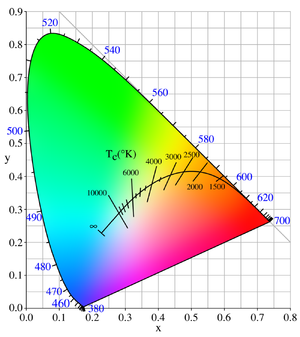
radiators are the reference by which the whiteness of light sources is judged. A black body can be described by its color temperature, whose hues are depicted above. By analogy, nearly-Planckian light sources such as certain fluorescent
Fluorescent lamp
A fluorescent lamp or fluorescent tube is a gas-discharge lamp that uses electricity to excite mercury vapor. The excited mercury atoms produce short-wave ultraviolet light that then causes a phosphor to fluoresce, producing visible light. A fluorescent lamp converts electrical power into useful...
or high-intensity discharge lamp
High-intensity discharge lamp
High-intensity discharge lamps are a type of electrical lamp which produces light by means of an electric arc between tungsten electrodes housed inside a translucent or transparent fused quartz or fused alumina arc tube. This tube is filled with both gas and metal salts. The gas facilitates the...
s can be judged by their correlated color temperature (CCT); the color temperature of the Planckian radiator that best approximates them. The question is: what is the relationship between the light source's relative spectral power distribution
Spectral power distribution
In color science and radiometry, a spectral power distribution describes the power per unit area per unit wavelength of an illumination , or more generally, the per-wavelength contribution to any radiometric quantity .Mathematically, for the spectral...
and its correlated color temperature?
Background
_diagram.svg.png)

- "Those for which the spectral distribution of energy is identical with that given by the Planckian formula."
- "Those for which the spectral distribution of energy is not identical with that given by the Planckian formula, but still is of such a form that the quality of the color evoked is the same as would be evoked by the energy from a Planckian radiator at the given color temperature."
- "Those for which the spectral distribution of energy is such that the color can be matched only approximately by a stimulus of the Planckian form of spectral distribution."
Several important developments occurred in 1931. In chronological order:
- Davis published a paper on correlated color temperature (his term). Referring to the Planckian locusPlanckian locusIn physics and color science, the Planckian locus or black body locus is the path or locus that the color of an incandescent black body would take in a particular chromaticity space as the blackbody temperature changes...
on the r-g diagram, he defined the CCT as the average of the primary component temperatures (RGB CCTs), using trilinear coordinatesTrilinear coordinatesIn geometry, the trilinear coordinates of a point relative to a given triangle describe the relative distances from the three sides of the triangle. Trilinear coordinates are an example of homogeneous coordinates...
. - The CIE announced the XYZ color space.
- Judd published a paper on the nature of "least perceptible differencesJust noticeable differenceIn psychophysics, a just noticeable difference, customarily abbreviated with lowercase letters as jnd, is the smallest detectable difference between a starting and secondary level of a particular sensory stimulus...
" with respect to chromatic stimuli. By empirical means he determined that the difference in sensation, which he termed ΔEColor differenceThe difference or distance between two colors is a metric of interest in color science. It allows people to quantify a notion that would otherwise be described with adjectives, to the detriment of anyone whose work is color critical...
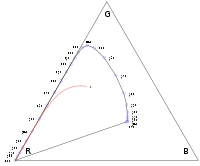
for a "discriminatory step between colors…Empfindung" (German for sensation) was proportional to the distance of the colors on the chromaticity diagram. Referring to the (r,g) chromaticity diagram depicted aside, he hypothesized that:
-
- KΔE = |c1 - c2| = max(|r1 - r2|, |g1 - g2|)
These developments paved the way for the development of new chromaticity spaces that are more suited to the estimation of correlated color temperatures and chromaticity differences. Bridging the concepts of color difference and color temperature, Priest made the observation that the eye is sensitive to constant differences in reciprocal temperature:
Priest proposed to use "the scale of temperature as a scale for arranging the chromaticities of the several illuminants in a serial order." Over the next few years, Judd published three more significant papers:
- The first verified the findings of Priest, Davis, and Judd, with a paper on sensitivity to change in color temperature.
The second proposed a new chromaticity space, guided by a principle that has become the holy grail of color spaces: perceptual uniformity (chromaticity distance should be commensurate with perceptual difference). By means of a projective transformation, Judd found a more uniform chromaticity space (UCS) in which to find the CCT. Judd determined the nearest color temperature by simply finding the nearest point on the Planckian locus
Planckian locus
In physics and color science, the Planckian locus or black body locus is the path or locus that the color of an incandescent black body would take in a particular chromaticity space as the blackbody temperature changes...
to the chromaticity of the stimulus on Maxwell
James Clerk Maxwell
James Clerk Maxwell of Glenlair was a Scottish physicist and mathematician. His most prominent achievement was formulating classical electromagnetic theory. This united all previously unrelated observations, experiments and equations of electricity, magnetism and optics into a consistent theory...
's color triangle
Color triangle
A color triangle is an arrangement of colors within a triangle, based on the additive combination of three primary colors at its corners.An additive color space defined by three primary colors has a chromaticity gamut that is a color triangle, when the amounts of the primaries are constrained to be...
, depicted aside. The transformation matrix he used to convert X,Y,Z tristimulus values to R,G,B coordinates was:
 .
.From this one can find these chromaticities:

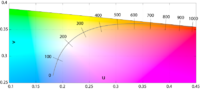
- The third depicted the locus of the isothermal chromaticities on the CIE 1931 x,y chromaticity diagram. Since the isothermal points formed normalsSurface normalA surface normal, or simply normal, to a flat surface is a vector that is perpendicular to that surface. A normal to a non-flat surface at a point P on the surface is a vector perpendicular to the tangent plane to that surface at P. The word "normal" is also used as an adjective: a line normal to a...
on his UCS diagram, transformation back into the xy plane revealed them still to be lines, but no longer perpendicular to the locus.
Calculation
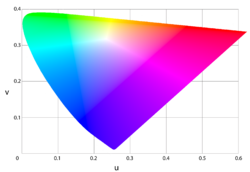
Judd's idea of determining the nearest point to the Planckian locus on a uniform chromaticity space is current. In 1937, MacAdam suggested a "modified uniform chromaticity scale diagram", based on certain simplifying geometrical considerations:
This (u,v) chromaticity space became the CIE 1960 color space
CIE 1960 color space
The CIE 1960 color space is another name for the chromaticity space devised by David MacAdam....
, which is still used to calculate the CCT (even though MacAdam did not devise it with this purpose in mind). Using other chromaticity spaces, such as u'v', leads to non-standard results that may nevertheless be perceptually meaningful.
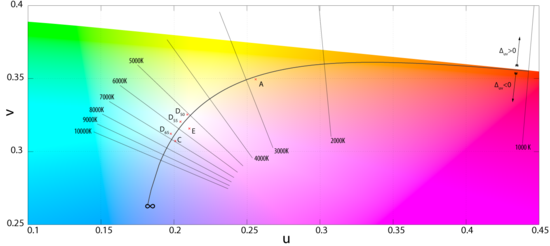
 ; positive for points above the locus. This concept of distance has evolved to become Delta E, which continues to be used today.
Robertson's method
Before the advent of powerful, personal computerPersonal computer
A personal computer is any general-purpose computer whose size, capabilities, and original sales price make it useful for individuals, and which is intended to be operated directly by an end-user with no intervening computer operator...
s, it was common to estimate the correlated color temperature by way of interpolation from look-up tables and charts. The most famous such method is Robertson's, who took advantage of the relatively even spacing of the mired scale (see above) to calculate the CCT Tc using linear interpolation
Linear interpolation
Linear interpolation is a method of curve fitting using linear polynomials. Lerp is an abbreviation for linear interpolation, which can also be used as a verb .-Linear interpolation between two known points:...
of the isotherm's mired values:


where
 and
and  are the color temperatures of the look-up isotherms and i is chosen such that
  . (Furthermore, the test chromaticity lies between the only two adjacent lines for which
  .)
.)If the isotherms are tight enough, one can assume
 , leading to
The distance of the test point to the i'th isotherm is given by
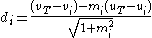
where
 is the chromaticity coordinate of the i'th isotherm on the Planckian locus and mi is the isotherm's slope
Slope
In mathematics, the slope or gradient of a line describes its steepness, incline, or grade. A higher slope value indicates a steeper incline....
. Since it is perpendicular to the locus, it follows that
 where li is the slope of the locus at
  .
.Precautions
Although the CCT can be calculated for any chromaticity coordinate, the result is meaningful only if the light sources are nearly white. The CIE recommends that "The concept of correlated color temperature should not be used if the chromaticity of the test source differs more than [ ] from the Planckian radiator."
Beyond a certain value of
 , a chromaticity co-ordinate may be equidistant to two points on the locus, causing ambiguity in the CCT.
Approximation
If a narrow range of color temperatures is considered—those encapsulating daylight being the most practical case—one can approximate the Planckian locus in order to calculate the CCT in terms of chromaticity coordinates. Following Kelly's observation that the isotherms intersect in the purple region near (x=0.325, y=0.154), McCamy proposed this cubic approximation:- CCT(x, y) = -449n3 + 3525n2 - 6823.3n + 5520.33
where n = (x - xe)/(y - ye) is the inverse slope line and (xe = 0.3320, ye = 0.1858) is the "epicenter"; quite close to the intersection point mentioned by Kelly. The maximum absolute error for color temperatures ranging from 2856 (illuminant A) to 6504 (D65) is under 2 K.
A more recent proposal, using exponential terms, considerably extends the applicable range by adding a second epicenter for high color temperatures:
- CCT(x,y) = A0 + A1exp(-n/t1) + A2exp(-n/t2) + A3exp(-n/t3)
where n is as before and the other constants are defined below:
| 3–50 kK | 50–800 kK | |
|---|---|---|
| xe | 0.3366 | 0.3356 |
| ye | 0.1735 | 0.1691 |
| A0 | -949.86315 | 36284.48953 |
| A1 | 6253.80338 | 0.00228 |
| t1 | 0.92159 | 0.07861 |
| A2 | 28.70599 | 5.4535×10−36 |
| t2 | 0.20039 | 0.01543 |
| A3 | 0.00004 | |
| t3 | 0.07125 |
The inverse calculation, from color temperature to corresponding chromaticity co-ordinates, is discussed in Planckian locus.
Color rendering index
The CIEInternational Commission on Illumination
The International Commission on Illumination is the international authority on light, illumination, color, and color spaces...
color rendering index (CRI) is a method to determine how well a light source's illumination of eight sample patches compares to the illumination provided by a reference source. Cited together, the CRI and CCT give a numerical estimate of what reference (ideal) light source best approximates a particular artificial light, and what the difference is.
Spectral power distribution
Light sources and illuminants may be characterized by their spectral power distributionSpectral power distribution
In color science and radiometry, a spectral power distribution describes the power per unit area per unit wavelength of an illumination , or more generally, the per-wavelength contribution to any radiometric quantity .Mathematically, for the spectral...
(SPD). The relative SPD curves provided by many manufacturers may have been produced using 10-nanometer (nm) increments or more on their spectroradiometer
Spectroradiometer
Spectroradiometers are designed to measure the spectral power distributions of illuminants. They operate almost like spectrophotometers in the visible region...
. The result is what would seem to be a smoother ("fuller spectrum") power distribution than the lamp actually has. Owing to their spiky distribution, much finer increments are advisable for taking measurements of fluorescent lights, and this requires more expensive equipment.
See also
- Luminous efficacyLuminous efficacyLuminous efficacy is a measure of how well a light source produces visible light. It is the ratio of luminous flux to power. Depending on context, the power can be either the radiant flux of the source's output, or it can be the total electric power consumed by the source.Which sense of the term is...
- Over-illuminationOver-illuminationOver-illumination is the presence of lighting intensity beyond that required for a specified activity. Over-illumination was commonly ignored between 1950 and 1995, especially in office and retail environments; only since then has the interior design community begun to reconsider this practice.The...
- Brightness temperatureBrightness temperatureBrightness temperature is the temperature a black body in thermal equilibrium with its surroundings would have to be to duplicate the observed intensity of a grey body object at a frequency \nu....
- Effective temperatureEffective temperatureThe effective temperature of a body such as a star or planet is the temperature of a black body that would emit the same total amount of electromagnetic radiation...
- WhitenessWhitenessIn colorimetry, whiteness is the degree to which a surface is white. An example of its use might be to quantitatively compare two pieces of paper which appear white viewed individually, but not when juxtaposed....
- Color metamerism
External links
- Boyd, Andrew. Kelvin temperature in photography at The Discerning Photographer.
- Charity, Mitchell. What color is a blackbody? sRGB values corresponding to blackbodies of varying temperature.
- Lindbloom, Bruce. ANSI C implementation of Robertson's method to calculate the correlated color temperature of a color in XYZ.
- Konica Minolta Sensing. The Language of Light.