


Collegium Novum

Encyclopedia
Gothic Revival architecture
The Gothic Revival is an architectural movement that began in the 1740s in England...
main building of the Jagiellonian University
Jagiellonian University
The Jagiellonian University was established in 1364 by Casimir III the Great in Kazimierz . It is the oldest university in Poland, the second oldest university in Central Europe and one of the oldest universities in the world....
in Kraków
Kraków
Kraków also Krakow, or Cracow , is the second largest and one of the oldest cities in Poland. Situated on the Vistula River in the Lesser Poland region, the city dates back to the 7th century. Kraków has traditionally been one of the leading centres of Polish academic, cultural, and artistic life...
, Poland
Poland
Poland , officially the Republic of Poland , is a country in Central Europe bordered by Germany to the west; the Czech Republic and Slovakia to the south; Ukraine, Belarus and Lithuania to the east; and the Baltic Sea and Kaliningrad Oblast, a Russian exclave, to the north...
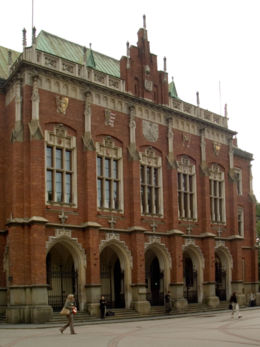
, built in 1873-1887. Based on a design by architect Feliks Księżarski to match the oldest building of the University, it was opened for the 500th anniversary of the University's foundation. The Collegium Novum replaced a former academic boarding school called Jeruzalem, consumed by fire in the mid-19th century.
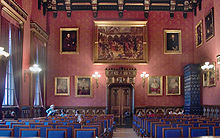
The building contains lecture rooms including an impressive assembly hall (called Aula), Rector's, Deans', and other university authorities' offices as well as those of a number of prominent professors. It is the Jagiellonian University's administrative centre.
Collegium Novum was opened on June 14, 1887, commencing several years of debate and construction. The decision regarding the allocation of subsidies was made in the Austro-Hungarian
Austria-Hungary
Austria-Hungary , more formally known as the Kingdoms and Lands Represented in the Imperial Council and the Lands of the Holy Hungarian Crown of Saint Stephen, was a constitutional monarchic union between the crowns of the Austrian Empire and the Kingdom of Hungary in...
capital of Vienna
Vienna
Vienna is the capital and largest city of the Republic of Austria and one of the nine states of Austria. Vienna is Austria's primary city, with a population of about 1.723 million , and is by far the largest city in Austria, as well as its cultural, economic, and political centre...
, with the University's vital interests defended by Julian Dunajewski, the then Austrian Finance Minister. The work might not have begun at all had it not been for his commitment, as well as that of his brother Cardinal Albin Dunajewski.
Until the end of First World War
World War I
World War I , which was predominantly called the World War or the Great War from its occurrence until 1939, and the First World War or World War I thereafter, was a major war centred in Europe that began on 28 July 1914 and lasted until 11 November 1918...
, a portrait of His Imperial Majesty Franz Joseph I of Austria
Franz Joseph I of Austria
Franz Joseph I or Francis Joseph I was Emperor of Austria, King of Bohemia, King of Croatia, Apostolic King of Hungary, King of Galicia and Lodomeria and Grand Duke of Cracow from 1848 until his death in 1916.In the December of 1848, Emperor Ferdinand I of Austria abdicated the throne as part of...
, painted by Kazimierz Pochwalski, hung in the Aula of the Collegium. On October 31, 1918 a group of University students tore it to pieces, manifesting their determination for the recreation of an independent Republic of Poland
Second Polish Republic
The Second Polish Republic, Second Commonwealth of Poland or interwar Poland refers to Poland between the two world wars; a period in Polish history in which Poland was restored as an independent state. Officially known as the Republic of Poland or the Commonwealth of Poland , the Polish state was...
. However, a number of other paintings did survive, including portraits of the University's founding fathers Casimir the Great and Władysław Jagiełło dating back to the early 1860s, a picture of Queen Jadwiga painted in 1900 to celebrate her Jubilee, as well as the works of Jan Matejko
Jan Matejko
Jan Matejko was a Polish painter known for paintings of notable historical Polish political and military events. His most famous works include oil on canvas paintings like Battle of Grunwald, paintings of numerous other battles and court scenes, and a gallery of Polish kings...
, including his painting entitled Copernicus: Conversation with God. The chairs in the assembly hall were designed by Tadeusz Stryjeński.
On the upper floor of the College there is a lecture hall named after Józef Szujski – now used by historians – with the commemorative plaque in remembrance of the events surrounding Nazi German
Nazi Germany
Nazi Germany , also known as the Third Reich , but officially called German Reich from 1933 to 1943 and Greater German Reich from 26 June 1943 onward, is the name commonly used to refer to the state of Germany from 1933 to 1945, when it was a totalitarian dictatorship ruled by...
action called Sonderaktion Krakau
Sonderaktion Krakau
Sonderaktion Krakau was the codename for a German operation against professors and academics from the University of Kraków and other Kraków universities at the beginning of World War II....
where 183 professors were arrested and later sent to camps in Sachsenhausen
Sachsenhausen concentration camp
Sachsenhausen or Sachsenhausen-Oranienburg was a Nazi concentration camp in Oranienburg, Germany, used primarily for political prisoners from 1936 to the end of the Third Reich in May, 1945. After World War II, when Oranienburg was in the Soviet Occupation Zone, the structure was used as an NKVD...
and Dachau. The plaque reads: "For the freedom of spirit and service to science and nation of Jagiellonian University professors deceitfully and forcefully taken away from this hall and imprisoned by the Nazi occupant on November 6, 1939."
The restoration of the Neo-Gothic architectural structure took place at the end of the 20th century. It was faced with a number of challenges, notably the task of reviving the original form of the building while simultaneously improving its functionality as an educational facility. The restoration was carried out on its façade in 1994 along with the modernization of the assembly hall, which was completed in 1999. The collaboration of specialists from various disciplines allowed for both restoration and functional needs of the Collegium to be met successfully.
See also
- German AB Action operation in Poland during World War II
- Collegium Maius, the oldest residence of the Jagiellonian UniversityCollegium MaiusThe Collegium Maius , in Kraków, Poland, is the Jagiellonian University's oldest building, dating back to the 15th century. It stands at the corner of ulica Jagiellońska and ulica Świętej Anny The Collegium Maius (Latin for "Great College"), in Kraków, Poland, is the Jagiellonian University's...