

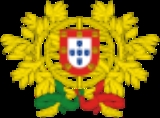
Coat of arms of Portugal

Encyclopedia
The coat of arms of Portugal was officially adopted on 30 June 1911, along with the republican flag
of Portugal
. It is based on the coat of arms used by the Portuguese Kingdom
since the Middle Ages
.
blue on a silver cross, successive elements were added or taken, culminating with the complex heraldic design that was officially adopted in 1911 (after the Republican Revolution
of 1910). The two stripes bear the colours of the Portuguese flag: red and green.
as an independent country in 1143 (it had been declared in 1139), silver bezant
s were added to the Burgundian flag, symbolising coins and the right the monarch had to issue currency, as leader of a sovereign state. Eventually, and given the enormous dynamism of medieval heraldry
, it is believed that the shield degraded and lost some elements in battle, eventually losing the cross format. This is how King Sancho I
inherited the shield from his father, Afonso Henriques, with no cross and five escutcheons (known in Portuguese
as quinas), which stood where the silver bezants had been placed.
Later, the number of silver bezants in each escutcheon would be reduced from eleven to five by King Sebastian I, and modern explanations interpret them as the five wounds of Jesus Christ, although this is highly improbable.
. Their origin is probably Castilian
, but unlike Spanish castles, which usually have their gates coloured blue (hence opened), Portuguese castles were always depicted with gold gates (hence closed). As a matter of fact, Afonso III was the second son of King Afonso II of Portugal and thus was not expected to inherit the throne, which was destined to go to his elder brother King Sancho II of Portugal. As a second son, the coat of arms of Afonso III included both the arms of his father and the arms of his mother Urraca of Castile, thus the castillan red border with golden castillan castles, around the portuguese shield inherited from his father.
was many times used in Portuguese colonial flags, mainly in Brazil
. It was a navigation instrument used to calculate distances and represents the importance of Portugal during the Age of Discovery
, as well as the vastness of its colonial empire when the First Republic was implemented.
Although it is commonly used as a "republican" element, as opposed to the monarchist crown in the blue/white flag (see Flag of Portugal
), some monarchist flags, such as the flag of the United Kingdom of Portugal, Brazil and the Algarves, already depicted armillary spheres. The incorporation of the armillary sphere into the 1816 flag of the United Kingdom of Portugal is related to the adoption of the first flag of the Kingdom of Brazil, an armillary sphere on a blue background.
Flag of Portugal
The flag of Portugal is the national flag of the Portuguese Republic. It is a rectangular bicolour with a field unevenly divided into green on the hoist, and red on the fly. The lesser version of the national coat of arms is centered over the colour boundary at equal distance from the upper and...
of Portugal
Portugal
Portugal , officially the Portuguese Republic is a country situated in southwestern Europe on the Iberian Peninsula. Portugal is the westernmost country of Europe, and is bordered by the Atlantic Ocean to the West and South and by Spain to the North and East. The Atlantic archipelagos of the...
. It is based on the coat of arms used by the Portuguese Kingdom
Kingdom of Portugal
The Kingdom of Portugal was Portugal's general designation under the monarchy. The kingdom was located in the west of the Iberian Peninsula, Europe and existed from 1139 to 1910...
since the Middle Ages
Middle Ages
The Middle Ages is a periodization of European history from the 5th century to the 15th century. The Middle Ages follows the fall of the Western Roman Empire in 476 and precedes the Early Modern Era. It is the middle period of a three-period division of Western history: Classic, Medieval and Modern...
.
History and meaning
The Portuguese coat of arms is the result of almost a millennium of modifications and alterations. Starting with Henry of BurgundyHenry of Burgundy
Henry of Burgundy may refer to:*Henry I, Duke of Burgundy , sometimes called Eudes Henry or Odo Henry*Henry I of France , also held Burgundy as Henry II...
blue on a silver cross, successive elements were added or taken, culminating with the complex heraldic design that was officially adopted in 1911 (after the Republican Revolution
Portuguese First Republic
The Portuguese First Republic spans a complex 16 year period in the history of Portugal, between the end of the period of constitutional monarchy marked by the 5 October 1910 revolution and the 28 May coup d'état of 1926...
of 1910). The two stripes bear the colours of the Portuguese flag: red and green.
Escutcheons and bezants
After the official recognition of the Kingdom of PortugalHistory of Portugal (1112-1279)
The history of Portugal, in most of the 12th and 13th centuries, is chiefly that of its origin as a separate state, in the process of the Christian reconquest of the Iberian Peninsula.-Background:...
as an independent country in 1143 (it had been declared in 1139), silver bezant
Bezant
Bezant is a medieval term for a gold coin from the Byzantine Empire, which term is derived from the Greek name Βυζάντιον for the relatively minor city which in the 4th c. became the capital of the Eastern Roman Empire, renamed Constantinople by the Roman Emperor Constantine the Great...
s were added to the Burgundian flag, symbolising coins and the right the monarch had to issue currency, as leader of a sovereign state. Eventually, and given the enormous dynamism of medieval heraldry
Heraldry
Heraldry is the profession, study, or art of creating, granting, and blazoning arms and ruling on questions of rank or protocol, as exercised by an officer of arms. Heraldry comes from Anglo-Norman herald, from the Germanic compound harja-waldaz, "army commander"...
, it is believed that the shield degraded and lost some elements in battle, eventually losing the cross format. This is how King Sancho I
Sancho I of Portugal
Sancho I , nicknamed the Populator , second monarch of Portugal, was born on 11 November 1154 in Coimbra and died on 26 March 1212 in the same city. He was the second but only surviving legitimate son and fourth child of Afonso I of Portugal by his wife, Maud of Savoy. Sancho succeeded his father...
inherited the shield from his father, Afonso Henriques, with no cross and five escutcheons (known in Portuguese
Portuguese language
Portuguese is a Romance language that arose in the medieval Kingdom of Galicia, nowadays Galicia and Northern Portugal. The southern part of the Kingdom of Galicia became independent as the County of Portugal in 1095...
as quinas), which stood where the silver bezants had been placed.
Later, the number of silver bezants in each escutcheon would be reduced from eleven to five by King Sebastian I, and modern explanations interpret them as the five wounds of Jesus Christ, although this is highly improbable.
Castles
It was during the reign of Afonso III that the red border with golden castles (not towers, as some sources state) was added. Although the number of castles could vary between eight to twelve, Afonso IV would define them as twelve and Sebastian I would finally fix them as seven. They supposedly represent the Moorish castles conquered by the Kingdom of Portugal during the ReconquistaReconquista
The Reconquista was a period of almost 800 years in the Middle Ages during which several Christian kingdoms succeeded in retaking the Muslim-controlled areas of the Iberian Peninsula broadly known as Al-Andalus...
. Their origin is probably Castilian
Kingdom of Castile
Kingdom of Castile was one of the medieval kingdoms of the Iberian Peninsula. It emerged as a political autonomous entity in the 9th century. It was called County of Castile and was held in vassalage from the Kingdom of León. Its name comes from the host of castles constructed in the region...
, but unlike Spanish castles, which usually have their gates coloured blue (hence opened), Portuguese castles were always depicted with gold gates (hence closed). As a matter of fact, Afonso III was the second son of King Afonso II of Portugal and thus was not expected to inherit the throne, which was destined to go to his elder brother King Sancho II of Portugal. As a second son, the coat of arms of Afonso III included both the arms of his father and the arms of his mother Urraca of Castile, thus the castillan red border with golden castillan castles, around the portuguese shield inherited from his father.
Armillary sphere
An important element of Portuguese heraldry since the 15th century, the armillary sphereArmillary sphere
An armillary sphere is a model of objects in the sky , consisting of a spherical framework of rings, centred on Earth, that represent lines of celestial longitude and latitude and other astronomically important features such as the ecliptic...
was many times used in Portuguese colonial flags, mainly in Brazil
Brazil
Brazil , officially the Federative Republic of Brazil , is the largest country in South America. It is the world's fifth largest country, both by geographical area and by population with over 192 million people...
. It was a navigation instrument used to calculate distances and represents the importance of Portugal during the Age of Discovery
Age of Discovery
The Age of Discovery, also known as the Age of Exploration and the Great Navigations , was a period in history starting in the early 15th century and continuing into the early 17th century during which Europeans engaged in intensive exploration of the world, establishing direct contacts with...
, as well as the vastness of its colonial empire when the First Republic was implemented.
Although it is commonly used as a "republican" element, as opposed to the monarchist crown in the blue/white flag (see Flag of Portugal
Flag of Portugal
The flag of Portugal is the national flag of the Portuguese Republic. It is a rectangular bicolour with a field unevenly divided into green on the hoist, and red on the fly. The lesser version of the national coat of arms is centered over the colour boundary at equal distance from the upper and...
), some monarchist flags, such as the flag of the United Kingdom of Portugal, Brazil and the Algarves, already depicted armillary spheres. The incorporation of the armillary sphere into the 1816 flag of the United Kingdom of Portugal is related to the adoption of the first flag of the Kingdom of Brazil, an armillary sphere on a blue background.
Crowns
The coat of arms sported different crowns during imperial rule of Portguese and foreign crowns.- pre mid-1500s the coat of arms had a open imperial crown
- Crown of the House of Habsburg
- Crown of House of Braganza-Saxe-Coburg and GothaHouse of Braganza-Saxe-Coburg and GothaThe House of Braganza-Saxe-Coburg and Gotha was a branch of the House of Braganza that ruled the Kingdom of Portugal from 1853 until the declaration of the republic in 1910....
with influence from the Germanic House of Saxe-Coburg and GothaHouse of Saxe-Coburg and GothaThe House of Saxe-Coburg and Gotha is a German dynasty, the senior line of the Saxon House of Wettin that ruled the Ernestine duchies, including the duchy of Saxe-Coburg and Gotha....
See also
- Flag of PortugalFlag of PortugalThe flag of Portugal is the national flag of the Portuguese Republic. It is a rectangular bicolour with a field unevenly divided into green on the hoist, and red on the fly. The lesser version of the national coat of arms is centered over the colour boundary at equal distance from the upper and...
- History of PortugalHistory of PortugalThe history of Portugal, a European and an Atlantic nation, dates back to the Early Middle Ages. In the 15th and 16th centuries, it ascended to the status of a world power during Europe's "Age of Discovery" as it built up a vast empire including possessions in South America, Africa, Asia and...
- Coats of arms of Portuguese coloniesCoats of arms of Portuguese coloniesThe coats of arms of the Portuguese Empire's colonies were all of a uniform style following 1935. Two of them had, however, been using provisional coats of arms of the same style shortly prior to this.-Gallery:...
- Coat of arms of CeutaCoat of arms of CeutaThough a city of Spain, the coat of arms of Ceuta is nearly identical to the coat of arms of Portugal, since that city was conquered by King John I of Portugal on 21 August 1415...