
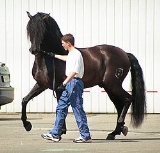
The
Andalusian, also known as the
Pure Spanish Horse or
PRE (
Pura Raza Española), is a
horse breedHorse breed is a broad term with no clear consensus as to definition, but most commonly refers to selectively bred populations of domesticated horses, often with pedigrees recorded in a breed registry. However, the term is sometimes used in a very broad sense to define landrace animals, or...
developed in the
Iberian PeninsulaThe Iberian Peninsula , sometimes called Iberia, is located in the extreme southwest of Europe and includes the modern-day sovereign states of Spain, Portugal and Andorra, as well as the British Overseas Territory of Gibraltar...
. Its ancestors have been present on the Iberian Peninsula for thousands of years. The Andalusian has been recognized as an individual breed since the 15th century, and its
conformationEquine conformation evaluates the degree of correctness of a horse's bone structure, musculature, and its body proportions in relation to each other. Undesirable conformation can limit the ability to perform a specific task. Although there are several universal "faults," a horse's conformation is...
has changed very little over the centuries. Throughout its history, it has been known for its prowess as a
war horseThe first use of horses in warfare occurred over 5,000 years ago. The earliest evidence of horses ridden in warfare dates from Eurasia between 4000 and 3000 BC. A Sumerian illustration of warfare from 2500 BC depicts some type of equine pulling wagons...
, and was prized by the nobility. The breed was used as a tool of diplomacy by the Spanish government, and kings across Europe rode and owned Spanish horses. During the 19th century, warfare, disease and
crossbreedA crossbreed or crossbred usually refers to an animal with purebred parents of two different breeds, varieties, or populations. Crossbreeding refers to the process of breeding such an animal, often with the intention to create offspring that share the traits of both parent lineages, or producing...
ing reduced herd numbers dramatically, and despite some recovery in the late 19th century, the trend continued into the early 20th century. Exports of Andalusians were restricted until the 1960s, but the breed has since spread throughout the world, despite still-low population numbers. , there were over 75,000 registered living Andalusians worldwide.
Strongly built, and compact yet elegant, Andalusians have long, thick manes and tails. Their most common
coat colorHorses exhibit a diverse array of coat colors and distinctive markings. A specialized vocabulary has evolved to describe them.While most horses remain the same color throughout life, a few, over the course of several years, will develop a different coat color from that with which they were born...
is
grayGray or grey is a coat color of horses characterized by progressive silvering of the colored hairs of the coat. Most gray horses have black skin and dark eyes; unlike many depigmentation genes, gray does not affect skin or eye color Their adult hair coat is white, dappled, or white intermingled...
, although they can be found in many other colors. They are known for their intelligence, sensitivity and docility. A sub-strain within the breed known as the Carthusian, is considered by breeders to be the purest strain of Andalusian, though there is no genetic evidence for this claim. The strain is still considered separate from the main breed however, and is preferred by breeders because buyers pay more for horses of Carthusian bloodlines. There are several competing
registriesA breed registry, also known as a stud book or register, in animal husbandry and the hobby of animal fancy, is an official list of animals within a specific breed whose parents are known. Animals are usually registered by their breeders when they are still young...
keeping records of horses designated as Andalusian or PRE, but they differ on their definition of the Andalusian and PRE, the purity of various strains of the breed, and the legalities of
stud bookA breed registry, also known as a stud book or register, in animal husbandry and the hobby of animal fancy, is an official list of animals within a specific breed whose parents are known. Animals are usually registered by their breeders when they are still young...
ownership. At least one lawsuit is in progress as of 2010 to determine the ownership of the Spanish PRE stud book.
The Andalusian is closely related to the
LusitanoThe Lusitano is a Portuguese horse breed, closely related to the Spanish Andalusian horse. Both are sometimes called Iberian horses, as the breeds both developed on the Iberian peninsula, and until the 1960s they were considered one breed, under the Andalusian name...
of Portugal, and has been used to develop many other breeds, especially in Europe and the Americas.
Breeds with Andalusian ancestry include many of the
warmbloodWarmbloods are a group of middle-weight horse types and breeds, primarily originating in Europe, registered with organizations that are characterized by open studbook policy, studbook selection, and the aim of breeding for equestrian sport...
s in Europe as well as
western hemisphereThe Western Hemisphere or western hemisphere is mainly used as a geographical term for the half of the Earth that lies west of the Prime Meridian and east of the Antimeridian , the other half being called the Eastern Hemisphere.In this sense, the western hemisphere consists of the western portions...
breeds such as the
AztecaThe Azteca is a horse breed from Mexico, with a subtype, called the "American Azteca", found in the United States. They are well-muscled horses that may be of any solid color, and the American Azteca may also carry pinto colors. Aztecas are known to compete in many western riding and some English...
. Over its centuries of development, the Andalusian breed has been selected for athleticism and stamina. The horses were originally used for
classical dressageClassical dressage evolved from cavalry movements and training for the battlefield, and has since developed into the competitive dressage seen today...
,
drivingDriving, when applied to horses, ponies, mules, or donkeys, is a broad term for hitching equines to a wagon, carriage, cart, sleigh, or other horse-drawn vehicle by means of a harness and working them in this way...
,
bullfightingBullfighting is a traditional spectacle of Spain, Portugal, southern France and some Latin American countries , in which one or more bulls are baited in a bullring for sport and entertainment...
, and as
stock horseA Stock horse is a horse of a type that is well suited for working with livestock, particularly cattle. Such horses are riding horsescharacterized by agility, quickness, and powerful hindquarters...
s. Modern Andalusians are used for many
equestrianEquestrianism more often known as riding, horseback riding or horse riding refers to the skill of riding, driving, or vaulting with horses...
activities, including
dressageDressage is a competitive equestrian sport, defined by the International Equestrian Federation as "the highest expression of horse training." Competitions are held at all levels from amateur to the World Equestrian Games...
,
show jumpingShow jumping, also known as "stadium jumping," "open jumping," or "jumpers," is a member of a family of English riding equestrian events that also includes dressage, eventing, hunters, and equitation. Jumping classes commonly are seen at horse shows throughout the world, including the Olympics...
and driving. The breed is also used extensively in movies, especially historical pictures and fantasy epics.
Characteristics
Generally standing between high, Andalusian horses are both elegant and strongly built. Members of the breed have heads of medium length, with a straight or slightly convex profile. Ultra convex and concave profiles are discouraged in the breed, and are penalized in breed shows. Necks are long and broad, running to well-defined
withersThe withers is the ridge between the shoulder blades of a four-legged animal. In many species it is the tallest point of the body, and in horses and dogs it is the standard place to measure the animal's height .-Horses:The withers in horses are formed by the dorsal spinal processes of roughly the...
; chests massive; backs short; hindquarters broad and strong, with well-rounded
croupsThe rump or croup, in the external morphology of an animal, is the portion of the posterior dorsum that is posterior to the loins and anterior to the tail. Anatomically, the rump corresponds to the sacrum....
. The breed tends to have clean legs, with no propensity for blemishes or injuries, and energetic gaits. The mane and tail are thick and long, although the legs do not have excess
featheringFeathering, or feather, is a term used to describe the long hair on the lower legs and fetlocks of some breeds of horse and pony. On some horses, especially draft breeds, the hair can almost cover the hooves...
. Andalusians tend to be docile, but also intelligent and sensitive. When treated with respect they are quick to learn, responsive and cooperative.
There are two additional characteristics unique to the Carthusian strain, believed to trace to the strain's
foundation stallionFoundation bloodstock or foundation stock are horses that are the progenitor, or foundation, of a new horse breed or a given bloodline within a breed. The term is also used in a similar manner when discussing purebred dogs...
Esclavo. The first is warts under the tail, a trait which Esclavo passed to his offspring, and a trait which some breeders felt was necessary to prove that a horse was a member of the Esclavo bloodline. The second characteristic is the occasional presence of "horns", which are actually frontal bosses, possibly inherited from Asian ancestors. The physical descriptions of the bosses vary, ranging from
calciumCalcium is the chemical element with the symbol Ca and atomic number 20. It has an atomic mass of 40.078 amu. Calcium is a soft gray alkaline earth metal, and is the fifth-most-abundant element by mass in the Earth's crust...
-like deposits at the
templeTemple indicates the side of the head behind the eyes. The bone beneath is the temporal bone as well as part of the sphenoid bone.-Anatomy:Cladists classify land vertebrates based on the presence of an upper hole, a lower hole, both, or neither in the cover of dermal bone which formerly covered the...
to small horn-like protrubences near or behind the ear. However, these "horns" are not considered proof of Esclavo descent, unlike the tail warts.
When the breed was first developed, most
coat colorsHorses exhibit a diverse array of coat colors and distinctive markings. A specialized vocabulary has evolved to describe them.While most horses remain the same color throughout life, a few, over the course of several years, will develop a different coat color from that with which they were born...
were found, including spotted patterns. Today, around 80 percent of all Andalusians are
grayGray or grey is a coat color of horses characterized by progressive silvering of the colored hairs of the coat. Most gray horses have black skin and dark eyes; unlike many depigmentation genes, gray does not affect skin or eye color Their adult hair coat is white, dappled, or white intermingled...
. Of the remaining horses, approximately 15 percent are bay and 5 percent are
blackBlack is a hair coat color of horses in which the entire hair coat is black. Black is a relatively uncommon coat color, and novices frequently mistake dark chestnuts or bays for black. However, some breeds of horses, such as the Friesian horse, Murgese and Ariegeois are almost exclusively black...
,
dunThe dun gene is a dilution gene that affects both red and black pigments in the coat color of a horse. The dun gene has the ability to affect the appearance of all black, bay, or chestnut -based horses to some degree by lightening the base body coat and suppressing the underlying base color to the...
or
palominoPalomino is a coat color in horses, consisting of a gold coat and white mane and tail. Genetically, the palomino color is created by a single allele of a dilution gene called the cream gene working on a "red" base coat...
or
chestnutChestnut is a hair coat color of horses consisting of a reddish-to-brown coat with a mane and tail the same or lighter in color than the coat. Genetically and visually, chestnut is characterized by the absolute absence of true black hairs...
. Other colors, such as buckskin, pearl, and cremello, are rare, but are recognized as allowed colors by the International Andalusian and Lusitano Horse Association. In the early history of the breed, certain
white markingsMarkings on horses usually are distinctive white areas on an otherwise dark base coat color. Most horses have some markings, and they help to identify the horse as a unique individual. Markings are present at birth and do not change over the course of the horse's life...
and
whorlsA hair whorl is a patch of hair growing in the opposite direction of the rest of the hair. Hair whorls can occur on animals with hairy coats, and are often found on horses and cows. Locations where whorls are found in equines include the stomach area, the face, stifle areas, and sometimes on the...
were considered to be indicators of character and good or bad luck. Horses with white socks on their feet were considered to have good or bad luck, depending on the leg or legs affected. A horse with no white markings at all was considered to be ill-tempered and vice-ridden, while certain facial markings were considered representative of honesty, loyalty and endurance. Similarly, hair whorls in various places were considered to show good or bad luck, with the most unlucky being in places where the horse itself could not see them – for example the temples, cheek, shoulder or heart. Two whorls near the root of the tail were considered a sign of courage and good luck.
The movement of Andalusian horses is extended, elevated, cadenced and harmonious, with a balance of roundness and forward movement. Poor elevation, irregular tempo, and excessive winging (sideways movement of the legs from the knee down) are discouraged by breed registry standards. Andalusians are known for their agility and their ability to learn difficult moves quickly, such as advanced
collectionCollection is when a horse carries more weight on his hindlegs than his front legs. The horse draws the body in upon itself so that it becomes like a giant spring whose stored energy can be reclaimed for fighting or running from a predator...
and turns on the haunches. A 2001 study compared the kinematic characteristics of Andalusian, Arabian and
Anglo-ArabianThe Anglo-Arabian or Anglo-Arab is a crossbred horse that now also has its own status as a horse breed. It is a Thoroughbred crossed with an Arabian. The cross can be made between a Thoroughbred stallion and an Arabian mare, or vice-versa...
horses while moving at the
trotThe trot is a two-beat diagonal gait of the horse, where the diagonal pairs of legs move forward at the same time. There is a moment of suspension between each beat....
. Andalusians were found to overtrack less (the degree to which the hind foot lands ahead of the front hoof print) but also exhibit greater flexing of both fore and hind joints, movement consistent with the more elevated way of going typically found in this breed. The authors of the study theorized that these characteristics of the breed's trot may contribute to their success as a riding and dressage horse.
A 2008 study found that Andalusians experience ischaemic (reduced blood flow) diseases of the
small intestineThe small intestine is the part of the gastrointestinal tract following the stomach and followed by the large intestine, and is where much of the digestion and absorption of food takes place. In invertebrates such as worms, the terms "gastrointestinal tract" and "large intestine" are often used to...
at a rate significantly higher than other breeds, and stallions had higher numbers of
inguinal herniaAn inguinal hernia is a protrusion of abdominal-cavity contents through the inguinal canal. They are very common , and their repair is one of the most frequently performed surgical operations....
s, with risk for occurrence 30 times greater than other breeds. At the same time, they also showed a lower incidence of
large intestinalThe large intestine is the third-to-last part of the digestive system — — in vertebrate animals. Its function is to absorb water from the remaining indigestible food matter, and then to pass useless waste material from the body...
obstruction. In the course of the study, Andalusians also showed the highest risk of
laminitisLaminitis is a disease that affects the feet of ungulates. It is best known in horses and cattle. Symptoms include lameness, and increased temperature in the hooves...
as a
medical complicationComplication, in medicine, is an unfavorable evolution of a disease, a health condition or a medical treatment. The disease can become worse in its severity or show a higher number of signs, symptoms or new pathological changes, become widespread throughout the body or affect other organ systems. A...
related to the intestinal issues.
Early development
The Andalusian horse is descended from the
Iberian horseThe Iberian horse is a title given to a number of horse breeds native to the Iberian peninsula. At present, 17 horse breeds are recognized by FAO as characteristic of the Iberian Peninsula....
s of Spain and Portugal, and derives its name from its place of origin, the Spanish region of
AndalusiaAndalusia is the most populous and the second largest in area of the autonomous communities of Spain. The Andalusian autonomous community is officially recognised as a nationality of Spain. The territory is divided into eight provinces: Huelva, Seville, Cádiz, Córdoba, Málaga, Jaén, Granada and...
. Cave paintings show that horses have been present on the
Iberian PeninsulaThe Iberian Peninsula , sometimes called Iberia, is located in the extreme southwest of Europe and includes the modern-day sovereign states of Spain, Portugal and Andorra, as well as the British Overseas Territory of Gibraltar...
as far back as 20,000 to 30,000 BCE. Although Portuguese historian Ruy d'Andrade hypothesized that the ancient
SorraiaThe Sorraia is a rare breed of horse indigenous to the portion of the Iberian peninsula known today as Portugal. The Sorraia is known for its primitive features, including a convex profile and dun coloring with primitive markings...
breed was an ancestor of the Southern Iberian breeds, including the Andalusian, genetic studies using
mitochondrial DNAMitochondrial DNA is the DNA located in organelles called mitochondria, structures within eukaryotic cells that convert the chemical energy from food into a form that cells can use, adenosine triphosphate...
show that the Sorraia is part of a genetic cluster that is largely separated from most Iberian breeds.
Throughout history, the Iberian breeds have been influenced by many different peoples and cultures who occupied Spain, including the Celts, the Carthaginians, the
RomansAncient Rome was a thriving civilization that grew on the Italian Peninsula as early as the 8th century BC. Located along the Mediterranean Sea and centered on the city of Rome, it expanded to one of the largest empires in the ancient world....
, various Germanic tribes and the
MoorsThe description Moors has referred to several historic and modern populations of the Maghreb region who are predominately of Berber and Arab descent. They came to conquer and rule the Iberian Peninsula for nearly 800 years. At that time they were Muslim, although earlier the people had followed...
. The Iberian horse was identified as a talented
war horseThe first use of horses in warfare occurred over 5,000 years ago. The earliest evidence of horses ridden in warfare dates from Eurasia between 4000 and 3000 BC. A Sumerian illustration of warfare from 2500 BC depicts some type of equine pulling wagons...
as early as 450 BCE. Mitochondrial DNA studies of the modern Andalusian horse of the
Iberian peninsulaThe Iberian Peninsula , sometimes called Iberia, is located in the extreme southwest of Europe and includes the modern-day sovereign states of Spain, Portugal and Andorra, as well as the British Overseas Territory of Gibraltar...
and
BarbDeveloped on the Barbary Coast of North Africa, the Barb horse is a desert breed with great hardiness and stamina. The Barb generally possesses a fiery temperament and an atypical sport-horse conformation, but nevertheless has influenced modern breeds....
horse of
North AfricaNorth Africa or Northern Africa is the northernmost region of the African continent, linked by the Sahara to Sub-Saharan Africa. Geopolitically, the United Nations definition of Northern Africa includes eight countries or territories; Algeria, Egypt, Libya, Morocco, South Sudan, Sudan, Tunisia, and...
, present convincing evidence that both breeds crossed the
Strait of GibraltarThe Strait of Gibraltar is a narrow strait that connects the Atlantic Ocean to the Mediterranean Sea and separates Spain in Europe from Morocco in Africa. The name comes from Gibraltar, which in turn originates from the Arabic Jebel Tariq , albeit the Arab name for the Strait is Bab el-Zakat or...
and were used for breeding with each other, influencing one another's bloodlines. Thus, the Andalusian may have been the first European "warmblood", a mixture of heavy European and lighter
Oriental horseThe term oriental horse refers to the ancient breeds of horses developed in the Middle East, such as the Arabian, Akhal-Teke, Barb, and the now-extinct Turkoman horse. They tend to be thin-skinned, long-legged, slim in build and more physically refined than other types, but with great endurance...
s. Some of the earliest written
pedigreesA pedigree chart is a diagram that shows the occurrence and appearance or phenotypes of a particular gene or organism and its ancestors from one generation to the next, most commonly humans, show dogs, and race horses....
in recorded European history were kept by
CarthusianThe Carthusian Order, also called the Order of St. Bruno, is a Roman Catholic religious order of enclosed monastics. The order was founded by Saint Bruno of Cologne in 1084 and includes both monks and nuns...
monks, beginning in the 13th century. Because they could read and write, and were thus able to maintain careful records, monastics were given the responsibility for horse breeding by certain members of the nobility, particularly in Spain. Andalusian
stud farmA stud farm or stud in animal husbandry, is an establishment for selective breeding of livestock. The word "stud" comes from the Old English stod meaning "herd of horses, place where horses are kept for breeding" Historically, documentation of the breedings that occur on a stud farm leads to the...
s for breeding were formed in the late 15th century in Carthusian monasteries in
JerezJerez de la Frontera is a municipality in the province of Cádiz in the autonomous community of Andalusia, in southwestern Spain, situated midway between the sea and the mountains. , the city, the largest in the province, had 208,896 inhabitants; it is the fifth largest in Andalusia...
,
SevilleSeville is the artistic, historic, cultural, and financial capital of southern Spain. It is the capital of the autonomous community of Andalusia and of the province of Seville. It is situated on the plain of the River Guadalquivir, with an average elevation of above sea level...
and
CazallaCazalla de la Sierra is a small town in the province of Seville, in southern Spain. It is located in the foothills of the Sierra Morena, which acts as a border between the region of Andalusia and the regions of Extremadura and Castilla-La Mancha....
.
The Carthusians bred powerful, weight-bearing horses in Andalusia for the
Crown of CastileThe Crown of Castile was a medieval and modern state in the Iberian Peninsula that formed in 1230 as a result of the third and definitive union of the crowns and parliaments of the kingdoms of Castile and León upon the accession of the then King Ferdinand III of Castile to the vacant Leonese throne...
, using the finest
Spanish JennetsA Jennet or Spanish Jennet was a small Spanish horse. It was noted for a smooth naturally ambling gait, compact and well-muscled build, and a good disposition...
as
foundation bloodstockFoundation bloodstock or foundation stock are horses that are the progenitor, or foundation, of a new horse breed or a given bloodline within a breed. The term is also used in a similar manner when discussing purebred dogs...
. These horses were a blend of Jennet and
warmbloodWarmbloods are a group of middle-weight horse types and breeds, primarily originating in Europe, registered with organizations that are characterized by open studbook policy, studbook selection, and the aim of breeding for equestrian sport...
breeding, taller and more powerfully built than the original Jennet. By the 15th century, the Andalusian had become a distinct breed, and was being used to influence the development of other breeds. They were also noted for their use as
cavalryCavalry or horsemen were soldiers or warriors who fought mounted on horseback. Cavalry were historically the third oldest and the most mobile of the combat arms...
horses. Even though in the 16th and 17th centuries Spanish horses had not yet reached the final form of the modern Andalusian, by 1667 William Cavendish, the
Duke of NewcastleDuke of Newcastle-upon-Tyne is a title which has been created three times in British history while the title of Duke of Newcastle-under-Lyne has been created once. The title was created for the first time in the Peerage of England in 1664 when William Cavendish, 1st Marquess of Newcastle-upon-Tyne...
, called the Spanish horse of Andalusia the "princes" of the horse world, and reported that they were "unnervingly intelligent". The Iberian horse became known as the "royal horse of Europe" and was seen at many royal courts and riding academies, including those in Austria, Italy, France and Germany. By the 16th century, during the reigns of
Charles VCharles V was ruler of the Holy Roman Empire from 1519 and, as Charles I, of the Spanish Empire from 1516 until his voluntary retirement and abdication in favor of his younger brother Ferdinand I and his son Philip II in 1556.As...
(1500–1558) and
Phillip IIPhilip II was King of Spain, Portugal, Naples, Sicily, and, while married to Mary I, King of England and Ireland. He was lord of the Seventeen Provinces from 1556 until 1581, holding various titles for the individual territories such as duke or count....
(1556–1581), Spanish horses were considered the finest in the world. Even in Spain, quality horses were owned mainly by the wealthy. During the 16th century, inflation and an increased demand for harness and cavalry horses drove the price of horses extremely high. The always expensive Andalusian became even more so, and it was often impossible to find a member of the breed to purchase at any price.
Dissemination
Spanish horses also were spread widely as a tool of diplomacy by the government of Spain, which granted both horses and export rights to favored citizens and to other royalty. As early as the 15th century, the Spanish horse was widely distributed throughout the Mediterranean, and was known in northern European countries, despite being less common and more expensive there. As time went on, kings from across Europe, including every French monarch from
Francis IFrancis I was King of France from 1515 until his death. During his reign, huge cultural changes took place in France and he has been called France's original Renaissance monarch...
to Louis XVI, had equestrian
portraitthumb|250px|right|Portrait of [[Thomas Jefferson]] by [[Rembrandt Peale]], 1805. [[New-York Historical Society]].A portrait is a painting, photograph, sculpture, or other artistic representation of a person, in which the face and its expression is predominant. The intent is to display the likeness,...
s created showing themselves riding Spanish-type horses. The kings of France, including Louis XIII and Louis XIV, especially preferred the Spanish horse; the head groom to Henri IV, Salomon de la Broue, said in 1600, "Comparing the best horses, I give the Spanish horse first place for its perfection, because it is the most beautiful, noble, graceful and courageous". War horses from Spain and Portugal began to be introduced to England in the 12th century, and importation continued through the 15th century. In the 16th century,
Henry VIIIHenry VIII was King of England from 21 April 1509 until his death. He was Lord, and later King, of Ireland, as well as continuing the nominal claim by the English monarchs to the Kingdom of France...
received gifts of Spanish horses from Charles V,
Ferdinand II of AragonFerdinand the Catholic was King of Aragon , Sicily , Naples , Valencia, Sardinia, and Navarre, Count of Barcelona, jure uxoris King of Castile and then regent of that country also from 1508 to his death, in the name of...
and the Duke of Savoy and others when he wed Katherine of Aragon. He also purchased additional war and riding horses through agents in Spain. By 1576, Spanish horses made up one third of British royal studs at
MalmesburyMalmesbury is a market town and civil parish located in the southern Cotswolds in the county of Wiltshire, England. Historically Malmesbury was a centre for learning and home to Malmesbury Abbey...
and
TutburyTutbury is a large village and civil parish of about 3,000 residents in the English county of Staffordshire.It is surrounded by the agricultural countryside of both Staffordshire and Derbyshire. The site has been inhabited for over 3000 years, with Iron Age defensive ditches encircling the main...
. The Spanish horse peaked in popularity in Great Britain during the 17th century, when horses were freely imported from Spain and exchanged as gifts between royal families. With the introduction of the
ThoroughbredThe Thoroughbred is a horse breed best known for its use in horse racing. Although the word thoroughbred is sometimes used to refer to any breed of purebred horse, it technically refers only to the Thoroughbred breed...
, interest in the Spanish horse faded after the mid-18th century, although they remained popular through the early 19th century. The
ConquistadorConquistadors were Spanish soldiers, explorers, and adventurers who brought much of the Americas under the control of Spain in the 15th to 16th centuries, following Europe's discovery of the New World by Christopher Columbus in 1492...
s of the 16th century rode Spanish horses, particularly animals from Andalusia, and the modern Andalusian descended from similar bloodstock. By 1500, Spanish horses were established in studs on
Santo DomingoSanto Domingo, known officially as Santo Domingo de Guzmán, is the capital and largest city in the Dominican Republic. Its metropolitan population was 2,084,852 in 2003, and estimated at 3,294,385 in 2010. The city is located on the Caribbean Sea, at the mouth of the Ozama River...
, and Spanish horses made their way into the ancestry of many breeds founded in North and South America. Many Spanish explorers from the 16th century on brought Spanish horses with them for use as war horses and later as breeding stock. By 1642, the Spanish horse had spread to Moldovia, to the stables of
TransylvaniaTransylvania is a historical region in the central part of Romania. Bounded on the east and south by the Carpathian mountain range, historical Transylvania extended in the west to the Apuseni Mountains; however, the term sometimes encompasses not only Transylvania proper, but also the historical...
n prince
George RakocziGyörgy Rákóczi I was elected Hungarian prince of Transylvania from 1630 until his death. During his influence Transylvania grew politically and economically stronger.-Biography:...
.
19th century to present
Despite their ancient history, all living Andalusians trace to a small number of horses bred by religious orders in the 18th and 19th centuries. An influx of
heavy horseA draft horse , draught horse or dray horse , less often called a work horse or heavy horse, is a large horse bred for hard, heavy tasks such as ploughing and farm labour...
blood beginning in the 16th century, resulted in the dilution of many of the bloodlines; only those protected by selective breeding remained intact to become the modern Andalusian. During the 19th century, the Andalusian breed was threatened because many horses were stolen or requisitioned in wartime, including the
War of the OrangesThe War of the Oranges was a brief conflict in 1801 in which Spanish forces, instigated by the government of France, and ultimately supported by the French military, invaded Portugal...
, the
Peninsular WarThe Peninsular War was a war between France and the allied powers of Spain, the United Kingdom, and Portugal for control of the Iberian Peninsula during the Napoleonic Wars. The war began when French and Spanish armies crossed Spain and invaded Portugal in 1807. Then, in 1808, France turned on its...
and the three
Carlist WarsThe Carlist Wars in Spain were the last major European civil wars in which contenders fought to establish their claim to a throne. Several times during the period from 1833 to 1876 the Carlists — followers of Infante Carlos and his descendants — rallied to the cry of "God, Country, and King" and...
. Napoleon's invading army also stole many horses. One herd of Andalusians was hidden from the invaders however, and subsequently used to renew the breed. In 1822, breeders began to add
NormanThe Anglo-Norman horse was a warmblood horse breed from the old province of Normandy in northern France. From early in the 19th century, local Norman mares were crossed with imported English thoroughbreds, Norfolk Roadsters and half-breds, which themselves had Norfolk Roadster and Mecklenburg blood...
blood into Spanish bloodlines, as well as further infusions of
ArabianThe Arabian or Arab horse is a breed of horse that originated on the Arabian Peninsula. With a distinctive head shape and high tail carriage, the Arabian is one of the most easily recognizable horse breeds in the world. It is also one of the oldest breeds, with archaeological evidence of horses...
blood. This was partially because increasing mechanization and changing needs within the military called for horses with more speed in cavalry charges as well as horses with more bulk for pulling gun carriages. In 1832, an epidemic seriously affected Spain's horse population, from which only one small herd survived in a stud at the monastery in
CartujaIsla de la Cartuja is an island in the Guadalquivir River at Seville, Spain.The island's name derives from the cloistered monastery located on the site, the Monasterio de Santa María de las Cuevas...
. During the 19th and early 20th centuries, European breeders, especially the Germans, changed from an emphasis on Andalusian and
NeapolitanThe Neapolitan Horse, , Neapolitano or Napolitano, is a horse breed that originated in the plains between Naples and Caserta, in the Campania region of Italy, but which may have been bred throughout the Kingdom of Naples. The Neapolitan horse was frequently mentioned in literature from the 16th to...
horses (an emphasis that had been in place since the decline of
chivalryChivalry is a term related to the medieval institution of knighthood which has an aristocratic military origin of individual training and service to others. Chivalry was also the term used to refer to a group of mounted men-at-arms as well as to martial valour...
), to an emphasis on the breeding of
ThoroughbredThe Thoroughbred is a horse breed best known for its use in horse racing. Although the word thoroughbred is sometimes used to refer to any breed of purebred horse, it technically refers only to the Thoroughbred breed...
s and
warmbloodWarmbloods are a group of middle-weight horse types and breeds, primarily originating in Europe, registered with organizations that are characterized by open studbook policy, studbook selection, and the aim of breeding for equestrian sport...
s, further depleting the stock of Andalusians. Despite this change in focus, Andalusian breeding slowly recovered, and in 1869, the Seville Horse Fair (originally begun by the Romans), played host to between ten and twelve thousand Spanish horses. In the early 20th century, Spanish horse breeding began to focus on other breeds, particularly
draft breedsA draft horse , draught horse or dray horse , less often called a work horse or heavy horse, is a large horse bred for hard, heavy tasks such as ploughing and farm labour...
, Arabians, Thoroughbreds and crosses between these breeds, as well as crosses between these breeds and the Andalusian. The purebred Andalusian was not viewed favorably by breeders or the military, and their numbers decreased significantly.
Andalusians only began to be exported from Spain in 1962. The first Andalusians were imported into Australia in 1971, and in 1973 the Andalusian Horse Association of Australasia was formed for the registration of these Andalusians and their offspring. Strict quarantine guidelines prohibited the importation of new Andalusian blood to Australia for many years, but since 1999, regulations have been relaxed and more than half a dozen new horses have been imported. Bloodines in the United States also rely on imported stock, and today, all American Andalusians can be traced directly to the stud books in Portugal and Spain. There are around 4,500 animals living today in the United States, where the International Andalusian and Lusitano Horse Association (IALHA) registers around 400 new foals every year. These numbers indicate that the Andalusian is a relatively rare breed in the United States. As of 2003, there were 75,389 living horses registered in the stud book, and they constituted almost 66 percent of the horses in Spain. Breed numbers have been increasing during the 21st century.
Strains and sub-types
The Carthusian Andalusian or
Cartujano is generally considered the purest Andalusian strain, and has one of the oldest recorded pedigree lines in the world. The pure sub-type is rare, as only around 12 percent of the Andalusian horses registered between the founding of the stud book in the 19th century and 1998 were considered Carthusians. They made up only 3.6 percent of the overall breeding stock, but 14.2 percent of the stallions used for breeding. In the past, Carthusians were given preference in breeding, leading to a large proportion of the Andalusian population claiming ancestry from a small number of horses and possibly limiting the breed's
genetic variabilityGenetic variability is a measure of the tendency of individual genotypes in a population to vary from one another. Variability is different from genetic diversity, which is the amount of variation seen in a particular population. The variability of a trait describes how much that trait tends to...
. A 2005 study compared the
genetic distanceGenetic distance refers to the genetic divergence between species or between populations within a species. It is measured by a variety of parameters. Smaller genetic distances indicate a close genetic relationship whereas large genetic distances indicate a more distant genetic relationship...
between Carthusian and non-Carthusian horses. They calculated a Fixation index (F
ST) based on genealogical information and concluded that the distinction between the two is not supported by genetic evidence. However, there are slight physical differences; Carthusians have more "oriental" or concave head shapes and are more often gray in color, while non-Carthusians tend toward convex profiles and more often exhibit other coat colors such as bay.
The Carthusian line was established in the early 18th century when two Spanish brothers, Andrés and Diego Zamora, purchased a
stallionA Stallion is a male horse.Stallion may also refer to:* Stallion , an American pop rock group* Stallion , a figure in the Gobot toyline* Stallion , a character in the console role-playing game series...
named El Soldado and bred him to two
mareFemale horses are called mares.Mare is the Latin word for "sea".The word may also refer to:-People:* Ahmed Marzooq, also known as Mare, a footballer and Secretary General of Maldives Olympic Committee* Mare Winningham, American actress and singer...
s. The mares were descended from mares purchased by the Spanish king and placed at
AranjuezAranjuez is a town lying 48 km south of Madrid, in the southern part of the Community of Madrid. It is located at the confluence of the Tagus and Jarama rivers, 48 km from Toledo. As of 2009, it has a population of 54,055.-History:...
, one of the oldest horse breeding farms in Spain. One of the offspring of El Soldado, a dark gray
coltA colt is a young male horse, under the age of four. The term "colt" is often confused with foal, which refers to a horse of either sex under one year of age....
named Esclavo, became the foundation sire of the Carthusian line. One group of mares sired by Esclavo in about 1736 were given to a group of Carthusian monks to settle a debt. Other animals of these bloodlines were absorbed into the main Andalusian breed; the stock given to the monks was bred into a special line, known as Zamoranos. Throughout the following centuries, the Zamoranos bloodlines were guarded by the Carthusian monks, to the point of defying royal orders to introduce outside blood from the
Neapolitan horseThe Neapolitan Horse, , Neapolitano or Napolitano, is a horse breed that originated in the plains between Naples and Caserta, in the Campania region of Italy, but which may have been bred throughout the Kingdom of Naples. The Neapolitan horse was frequently mentioned in literature from the 16th to...
and central European breeds. They did, however, introduce
ArabianThe Arabian or Arab horse is a breed of horse that originated on the Arabian Peninsula. With a distinctive head shape and high tail carriage, the Arabian is one of the most easily recognizable horse breeds in the world. It is also one of the oldest breeds, with archaeological evidence of horses...
and
BarbDeveloped on the Barbary Coast of North Africa, the Barb horse is a desert breed with great hardiness and stamina. The Barb generally possesses a fiery temperament and an atypical sport-horse conformation, but nevertheless has influenced modern breeds....
blood to improve the strain. The original stock of Carthusians was greatly depleted during the Peninsular Wars, and the strain might have become extinct if not for the efforts of the Zapata family. Today, the Carthusian strain is raised in state-owned
stud farmA stud farm or stud in animal husbandry, is an establishment for selective breeding of livestock. The word "stud" comes from the Old English stod meaning "herd of horses, place where horses are kept for breeding" Historically, documentation of the breedings that occur on a stud farm leads to the...
s around
Jerez de la FronteraJerez de la Frontera is a municipality in the province of Cádiz in the autonomous community of Andalusia, in southwestern Spain, situated midway between the sea and the mountains. , the city, the largest in the province, had 208,896 inhabitants; it is the fifth largest in Andalusia...
,
BadajozBadajoz is the capital of the Province of Badajoz in the autonomous community of Extremadura, Spain, situated close to the Portuguese border, on the left bank of the river Guadiana, and the Madrid–Lisbon railway. The population in 2007 was 145,257....
and
Cordoba-History:The first trace of human presence in the area are remains of a Neanderthal Man, dating to c. 32,000 BC. In the 8th century BC, during the ancient Tartessos period, a pre-urban settlement existed. The population gradually learned copper and silver metallurgy...
, and also by several private families. Carthusian horses continue to be in demand in Spain, and buyers pay high prices for members of the strain.
Influence on other breeds
Spain's worldwide military activities between the 14th and 17th centuries called for large numbers of horses, more than could be supplied by native Spanish mares. Spanish custom also called for mounted troops to ride
stallionA Stallion is a male horse.Stallion may also refer to:* Stallion , an American pop rock group* Stallion , a figure in the Gobot toyline* Stallion , a character in the console role-playing game series...
s, never
mareFemale horses are called mares.Mare is the Latin word for "sea".The word may also refer to:-People:* Ahmed Marzooq, also known as Mare, a footballer and Secretary General of Maldives Olympic Committee* Mare Winningham, American actress and singer...
s or
geldingA gelding is a castrated horse or other equine such as a donkey or a mule. Castration, and the elimination of hormonally driven behavior associated with a stallion, allows a male horse to be calmer and better-behaved, making the animal quieter, gentler and potentially more suitable as an everyday...
s. Due to these factors, Spanish stallions were crossed with local mares in many countries, adding Spanish bloodlines wherever they went, especially to other European breeds.
Because of the influence of the later
HabsburgThe House of Habsburg , also found as Hapsburg, and also known as House of Austria is one of the most important royal houses of Europe and is best known for being an origin of all of the formally elected Holy Roman Emperors between 1438 and 1740, as well as rulers of the Austrian Empire and...
families, who ruled in both Spain and other nations of Europe, the Andalusian was crossbred with horses of Central Europe and the
Low CountriesThe Low Countries are the historical lands around the low-lying delta of the Rhine, Scheldt, and Meuse rivers, including the modern countries of Belgium, the Netherlands, Luxembourg and parts of northern France and western Germany....
and thus was closely related to many breeds that developed, including the
Neapolitan horseThe Neapolitan Horse, , Neapolitano or Napolitano, is a horse breed that originated in the plains between Naples and Caserta, in the Campania region of Italy, but which may have been bred throughout the Kingdom of Naples. The Neapolitan horse was frequently mentioned in literature from the 16th to...
,
GroningenThe Groningen Horse is a Dutch horse breed developed for light draft and agricultural work. It is closely related to heavy warmblood breeds like the East Friesian and Alt-Oldenburger...
, Lipizzaner and
KladruberThe Kladruber is the oldest Czech horse breed, and today is considered very rare. The main breeding centre is in National stud farm Kladruby nad Labem in the Czech republic where Kladrubers have been bred for more than 400 years, being now one of the world's oldest horse breeds...
. Spanish horses were used extensively in classical dressage in Germany from the 16th century on. From this use, they influenced many German breeds, including the
HanoverianA Hanoverian is a warmblood horse originating in Germany, which is often seen in the Olympic Games and other competitive English riding styles, and have won gold medals in all three equestrian Olympic competitions. It is one of the oldest, most numerous, and most successful of the warmbloods...
,
HolsteinThe Holsteiner is a breed of horse originating in the Schleswig-Holstein region of northern Germany. It is thought to be the oldest of warmblood breeds, tracing back to the 13th century...
, East Friesian and
OldenburgOldenburg is an independent city in Lower Saxony, Germany. It is situated in the western part of the state between the cities of Bremen and Groningen, Netherlands, at the Hunte river. It has a population of 160,279 which makes it the fourth biggest city in Lower Saxony after Hanover, Braunschweig...
. Dutch breeds such as the
FriesianThe Friesian is a horse breed originating in Friesland, Netherlands. Although the breed's conformation resembles that of a light draft horse, Friesians are graceful and nimble for their size. During the Middle Ages, it is believed that the ancestors of Friesian horses were in great demand as war...
and
GelderlandThe Gelderland, or Gelderlander, is a heavy warmblood breed of horse that was developed in the province of Gelderland in the Netherlands. The Gelderlander, along with the similar Groninger horse from the north, provided the foundation for the Dutch Warmblood...
also contain significant Spanish blood, as do Danish breeds such as the
FredericksborgThe Frederiksborger is Denmark's oldest horse breed. They were tremendously popular throughout the Renaissance and Baroque periods and were considered luxury items. Today the breed is rare, but has a loyal following. Stallions and mares undergo studbook inspections before being allowed to breed...
and Knabstrupper.
Andalusians were a significant influence on the creation of the Alter Real, a strain of the
LusitanoThe Lusitano is a Portuguese horse breed, closely related to the Spanish Andalusian horse. Both are sometimes called Iberian horses, as the breeds both developed on the Iberian peninsula, and until the 1960s they were considered one breed, under the Andalusian name...
, and the
AztecaThe Azteca is a horse breed from Mexico, with a subtype, called the "American Azteca", found in the United States. They are well-muscled horses that may be of any solid color, and the American Azteca may also carry pinto colors. Aztecas are known to compete in many western riding and some English...
, a Mexican breed created by crossing the Andalusian with
American Quarter HorseThe American Quarter Horse is an American breed of horse that excels at sprinting short distances. Its name came from its ability to outdistance other breeds of horses in races of a quarter mile or less; some individuals have been clocked at speeds up to 55 mph...
and Criollo bloodlines. The Spanish jennet ancestors of the Andalusian also developed the Colonial Spanish Horse in America, which became the foundation bloodstock for many North and South American breeds.
Naming and registration
Until modern times, horse breeds throughout Europe were known primarily by the name of the region where they were bred. Thus the original term "Andalusian" simply described the horses of distinct quality that came from
AndalusiaAndalusia is the most populous and the second largest in area of the autonomous communities of Spain. The Andalusian autonomous community is officially recognised as a nationality of Spain. The territory is divided into eight provinces: Huelva, Seville, Cádiz, Córdoba, Málaga, Jaén, Granada and...
in Spain. Similarly, the
LusitanoThe Lusitano is a Portuguese horse breed, closely related to the Spanish Andalusian horse. Both are sometimes called Iberian horses, as the breeds both developed on the Iberian peninsula, and until the 1960s they were considered one breed, under the Andalusian name...
, a Portuguese horse very similar to the Andalusian, takes its name from
LusitaniaLusitania or Hispania Lusitania was an ancient Roman province including approximately all of modern Portugal south of the Douro river and part of modern Spain . It was named after the Lusitani or Lusitanian people...
, an ancient Roman name for Portugal.
The Andalusian horse has been known through history as the Iberian Saddle Horse, Iberian War Horse, Spanish Horse, Portuguese, Peninsular, Extremeno, Villanos, Zapata and Zamaranos. The Portuguese name refers to what is now the Lusitano, while the Peninsular, Iberian Saddle Horse and Iberian War Horse names refer to horses from the Iberian Peninsula as a whole. The Extremeno name refers to Spanish horses from the
ExtremaduraExtremadura is an autonomous community of western Spain whose capital city is Mérida. Its component provinces are Cáceres and Badajoz. It is bordered by Portugal to the west...
province of Spain and the Zapata or Zapatero name to horses that come from the Zapata family stud. The Villano name has occasionally been applied to modern Andalusians, but originally referred to heavy, crossbred horses from the mountains north of
JaenJaén is a city in south-central Spain, the name is derived from the Arabic word Jayyan, . It is the capital of the province of Jaén. It is located in the autonomous community of Andalusia....
. The Carthusian horse, also known as the Carthusian-Andalusian and the Cartujano, is a sub-type of the Andalusian, rather than a distinct breed in itself. A common nickname for the Andalusian is the "Horse of Kings". Some sources state that the Andalusian and the Lusitano are genetically the same, and the only difference is the country in which individual horses are born.
In many areas today, the breeding, showing, and registration of the Andalusian and Lusitano are controlled by the same
registriesA breed registry, also known as a stud book or register, in animal husbandry and the hobby of animal fancy, is an official list of animals within a specific breed whose parents are known. Animals are usually registered by their breeders when they are still young...
. One example of this is the International Andalusian and Lusitano Horse Association (IALHA) – currently the largest Andalusian registering organization in the world. Other organizations, such as The Association of Purebred Spanish Horse Breeders of Spain (
Asociación Nacional de Criadores de Caballo de Pura Raza Española or ANCCE), use the term "Pura Raza Española" or PRE to describe the true Spanish horse, and claim sole authority to officially register and issue documentation for PRE Horses, both in Spain and anywhere else in the world. In most of the world the terms "Andalusian" and "PRE" are considered one and the same breed, but the public position of the ANCCE is that terms such as "Andalusian" and "Lusitano" refer only to crossbreds, which the ANCCE considers to be horses that lack quality and purity, without official documentation or registration from official Spanish Stud Book.
In
AustralasiaAustralasia is a region of Oceania comprising Australia, New Zealand, the island of New Guinea, and neighbouring islands in the Pacific Ocean. The term was coined by Charles de Brosses in Histoire des navigations aux terres australes...
, the Australasia Andalusian Association registers Andalusians (which the registry considers an interchangeable term for PRE), Australian Andalusians, and partbred Andalusians. They share responsibility for the Purebred Iberian Horse (an Andalusian/Lusitano cross) with the Lusitano Association of Australasia. In the Australian registry, there are various levels of crossbred horses. A first cross Andalusian is a crossbreed that is 50 percent Andalusian, while a second cross Andalusian is the result of crossing a
purebredPurebreds, also called purebreeds, are cultivated varieties or cultivars of an animal species, achieved through the process of selective breeding...
Andalusian with a first cross – resulting in a horse of 75 percent Andalusian blood. A third cross, also known by the registry as an Australian Andalusian, is when a second cross individual is mated with a foundation Andalusian mare. This sequence is known as a "breeding up" program by the registry.
Pure Spanish Horse
The name
Pura Raza Española (PRE), translated as "Pure Spanish Horse," is the term used by the ANCCE, a private organization, and the Ministry of Agriculture of Spain. The ANCCE uses neither the term "Andalusian" nor "Lusitano", and only registers horses that have certain recognized bloodlines. In addition, all breeding stock must undergo an evaluation process. The ANCCE was founded in 1972. Spain's Ministry of Agriculture recognizes the ANCCE as the representing entity for PRE breeders and owners across the globe, as well as the administrator of the breed stud book. ANCCE functions as the international parent association for all breeders worldwide who record their horses as PRE. For example, the United States PRE association is affiliated with ANCCE, follows ANCCE rules, and has a wholly separate governance system from the IALHA.
A second group, the Foundation for the Pure Spanish Horse or PRE Mundial, has begun another PRE registry as an alternative to the ANCCE. This new registry claims that all of their registered horses trace back to the original stud book maintained by the
Cria Caballar, which was a branch of the Spanish Ministry of Defense for 100 years. Thus, the PRE Mundial registry asserts that their registry is the most authentic, purest PRE registry functioning today.
As of August 2011, there is a lawsuit in progress to determine the legal holder of the PRE stud book. The Unión de Criadores de Caballos Españoles (UCCE or Union of Spanish Horse Breeders) has brought a case to the highest
European UnionThe European Union is an economic and political union of 27 independent member states which are located primarily in Europe. The EU traces its origins from the European Coal and Steel Community and the European Economic Community , formed by six countries in 1958...
courts in
BrusselsBrussels , officially the Brussels Region or Brussels-Capital Region , is the capital of Belgium and the de facto capital of the European Union...
, charging that the Ministry of Spain's transfer of the original PRE Libro de Origen (the official stud book) from the
Cria Caballar to ANCCE was illegal. In early 2009, the courts decided on behalf of UCCE, explaining that the
Cria Caballar formed the
Libro de Origin. Because it was formed by a government entity, it is against European Union law for the stud book to be transferred to a private entity, a law that was broken by the transfer of the book to ANCCE, which is a non-governmental organization. The court found that by giving ANCCE sole control of the stud book, Spain's Ministry of Defense was acting in a discriminatory manner. The court held that Spain must give permission to maintain a breed stud book (called a
Libro Genealógico) to any international association or Spanish national association which requests it. Based on the Brussels court decision, an application has been made by the Foundation for the Pure Spanish Horse to maintain the United States stud book for the PRE. As of March 2011, Spain has not yet revoked ANCCE's right to be the sole holder of the PRE stud book, and has instead reaffirmed the organization's status.
Uses
The Andalusian breed has over the centuries been consistently selected for athleticism. In the 17th century, referring to multi-kilometer races, Cavendish said, "They were so much faster than all other horses known at that time that none was ever seen to come close to them, even in the many remarkable races that were run." In 1831, horses at five years old were expected to be able to gallop, without changing pace, four or five leagues, about 12 to 15 mi (19.3 to 24.1 km). By 1925, the Portuguese military expected horses to "cover 40 km over uneven terrain at a minimum speed of 10 km/h, and to gallop a flat course of 8 km at a mimimum speed of 800 metres per minute carrying a weight of at least 70 kg", and the Spanish military had similar standards.
From the very beginning of their history, Andalusians have been used for both riding and
drivingDriving, when applied to horses, ponies, mules, or donkeys, is a broad term for hitching equines to a wagon, carriage, cart, sleigh, or other horse-drawn vehicle by means of a harness and working them in this way...
. Among the first horses used for classical dressage, they are still making a mark in international competition in
dressageDressage is a competitive equestrian sport, defined by the International Equestrian Federation as "the highest expression of horse training." Competitions are held at all levels from amateur to the World Equestrian Games...
today. At the 2002
World Equestrian GamesThe FEI World Equestrian Games are the major international championships for equestrianism, and administered by the Fédération Equestre Internationale . The games have been held every four years, halfway between sets of consecutive Summer Olympic Games, since 1990...
, two Andalusians were on the bronze-medal winning Spanish dressage team, a team that went on to take the silver medal at the
2004 Summer OlympicsThe 2004 Summer Olympic Games, officially known as the Games of the XXVIII Olympiad, was a premier international multi-sport event held in Athens, Greece from August 13 to August 29, 2004 with the motto Welcome Home. 10,625 athletes competed, some 600 more than expected, accompanied by 5,501 team...
. Today, the breed is increasingly being selectively bred for increased aptitude in classical dressage. Historically, however, they were also used as
stock horseA Stock horse is a horse of a type that is well suited for working with livestock, particularly cattle. Such horses are riding horsescharacterized by agility, quickness, and powerful hindquarters...
s, especially suited to working with Iberian bulls, known for their aggressive temperaments. They were, and still are, known for their use in mounted bull fighting. Mares were traditionally used for
la trilla, the Spanish process of threshing corn practiced until the 1960s. Mares, some pregnant or with foals at their side, spent full days trotting over the corn. As well as being a traditional farming practice, it also served as a test of endurance, hardiness and willingness for the maternal Andalusian lines.
Andalusians today are used for
show jumpingShow jumping, also known as "stadium jumping," "open jumping," or "jumpers," is a member of a family of English riding equestrian events that also includes dressage, eventing, hunters, and equitation. Jumping classes commonly are seen at horse shows throughout the world, including the Olympics...
,
western pleasureWestern Pleasure is a western style competition at horse shows that evaluates horses on manners and suitability of the horse for a relaxed but collected gait cadence and relatively slow speed of gait, along with calm and responsive disposition. The horse is to appear to be a "pleasure" to ride and...
and many other classes at
horse showA Horse show is a judged exhibition of horses and ponies. Many different horse breeds and equestrian disciplines hold competitions worldwide, from local to the international levels. Most horse shows run from one to three days, sometimes longer for major, all-breed events or national and...
s. The current
TravelerTraveler is a horse who is the mascot of the University of Southern California. He appears at all USC home football games in the Los Angeles Memorial Coliseum as well as many other outdoor events, including numerous Rose Parades. The current horse is Traveler VII...
, the mascot of the
University of Southern CaliforniaThe University of Southern California is a private, not-for-profit, nonsectarian, research university located in Los Angeles, California, United States. USC was founded in 1880, making it California's oldest private research university...
, is an Andalusian. The dramatic appearance of the Andalusian horse, with its arched neck, muscular build and energetic gaits, has made it a popular breed to use in film, particularly in historical and fantasy epics. Andalusians have been present in films ranging from
GladiatorGladiator is a 2000 historical epic film directed by Ridley Scott, starring Russell Crowe, Joaquin Phoenix, Connie Nielsen, Ralf Möller, Oliver Reed, Djimon Hounsou, Derek Jacobi, John Shrapnel and Richard Harris. Crowe portrays the loyal Roman General Maximus Decimus Meridius, who is betrayed...
to
Interview with a VampireInterview with the Vampire: The Vampire Chronicles is a 1994 American drama and horror film directed by Neil Jordan, based on the 1976 novel Interview with the Vampire by Anne Rice. The film focuses on Lestat and Louis, beginning with Louis' transformation into a vampire by Lestat in 1791...
, and
Lara Croft Tomb Raider: The Cradle of LifeLara Croft Tomb Raider: The Cradle of Life is a 2003 action film directed by Jan de Bont, and starring Angelina Jolie as Lara Croft. It is a sequel to the 2001 film Lara Croft: Tomb Raider...
to
BraveheartBraveheart is a 1995 epic historical drama war film directed by and starring Mel Gibson. The film was written for the screen and then novelized by Randall Wallace...
. The horses have also been seen in such fantasy epics as
The Lord of the Rings film trilogyThe Lord of the Rings is an epic film trilogy consisting of three fantasy adventure films based on the three-volume book of the same name by English author J. R. R. Tolkien. The films are The Fellowship of the Ring , The Two Towers and The Return of the King .The films were directed by Peter...
,
King ArthurKing Arthur is a 2004 film directed by Antoine Fuqua and written by David Franzoni. It stars Clive Owen as the title character, Ioan Gruffudd as Lancelot, and Keira Knightley as Guinevere....
, and
The Chronicles of Narnia: The Lion, the Witch and the WardrobeThe Chronicles of Narnia: The Lion, the Witch and the Wardrobe is a 2005 epic fantasy adventure film directed by Andrew Adamson and based on The Lion, the Witch and the Wardrobe, the first published and second chronological novel in C. S. Lewis's children's epic fantasy series, The Chronicles of...
. In 2006, a rearing Andalusian
stallionA Stallion is a male horse.Stallion may also refer to:* Stallion , an American pop rock group* Stallion , a figure in the Gobot toyline* Stallion , a character in the console role-playing game series...
, ridden by Mexican
conquistadorConquistadors were Spanish soldiers, explorers, and adventurers who brought much of the Americas under the control of Spain in the 15th to 16th centuries, following Europe's discovery of the New World by Christopher Columbus in 1492...
Don Juan de Oñate, was recreated as the largest bronze equine in the world. Measuring 36 feet (11 m) high, the statue currently stands in
El Paso, TexasEl Paso, is a city in and the county seat of El Paso County, Texas, United States, and lies in far West Texas. In the 2010 census, the city had a population of 649,121. It is the sixth largest city in Texas and the 19th largest city in the United States...
.
External links