


Civil Rights Act of 1871

Encyclopedia
The Civil Rights Act of 1871, , enacted April 20, 1871, is a federal law in force in the United States. The Act was originally enacted a few years after the American Civil War
, along with the 1870 Force Act
. One of the chief reasons for its passage was to protect southern blacks from the Ku Klux Klan
by providing a civil remedy for abuses then being committed in the South. The statute has been subject to only minor changes since then, but has been the subject of voluminous interpretation by courts.
This legislation—also known as the Ku Klux Klan Act and formally titled An Act to enforce the Provisions of the Fourteenth Amendment to the Constitution of the United States, and for other Purposes—was asked for by President U.S. Grant, and passed within one month of the president's request for it to Congress. Grant's request was as a result of reports he was receiving of widespread racial terrorism in the Deep South, particularly in South Carolina. He felt that he needed to have his authority broadened before he could effectively intervene. After the act's passage, the president had the power for the first time to both suppress state disorders on his own initiative and to suspend the right of habeas corpus
. Grant did not hesitate to use this authority on numerous occasions during his presidency, and as a result the first era KKK was completely dismantled and did not resurface in any meaningful way until the first part of the 20th century. Several of its provisions still exist today as codified statutes, but the most important still-existing provision is .
Senator John Scott
of Pennsylvania
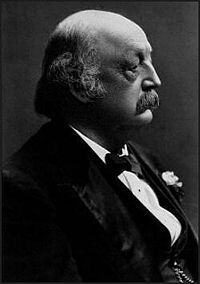
convened a congressional committee to hear testimony from witnesses of Klan atrocities. In February, Congressman Benjamin Franklin Butler
of Massachusetts
introduced his anti-Klan bill, intended to enforce both the Fourteenth Amendment
and the Civil Rights Act of 1866
. Butler's bill was narrowly defeated in the House, whereupon Rep. Samuel Shellabarger
, of Ohio, introduced a substitute bill—only slightly less sweeping than Butler's original. This bill brought a few holdout Republicans into line, and the bill narrowly passed the House, sailed through the Senate and was signed into law on April 20 by President
Ulysses S. Grant
.
was suspended in nine counties in South Carolina. These efforts were so successful that the Klan was destroyed in South Carolina and decimated throughout the rest of the former Confederacy, where it had already been in decline for several years. The Klan was not to exist again until its recreation in 1915, but it had already achieved many of its goals in the South, such as denying voting rights
to Southern blacks.
In its early history, under the Grant Administration, this act was used—along with the Force Act—to bring to justice those who were violating the Civil Rights of newly freed African Americans. After the end of the Grant Administration, and the dismantling of Reconstruction under Rutherford B. Hayes, enforcement of the Act fell into disuse and few cases were brought under the statute for almost a hundred years.
Section 1983 essentially made equitable relief available to those whose constitutional rights had been violated by an actor acting under State authority. Normally constitutional rights violations are remedied by specific performance including injunctions by the courts. For example, if a person's right to due process was violated by a prison guard who was said to be acting under the authority of the state, then that person could bring suit for monetary damages against the prison guard. Without Section 1983, that person would have to seek an injunction by the courts for the due process violation. The problem with such an action by the court is that injunctions cannot apply to past harm, only future harm. So, essentially the person would have an actionable cause-the constitutional violation-with no adequate remedy. Most Section 1983 claims are brought against prison officials by prisoners, but prisoner claims are usually dismissed as being without merit. Claims can be brought by anyone stating a proper cause of action.
Circumstances changed in 1961 when the Supreme Court of the United States articulated three purposes that underlay the statute: "1) 'to override certain kinds of state
laws'; 2) to provide 'a remedy where state law was inadequate'; and 3) to provide 'a federal remedy where the state remedy, though adequate in theory, was not available in practice.' "
Now the statute stands as one of the most powerful authorities with which state and federal courts may protect those whose rights are deprived. Section 1983 of the Civil Rights Act provides a way individuals can sue to redress violations of federally protected rights, like the First Amendment
rights and the Due Process Clause and the Equal Protection Clause
of the Fourteenth Amendment
of the United States Constitution
. Section 1983 can be used to enforce rights based on the federal Constitution and federal statutes, such as the prohibition of public sector employment discrimination based on race, color, national origin, sex and religion.
In some jurisdictions, 1983 has been applied directly to private employers when litigants have sued under this act. It can also be applied in virtually all jurisdictions in a more indirect manner to private employers if they are acting under state or federal authority. For example, if an additional private security company is hired by the police for an event and are given authority by the police, and, during the event, the security company violates a participant's First Amendment
right, they can be sued under section 1983.
Although some provisions were ruled unconstitutional in 1882, the Force Act and the Klan Act have been invoked in later civil rights conflicts, including the 1964 murders of Chaney, Goodman, and Schwerner
; the 1965 murder of Viola Liuzzo
; and in Bray v. Alexandria Women's Health Clinic
, 506 U.S. 263 (1993), in which the court ruled that "The first clause of 1985(3) does not provide a federal cause of action against persons obstructing access to abortion clinics."
It was also utilized in the 1969 case of Tinker v. Des Moines. By the time Beth Tinker was in school, the law had expanded to make even school boards liable if they stood in the way of people's federally-protected rights.
Today, the Civil Rights Act can be invoked whenever a state or local government official violates a federally guaranteed right. The most common use today is to redress violations of the Fourth Amendment's protection against unreasonable search and seizure. Such lawsuits concern false arrest and police brutality, most notably in the Rodney King case
.
The Act was invoked in the 2010 Robbins v. Lower Merion School District case, where plaintiffs charged two suburban Philadelphia high schools secretly spied on students by surreptitiously and remotely activating webcams embedded in school-issued laptops the students were using at home, violating their right to privacy. The schools admitted to snapping over 66,000 webshots and screenshots secretly, including webcam shots of students in their bedrooms.
American Civil War
The American Civil War was a civil war fought in the United States of America. In response to the election of Abraham Lincoln as President of the United States, 11 southern slave states declared their secession from the United States and formed the Confederate States of America ; the other 25...
, along with the 1870 Force Act
Force Acts
Force Acts can refer to several groups of acts passed by the United States Congress. The term usually refers to the events after the American Civil War.-Andrew Jackson's Tariff Enforcement :The Force Bill, 4 Stat...
. One of the chief reasons for its passage was to protect southern blacks from the Ku Klux Klan
Ku Klux Klan
Ku Klux Klan, often abbreviated KKK and informally known as the Klan, is the name of three distinct past and present far-right organizations in the United States, which have advocated extremist reactionary currents such as white supremacy, white nationalism, and anti-immigration, historically...
by providing a civil remedy for abuses then being committed in the South. The statute has been subject to only minor changes since then, but has been the subject of voluminous interpretation by courts.
This legislation—also known as the Ku Klux Klan Act and formally titled An Act to enforce the Provisions of the Fourteenth Amendment to the Constitution of the United States, and for other Purposes—was asked for by President U.S. Grant, and passed within one month of the president's request for it to Congress. Grant's request was as a result of reports he was receiving of widespread racial terrorism in the Deep South, particularly in South Carolina. He felt that he needed to have his authority broadened before he could effectively intervene. After the act's passage, the president had the power for the first time to both suppress state disorders on his own initiative and to suspend the right of habeas corpus
Habeas corpus
is a writ, or legal action, through which a prisoner can be released from unlawful detention. The remedy can be sought by the prisoner or by another person coming to his aid. Habeas corpus originated in the English legal system, but it is now available in many nations...
. Grant did not hesitate to use this authority on numerous occasions during his presidency, and as a result the first era KKK was completely dismantled and did not resurface in any meaningful way until the first part of the 20th century. Several of its provisions still exist today as codified statutes, but the most important still-existing provision is .
History
In January 1871, RepublicanRepublican Party (United States)
The Republican Party is one of the two major contemporary political parties in the United States, along with the Democratic Party. Founded by anti-slavery expansion activists in 1854, it is often called the GOP . The party's platform generally reflects American conservatism in the U.S...
Senator John Scott
John Scott (Pennsylvania)
John Scott was an American lawyer and Republican party politician. He served in the Pennsylvania House of Representatives and represented Pennsylvania in the United States Senate....
of Pennsylvania
Pennsylvania
The Commonwealth of Pennsylvania is a U.S. state that is located in the Northeastern and Mid-Atlantic regions of the United States. The state borders Delaware and Maryland to the south, West Virginia to the southwest, Ohio to the west, New York and Ontario, Canada, to the north, and New Jersey to...
convened a congressional committee to hear testimony from witnesses of Klan atrocities. In February, Congressman Benjamin Franklin Butler
Benjamin Franklin Butler (politician)
Benjamin Franklin Butler was an American lawyer and politician who represented Massachusetts in the United States House of Representatives and later served as the 33rd Governor of Massachusetts....
of Massachusetts
Massachusetts
The Commonwealth of Massachusetts is a state in the New England region of the northeastern United States of America. It is bordered by Rhode Island and Connecticut to the south, New York to the west, and Vermont and New Hampshire to the north; at its east lies the Atlantic Ocean. As of the 2010...
introduced his anti-Klan bill, intended to enforce both the Fourteenth Amendment
Fourteenth Amendment to the United States Constitution
The Fourteenth Amendment to the United States Constitution was adopted on July 9, 1868, as one of the Reconstruction Amendments.Its Citizenship Clause provides a broad definition of citizenship that overruled the Dred Scott v...
and the Civil Rights Act of 1866
Civil Rights Act of 1866
The Civil Rights Act of 1866, , enacted April 9, 1866, is a federal law in the United States that was mainly intended to protect the civil rights of African-Americans, in the wake of the American Civil War...
. Butler's bill was narrowly defeated in the House, whereupon Rep. Samuel Shellabarger
Samuel Shellabarger (congressman)
Samuel Shellabarger was a U.S. Representative from Ohio.Born near Enon, Ohio, Shellabarger attended the county schools and was graduated from Miami University, Oxford, Ohio, in 1841.He studied law....
, of Ohio, introduced a substitute bill—only slightly less sweeping than Butler's original. This bill brought a few holdout Republicans into line, and the bill narrowly passed the House, sailed through the Senate and was signed into law on April 20 by President
President of the United States
The President of the United States of America is the head of state and head of government of the United States. The president leads the executive branch of the federal government and is the commander-in-chief of the United States Armed Forces....
Ulysses S. Grant
Ulysses S. Grant
Ulysses S. Grant was the 18th President of the United States as well as military commander during the Civil War and post-war Reconstruction periods. Under Grant's command, the Union Army defeated the Confederate military and ended the Confederate States of America...
.
Use during Reconstruction
Under the Klan Act during Reconstruction, federal troops were used rather than state militias to enforce the law, and Klansmen were prosecuted in federal court, where juries were often predominantly black. Hundreds of Klan members were fined or imprisoned, and habeas corpusHabeas corpus
is a writ, or legal action, through which a prisoner can be released from unlawful detention. The remedy can be sought by the prisoner or by another person coming to his aid. Habeas corpus originated in the English legal system, but it is now available in many nations...
was suspended in nine counties in South Carolina. These efforts were so successful that the Klan was destroyed in South Carolina and decimated throughout the rest of the former Confederacy, where it had already been in decline for several years. The Klan was not to exist again until its recreation in 1915, but it had already achieved many of its goals in the South, such as denying voting rights
Voting rights in the United States
The issue of voting rights in the United States has been contentious throughout the country's history. Eligibility to vote in the U.S. is determined by both Federal and state law. Currently, only citizens can vote in U.S. elections . Who is a citizen is governed on a national basis by Federal law...
to Southern blacks.
In its early history, under the Grant Administration, this act was used—along with the Force Act—to bring to justice those who were violating the Civil Rights of newly freed African Americans. After the end of the Grant Administration, and the dismantling of Reconstruction under Rutherford B. Hayes, enforcement of the Act fell into disuse and few cases were brought under the statute for almost a hundred years.
As Later Amended and Placed in U.S. Code as Section 1983
now reads:- Every person who under color of any statute, ordinance, regulation, custom, or usage, of any State or Territory or the District of Columbia, subjects, or causes to be subjected, any citizen of the United States or other person within the jurisdiction thereof to the deprivation of any rights, privileges, or immunities secured by the Constitution and laws, shall be liable to the party injured in an action at law, Suit in equity, or other proper proceeding for redress, except that in any action brought against a judicial officer for an act or omission taken in such officer's judicial capacity, injunctive relief shall not be granted unless a declaratory decree was violated or declaratory relief was unavailable. For the purposes of this section, any Act of Congress applicable exclusively to the District of Columbia shall be considered to be a statute of the District of Columbia.
Section 1983 essentially made equitable relief available to those whose constitutional rights had been violated by an actor acting under State authority. Normally constitutional rights violations are remedied by specific performance including injunctions by the courts. For example, if a person's right to due process was violated by a prison guard who was said to be acting under the authority of the state, then that person could bring suit for monetary damages against the prison guard. Without Section 1983, that person would have to seek an injunction by the courts for the due process violation. The problem with such an action by the court is that injunctions cannot apply to past harm, only future harm. So, essentially the person would have an actionable cause-the constitutional violation-with no adequate remedy. Most Section 1983 claims are brought against prison officials by prisoners, but prisoner claims are usually dismissed as being without merit. Claims can be brought by anyone stating a proper cause of action.
Circumstances changed in 1961 when the Supreme Court of the United States articulated three purposes that underlay the statute: "1) 'to override certain kinds of state
U.S. state
A U.S. state is any one of the 50 federated states of the United States of America that share sovereignty with the federal government. Because of this shared sovereignty, an American is a citizen both of the federal entity and of his or her state of domicile. Four states use the official title of...
laws'; 2) to provide 'a remedy where state law was inadequate'; and 3) to provide 'a federal remedy where the state remedy, though adequate in theory, was not available in practice.' "
Now the statute stands as one of the most powerful authorities with which state and federal courts may protect those whose rights are deprived. Section 1983 of the Civil Rights Act provides a way individuals can sue to redress violations of federally protected rights, like the First Amendment
First Amendment to the United States Constitution
The First Amendment to the United States Constitution is part of the Bill of Rights. The amendment prohibits the making of any law respecting an establishment of religion, impeding the free exercise of religion, abridging the freedom of speech, infringing on the freedom of the press, interfering...
rights and the Due Process Clause and the Equal Protection Clause
Equal Protection Clause
The Equal Protection Clause, part of the Fourteenth Amendment to the United States Constitution, provides that "no state shall ... deny to any person within its jurisdiction the equal protection of the laws"...
of the Fourteenth Amendment
Fourteenth Amendment to the United States Constitution
The Fourteenth Amendment to the United States Constitution was adopted on July 9, 1868, as one of the Reconstruction Amendments.Its Citizenship Clause provides a broad definition of citizenship that overruled the Dred Scott v...
of the United States Constitution
United States Constitution
The Constitution of the United States is the supreme law of the United States of America. It is the framework for the organization of the United States government and for the relationship of the federal government with the states, citizens, and all people within the United States.The first three...
. Section 1983 can be used to enforce rights based on the federal Constitution and federal statutes, such as the prohibition of public sector employment discrimination based on race, color, national origin, sex and religion.
In some jurisdictions, 1983 has been applied directly to private employers when litigants have sued under this act. It can also be applied in virtually all jurisdictions in a more indirect manner to private employers if they are acting under state or federal authority. For example, if an additional private security company is hired by the police for an event and are given authority by the police, and, during the event, the security company violates a participant's First Amendment
First Amendment to the United States Constitution
The First Amendment to the United States Constitution is part of the Bill of Rights. The amendment prohibits the making of any law respecting an establishment of religion, impeding the free exercise of religion, abridging the freedom of speech, infringing on the freedom of the press, interfering...
right, they can be sued under section 1983.
Although some provisions were ruled unconstitutional in 1882, the Force Act and the Klan Act have been invoked in later civil rights conflicts, including the 1964 murders of Chaney, Goodman, and Schwerner
Mississippi civil rights worker murders
The Mississippi civil rights workers murders involved the lynching of three political activists in Neshoba County, Mississippi on June 21, 1964, during the American Civil Rights Movement....
; the 1965 murder of Viola Liuzzo
Viola Liuzzo
Viola Fauver Gregg Liuzzo was a Unitarian Universalist civil rights activist from Michigan, who was murdered by Ku Klux Klan members after the 1965 Selma to Montgomery marches in Alabama...
; and in Bray v. Alexandria Women's Health Clinic
Bray v. Alexandria Women's Health Clinic
Bray v. Alexandria Women's Health Clinic, was a United States abortion rights case , which affirmed that Ku Klux Klan Act of 1871 could not be used to halt blockades of abortion clinics.-See also:...
, 506 U.S. 263 (1993), in which the court ruled that "The first clause of 1985(3) does not provide a federal cause of action against persons obstructing access to abortion clinics."
It was also utilized in the 1969 case of Tinker v. Des Moines. By the time Beth Tinker was in school, the law had expanded to make even school boards liable if they stood in the way of people's federally-protected rights.
Today, the Civil Rights Act can be invoked whenever a state or local government official violates a federally guaranteed right. The most common use today is to redress violations of the Fourth Amendment's protection against unreasonable search and seizure. Such lawsuits concern false arrest and police brutality, most notably in the Rodney King case
Rodney King
Rodney Glen King is an American best known for his involvement in a police brutality case involving the Los Angeles Police Department on March 3, 1991...
.
The Act was invoked in the 2010 Robbins v. Lower Merion School District case, where plaintiffs charged two suburban Philadelphia high schools secretly spied on students by surreptitiously and remotely activating webcams embedded in school-issued laptops the students were using at home, violating their right to privacy. The schools admitted to snapping over 66,000 webshots and screenshots secretly, including webcam shots of students in their bedrooms.
External links
- Text of Civil Rights Act of 1871 as codified- 42 U.S. Code 21 §§1983, 1988
- 18 U.S.C. § 242 is "the criminal analog of 1983."