

.gif)
Chuo Line (Rapid)

Encyclopedia
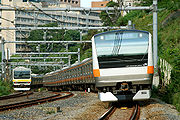
Chuo Main Line
The , commonly called the Chūō Line, is one of the major trunk railway lines in Japan. It runs between Tokyo and Nagoya, although it is the slowest direct railway connection between the two cities; the coastal Tōkaidō Main Line is slightly faster, while the Tōkaidō Shinkansen is the fastest rail...
operated by the East Japan Railway Company
East Japan Railway Company
is the largest passenger railway company in the world and one of the seven Japan Railways Group companies. The company name is officially abbreviated as JR East in English, and as in Japanese. The company's headquarters are in Yoyogi, Shibuya, Tokyo....
(JR East) between and stations.
Basic data
- Operator: East Japan Railway CompanyEast Japan Railway Companyis the largest passenger railway company in the world and one of the seven Japan Railways Group companies. The company name is officially abbreviated as JR East in English, and as in Japanese. The company's headquarters are in Yoyogi, Shibuya, Tokyo....
(Services and tracks)- Tokyo – Takao: 53.1 km (33 mi)
- GaugeRail gaugeTrack gauge or rail gauge is the distance between the inner sides of the heads of the two load bearing rails that make up a single railway line. Sixty percent of the world's railways use a standard gauge of . Wider gauges are called broad gauge; smaller gauges, narrow gauge. Break-of-gauge refers...
: - Stations: 24
- Double-tracked section: Entire line
- Electrification: 1,500 V DC
- Railway signallingRailway signallingRailway signalling is a system used to control railway traffic safely, essentially to prevent trains from colliding. Being guided by fixed rails, trains are uniquely susceptible to collision; furthermore, trains cannot stop quickly, and frequently operate at speeds that do not enable them to stop...
: ATSAutomatic Train StopAn automatic train stop is a system on a train that will automatically stop a train if certain situations happened to prevent accidents from happening.... - CTCCentralized traffic controlCentralized traffic control is a form of railway signalling that originated in North America and centralizes train routing decisions that were previously carried out by local signal operators or the train crews themselves. The system consists of a centralized train dispatcher's office that...
center: Tokyo Operations Control Center - Maximum speed: 95 km/h (59 mph)
Services
Although the Chūō Line (Rapid) designation only refers to the section between Tokyo and Takao stations, many trains continue on past Takao to Ōtsuki. These include both limited express and various special rapid services. For details, see the Chūō Main LineChuo Main Line
The , commonly called the Chūō Line, is one of the major trunk railway lines in Japan. It runs between Tokyo and Nagoya, although it is the slowest direct railway connection between the two cities; the coastal Tōkaidō Main Line is slightly faster, while the Tōkaidō Shinkansen is the fastest rail...
article. In addition, Chūō Line (Rapid) trains do not stop at some stations between Ochanomizu and Nakano stations; for information on those services, see the Chūō-Sōbu Line
Chuo-Sobu Line
The is a railway line located in Tokyo and Chiba Prefecture, Japan. Part of the East Japan Railway Company network, it runs on separate tracks along the right-of-way of the Chūō Main Line and Sōbu Main Line , providing service between Mitaka Station in the cities of Mitaka and Musashino and...
article.
The Chūō Line (Rapid) uses the two express tracks on the four-track section between Ochanomizu and Mitaka stations. Past Mitaka, trains use both tracks on the remaining double-track section. Since the express tracks do not have platforms at several stations in central Tokyo, even the slowest services of the Chūō Line (Rapid) skip such stations and are therefore called . In addition to the basic type of "Rapid", there are some variations of the service types with fewer stops.
Rapid
- This service is the most common on the Chūō Line (Rapid) route; they stop at all stations west of except that on weekends and holidays, trains do not stop at , , or stations. The signature color of the rolling stock, station signs and line diagrams is orange (■).
Chūō Special RapidŌme Special Rapid
- Four services per hour in off-peak hours make limited stops between Tokyo and , and stop at all stations west of Tachikawa. Chūō Special Rapid stays on the Chūō Main Line to Takao and Ōtsuki while Ōme Special Rapid spurs to the Ōme LineOme LineThe is a railway line operated by East Japan Railway Company in western Tokyo, Japan. It links Tachikawa and the Chūō Line with the town of Okutama. Many Chūō Line trains operate via the Ōme Line to Ōme Station, providing non-stop service to Tokyo Station....
. The service's signature color on service diagrams is blue (■) for Chūō Special Rapid and green (■) for Ōme Special Rapid.
Commuter Rapid
- Commuter Rapid service operates weekday evening. The service's signature color on service diagrams is purple (■). It stops at Ogikubo and Kichijōji in addition to the stops of Chūō Special Rapid.
Commuter Special Rapid
- Weekday morning services for Tokyo; two from Ōtsuki, two from Ōme and one from Takao. The service's signature color on service diagrams is pink (■).
Chūō/Ōme Liners
The Chūō LinerChuo Liner
The Chūō Liner is a limited-stop reserved-seat "Home Liner" service for commuters on the Chūō Rapid Line operated by East Japan Railway Company . The train operates on weekdays only...
and Ōme Liner
Ome Liner
The Ōme Liner is a limited-stop reserved-seat "Liner" service for commuters on the Chūō Rapid Line and Ōme Line operated by East Japan Railway Company . The train operates on weekdays only...
services run on weekday peak periods only. There is one Chūō Liner from Takao for Tokyo in the morning and six in the evenings from Tokyo for Takao and Hachioji. The Ōme Liner has one service during the morning from Ōme and two in the evening from Tokyo. Unlike other rapid services, the Chūō/Ōme Liners require the purchase of a liner ticket in addition to the base fare; all seats are unreserved, but the number of liner tickets solid is limited to the number of seats available. Liner services are provided by E257 series
E257 series
The is a DC electric multiple unit operated by East Japan Railway Company and built jointly by Hitachi, Kinki Sharyo, and Tokyu Car Corporation...
11-car or 9-car EMUs (introduced in July 2002) and E351 series
E351 series
The is a DC electric multiple unit operated by East Japan Railway Company on Chūō Main Line Super Azusa Limited express services in Japan. First introduced in December 1993 , the trains feature a tilting mechanism...
12-car EMUs (introduced in March 2008).
Chūō Liners stop at: Tokyo - Shinjuku - Hachiōji - (Takao)
Ōme Liners stops at: Tokyo - Shinjuku - Tachikawa - Haijima - Kabe - Ōme
History
Most of the route of the Chūō Line (Rapid) was built by the Kōbu Railway and later acquired by the Japanese Government RailwaysJapanese Government Railways
The Japanese Government Railways was the national railway system directly operated by the central government of Japan until 1949. It is a predecessor of Japanese National Railways and the Japan Railways Group.- Name :...
in 1906.
Operation of electric multiple unit
Electric multiple unit
An electric multiple unit or EMU is a multiple unit train consisting of self-propelled carriages, using electricity as the motive power. An EMU requires no separate locomotive, as electric traction motors are incorporated within one or a number of the carriages...
(EMU) trains on the Chūō Main Line began in 1904. By 1930, the EMU service had reached Tokyo to the east and Asakawa (now Takao) to the west. In 1933, two tracks were added to the existing double-tracked section between Ochanomizu and Iidamachi stations (later closed) to complete the four-track line between Ochanomizu and Nakano. On these additional tracks, , which skipped all stations except Yotsuya and Shinjuku, were introduced the same year. The express service was renamed to service in March 1961.
Initially, the operation of express/rapid services was limited to weekday peak periods only. Express service began on weekends on March 5, 1944; daytime non-peak operation began on November 9, 1959, but it was limited to weekdays only until April 28, 1966.
Manseibashi Station, located between Kanda and Ochanomizu, was closed in 1943. On the section east of Takao, only Nishi-Kokubunji Station (opened in 1973) and Nishi-Hachiōji Station (opened in 1939) were opened after the start of rapid services.
- August 20, 1979: 201 series201 seriesThe is a commuter electric multiple unit train type introduced in 1979 by Japanese National Railways , and currently operated by West Japan Railway Company , and formerly also operated by East Japan Railway Company ....
EMUs introduced - March 16, 1991: Ohayō Liner Takao/Ōme and Home Liner Takao/Ōme begin operation
- April 10, 1993: Kokubunji Station added to Ōme Special Rapid stops; Commuter Special Rapid begins operation
- December 1, 1997: Chūō Main LineChuo Main LineThe , commonly called the Chūō Line, is one of the major trunk railway lines in Japan. It runs between Tokyo and Nagoya, although it is the slowest direct railway connection between the two cities; the coastal Tōkaidō Main Line is slightly faster, while the Tōkaidō Shinkansen is the fastest rail...
-bound 115 series115 seriesThe is a DC electric multiple unit train type developed by Japanese National Railways and now operated by East Japan Railway Company , West Japan Railway Company , and the Shinano Railway.-JR East:...
EMUs no longer service Shinjuku Station - October 5, 2005: Women-only cars introduced
- December 26, 2006: E233 seriesE233 seriesThe is a commuter and suburban electric multiple unit type developed by East Japan Railway Company from the earlier E231 series and the E531 series design...
EMUs introduced
The Chūō Rapid Line is known for a high number of suicides
Suicide in Japan
Suicide in Japan has become a significant problem nationally. Factors in suicide include unemployment , depression, and social pressures. In 2007, the National Police Agency revised the categorization of motives for suicide into a division of 50 reasons with up to three reasons listed for each...
, primarily due to the high speed at which some trains pass through stations on the line.
Station list
- All stations are located in TokyoTokyo, ; officially , is one of the 47 prefectures of Japan. Tokyo is the capital of Japan, the center of the Greater Tokyo Area, and the largest metropolitan area of Japan. It is the seat of the Japanese government and the Imperial Palace, and the home of the Japanese Imperial Family...
. - For information on the Chūō Line west of Takao, please see the Chūō Main LineChuo Main LineThe , commonly called the Chūō Line, is one of the major trunk railway lines in Japan. It runs between Tokyo and Nagoya, although it is the slowest direct railway connection between the two cities; the coastal Tōkaidō Main Line is slightly faster, while the Tōkaidō Shinkansen is the fastest rail...
article. - Information on the AzusaAzusa (train)The and are limited express services operated by East Japan Railway , which run between Shinjuku and Matsumoto via the Chūō Main Line and Shinonoi Line.The name Azusa is taken from the Azusa River in Matsumoto, Nagano.-Azusa:-Super Azusa:...
, KaijiKaiji (train)The is a limited express train service in Japan operated by East Japan Railway Company . It runs mainly between Shinjuku Station in Tokyo and Kōfu Station in Kōfu, Yamanashi via the Chūō Main Line.-Kaiji:Shinjuku - Kōfu...
, and other limited express and seasonal trains can be found on their respective pages.
Legend
- ●・○: All trains stop (○: mornings and evenings only)
- |: All trains pass
- ◆: All trains pass on weekends and holidays
- ◇: Outbound trains originating from Shinjuku pass
- ∥: Trains do not run over this section of track
| Name | Japanese | Distance (km) | Rapid | Comm. Rapid |
Special Rapid |
Ōme Special Rapid |
Comm. Special Rapid |
Chūō /Ōme Liners |
Transfers | Location | |
|---|---|---|---|---|---|---|---|---|---|---|---|
| Between Stations |
Total | ||||||||||
| 東京 | - | 0.0 | ● | ● | ● | ● | ● | ● | Tōhoku Shinkansen Tohoku Shinkansen The is a Japanese high-speed Shinkansen rail line, connecting Tokyo with Aomori in Aomori Prefecture for a total length of 674 km, Japan's longest Shinkansen line. It runs through the more sparsely populated Tōhoku region of Japan's main island Honshu. It has two spur lines, Yamagata... , Jōetsu Shinkansen Joetsu Shinkansen The is a high-speed railway line connecting Tokyo and Niigata, Japan, via the Tōhoku Shinkansen, operated by the East Japan Railway Company .-History:The program was initiated in 1971 by Niigata-born prime minister Tanaka Kakuei... , Nagano Shinkansen Nagano Shinkansen The is a Shinkansen high-speed rail line operated by East Japan Railway Company between Takasaki and Nagano in Japan. It opened on 1 October 1997, connecting Tokyo and Nagano in time for the 1998 Winter Olympics held in Nagano... , Yamanote Line Yamanote Line The is commuter rail loop line in Tokyo, Japan, operated by East Japan Railway Company . It is one of Tokyo's busiest and most important lines, connecting most of Tokyo's major stations and urban centres, including the Yūrakuchō/Ginza area, Shibuya, Shinjuku, and Ikebukuro, with all but two of its... , Keihin-Tōhoku Line Keihin-Tohoku Line The , is a railway line in Japan which connects the cities of Saitama, Kawaguchi, Tokyo, Kawasaki, and Yokohama. It is part of the East Japan Railway Company network. The line's name is derived from the characters for , and the... , Tōkaidō Line, Sōbu Line (Rapid) Sobu Line (Rapid) The is a railway service on the Sōbu Main Line in Tokyo and Chiba Prefecture, Japan. It connects in Chūō, Tokyo and in Chūō-ku, Chiba via the cities of Ichikawa, Funabashi, and Narashino... , Yokosuka Line Yokosuka Line The is a railway line in Japan operated by the East Japan Railway Company .The Yokosuka Line connects in Chūō, Tokyo and in Yokosuka, Kanagawa... , Keiyō Line Keiyo Line The is a railway line connecting Tokyo and Chiba, Japan, running mainly along the edge of Tokyo Bay. It is operated by the East Japan Railway Company .It provides the main rail access to the Tokyo Disney Resort and the Makuhari Messe exhibition center... Tōkaidō Shinkansen Tokyo Metro Marunouchi Line (M-17) |
Chiyoda Chiyoda, Tokyo is one of the 23 special wards in central Tokyo, Japan. In English, it is called Chiyoda ward. As of October 2007, the ward has an estimated population of 45,543 and a population density of 3,912 people per km², making it by far the least populated of the special wards... |
|
| 神田 | 1.3 | 1.3 | ● | ● | ● | ● | ● | | | Yamanote Line, Keihin-Tōhoku Line Tokyo Metro Ginza Line Tokyo Metro Ginza Line The is a subway line located in Tokyo, Japan. It is part of the of Tokyo Metro network. The official name is . It is 14.3 km long and serves the wards of Shibuya, Minato, Chūō, Chiyoda, and Taitō.... (G-13) |
||
| 御茶ノ水 | 1.3 | 2.6 | ● | ● | ● | ● | ● | | | Chūō-Sōbu Line (Local) Chuo-Sobu Line The is a railway line located in Tokyo and Chiba Prefecture, Japan. Part of the East Japan Railway Company network, it runs on separate tracks along the right-of-way of the Chūō Main Line and Sōbu Main Line , providing service between Mitaka Station in the cities of Mitaka and Musashino and... Tokyo Metro Marunouchi Line (M-20), Tokyo Metro Chiyoda Line (C-12) |
||
| 四ツ谷 | 0.8 | 6.6 | ● | ● | ● | ● | ● | | | Chūō-Sōbu Line (Local) Tokyo Metro Marunouchi Line (M-12), Tokyo Metro Namboku Line Tokyo Metro Namboku Line The is a subway line owned and operated by Tokyo Metro in Tokyo, Japan. Its name literally means South-North Line. The line runs between Meguro in Shinagawa and Akabane-Iwabuchi in Kita... (N-08) |
Shinjuku Shinjuku, Tokyo is one of the 23 special wards of Tokyo, Japan. It is a major commercial and administrative center, housing the busiest train station in the world and the Tokyo Metropolitan Government Building, the administration center for the government of Tokyo.As of 2008, the ward has an estimated population... |
|
| 新宿 | 0.7 | 10.3 | ● | ● | ● | ● | ● | ● | Yamanote Line, Chūō-Sōbu Line (Local), Saikyō Line Saikyo Line The is a railway line between Ōsaki Station in Shinagawa, Tokyo, and Ōmiya Station in Saitama Prefecture, Japan. It is a part of the East Japan Railway Company network... , Shōnan-Shinjuku Line Shonan-Shinjuku Line The is a passenger railway service in Japan which commenced in December 2001. The line has no dedicated track as services run through shared sections along the Ryōmō Line, Takasaki Line, Utsunomiya Line, Yamanote Freight Line, Yokosuka Line, and Tōkaidō Main Line... Odakyū Odawara Line Keiō Line, Keiō New Line Keio New Line The is a 3.6 km link which connects Keio Corporation's Keiō Line from Sasazuka Station in Shibuya to Shinjuku Station with through service on to the Shinjuku Line of the Tokyo Metropolitan Bureau of Transportation.-Synopsis:... Tokyo Metro Marunouchi Line (M-08) Toei Shinjuku Line Toei Shinjuku Line The is a subway line in Tokyo and Chiba Prefecture, Japan, operated by Tokyo Metropolitan Bureau of Transportation . The line runs between Motoyawata Station in Ichikawa, Chiba in the east and Shinjuku Station in the west... (S-01), Toei Ōedo Line Toei Oedo Line The is a subway line in Tokyo, Japan operated by the Tokyo Metropolitan Bureau of Transportation . It commenced full operations on December 12, 2000; using the Japanese calendar this reads "12/12/12" as the year 2000 equals Heisei 12... (E-01, E-27) Seibu Shinjuku Line |
||
| 中野 | 1.9 | 14.7 | ● | ● | ◇ | ● | | | | | Tokyo Metro Tōzai Line Tokyo Metro Tozai Line The is a rapid transit line owned and operated by Tokyo Metro located in Tokyo and Chiba Prefecture, Japan. Its name literally means East-West Line. The line runs between Nakano Station in Nakano, Tokyo and Nishi-Funabashi Station in Funabashi, Chiba... (T-01) |
Nakano Nakano, Tokyo is one of the 23 special wards of Tokyo, Japan. In English, it calls itself Nakano City .As of April 1, 2011, the ward has an estimated population of 311,690 with a household number of 176,936 and a density of 19,992.94 persons per km². The total area is 15.59 km².-Geography:Five special wards... |
|
| 高円寺 | 1.4 | 16.1 | ◆ | | | | | | | | | | | Suginami Suginami, Tokyo is one of the 23 special wards of Tokyo, Japan. In English, it calls itself Suginami City.As of April 1, 2011, the ward has an estimated population of 538,703, with 301,277 households, and a density of 15,834.39 persons per km². The total area is 34.02 km².-Geography:Suginami occupies the... |
||
| 阿佐ケ谷 | 1.2 | 17.3 | ◆ | | | | | | | | | | | |||
| 荻窪 | 1.4 | 18.7 | ● | ● | | | | | | | | | Tokyo Metro Marunouchi Line (M-01) | ||
| 西荻窪 | 1.9 | 20.6 | ◆ | | | | | | | | | | | |||
| 吉祥寺 | 1.9 | 22.5 | ● | ● | | | | | | | | | Keiō Inokashira Line | Musashino Musashino, Tokyo is a city located in Tokyo, Japan.As of October 1, 2010, the city has an estimated population of 137,222 and a population density of 12,788.63 persons per km². The total area is 10.73 km².The city was founded on November 3, 1947... |
|
| 三鷹 | 1.6 | 24.1 | ● | ● | ● | ● | | | | | Mitaka Mitaka, Tokyo is a city located in Tokyo, Japan. As of 1 November 2010, the city has an estimated population of 176,737. The total area is 16.50 km² and is about 50 – 55 meters above sea level... |
||
| 武蔵境 | 1.6 | 25.7 | ● | | | | | | | | | | | Seibu Tamagawa Line Seibu Tamagawa Line The Tamagawa Line, or , part of the Seibu Railway system, is an 8.0 km railway line in the western suburbs of Tokyo. The line runs from Musashi-Sakai Station on the Chūō Main Line to Koremasa Station along the Tama River. The line has only six stations and is not connected to any other part of... |
Musashino | |
| 東小金井 | 1.7 | 27.4 | ● | | | | | | | | | | | Koganei Koganei, Tokyo is a city located in Tokyo, Japan. As of July 1, 2011, the city has an officially registered population of 116,055 with 56,296 households and a population density of 10,243.16 persons per km²... |
||
| 武蔵小金井 | 1.7 | 29.1 | ● | | | | | | | | | | | |||
| 国分寺 | 2.3 | 31.4 | ● | ● | ● | ● | ● | | | Seibu Kokubunji Line, Seibu Tamako Line | Kokubunji Kokubunji, Tokyo is a city in Tokyo, Japan.As of 1 June 2008, the city has an estimated population of 117,335 . The total area is 11.48 km²... |
|
| 西国分寺 | 1.4 | 32.8 | ● | | | | | | | | | | | Musashino Line Musashino Line The is a railway line operated by the East Japan Railway Company . It links Tsurumi Station in Yokohama with Nishi-Funabashi Station in Chiba Prefecture, forming a 100.6 km unclosed loop around central Tokyo... |
||
| 国立 | 1.7 | 34.5 | ● | | | | | | | | | | | Kunitachi Kunitachi, Tokyo is a city located in the western part of the metropolitan area of Tokyo, Japan. As of October 1, 2010, the city has an estimated population of 74,623.- History :Kunitachi was founded on January 1, 1967... |
||
| 立川 | 3.0 | 37.5 | ● | ● | ● | ● | ● | ● | Ōme Line Ome Line The is a railway line operated by East Japan Railway Company in western Tokyo, Japan. It links Tachikawa and the Chūō Line with the town of Okutama. Many Chūō Line trains operate via the Ōme Line to Ōme Station, providing non-stop service to Tokyo Station.... (some trains through to/from Tokyo), Nambu Line Nambu Line The is a Japanese railway line which connects Tachikawa Station in Tachikawa, Tokyo and Kawasaki Station in Kawasaki, Kanagawa Prefecture. For most of its length, it parallels the Tama River, the natural border between Tokyo and Kanagawa prefectures. It is part of the East Japan Railway Company ... Tama Toshi Monorail Line Tama Toshi Monorail Line The , also referred to as the Tama Monorail, is an important part of the Western Tokyo public transport network.Operated by Tokyo Tama Intercity Monorail Co., Ltd., the double tracked, 16.0 km monorail line carries passengers between the suburban cities of Higashiyamato and Tama via Tachikawa,... |
Tachikawa Tachikawa, Tokyo is a city located in western Tokyo, Japan.As of February 1, 2010, the city has an estimated population of 178,064 and the density of 7,303.69 people per km². The total area is 24.38 km²... |
|
| 日野 | 3.3 | 40.8 | ● | ● | ● | Through to/ from Ōme Line Ome Line The is a railway line operated by East Japan Railway Company in western Tokyo, Japan. It links Tachikawa and the Chūō Line with the town of Okutama. Many Chūō Line trains operate via the Ōme Line to Ōme Station, providing non-stop service to Tokyo Station.... |
| | | | Hino Hino, Tokyo is a city located in central Tokyo Metropolis, Japan. As of 2010, the city has an estimated population of 182,092 and a population density of 6,610 persons per km². The total area was 27.53 km².-Geography:... |
||
| 豊田 | 2.3 | 43.1 | ● | ● | ● | | | | | ||||
| 八王子 | 4.3 | 47.4 | ● | ● | ● | ● | ● | Yokohama Line, Hachikō Line Hachiko Line The is a 92.0 km regional railway line owned and operated by East Japan Railway Company . It is located within Tokyo, Saitama, and Gunma Prefectures in Japan. Its endpoints are Hachiōji Station in Hachiōji, Tokyo and Kuragano Station in Takasaki, Gunma Prefecture.-Services:Komagawa Station in... Keiō Line |
Hachiōji Hachioji, Tokyo is a city located in Tokyo, Japan, about 40 kilometers west of the center of the special wards of Tokyo.As of January 1, 2010, the city has an estimated population of 551,901 and a population density of 2,962.27/km². The total area is 186.31 km². It is the eighth largest city in the... |
||
| 西八王子 | 2.4 | 49.8 | ● | ● | ● | | | | | ||||
| 高尾 | 3.3 | 53.1 | ● | ● | ● | ● | ● | Chūō Main Line Chuo Main Line The , commonly called the Chūō Line, is one of the major trunk railway lines in Japan. It runs between Tokyo and Nagoya, although it is the slowest direct railway connection between the two cities; the coastal Tōkaidō Main Line is slightly faster, while the Tōkaidō Shinkansen is the fastest rail... (some trains through to ) Keiō Takao Line |
|||
Rolling stock
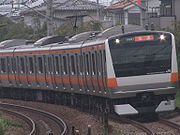
- E233 seriesE233 seriesThe is a commuter and suburban electric multiple unit type developed by East Japan Railway Company from the earlier E231 series and the E531 series design...
(from December 2006)
Chūō Liner / Ōme Liner
- E257 seriesE257 seriesThe is a DC electric multiple unit operated by East Japan Railway Company and built jointly by Hitachi, Kinki Sharyo, and Tokyu Car Corporation...
(from July 2002) - E351 seriesE351 seriesThe is a DC electric multiple unit operated by East Japan Railway Company on Chūō Main Line Super Azusa Limited express services in Japan. First introduced in December 1993 , the trains feature a tilting mechanism...
(from March 15, 2008)
Rolling stock used in past
- 72 series
- 101 series101 seriesThe is a commuter EMU introduced in 1958 by Japanese National Railways , and formerly operated by East Japan Railway Company and West Japan Railway Company . The last remaining trains were withdrawn in November 2003.-History:...
- 103 series103 seriesThe is a commuter electric multiple unit type introduced in 1964 by Japanese National Railways , and currently operated by West Japan Railway Company and Kyushu Railway Company . They were also operated by East Japan Railway Company and Central Japan Railway Company .-Prototype:Built in 1963...
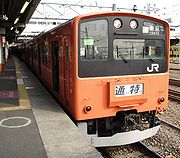
- 201 series201 seriesThe is a commuter electric multiple unit train type introduced in 1979 by Japanese National Railways , and currently operated by West Japan Railway Company , and formerly also operated by East Japan Railway Company ....
Chūō Liner / Ōme Liner
- 183 series183 seriesThe is a limited express EMU introduced in 1972 by Japanese National Railways , and currently operated by East Japan Railway Company and West Japan Railway Company...
(March 14, 1991 - March 14, 2008)