

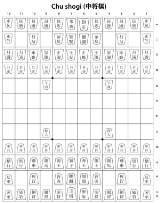
Chu shogi

Encyclopedia
Chū shōgi is a board game
native to Japan
. It is similar to modern shogi
(sometimes called Japanese chess) in its rules and game play. Its name means "mid-sized shogi", from a time when there were three sizes of shogi variant
s in regular use. Chu shogi seems to have been developed in the early 14th century as a derivative of dai shogi
("large shogi"). There are earlier references, but it is not clear that they refer to the game as we now know it. With fewer pieces than dai shogi, the game was considered more exciting. It was still commonly played in Japan in the early 20th century, especially in Kyoto
, but now has largely died out. It has, however, gained some adherents in the West. The main reference work in English is the Middle Shogi Manual by George Hodges.
board.
Each player has a set of 46 pieces of 21 different types, and each piece has its name written on it in Japanese kanji
. The writing is typically in black. On the reverse side of most pieces there are characters to indicate the piece's promoted rank, typically written in red. The pieces are wedge-shaped
and their orientation indicates which player they belong to, as they point toward the opposing side. The pieces are of slightly different sizes; from largest to smallest (most to least powerful) they are:
Listed below are the pieces of the game and, if they promote, the pieces they promote to. Names are rough translations that have become somewhat standardized in English. Pieces are listed alphabetically by their English name.
The promotions apply only to pieces which start out with the ranks in the left-most column, that is, pieces with these ranks written in black; promoted pieces with those same ranks written in red may not promote further. Pieces which only appear upon promotion, that is, names which only occur written in red, are marked with an asterisk. The king, free king, and lion do not promote.
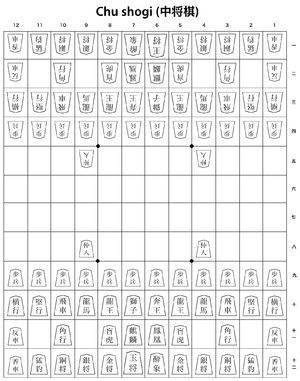
Below is a diagram showing the setup of the players’ pieces. The board setup is symmetrical: the way one player sees their own pieces is the same way that the opposing player sees their pieces.
Many promoting pieces promote to a piece that exists in the initial setup of the board. However, such a promoted piece cannot then promote a second time as its namesake does. For example, a drunk elephant promotes to a crown prince. However, while a go-between can promote to a drunk elephant, it does not further promote to a crown prince later. Rather, it remains a drunk elephant for the rest of the game. This should be obvious from the game pieces, which only have two sides.
Promoting a piece has the effect of changing how that piece moves. See below.
If a pawn or lance reaches the furthest rank, it must promote, since it would otherwise have no legal move on subsequent turns.
Each piece on the game moves in a characteristic pattern. Pieces move either orthogonally (that is, forward, backward, left, or right, in the direction of one of the arms of a plus sign, +), or diagonally (in the direction of one of the arms of a multiplication sign, ×). The lion is the sole exception, in that it is not required to move in a straight line.
As stated earlier, this game is based on dai shogi and all of the pieces of this game can be found in dai shogi. The eight types of pieces that were removed all promoted to gold generals, which made for comparatively dull game play.
If a pawn or lance, which cannot retreat or move aside, advances across the board until it reaches the other side, it must promote.
Many pieces are capable of several kinds of movement, with the type of movement most often depending on the direction in which they move. The movement categories are:
The step movers are the king, drunk elephant, blind tigers, ferocious leopards, the generals, go-betweens, and the 12 pawns of each side. Only the king and crown prince can potentially move in all eight directions.
The ranging pieces are the free king, dragon king, dragon horse, rook, bishop, vertical mover, side mover, reverse chariot, lance, and all those pieces which do not appear in the initial setup. Only the free king can range along all eight directions.
(1) Lion, note on protection: This may involve so-called "hidden protectors". The attacking lion is ignored when determining whether the defending lion is protected. That is, it doesn't matter if the attacking lion blocks the line of protection: if the attacking lion could be captured upon taking the defending lion, then the defending lion is considered to be protected. For example, in the diagram below, the black lion is directly protected by the black pawn, so, since the two lions are not adjacent, red cannot capture black. Similarly, even though the black lion occupies the line of protection between the red bishop and the red lion, it could be captured by the red bishop if it were to take the red lion, so it is not allowed to do so. (This is the case even if the red bishop is tied down protecting the red king, and would not actually be used to capture the black lion.)
, and effectively wins the game.
Unlike Western chess, a player need not move out of check in chu shogi, and indeed may even move into check. Although obviously not often a good idea, a player with more than one royal may occasionally sacrifice one of these pieces as part of a gambit
.
A player is not allowed to give perpetual check
. This is not a rule in itself, but arises from the repetition rule.
A player who makes an illegal move loses immediately. (This rule may be relaxed in casual games.)
The imbalance created by this method of handicapping is not as strong as it is in international chess because material advantage is not as powerful in chu shogi as it is in chess.
The handicaps detailed in the Middle Shogi Manual, in increasing order of size, are as follows:
Other handicaps may be used, such as Free King, or Free King and Dragon King.
, but modifications have been made for chu shogi.
A typical example is p-8f. The first letter represents the piece moved (see setup above). Promoted pieces have a + added in front of the letter, for example +p for a tokin (promoted pawn). The designation of the piece is followed by a symbol indicating the type of move: - for an ordinary move or x for a capture.
Next is the designation for the square on which the piece lands. This consists of a number representing the file and a lowercase letter representing the rank, with 1a being the top right corner (as seen from Black's point of view) and 12l being the bottom left corner. (This method of designating squares is based on Japanese convention, which, however, uses Japanese numerals
instead of letters. For example, the square 2c is denoted by 2三 in Japanese.)
If a move entitles the player to promote the piece, then a + is added to the end to signify that the promotion was taken, or an = to indicate that it was declined.
For example, px7d= indicates a pawn capturing on 7d without promoting.
In cases where the above notation would be ambiguous, the designation of the start square is added after the designation for the piece in order to make clear which piece is meant.
When a 'Lion', 'Horned Falcon' or 'Soaring Eagle' captures by 'igui' (that is, without moving), the square of the piece being captured is used instead of the destination square, and this is preceded by the symbol '!'. For example, a Lion on 8c capturing a piece on 9d would be shown as Lnx!9d.
When a piece makes a double capture with 'Lion' powers both captures are shown in the order that they were made. For example, a Lion on 3g, capturing a piece on 3h and then capturing another on 2i, would be represented by Lnx3hx2i.
Moves are commonly numbered as in chess.
One modern variant of Chu Shogi, called Heisei Chu Shogi (平成中将棋), is played on a more open board. Forty percent of the pieces are set aside at setup and held in reserve, and once during the game a player may drop one of these on an empty square adjacent to a friendly piece. Captured pieces do not come back into play, and the rest of the game is played as in regular Chu.
The set-aside pieces are the Lances, Coppers, Silvers, Side Movers, Vertical Movers, Reverse Chariots, Kyrin, and Phoenix. As with dropped pieces in standard shogi, the piece may not be dropped on a square from where it cannot move (e.g. a Lance in the far rank). If dropped into the promotion zone, the piece may promote immediately or on any subsequent move in the promotion zone.
Board game
A board game is a game which involves counters or pieces being moved on a pre-marked surface or "board", according to a set of rules. Games may be based on pure strategy, chance or a mixture of the two, and usually have a goal which a player aims to achieve...
native to Japan
Japan
Japan is an island nation in East Asia. Located in the Pacific Ocean, it lies to the east of the Sea of Japan, China, North Korea, South Korea and Russia, stretching from the Sea of Okhotsk in the north to the East China Sea and Taiwan in the south...
. It is similar to modern shogi
Shogi
, also known as Japanese chess, is a two-player board game in the same family as Western chess, chaturanga, and Chinese Xiangqi, and is the most popular of a family of chess variants native to Japan...
(sometimes called Japanese chess) in its rules and game play. Its name means "mid-sized shogi", from a time when there were three sizes of shogi variant
Shogi variant
Many variants of shogi have been developed over the centuries, ranging from some of the largest chess-type games ever played to some of the smallest...
s in regular use. Chu shogi seems to have been developed in the early 14th century as a derivative of dai shogi
Dai shogi
Dai shōgi is a board game native to Japan. It is similar to standard shogi in its rules and game play. Dai shogi is only one of several large board shogi variants. Its name means large shogi, from a time when there were three sizes of shogi games...
("large shogi"). There are earlier references, but it is not clear that they refer to the game as we now know it. With fewer pieces than dai shogi, the game was considered more exciting. It was still commonly played in Japan in the early 20th century, especially in Kyoto
Kyoto
is a city in the central part of the island of Honshū, Japan. It has a population close to 1.5 million. Formerly the imperial capital of Japan, it is now the capital of Kyoto Prefecture, as well as a major part of the Osaka-Kobe-Kyoto metropolitan area.-History:...
, but now has largely died out. It has, however, gained some adherents in the West. The main reference work in English is the Middle Shogi Manual by George Hodges.
Objective
The objective of the game is to capture the opponent's king and, if present, the crown prince, which counts as a second king. Alternatively, if the player has only the king or crown prince, together with an unpromoted gold general, it suffices to capture all the other pieces, leaving a bare king or a bare crown prince, whereupon the player wins and the game ends early. Unlike standard shogi, pieces may not be dropped back into play after capture.Game play
Two players alternate making a move, with Black moving first. (The pieces are not differentiated by color; the traditional chess terms "Black" and "White" are only used to indicate who plays first, and to differentiate the sides during discussions of the game.) A move consists of moving a piece either to an empty square on the board or to a square occupied by an opposing piece, thus capturing that piece; and optionally of promoting the moving piece, if all or part of its move lies in the promotion zone.Game equipment
Two players, Black and White (or 先手 sente and 後手 gote), play on a board ruled into a grid of 12 ranks (rows) and 12 files (columns). The squares are undifferentiated by marking or color, unlike a Western chessChess
Chess is a two-player board game played on a chessboard, a square-checkered board with 64 squares arranged in an eight-by-eight grid. It is one of the world's most popular games, played by millions of people worldwide at home, in clubs, online, by correspondence, and in tournaments.Each player...
board.
Each player has a set of 46 pieces of 21 different types, and each piece has its name written on it in Japanese kanji
Kanji
Kanji are the adopted logographic Chinese characters hanzi that are used in the modern Japanese writing system along with hiragana , katakana , Indo Arabic numerals, and the occasional use of the Latin alphabet...
. The writing is typically in black. On the reverse side of most pieces there are characters to indicate the piece's promoted rank, typically written in red. The pieces are wedge-shaped
Wedge (mechanics)
A wedge is a triangular shaped round tool, a compound and portable inclined plane, and one of the six classical simple machines. It can be used to separate two objects or portions of an object, lift an object, or hold an object in place. It functions by converting a force applied to its blunt end...
and their orientation indicates which player they belong to, as they point toward the opposing side. The pieces are of slightly different sizes; from largest to smallest (most to least powerful) they are:
- 1 King
- 1 Free king
- 1 Lion
- 2 Dragon kings
- 2 Dragon horses
- 2 Rooks
- 2 Bishops
- 1 Kirin
- 1 Phoenix
- 1 Drunk elephant
- 2 Blind tigers
- 2 Ferocious leopards
- 2 Gold generals
- 2 Silver generals
- 2 Copper generals
- 2 Vertical movers
- 2 Side movers
- 2 Reverse Chariots
- 2 Lances
- 2 Go-betweens
- 12 Pawns
Listed below are the pieces of the game and, if they promote, the pieces they promote to. Names are rough translations that have become somewhat standardized in English. Pieces are listed alphabetically by their English name.
The promotions apply only to pieces which start out with the ranks in the left-most column, that is, pieces with these ranks written in black; promoted pieces with those same ranks written in red may not promote further. Pieces which only appear upon promotion, that is, names which only occur written in red, are marked with an asterisk. The king, free king, and lion do not promote.
| Piece name | Kanji Kanji Kanji are the adopted logographic Chinese characters hanzi that are used in the modern Japanese writing system along with hiragana , katakana , Indo Arabic numerals, and the occasional use of the Latin alphabet... |
Romaji | Abbrev. | Promotion |
|---|---|---|---|---|
| bishop | 角行 | kakugyō | 角 | dragon horse |
| blind tiger | 盲虎 | mōko | 虎 | flying stag |
| copper general | 銅将 | dōshō | 銅 | side mover |
| *crown prince | 太子 | taishi | 太 | (promoted drunk elephant) |
| dragon horse | 龍馬 | ryūma1 | 馬 | horned falcon |
| dragon king Dragon King The four Dragon Kings are, in Chinese mythology, the divine rulers of the four seas . Although Dragon Kings appear in their true forms as dragons, they have the ability to shapeshift into human form... |
龍王 | ryūō | 龍 | soaring eagle |
| drunk elephant | 酔象 | suizō | 象 | crown prince |
| ferocious leopard | 猛豹 | mōhyō | 豹 | bishop |
| *flying ox | 飛牛 | higyū | 牛 | (promoted vertical mover) |
| *flying stag | 飛鹿 | hiroku | 鹿 | (promoted blind tiger) |
| *free boar | 奔猪 | honcho | 猪 | (promoted side mover) |
| free king | 奔王 | honnō1 | 奔 | |
| go-between | 仲人 | chūnin | 仲 | drunk elephant |
| gold general | 金将 | kinshō | 金 | rook |
| *horned falcon | 角鷹 | kakuō | 鷹 | (promoted dragon horse) |
| king (challenging) | 玉将 | gyokushō | 玉 | |
| king (reigning) | 王将 | ōshō | 王 | |
| kirin Qilin The Qilin is a mythical hooved Chinese chimerical creature known throughout various East Asian cultures, and is said to appear with the imminent arrival or passing of a wise sage or an illustrious ruler. It is a good omen that brings rui . It is often depicted with what looks like fire all over... |
麒麟 | kirin | 麒 | lion |
| lance | 香車 | kyōsha | 香 | white horse |
| lion | 獅子 | shishi | 獅 | |
| pawn | 歩兵 | fuhyō | 歩 | tokin (gold general2) |
| phoenix Fenghuang Fenghuang are mythological birds of East Asia that reign over all other birds. The males are called Feng and the females Huang. In modern times, however, such a distinction of gender is often no longer made and the Feng and Huang are blurred into a single feminine entity so that the bird can be... |
鳳凰 | hōō | 鳳 | free king |
| reverse chariot | 反車 | hensha1 | 反 | whale |
| rook | 飛車 | hisha | 飛 | dragon king |
| side mover | 横行 | ōgyō | 横 | free boar |
| silver general | 銀将 | ginshō | 銀 | vertical mover |
| *soaring eagle | 飛鷲 | hijū | 鷲 | (promoted dragon king) |
| *tokin2 | と金 | tokin | と | (promoted pawn) |
| vertical mover | 竪行 | shugyō | 竪 | flying ox |
| *whale | 鯨鯢 | keigei | 鯨 | (promoted reverse chariot) |
| *white horse White Horse Temple White Horse Temple is, according to tradition, the first Buddhist temple in China, established in 68 AD under the patronage of Emperor Ming in the Eastern Han capital Luoyang. Today the site is located just outside the walls of the ancient Eastern Han capital, some east of Luoyang in Henan... |
白駒 | hakku1 | 駒 | (promoted lance) |
- 1 The names of 龍馬, 奔王, 反車, and 白駒 are irregular. The regular forms ryūme, hon’ō, hansha, and hakuku are also seen.
- 2 In many accounts of chu shogi, a pawn is described as promoting to gold; the special name tokin for a promoted pawn is in these descriptions restricted to standard shogi. Note that this is simply a naming convention and makes no difference in the movement of the piece.
Below is a diagram showing the setup of the players’ pieces. The board setup is symmetrical: the way one player sees their own pieces is the same way that the opposing player sees their pieces.
| 12 | 11 | | 10 | | 9 | | 8 | | 7 | | 6 | | 5 | | 4 | | 3 | | 2 | | 1 | | |
|---|---|---|---|---|---|---|---|---|---|---|---|---|
| L | FL | C | S | G | DE | K | G | S | C | FL | L | a |
| RC | B | BT | Ph | Kr | BT | B | RC | b | ||||
| SM | VM | R | DH | DK | FK | Ln | DK | DH | R | VM | SM | c |
| p | p | p | p | p | p | p | p | p | p | p | p | d |
| GB | GB | e | ||||||||||
| f | ||||||||||||
| g | ||||||||||||
| GB | GB | h | ||||||||||
| p | p | p | p | p | p | p | p | p | p | p | p | i |
| SM | VM | R | DH | DK | Ln | FK | DK | DH | R | VM | SM | j |
| RC | B | BT | Kr | Ph | BT | B | RC | k | ||||
| L | FL | C | S | G | K | DE | G | S | C | FL | L | l |
|
|
|
Promotion
The promotion zone is the 'enemy camp', the farthest four ranks of the board, which are mostly occupied by the opposing player's pieces when the board is first set up. When a promotable piece makes a move within the promotion zone—including entering, leaving, or moving entirely within the zone,—it has the option of "promoting" to a more powerful rank. Promotion is effected by turning the piece over after it moves, revealing the name of its promoted rank. Promotion is not mandatory if the unpromoted piece could move further on a later turn, and in some cases it may be beneficial to leave the piece unpromoted. Promotion is permanent and promoted pieces may not revert to their original rank. If a piece is not promoted upon entering the promotion zone, then it may not promote on the next turn unless it makes a capture, with the exception of pawns: If a pawn does not promote once entering the promotion zone, then it may not promote until it reaches the farthest rank.Many promoting pieces promote to a piece that exists in the initial setup of the board. However, such a promoted piece cannot then promote a second time as its namesake does. For example, a drunk elephant promotes to a crown prince. However, while a go-between can promote to a drunk elephant, it does not further promote to a crown prince later. Rather, it remains a drunk elephant for the rest of the game. This should be obvious from the game pieces, which only have two sides.
Promoting a piece has the effect of changing how that piece moves. See below.
If a pawn or lance reaches the furthest rank, it must promote, since it would otherwise have no legal move on subsequent turns.
Piece movement
An opposing piece is captured by displacement: That is, if a piece moves to a square occupied by an opposing piece, the opposing piece is displaced and removed from the board. A piece cannot move to a square occupied by a friendly piece, that is, by another piece controlled by the moving player.Each piece on the game moves in a characteristic pattern. Pieces move either orthogonally (that is, forward, backward, left, or right, in the direction of one of the arms of a plus sign, +), or diagonally (in the direction of one of the arms of a multiplication sign, ×). The lion is the sole exception, in that it is not required to move in a straight line.
As stated earlier, this game is based on dai shogi and all of the pieces of this game can be found in dai shogi. The eight types of pieces that were removed all promoted to gold generals, which made for comparatively dull game play.
If a pawn or lance, which cannot retreat or move aside, advances across the board until it reaches the other side, it must promote.
Many pieces are capable of several kinds of movement, with the type of movement most often depending on the direction in which they move. The movement categories are:
Step movers
Some pieces move only one square at a time. If a friendly piece occupies an adjacent square, the moving piece may not move in that direction; if an opposing piece is there, it may be displaced and captured.The step movers are the king, drunk elephant, blind tigers, ferocious leopards, the generals, go-betweens, and the 12 pawns of each side. Only the king and crown prince can potentially move in all eight directions.
Jumping pieces
Several pieces can jump, that is, they can pass over any intervening piece, whether friend or foe, with no effect on either. These are the lion, the kirin, the phoenix, the horned falcon and the soaring eagle. Only the lion can jump in all directions.Ranging pieces
Many pieces can move any number of empty squares along a straight orthogonal or diagonal line, limited only by the edge of the board. If an opposing piece intervenes, it may be captured by moving to that square and removing it from the board. A ranging piece must stop where it captures, and cannot bypass a piece that is in its way. If a friendly piece intervenes, the moving piece is limited to a distance that stops short of the intervening piece; if the friendly piece is adjacent, it cannot move in that direction at all.The ranging pieces are the free king, dragon king, dragon horse, rook, bishop, vertical mover, side mover, reverse chariot, lance, and all those pieces which do not appear in the initial setup. Only the free king can range along all eight directions.
Lion move (multiple capture)
The lion has a double-capture ability, called a 'lion move', as to a lesser extent do the soaring eagle and horned falcon (promoted dragon king and dragon horse). The details of these powerful moves are described for the lion below.Individual pieces
Following are diagrams that indicate the movement of each piece. Pieces are listed roughly in order, from front to back rows, with pieces making similar moves paired. Pieces with a grey heading start out in the game; those with a blue heading only appear on the board as a promoted piece.| Notation | |
| ○ | Steps to an adjacent square |
| ☆ | Jumps to a non-adjacent square, bypassing any intervening piece |
| │ | Ranges along a straight line, crossing any number of empty squares |
| ─ | |
| \ | |
| / | |
| ! | igui (capture without moving) |
| Go-Between 仲人 chūnin (promotes to drunk elephant) | Pawn 歩兵 fuhyō (promotes to tokin) | |||
| er="1" class="wikitable" align="right" style="margin: 10px; width:107px; font-size:95%"> | ||||
| ○ | ||||
| 仲 | ||||
| ○ | ||||
- Step
- The go-between steps one square directly forward or backward.
er="1" class="wikitable" align="right" style="margin: 10px; width:107px; font-size:95%"> ○ 歩 - Step
- The pawn can only step one square directly forward.
- It must promote upon reaching the farthest rank of the board.
Side Mover 横行 ōgyō (promotes to free boar) Vertical Mover 竪行 shugyō (promotes to flying ox) er="1" class="wikitable" align="right" style="margin: 10px; width:107px; font-size:95%"> ○ ─ ─ 横 ─ ─ ○ - Range
- The side mover can move any number of free squares orthogonally sideways; or,
- Step
- It can step one square directly forward or backward.
er="1" class="wikitable" align="right" style="margin: 10px; width:107px; font-size:95%"> │ │ ○ 竪 ○ │ │ - Range
- The vertical mover can move any number of free squares orthogonally, either forward or backward; or,
- Step
- It can take one step directly sideways.
Bishop 角行 kakugyō (promotes to dragon horse) Rook 飛車 hisha (promotes to dragon king) er="1" class="wikitable" align="right" style="margin: 10px; width:107px; font-size:95%"> \ / \ / 角 / \ / \ - Range
- The bishop can move any number of free squares along any one of the four diagonals.
- Because it cannot move orthogonally, an unpromoted bishop can only reach half the squares on the board.
er="1" class="wikitable" align="right" style="margin: 10px; width:107px; font-size:95%"> │ │ ─ ─ 飛 ─ ─ │ │ - Range
- The rook can move any number of free squares along any one of the four orthogonals.
Dragon Horse 龍馬 ryūma (promotes to horned falcon) Dragon King 龍王 ryūō (promotes to soaring eagle) er="1" class="wikitable" align="right" style="margin: 10px; width:107px; font-size:95%"> \ / \ ○ / ○ 馬 ○ / ○ \ / \ - Range
- The dragon horse can move any number of free squares along any one of the four diagonals; or,
- Step
- It can take one step in any direction.
er="1" class="wikitable" align="right" style="margin: 10px; width:107px; font-size:95%"> │ ○ │ ○ ─ ─ 龍 ─ ─ ○ │ ○ │ - Range
- The dragon king can move any number of free squares along any one of the four orthogonals; or,
- Step
- It can take one step in any direction.
Lance 香車 kyōsha (promotes to white horse) Reverse Chariot 反車 hensha (promotes to whale) er="1" class="wikitable" align="right" style="margin: 10px; width:107px; font-size:95%"> │ │ 香 - Range
- The lance can move any number of free squares directly forward. It cannot return and must promote upon reaching the farthest row.
er="1" class="wikitable" align="right" style="margin: 10px; width:107px; font-size:95%"> │ │ 反 │ │ - Ranging
- The reverse chariot can move any number of free squares directly forward or backward.
Blind Tiger 盲虎 mōko (promotes to flying stag) Ferocious Leopard 猛豹 mōhyō (promotes to bishop) er="1" class="wikitable" align="right" style="margin: 10px; width:107px; font-size:95%"> ○ ○ ○ 虎 ○ ○ ○ ○ - Step
- The blind tiger can take one step in any direction except directly forward.
er="1" class="wikitable" align="right" style="margin: 10px; width:107px; font-size:95%"> ○ ○ ○ 豹 ○ ○ ○ - Step
- The ferocious leopard can take one step to any of the three squares ahead or three squares behind it, but not directly to either side.
Copper General 銅将 dōshō (promotes to side mover) Silver General 銀将 ginshō (promotes to vertical mover) er="1" class="wikitable" align="right" style="margin: 10px; width:107px; font-size:95%"> ○ ○ ○ 銅 ○ - Step
- The copper general can take one step to any of the three squares ahead of it, or else directly backward, giving it four possibilities.
er="1" class="wikitable" align="right" style="margin: 10px; width:107px; font-size:95%"> ○ ○ ○ 銀 ○ ○ - Step
- The silver general can take one step diagonally, or else directly forward, giving it five possibilities.
Gold General 金将 kinshō (promotes to rook)
Promoted Pawn と金 tokinDrunk Elephant 酔象suizō (promotes to crown prince) er="1" class="wikitable" align="right" style="margin: 10px; width:107px; font-size:95%"> ○ ○ ○ ○ 金 ○ ○ - Step
- The gold general can take one step orthogonally, one else step diagonally forward, giving it six possibilities. The promoted pawn has a different symbol in some game sets, but moves identically.
er="1" class="wikitable" align="right" style="margin: 10px; width:107px; font-size:95%"> ○ ○ ○ ○ 象 ○ ○ ○ - The drunk elephant can take one step in any direction except directly backward.
Kirin 麒麟 kirin (promotes to lion) Phoenix 鳳凰 hōō (promotes to free king) er="1" class="wikitable" align="right" style="margin: 10px; width:107px; font-size:95%"> ☆ ○ ○ ☆ 麒 ☆ ○ ○ ☆ - Jump
- The drunk elephant can take one step in any direction except directly backward.
- The kirin can jump to the second square in one of the four orthogonal directions. Or,
- Step
- It can take one step diagonally.
- Because of its unusual movement, an unpromoted kirin can only reach half the squares on the board.
er="1" class="wikitable" align="right" style="margin: 10px; width:107px; font-size:95%"> ☆ ☆ ○ ○ 鳳 ○ ○ ☆ ☆ - Jump
- The phoenix can jump to the second square in one of the four diagonal directions. Or,
- Step
- It can take one step orthogonally.
Free King 奔王 honnō Flying Stag 飛鹿 hiroku (promoted blind tiger) er="1" class="wikitable" align="right" style="margin: 10px; width:107px; font-size:95%"> \ │ / \ │ / ─ ─ 奔 ─ ─ / │ \ / │ \ - Range
- The free king can move any number of free squares along any one of the eight orthogonal or diagonal directions.
er="1" class="wikitable" align="right" style="margin: 10px; width:107px; font-size:95%"> │ ○ │ ○ ○ 鹿 ○ ○ │ ○ │ - Range
- The flying stag can move any number of free squares directly forward or backward; or,
- Step
- It can take one step in any direction.
Flying Ox 飛牛 higyū (promoted vertical mover) Free Boar 奔猪 honcho (promoted side mover) er="1" class="wikitable" align="right" style="margin: 10px; width:107px; font-size:95%"> \ │ / \ │ / 牛 / │ \ / │ \ - Range
- The flying ox can move any number of free squares forwards, backwards, or diagonally, but not directly to the side.
er="1" class="wikitable" align="right" style="margin: 10px; width:107px; font-size:95%"> \ / \ / ─ ─ 猪 ─ ─ / \ / \ - Range
- The free boar can move any number of free squares diagonally or to the side, but not directly forward or backward.
Whale 鯨鯢 keigei (promoted reverse chariot) White Horse 白駒 hakku (promoted lance) er="1" class="wikitable" align="right" style="margin: 10px; width:107px; font-size:95%"> │ │ 鯨 / │ \ / │ \ - Range
- The whale can move any number of free squares directly forwards, backwards, or along either rear diagonal.
er="1" class="wikitable" align="right" style="margin: 10px; width:107px; font-size:95%"> \ │ / \ │ / 駒 │ │ - Range
- The white horse can move any number of free squares directly backwards, forwards, or along either forward diagonal.
King 玉将 gyokushō, 王将 ōshō Crown Prince 太子 taishi (promoted drunk elephant) er="1" class="wikitable" align="right" style="margin: 10px; width:107px; font-size:95%"> ○ ○ ○ ○ 王 ○ ○ ○ ○ - Step
- The king can take one step in any direction.
er="1" class="wikitable" align="right" style="margin: 10px; width:107px; font-size:95%"> ○ ○ ○ ○ 太 ○ ○ ○ ○ - Step
- The crown prince can take one step in any direction, like a king.
- If a crown prince is in play, it must be captured along with the king.
-
- The next three pieces have special movements that involve the ability to move and even capture twice per turn.
| Horned Falcon 角鷹 kakuō (promoted dragon horse) | Soaring Eagle 飛鷲 hijū (promoted dragon king) | |||
| er="1" class="wikitable" align="right" style="margin: 10px; width:107px; font-size:95%"> | ||||
| \ | ☆ | / | ||
| \ | ! | / | ||
| ─ | ─ | 鷹 | ─ | ─ |
| / | │ | \ | ||
| / | │ | \ |
- Range
- The horned falcon can move any number of free squares along a straight line in any direction except directly forwards.
- Lion move
- It can step or jump up to two squares along a line directly forward, potentially capturing two pieces. This power includes igui and skipping a turn (see "Lion"), but not moving off the orthogonal.
er="1" class="wikitable" align="right" style="margin: 10px; width:107px; font-size:95%"> ☆ │ ☆ ! │ ! ─ ─ 鷲 ─ ─ / │ \ / │ \ - Range
- The soaring eagle can move any number of free squares along a straight line in any direction except the forward diagonals.
- Lion move
- It can step or jump up to two squares along either forward diagonal, potentially capturing two pieces. This power includes igui and skipping a turn (see "Lion"), but not moving off the diagonal.
Lion 獅子 shishi
- Area move/double capture
- The lion can take a step in any direction up to twice per turn. It can continue after a capture on the first step, potentially capturing two pieces per turn. It can change directions after the first step, so that it can reach the squares that a knight jumps to in Western chess.
By returning to its starting square with the second step, it can effectively capture a piece on an adjacent square without moving. This is called 居喰い igui "stationary feeding". It can step to an adjacent empty square and back without capturing anything; this leaves the board unchanged, effectively passing a turn (jitto). Jitto may prove useful in endgame situations; it is traditionally indicated by tapping the lion and leaving it in place.
- Jump
- The lion can jump anywhere that it could step to on an empty board; that is, anywhere within a distance of two squares. This is equivalent to jumping in any of the eight diagonal or orthogonal directions, or making any of the jumps of a knight in Western chess.
- Lion vs. lion
- Some game rules state that a lion cannot capture another lion unless certain criteria are met. These rules are designed to keep the lions in play:
- A lion can always capture an adjacent lion.
- It can always capture a non-adjacent lion (on a "☆" square) that is unprotected.(1)
- It may only capture a non-adjacent protected lion if it first captures another piece so that it is then adjacent (double capture), and then only if the other piece is something other than a pawn or go-between.
- Finally, if one player captures a lion with a non-lion, the opponent cannot then capture a lion on the next move with anything but another lion (as a player may have such a second lion by promoting a kirin), and this may only be done if the rules listed above are met.
(1) Lion, note on protection: This may involve so-called "hidden protectors". The attacking lion is ignored when determining whether the defending lion is protected. That is, it doesn't matter if the attacking lion blocks the line of protection: if the attacking lion could be captured upon taking the defending lion, then the defending lion is considered to be protected. For example, in the diagram below, the black lion is directly protected by the black pawn, so, since the two lions are not adjacent, red cannot capture black. Similarly, even though the black lion occupies the line of protection between the red bishop and the red lion, it could be captured by the red bishop if it were to take the red lion, so it is not allowed to do so. (This is the case even if the red bishop is tied down protecting the red king, and would not actually be used to capture the black lion.)
| 獅 | ||||
| 獅 | ||||
| 歩 | ||||
| 角 |
Check and mate
When a player makes a move such that the opponent's only remaining royal (king or crown prince) could be captured on the following move, the move is said to give check; the king or crown prince is said to be in check. If a player's king or crown prince is in check and no legal move by that player will get it out of check, the checking move is also mateCheckmate
Checkmate is a situation in chess in which one player's king is threatened with capture and there is no way to meet that threat. Or, simply put, the king is under direct attack and cannot avoid being captured...
, and effectively wins the game.
Unlike Western chess, a player need not move out of check in chu shogi, and indeed may even move into check. Although obviously not often a good idea, a player with more than one royal may occasionally sacrifice one of these pieces as part of a gambit
Gambit
A gambit is a chess opening in which a player, most often White, sacrifices material, usually a pawn, with the hope of achieving a resulting advantageous position. Some well-known examples are the King's Gambit , Queen's Gambit , and Evans Gambit...
.
A player is not allowed to give perpetual check
Perpetual check
In the game of chess, perpetual check is a situation in which one player can force a draw by an unending series of checks. Such a situation typically arises when the player who is checking cannot deliver checkmate; while failing to continue the series of checks gives the opponent at least a chance...
. This is not a rule in itself, but arises from the repetition rule.
Repetition
A player may not make a move if the resulting position is one that has previously occurred in the game with the same player to move. Note that certain pieces have the ability to pass in certain situations (a Lion, when at least one square immediately adjacent to it is unoccupied, a Horned Falcon, when the square immediately in front of it is unoccupied, and a Soaring Eagle, when one or both of the two squares immediately diagonally in front of it are unoccupied). Such a pass move leaves the position unchanged, but it does not violate the repetition rule, as it will now be the turn of the other player to move. Of course, two consecutive passes are not possible, as the first player will see the same position as before.Game end
A player who captures the opponent's sole remaining king or crown prince wins the game. A player who has only one piece left (a bare king or bare crown prince) loses automatically if his opponent has a gold in play which is neither promoted to rook, nor promoted from a pawn—that is, unless he can bare his opponent in the next move (in which case the result is a draw). In practice these winning conditions are rarely fulfilled, as a player will resign when checkmated, as otherwise when loss is inevitable.A player who makes an illegal move loses immediately. (This rule may be relaxed in casual games.)
Handicaps
Games between players of disparate strengths are often played with handicaps. In a handicap game, one or more of White's pieces are removed from the setup—in exchange, a few of White's pieces may be moved up to fill in the gaps and protect the weaker pieces, and White plays first. Lions can also be handicapped by having Black's kirin promoted for a second lion, and, for a third, swapping Black's phoenix for White's kirin and promoting the latter.The imbalance created by this method of handicapping is not as strong as it is in international chess because material advantage is not as powerful in chu shogi as it is in chess.
The handicaps detailed in the Middle Shogi Manual, in increasing order of size, are as follows:
- Copper General
- Silver General
- Blind Tiger
- Ferocious Leopard
- Gold General
- Side Mover
- Vertical Mover
- Rook
- Two Lions
- Two Lions and a Copper General
- Two Lions and a Silver General
- Two Lions and a Ferocious Leopard
- Two Lions and a Gold General
- Two Lions and a Side Mover
- Two Lions and a Vertical Mover
- Three Lions
- Three Lions and One Piece: Three Lions and a Free King
- Three Lions and Two Pieces: Three Lions, a Free King and a Dragon King
- Three Lions and Three Pieces: Three Lions, a Free King, a Dragon King and a Rook
- Three Lions and Four Pieces: Three Lions, a Free King, a Dragon King, a Rook and a Vertical Mover
- Three Lions and Five Pieces: Three Lions, a Free King, a Dragon King, a Rook, a Vertical Mover and a Side Mover
Other handicaps may be used, such as Free King, or Free King and Dragon King.
Game notation
The method used in English-language texts to express shogi moves was established by George Hodges in 1976. It is derived from the algebraic notation used for chessAlgebraic chess notation
Algebraic notation is a method for recording and describing the moves in a game of chess. It is now standard among all chess organizations and most books, magazines, and newspapers...
, but modifications have been made for chu shogi.
A typical example is p-8f. The first letter represents the piece moved (see setup above). Promoted pieces have a + added in front of the letter, for example +p for a tokin (promoted pawn). The designation of the piece is followed by a symbol indicating the type of move: - for an ordinary move or x for a capture.
Next is the designation for the square on which the piece lands. This consists of a number representing the file and a lowercase letter representing the rank, with 1a being the top right corner (as seen from Black's point of view) and 12l being the bottom left corner. (This method of designating squares is based on Japanese convention, which, however, uses Japanese numerals
Japanese numerals
The system of Japanese numerals is the system of number names used in the Japanese language. The Japanese numerals in writing are entirely based on the Chinese numerals and the grouping of large numbers follow the Chinese tradition of grouping by 10,000...
instead of letters. For example, the square 2c is denoted by 2三 in Japanese.)
If a move entitles the player to promote the piece, then a + is added to the end to signify that the promotion was taken, or an = to indicate that it was declined.
For example, px7d= indicates a pawn capturing on 7d without promoting.
In cases where the above notation would be ambiguous, the designation of the start square is added after the designation for the piece in order to make clear which piece is meant.
When a 'Lion', 'Horned Falcon' or 'Soaring Eagle' captures by 'igui' (that is, without moving), the square of the piece being captured is used instead of the destination square, and this is preceded by the symbol '!'. For example, a Lion on 8c capturing a piece on 9d would be shown as Lnx!9d.
When a piece makes a double capture with 'Lion' powers both captures are shown in the order that they were made. For example, a Lion on 3g, capturing a piece on 3h and then capturing another on 2i, would be represented by Lnx3hx2i.
Moves are commonly numbered as in chess.
Variations
| 12 | 11 | | 10 | | 9 | | 8 | | 7 | | 6 | | 5 | | 4 | | 3 | | 2 | | 1 | | |
|---|---|---|---|---|---|---|---|---|---|---|---|---|
| FL | G | DE | K | G | FL | a | ||||||
| B | BT | BT | B | b | ||||||||
| R | DH | DK | FK | Ln | DK | DH | R | c | ||||
| p | p | p | p | p | p | p | p | p | p | p | p | d |
| GB | GB | e | ||||||||||
| f | ||||||||||||
| g | ||||||||||||
| GB | GB | h | ||||||||||
| p | p | p | p | p | p | p | p | p | p | p | p | i |
| R | DH | DK | Ln | FK | DK | DH | R | j | ||||
| B | BT | BT | B | k | ||||||||
| FL | G | K | DE | G | FL | l |
One modern variant of Chu Shogi, called Heisei Chu Shogi (平成中将棋), is played on a more open board. Forty percent of the pieces are set aside at setup and held in reserve, and once during the game a player may drop one of these on an empty square adjacent to a friendly piece. Captured pieces do not come back into play, and the rest of the game is played as in regular Chu.
The set-aside pieces are the Lances, Coppers, Silvers, Side Movers, Vertical Movers, Reverse Chariots, Kyrin, and Phoenix. As with dropped pieces in standard shogi, the piece may not be dropped on a square from where it cannot move (e.g. a Lance in the far rank). If dropped into the promotion zone, the piece may promote immediately or on any subsequent move in the promotion zone.
External links
- Chu Shogi page
- Chu Shogi strategy etc.
- German Chu Shogi Association (GCSA) with many reports and games to replay online
- Presentation of Chu Shogi
- SDIN Chu Shogi - Play Chu Shogi in real time vs human players or AI
- Chess Variants Game Courier - Play Chu Shogi via web page, with email notifications when it's your move.
- Richard's Play-by-eMail Server - Play Chu Shogi via web page or email your commands to the server, with email notifications when moves have been made in the game you're playing