

Choragiew

Encyclopedia
Polish cavalry
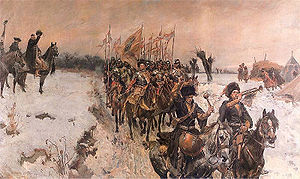
The Polish cavalry can trace its origins back to the days of Medieval mounted knights. Poland had always been a country of flatlands and fields and mounted forces operate well in this environment...
from the 14th century. An alternative name until the 17th century was Rota
Rota (formation)
Rotte or Rota is an infantry or cavalry unit. In Poland it was known increasingly from the 16th century by the alternative name of Chorągiew....
.
The name may derive from Slavic word Khorugv
Khorugv
Khorúgv , is a religious banner used liturgically in the Eastern Catholic and Eastern Orthodox Churches.The khorugv or banner consists of an icon of Christ, the Theotokos or a saint, either painted or embroidered on a rectangular piece of cloth. The cloth will often be pointed, swallow-tailed, or...
(banner).
Between the 14th and 17th century the Chorągiew was composed of smaller sub-units - the so-called Poczet
Poczet
Poczet was the smallest organized unit of soldiers in Kingdom of Poland and Polish-Lithuanian Commonwealth from the 15th until the 18th century. The name of a medium or heavy-cavalry soldiers in poczet was pocztowy.In the cavalry, each poczet was commanded by a towarzysz husarski or towarzysz...
.
Types of Chorągiew were:
- Chorągiew ziemska (District banner), formed by knights of a district.
- Chorągiew rodowa (Clan banner), formed by clansPolish heraldryPolish heraldry is a branch of heraldry focused on studying the development of coats of arms in the lands of historical Poland , as well as specifically-Polish traits of heraldry. The term is also used to refer to Polish heraldic system, as opposed to systems used elsewhere, notably in Western Europe...
. - Chorągiew nadworna (Court banner), formed by troops of the King.
In the cavalry, since the second half of the 15th century until the first half of the 18th century, a Chorągiew was formed according to the "companion system" (system zaciągu towarzyskiego). See: Towarzysz
Towarzysz
A Towarzysz was sort of a junior cavalry officer or rather knight-officer in the autorament narodowy Polish-Lithuanian Commonwealth National army, both in cavalry and infantry, from the 16th century until 1794 AD....
(companion).
Types of Chorągiew were:
- Chorągiew husarska (Hussar banner), formed by HussarsTowarzysz husarskiTowarzysz husarski or Husarz , was the name of a type of heavy cavalryman in Poland....
. - Chorągiew lekka ("Light" banner), formed by light-cavalry.
- Chorągiew pancerna ("Armoured" banner), formed by Pancerni.
- Chorągiew tatarska (Tatar banner), formed by TatarsTatarsTatars are a Turkic speaking ethnic group , numbering roughly 7 million.The majority of Tatars live in the Russian Federation, with a population of around 5.5 million, about 2 million of which in the republic of Tatarstan.Significant minority populations are found in Uzbekistan, Kazakhstan,...
. - Chorągiew wołoska (Vlach banner), light cavalry, not only formed by VlachsVlachsVlach is a blanket term covering several modern Latin peoples descending from the Latinised population in Central, Eastern and Southeastern Europe. English variations on the name include: Walla, Wlachs, Wallachs, Vlahs, Olahs or Ulahs...
. - Chorągiew kozacka (Cossack banner), formed by Cossacks.
Typical family/village clans of the Chorągiew Rodowa who provided men for battles consisting of approximately 100 men were:
- Topór, Dołęga and Gryf