

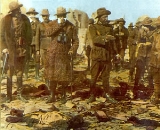
Chemical weapons in the Rif War

Encyclopedia
During the Third Rif War
in Spanish Morocco
between 1921 and 1927, the Spanish Army of Africa
dropped chemical warfare agents in an attempt to put down the Rif
fian Berber
rebellion
led by guerrilla leader Abd el-Krim.
These attacks in 1924 marked the first time mustard gas was dropped by airplanes, a year before the Geneva Protocol
for "the Prohibition of the Use in War of Asphyxiating, Poisonous or other Gases, and of Bacteriological Methods of Warfare" was signed. The gas used in these attacks was produced by the "Fabrica Nacional de Productos Quimicos" at La Marañosa
near Madrid
; a plant founded with significant assistance from Hugo Stoltzenberg
, a chemist associated with the German government's clandestine chemical warfare activities in the early 1920s who was later given Spanish citizenship.
, like Pedro Tonda Bueno in his autobiography La vida y yo (Life and I), published in 1974, talked about dropping toxic gases from airplanes and the consequent poisoning of the Rif fields. Likewise, Ignacio Hidalgo de Cisneros
, in his autobiographical work Cambio de rumbo (Course change), reveals how he was with several chemical attacks. Years later, in 1990, two German journalists and investigators, Rudibert Kunz
and Rolf-Dieter Müller
, in their work Giftgas Gegen Abd El Krim: Deutschland, Spanien und der Gaskrieg in Spanisch-marokko, 1922-1927 (Poison Gas against Abd El Krim: Germany, Spain and the Gas War in Spanish Morocco, 1922-1927), proved with scientific tests that chemical attacks had indeed occurred. The British historian Sebastian Balfour
, of the London School of Economics
, in his book Deadly Embrace, confirmed massive use of chemical arms after having studied numerous Spanish, French and British archives. According to his research, the strategy of the Spanish military was to choose highly populated zones as targets. Additional evidence is found in a telegram from a British official, H. Pughe Lloyd, sent to the British Minister of War.
, the motivation for the chemical attacks was based primarily on revenge for the defeat of the Spanish Army of Africa
and their Moroccan recruits the Regulares
at the Battle of Annual on July 22, 1921.
The Spanish defeat, the Disaster of Annual with 13,000 Spanish and colonial soldiers dead according to the official count, led to a major political crisis and a redefinition of Spanish colonial policy toward the Rif
region. The political crisis led Indalecio Prieto
to say in the Congress of Deputies: "We are at the most acute period of Spanish decadence. The campaign in Africa is a total failure, absolute, without extenuation, of the Spanish Army."
The Minister of War ordered the creation of an investigative commission, directed by the respected general Juan Picasso González
, which eventually developed the Expediente Picasso report. Despite identifying numerous military mistakes, it did not, owing to obstructions raised by various ministers and judges, go so far as to lay political responsibility for the defeat. Popular opinion widely blamed King Alfonso XIII who, according to several sources, encouraged General Manuel Fernández Silvestre
's irresponsible penetration of positions far from Melilla
without having adequate defenses in his rear.
Even before the use of chemical weapons, the Spanish Army commonly resorted to brutal methods of repression, which in some cases included decapitation, after its initial defeats in the Second Rif War of 1909
.
, diphosgene
, chloropicrin
and mustard gas (known as Iperita). Common targets were civilian populations, markets, and rivers. In a telegram sent by the High Commissioner
of Spanish Morocco
Dámaso Berenguer
on August 12, 1921 to the Spanish minister of War, Berenguer stated:
On August 20, 1921, Spain asked Germany to deliver mustard gas via Hugo Stoltzenberg
, although Germany was prohibited from manufacturing such weapons by the Treaty of Versailles
of 1919. The first delivery occurred in 1923. The use of chemical weapons against the Rif was first described in an article of a (now defunct) Francophone daily newspaper published in Tangier
called La Dépêche marocaine
dated on November 27, 1921. Historian Juan Pando
has been the only Spanish historian to have confirmed the usage of mustard gas starting in 1923. Spanish newspaper La Correspondencia de España published an article called Cartas de un soldado (Letters of a soldier) on August 16, 1923 which backed the usage of mustard gas.
According to military aviation general Hidalgo de Cisneros in his autobiographical book Cambio de rumbo, he was the first warfighter to drop a 100-kilogram mustard gas bomb from his Farman F60 Goliath aircraft in the summer of 1924. About 127 fighters and bombers flew in the campaign, dropping around 1,680 bombs each day. Thirteen of these planes were stationed in the military air base of Seville. The mustard gas bombs were brought from the stockpiles of Germany and delivered to Melilla
before being carried on Farman F60 Goliath airplanes.
region. However, no scientific study has proven to date the relationship between the usage of chemical weapons and the high rate of cancer
in the area.
) passed a bill to the Spanish Congress of Deputies requesting Spain to acknowledge the "systematic" use of chemical weapons against the population of the Rif mountains. The bill was rejected by 33 votes from the governing Socialist Labor Party
and the opposition right-wing Popular Party
who form the majority in the Spanish parliament.
Rif War (1920)
The Rif War, also called the Second Moroccan War, was fought between Spain and the Moroccan Rif Berbers.-Rifian forces:...
in Spanish Morocco
Spanish Morocco
The Spanish protectorate of Morocco was the area of Morocco under colonial rule by the Spanish Empire, established by the Treaty of Fez in 1912 and ending in 1956, when both France and Spain recognized Moroccan independence.-Territorial borders:...
between 1921 and 1927, the Spanish Army of Africa
Spanish Army of Africa
The Army of Africa was a Spanish field army that garrisoned Spanish Morocco from the early 20th century until Morocco's independence in 1956....
dropped chemical warfare agents in an attempt to put down the Rif
Rif
The Rif or Riff is a mainly mountainous region of northern Morocco, with some fertile plains, stretching from Cape Spartel and Tangier in the west to Ras Kebdana and the Melwiyya River in the east, and from the Mediterranean Sea in the north to the river of Wergha in the south.It is part of the...
fian Berber
Berber people
Berbers are the indigenous peoples of North Africa west of the Nile Valley. They are continuously distributed from the Atlantic to the Siwa oasis, in Egypt, and from the Mediterranean to the Niger River. Historically they spoke the Berber language or varieties of it, which together form a branch...
rebellion
Rebellion
Rebellion, uprising or insurrection, is a refusal of obedience or order. It may, therefore, be seen as encompassing a range of behaviors aimed at destroying or replacing an established authority such as a government or a head of state...
led by guerrilla leader Abd el-Krim.
These attacks in 1924 marked the first time mustard gas was dropped by airplanes, a year before the Geneva Protocol
Geneva Protocol
The Protocol for the Prohibition of the Use in War of Asphyxiating, Poisonous or other Gases, and of Bacteriological Methods of Warfare, usually called the Geneva Protocol, is a treaty prohibiting the first use of chemical and biological weapons. It was signed at Geneva on June 17, 1925 and entered...
for "the Prohibition of the Use in War of Asphyxiating, Poisonous or other Gases, and of Bacteriological Methods of Warfare" was signed. The gas used in these attacks was produced by the "Fabrica Nacional de Productos Quimicos" at La Marañosa
La Marañosa
La Marañosa is a locality of Madrid, Spain. Its hills overlook both banks of the Jarama river.The locality is known for being home of The "Fabrica Nacional de Productos Quimicos" which supplied the Spanish Army of Africa with chemical warfare agents during the Rif rebellion between 1923 and...
near Madrid
Madrid
Madrid is the capital and largest city of Spain. The population of the city is roughly 3.3 million and the entire population of the Madrid metropolitan area is calculated to be 6.271 million. It is the third largest city in the European Union, after London and Berlin, and its metropolitan...
; a plant founded with significant assistance from Hugo Stoltzenberg
Hugo Stoltzenberg
Hugo Gustav Adolf Stoltzenberg was a German chemist associated with the German government's clandestine chemical warfare activities in the early 1920s....
, a chemist associated with the German government's clandestine chemical warfare activities in the early 1920s who was later given Spanish citizenship.
Researches and revelations
The Spanish bombings were covered up but some observers of military aviationMilitary aviation
Military aviation is the use of aircraft and other flying machines for the purposes of conducting or enabling warfare, including national airlift capacity to provide logistical supply to forces stationed in a theater or along a front. Air power includes the national means of conducting such...
, like Pedro Tonda Bueno in his autobiography La vida y yo (Life and I), published in 1974, talked about dropping toxic gases from airplanes and the consequent poisoning of the Rif fields. Likewise, Ignacio Hidalgo de Cisneros
Ignacio Hidalgo de Cisneros
Ignacio Hidalgo de Cisneros y López de Montenegro was a Spanish General of the Spanish Air Force.-References and notes:...
, in his autobiographical work Cambio de rumbo (Course change), reveals how he was with several chemical attacks. Years later, in 1990, two German journalists and investigators, Rudibert Kunz
Rudibert Kunz
Rudibert Kunz is a German investigator, journalist and television editor.Kunz is known for being the first journalist to write about the use Chemical weapons in the Rif War. Since 1979, he has been researching the history of weapons of mass destruction...
and Rolf-Dieter Müller
Rolf-Dieter Müller
Rolf-Dieter Müller is a German military historian and political scientist, who has served as Scientific Director of the German Armed Forces Military History Research Office since 1999....
, in their work Giftgas Gegen Abd El Krim: Deutschland, Spanien und der Gaskrieg in Spanisch-marokko, 1922-1927 (Poison Gas against Abd El Krim: Germany, Spain and the Gas War in Spanish Morocco, 1922-1927), proved with scientific tests that chemical attacks had indeed occurred. The British historian Sebastian Balfour
Sebastian Balfour
Sebastian Balfour is an English historian and Professor Emeritus of Contemporary Spanish Studies at the London School of Economics.-References:* - London School of Economics...
, of the London School of Economics
London School of Economics
The London School of Economics and Political Science is a public research university specialised in the social sciences located in London, United Kingdom, and a constituent college of the federal University of London...
, in his book Deadly Embrace, confirmed massive use of chemical arms after having studied numerous Spanish, French and British archives. According to his research, the strategy of the Spanish military was to choose highly populated zones as targets. Additional evidence is found in a telegram from a British official, H. Pughe Lloyd, sent to the British Minister of War.
Background
According to Sebastian BalfourSebastian Balfour
Sebastian Balfour is an English historian and Professor Emeritus of Contemporary Spanish Studies at the London School of Economics.-References:* - London School of Economics...
, the motivation for the chemical attacks was based primarily on revenge for the defeat of the Spanish Army of Africa
Spanish Army of Africa
The Army of Africa was a Spanish field army that garrisoned Spanish Morocco from the early 20th century until Morocco's independence in 1956....
and their Moroccan recruits the Regulares
Regulares
The Fuerzas Regulares Indígenas , known simply as the Regulares , were the volunteer infantry and cavalry units of the Spanish Army recruited in Spanish Morocco. They consisted of Moroccans officered by Spaniards...
at the Battle of Annual on July 22, 1921.
The Spanish defeat, the Disaster of Annual with 13,000 Spanish and colonial soldiers dead according to the official count, led to a major political crisis and a redefinition of Spanish colonial policy toward the Rif
Rif
The Rif or Riff is a mainly mountainous region of northern Morocco, with some fertile plains, stretching from Cape Spartel and Tangier in the west to Ras Kebdana and the Melwiyya River in the east, and from the Mediterranean Sea in the north to the river of Wergha in the south.It is part of the...
region. The political crisis led Indalecio Prieto
Indalecio Prieto
Indalecio Prieto Tuero was a Spanish politician, one of the leading figures of the Spanish Socialist Workers' Party in the years before and during the Second Spanish Republic.-Early years:...
to say in the Congress of Deputies: "We are at the most acute period of Spanish decadence. The campaign in Africa is a total failure, absolute, without extenuation, of the Spanish Army."
The Minister of War ordered the creation of an investigative commission, directed by the respected general Juan Picasso González
Juan Picasso González
Juan Picasso González was a Spanish military man and general who participated in the Rif Wars with the Spanish Army of Africa in late 19th century and early 20th century...
, which eventually developed the Expediente Picasso report. Despite identifying numerous military mistakes, it did not, owing to obstructions raised by various ministers and judges, go so far as to lay political responsibility for the defeat. Popular opinion widely blamed King Alfonso XIII who, according to several sources, encouraged General Manuel Fernández Silvestre
Manuel Fernández Silvestre
Manuel Fernández Silvestre y Patinga and Pantiga was a Spanish military general.He was the son of the lieutenant colonel of artillery Victor Fernandez and of Doña Eleuteria Silvestre...
's irresponsible penetration of positions far from Melilla
Melilla
Melilla is a autonomous city of Spain and an exclave on the north coast of Morocco. Melilla, along with the Spanish exclave Ceuta, is one of the two Spanish territories located in mainland Africa...
without having adequate defenses in his rear.
Even before the use of chemical weapons, the Spanish Army commonly resorted to brutal methods of repression, which in some cases included decapitation, after its initial defeats in the Second Rif War of 1909
Rif War (1909)
The Second Melillan campaign was a conflict in 1909 and 1910 in Morocco around Melilla. The fighting involved local Rifains and the Spanish Army.- Prelude :...
.
The use of the chemical agents
Spain was one of the first powers to use chemical weapons against civilian populaces in their use against the Rif rebellion. Between 1921 and 1927, the Spanish army indiscriminately used phosgenePhosgene
Phosgene is the chemical compound with the formula COCl2. This colorless gas gained infamy as a chemical weapon during World War I. It is also a valued industrial reagent and building block in synthesis of pharmaceuticals and other organic compounds. In low concentrations, its odor resembles...
, diphosgene
Diphosgene
Diphosgene is a chemical compound with the formula ClCO2CCl3. This colorless liquid is a valuable reagent in the synthesis of organic compounds...
, chloropicrin
Chloropicrin
Chloropicrin, also known as PS, is a chemical compound with the structural formula Cl3CNO2. This colourless highly toxic liquid was once used in chemical warfare and is currently used as a fumigant and nematocide.-History:...
and mustard gas (known as Iperita). Common targets were civilian populations, markets, and rivers. In a telegram sent by the High Commissioner
High Commissioner
High Commissioner is the title of various high-ranking, special executive positions held by a commission of appointment.The English term is also used to render various equivalent titles in other languages.-Bilateral diplomacy:...
of Spanish Morocco
Spanish Morocco
The Spanish protectorate of Morocco was the area of Morocco under colonial rule by the Spanish Empire, established by the Treaty of Fez in 1912 and ending in 1956, when both France and Spain recognized Moroccan independence.-Territorial borders:...
Dámaso Berenguer
Dámaso Berenguer
Dámaso Berenguer y Fusté, Count of Xauen was a Spanish soldier and politician.Berenguer was born in San Juan de los Remedios, Cuba, while that island nation was still a Spanish province....
on August 12, 1921 to the Spanish minister of War, Berenguer stated:
On August 20, 1921, Spain asked Germany to deliver mustard gas via Hugo Stoltzenberg
Hugo Stoltzenberg
Hugo Gustav Adolf Stoltzenberg was a German chemist associated with the German government's clandestine chemical warfare activities in the early 1920s....
, although Germany was prohibited from manufacturing such weapons by the Treaty of Versailles
Treaty of Versailles
The Treaty of Versailles was one of the peace treaties at the end of World War I. It ended the state of war between Germany and the Allied Powers. It was signed on 28 June 1919, exactly five years after the assassination of Archduke Franz Ferdinand. The other Central Powers on the German side of...
of 1919. The first delivery occurred in 1923. The use of chemical weapons against the Rif was first described in an article of a (now defunct) Francophone daily newspaper published in Tangier
Tangier
Tangier, also Tangiers is a city in northern Morocco with a population of about 700,000 . It lies on the North African coast at the western entrance to the Strait of Gibraltar where the Mediterranean meets the Atlantic Ocean off Cape Spartel...
called La Dépêche marocaine
La Dépêche marocaine
La Dépêche marocaine was a daily francophone Moroccan newspaper published in Tangier. It is considered the oldest published newspaper in Morocco after being founded by Rober-Raynaud in 1905....
dated on November 27, 1921. Historian Juan Pando
Juan Pando
Juan Pando Despierto is a Spanish historian.Juan Pando was born within a family of military background. He is the son of the photographer Juan Pando Barrero. He received a triple formation, not only historical and military but a professional photographer...
has been the only Spanish historian to have confirmed the usage of mustard gas starting in 1923. Spanish newspaper La Correspondencia de España published an article called Cartas de un soldado (Letters of a soldier) on August 16, 1923 which backed the usage of mustard gas.
According to military aviation general Hidalgo de Cisneros in his autobiographical book Cambio de rumbo, he was the first warfighter to drop a 100-kilogram mustard gas bomb from his Farman F60 Goliath aircraft in the summer of 1924. About 127 fighters and bombers flew in the campaign, dropping around 1,680 bombs each day. Thirteen of these planes were stationed in the military air base of Seville. The mustard gas bombs were brought from the stockpiles of Germany and delivered to Melilla
Melilla
Melilla is a autonomous city of Spain and an exclave on the north coast of Morocco. Melilla, along with the Spanish exclave Ceuta, is one of the two Spanish territories located in mainland Africa...
before being carried on Farman F60 Goliath airplanes.
Alleged toxic effects
The Association for the Defence of Victims of the Rif War considers that the toxic effects are still being felt in the RifRif
The Rif or Riff is a mainly mountainous region of northern Morocco, with some fertile plains, stretching from Cape Spartel and Tangier in the west to Ras Kebdana and the Melwiyya River in the east, and from the Mediterranean Sea in the north to the river of Wergha in the south.It is part of the...
region. However, no scientific study has proven to date the relationship between the usage of chemical weapons and the high rate of cancer
Cancer
Cancer , known medically as a malignant neoplasm, is a large group of different diseases, all involving unregulated cell growth. In cancer, cells divide and grow uncontrollably, forming malignant tumors, and invade nearby parts of the body. The cancer may also spread to more distant parts of the...
in the area.
Bill of acknowledgment
On February 14, 2007, the Catalonian party of the Republican Left (Esquerra Republicana de CatalunyaEsquerra Republicana de Catalunya
The Republican Left of Catalonia is a left wing Catalan independentist political party in Spain. It is also the main sponsor of the independence movement from France and Spain in the territories known among Catalan nationalists as Països Catalans...
) passed a bill to the Spanish Congress of Deputies requesting Spain to acknowledge the "systematic" use of chemical weapons against the population of the Rif mountains. The bill was rejected by 33 votes from the governing Socialist Labor Party
Spanish Socialist Workers' Party
The Spanish Socialist Workers' Party is a social-democratic political party in Spain. Its political position is Centre-left. The PSOE is the former ruling party of Spain, until beaten in the elections of November 2011 and the second oldest, exceeded only by the Partido Carlista, founded in...
and the opposition right-wing Popular Party
People's Party (Spain)
The People's Party is a conservative political party in Spain.The People's Party was a re-foundation in 1989 of the People's Alliance , a party led and founded by Manuel Fraga Iribarne, a former Minister of Tourism during Francisco Franco's dictatorship...
who form the majority in the Spanish parliament.