

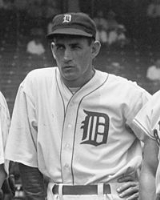
Charlie Gehringer

Encyclopedia
Charles Leonard Gehringer (May 11, 1903 – January 21, 1993), nicknamed “The Mechanical Man,” was a German-American Major League Baseball
second baseman
who played 19 seasons (1924–42) for the Detroit Tigers
. He was elected to the Baseball Hall of Fame in 1949.
and had seven seasons with more than 200 hits – a hit total never reached in a season by Ted Williams
or Mickey Mantle
and reached only once by Willie Mays
. He was the American League batting champion in 1937 with a .371 average and was also named the American League
’s Most Valuable Player
. He was among the Top 10 vote recipients in the Most Valuable Player voting for seven straight years from 1932 to 1938. He was the starting second baseman and played every inning of the first six All Star Games.
Gehringer's career totals of 2,839 hits and 574 doubles
both rank 19th in Major League history. Gehringer also led the Tigers to three American League pennants (1934, 1935, and 1940) and one World Series Championship (1935). Gehringer hit .379 in the 1934 World Series, and .375 in the 1935 Series.
Gehringer was also one of the best-fielding second basemen in history, having led all American League second basemen in fielding percentage and assists seven times. His 7,068 assists is the second highest total in major league history for a second baseman. He also collected 5,369 putouts as a second basemen (the 6th highest total for a second baseman) and 1,444 double plays (the 7th highest total for a second baseman).
Known for his consistency as a hitter and fielder, Gehringer was given the nickname "The Mechanical Man" by Yankee pitcher Lefty Gomez
. Teammate Doc Cramer
quipped: "You wind him up Opening Day and forget him." A durable player, Gehringer had two consecutive game streaks of more than 500 games—one from 1927 to 1931 and the other from 1931 to 1935.
Career statistics
. He was the second son of Leonard Gehringer and Theresa (Hahn) (Eisele) Gehringer, both German Catholic immigrants. Both of his parents had been married previously, and Charlie had eight half-siblings from Leonard's first marriage, and a half-sister from his mother's first marriage. As a young boy the family moved to a different rented farm just south of Fowlerville, Michigan
in Handy Township, Michigan
. In 1922 after graduating from Fowlerville High School, he enrolled at the University of Michigan
, about 30 miles from the family farm. Gehringer took physical education classes and played basketball and baseball. Gehringer later recalled that he lettered in basketball but not baseball.
In the fall of 1923, after his first year at the University of Michigan
, Gehringer was discovered by Detroit Tigers
left fielder Bobby Veach
. Veach heard about Gehringer, and brought him down to Navin Field to work out for a week and show the Tigers what he could do. (Anthony Connor, "Voices from Cooperstown" (1982), p. 37) Player-manager Ty Cobb
was reportedly so impressed with Gehringer that he asked club owner, Frank Navin
, to sign Gehringer to a contract on the spot. "I knew Charlie would hit and I was so anxious to sign him that I didn't even take the time to change out of my uniform before rushing him into the front office to sign a contract." Ty Cobb
In 1924, Gehringer played with London Tecumsehs
in the Class B Michigan Ontario League. He was called up briefly at the end of September and played five games for the Tigers, batting .462 in 13 at bats. Nevertheless, the 21-year-old Gehringer returned to the minor leagues where he played in 1925 for the Toronto Maple Leafs of the International League
, and 8 games with the Tigers.
Gehringer’s first full season in the big leagues was 1926, which was also Ty Cobb
’s last season as the Tigers’ player-manager. At first, Gehringer recalled that Cobb “was like a father to me.” Gehringer’s father had died in 1924. Cobb even made Gehringer use his own bat. According to Gehringer, Cobb’s bat was “a thin little thing,” and though Gehringer would have preferred a bigger bat, “I didn’t dare use another one.” Gehringer hit .277 in his first full season, and collected 17 triples (2nd best in the American League). Cobb and Gehringer subsequently had a falling out, and Gehringer later described Cobb as "a real hateful guy." (Al Stump
, Cobb: The Life and Times of the Meanest Man Who Ever Played Baseball (1994), p. 419)
Playing for the "small ball
" oriented Cobb, Gehringer also had a career-high 27 sacrifice hit
s in 1926. Six Tigers from the Cobb era (Donie Bush
, Ty Cobb
, Harry Heilmann
, Bobby Veach
, Sam Crawford
, and Ossie Vitt
) rank in the Top 50 all time for sacrifice hits. After Cobb's departure, Gehringer never again came close to 27 sacrifice hits.
and a lineup full of great hitters, including Heinie Manush
, Harry Heilmann
, Lu Blue
, and Bob Fothergill
. The 1927 season was also the beginning of Gehringer’s many seasons as a reliable .300 hitter. In 1927, he hit .317 and scored 110 runs – 4th best in the American League
. He also led American League second basemen with 438 assists and 84 double plays.
In 1928, he played in all 154 games for the Tigers, hit .320, collected 193 hits (5th best in the league), scored 108 runs (5th best in the league), and had 507 assists (best in the league for a 2nd baseman). At the end of the 1928 season, Gehringer placed 19th in the voting for the American League’s Most Valuable Player.
Gehringer’s steady improvement as a hitter continued in 1929, as he hit .339 with an on base percentage of .405, a slugging percentage of .532, and 106 RBIs. He also led the American League in many offensive categories, including hits (215), doubles (45), triples (19, including 3 in one game), runs (131), and stolen bases (27). He also led the league in putouts (404) and fielding percentage (.975) by a second basemen.
Gehringer’s consecutive game streak continued in 1930, as he played in every game of the 1928, 1929, and 1930 seasons. In 1930, he hit .330 with a .404 on base percentage and a .534 slugging percentage (9th best in the American League). He also scored 144 runs (3rd best in the league) and collected 201 hits, 78 extra base hits, 47 doubles (3rd in the league), 15 triples (5th in the league), and 19 stolen bases (2nd in the league).
Each year from 1926 to 1930, Gehringer improved his statistics in the three triple crown
categories (batting average
, home run
s and RBIs). The only other player to do that for five years running is Rogers Hornsby
.
In relative terms, 1931 was an “off” year for Gehringer. His consecutive game streak ended, as he played in 101 games. He also fell below the .300 mark (batting .298) for the only time between 1926 and 1941. Gehringer still had a fine year by most standards, and ended up No. 17 in the 1931 American League MVP voting.
In 1932, Gehringer was back at full strength, playing in 152 games and hitting .325 with 112 runs, 107 RBIs, and 44 doubles (2nd best in the league). Not generally known a power hitter, Gehringer even hit 19 home runs in 1932, 7th best in the American League. At the end of the year, Gehringer was 9th in the league’s MVP voting.
In 1933, the “Mechanical Man” continued his string of consistent seasons, playing in 155 games, batting .330 (5th best in the American League), and collecting 204 hits (2nd in the league), 42 doubles (4th in the league), 105 RBIs, and a career-high 542 assists (best in the league for 2nd basemen). Gehringer was once again among the top vote recipients in the 1933 MVP voting, this time placing 6th.
joked that "Charlie says `hello' on Opening Day, `goodbye' on closing day, and in between hits .350."
Gehringer acknowledged his quiet demeanor:
"I wasn't a rabble rouser. I wasn't a big noisemaker in the infield, which a lot of managers think you've got to be or you're not showing. But I don't think it contributes much." Gehringer also had a sense of humor about his reputation. At a civic banquet in his honor, Gehringer's entire speech consisted of the following: "I'm known around baseball as saying very little, and I'm not going to spoil my reputation." When asked why he signed his name "Chas. Gehringer," he responded: "Why use seven letters when four will do?" On another occasion, when asked about his closed-lip reputation, he responded: "Not true; if somebody asked me a question, I would answer them. If they said, 'Pass the salt,' I would pass the salt."
His unassuming nature is also reflected in his reaction to a "Charlie Gehringer Day" held by the Tigers in 1929. Fans from Gehringer’s hometown and throughout Detroit filled the stands for a 17–13 win over the Yankees. Gehringer handled 10 chances at second base, had four hits including a home run, and stole home. In a ceremony, the people of Fowlerville presented Gehringer with a set of golf clubs. Though the clubs were right-handed, and Gehringer was left-handed, Gehringer learned to golf right-handed rather than trade for a left-handed set of clubs.
.
The Detroit infield in the mid-1930s was one of the best-hitting combinations in major league history. With Hank Greenberg
at first, Gehringer at second, Billy Rogell
at shortstop, and Marv Owen
at third, the 1934 Tigers infield collected 769 hits (214 by Gehringer, 201 by Greenberg, 179 by Owen and 175 by Rogell), 462 RBIs (139 by Greenberg, 127 by Gehringer, 100 by Rogell, and 96 by Owen), and 179 doubles (63 by Greenberg, 50 by Gehringer, 34 by Owen and 32 by Rogell). Three members of the 1934 Tigers infield (Gehringer, Owen and Rogell) played in all 154 games, and the fourth (Greenberg) played in 153.
Gehringer’s 127 RBIs in 1934 is all the more remarkable given the fact that he played in the same lineup with one of the greatest RBI men of all time, Hank Greenberg
. Gehringer later recalled that Greenberg would tell him: “Just get the runner over to third," so Hank could drive them in. Gehringer noted that "Hank loved those RBIs," to the point that Gehringer once kidded Greenberg: "You'd trip a runner coming around third base just so you could knock him in yourself.”
The 1934 World Series was a match-up between St. Louis’s "Gashouse Gang
" and Detroit’s’ “G-Men” (so named because of stars Gehringer, Hank Greenberg
, and Goose Goslin
). Even 50 years later, Gehringer (interviewed in 1982) felt the Tigers were robbed of the 1934 championship by umpire Brick Owens. Detroit was ahead 3 games to 2, and in Gehringer's view "we should've won the sixth game." Late in the game, Brick Owens called Mickey Cochrane
out on a play at third base "even though all of the photographs show that he was safe by a mile." Gehringer insisted that, if Cochrane had been called safe, "we would've had the bases loaded with nobody out and we could've had a big inning.” The Tigers wound up losing Game 6 by one run. They then lost Game 7 in an 11–0 shutout thrown by Dizzy Dean
, despite a 2-for-4 game from Gehringer. Gehringer can’t be faulted for the World Series loss, as he played all seven games, batting .379 with an on base percentage of .438 and a .517 slugging percentage.
In 1935, Gehringer and the Tigers won a World Series, beating the Chicago Cubs
4 games to 2. It was the Tigers' first-ever World Series win, after failing in the fall classic in four previous appearances. For the year, Gehringer hit .330 with a .409 on base percentage and a .502 slugging percentage, collecting 201 hits, 123 runs, 108 RBIs, and 19 home runs. Once again, Gehringer was among the top vote getters in the MVP race, again losing to one of his own teammates, Hank Greenberg
.
Gehringer also continued his consistent hitting into the 1935 World Series, where he played all six games, and hit .375 with a .423 on base percentage, a .500 slugging percentage and 4 RBIs.
, Lou Gehrig
, and Jimmie Foxx
. They played 18 games against a Japanese All Star Team. The American team won all 18 games by a combined score of 189 to 39, but on November 20, 1934, 17-year-old Eiji Sawamura
pitched seven shutout innings and had consecutive strikeouts of Gehringer, Ruth, Gehrig, and Foxx. Gehringer recalled that, during batting practice, the Japanese fans would fill the 60,000 seat ballpark for every game. (Anthony Connor, "Voices from Cooperstown," p. 240.)
with other Major League players. One year, he traveled with a touring group from the Negro Leagues, including Satchel Paige
, Buck Leonard
, Judy Johnson
, and Mule Suttles
. Gehringer recalled that trying to hit Paige’s fastball and hesitation pitch was "no fun." Satchel Paige is also quoted as saying that Charlie was the best white hitter he ever pitched against.
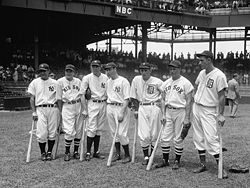 Although the 1936 Tigers finished in 2nd place, 19½ games behind the Yankees, the 33-year-old Gehringer may have had his best season. He led the American League in assists, double plays, and fielding percentage by a second baseman. And he had career-bests in hits (227) slugging percentage (.555), runs (144), extra base hits (87), total bases (356) and runs created (152). He also had a career-low 13 strikeouts in 641 at bats during the 1936 season. That equates to a strikeout every 49.3 times at bat. He finished 4th in the MVP voting, as Lou Gehrig
became the only non-Tiger to win the MVP award from 1934 to 1937.
Gehringer finally secured his own American League Most Valuable Player trophy, and a batting crown, in 1937. Gehringer won the batting championship with a career-high .371 batting average and placed 2nd in on base percentage with another career-high .458. The 1937 season also saw Gehringer collect 209 hits (his 7th 200 hit season) and score 133 runs (one of twelve 100-plus run seasons).
In 1938, Gehringer had another solid year, batting .306 with a .425 on base percentage (6th-best in the American League), 133 runs (3rd-best in the league), and career-highs in bases on balls with 113 (4th-best in the league), and home runs with 20. Gehringer finished 10th in MVP voting in 1938.
as his double play
partner at shortstop, making them one of the longest-tenured double-play combinations in the history of the game. The two twice led the league in double plays. (Ironically, another Tiger duo, Lou Whitaker and Alan Trammell
, holds the major league record with 1,918 games played as a double-play combination.)
Rogell's fiery demeanor was a stark contrast to the calm, quiet demeanor of Gehringer. On one occasion, after both failed to cover second on a steal attempt, player-manager Mickey Cochrane
charged out from behind the plate shouting at Rogell and Gehringer. As reported in The New Bill James Historical Baseball Abstract: "Rogell, astonished, looked at Gehringer to see if he was going to say anything. Gehringer, of course, had nothing to say. 'Goddamn you,' yelled Rogell. 'Don’t you come charging out here telling me how to play shortstop. You go back there and do the catching, and I’ll play shortstop. If I’m not good enough, you can find someone else.' Cochrane went back to his own position."
decided to go out on the town and forget about baseball. "But I played, and it was uncanny! I hit the fences with four straight line drives. I was so relaxed!" (Anthony O'Connor, "Voices from Cooperstown," pp. 158–159) [This is highly doubtful, since Gehringer and Bender were never on the same team as players or coaches. May refer to Chief Hogsett, left-handed pitcher and teammate of Gehringer's 1929–1936]
The 1940 season also saw the Tigers return to the World Series after four straight years of dominance by the Yankees. Gehringer finished 14th in the MVP voting in 1939 and dropped to 23rd in 1940. Gehringer hit .214 in 28 at bats in a losing effort in the 1940 World Series against the Cincinnati Reds
.
In 1941, Gehringer’s 17 seasons began to catch up with him. His batting average dropped almost 100 points to .220, but with 95 walks (5th-best in the American League) his on base percentage remained high at .363. In 1942, Gehringer lost the starting second baseman’s job to a young Billy Hitchcock
. Gehringer played only three games at 2nd base in 1942, finding himself relegated to a pinch-hitting role. He hit .267 with a .365 on base percentage in his final year.
Gehringer enlisted in the U.S. Navy after the 1942 season. He served three years, and was released in 1945.
Gehringer considered making a comeback at age 41. “I came out of the service in such good shape that I felt I could've played a few years.” Instead, Gehringer went into business selling fabrics to automobile manufacturers.
In 1949, Gehringer was elected to the Baseball Hall of Fame by the Baseball Writers. Gehringer received 159 votes on 187 ballots (85.03%).
, to Detroit. Gehringer recalled that she was a diabetic and "needed someone to look after her."
Gehringer speculated that he might have married earlier (he didn't marry until he was 42) "but I couldn't see bringing a wife into that kind of situation." Gehringer noted that his mother was a "great fan" who would either come out to the ballpark to watch her son play or listen to Harry Heilmann
's radio broadcasts on the porch.
Gehringer did not marry until after his mother died, and when he did get married in 1949, he did not let anything stand in the way—not even his induction into the Baseball Hall of Fame. Gehringer missed his Hall of Fame induction ceremony on June 13, 1949, because he did not want it to interfere with his wedding, which was to take place five days later.
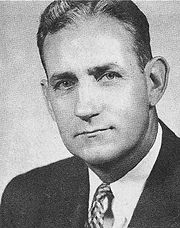 In 1950, Tigers’ owner, Walter Briggs asked Gehringer to be the Tigers’ general manager, and he agreed to do so. Gehringer later said that the job was a “nightmare.” As he put it: “We had a lousy ball club, and I'd been away from baseball at that time for ten years. I didn't know who was and who wasn't.” After serving as the Tigers’ general manager from 1951 to 1953, Gehringer was given the title of Tigers vice president in the mid-1950s. He went back to his business selling fabric to the automobile companies, continuing with the company until 1974 when he sold his interest in the business.
Gehringer also served as a member of the Baseball Hall of Fame Committee on Veterans from 1953 to 1990.
At a 1983 ceremony in Tiger Stadium, the Tigers retired uniform numbers 2 and 5 worn for many years by teammates Gehringer and Hank Greenberg
. Both players attended the ceremony.
At age 82, Gehringer served as the American League
honorary captain at the 1986 Major League Baseball All-Star Game
at the Astrodome in Houston, Texas
.
Gehringer died in Bloomfield Hills, Michigan
, at age 89.
In 1999
, he ranked Number 46 on The Sporting News list of the 100 Greatest Baseball Players, and was nominated as a finalist for the Major League Baseball
All-Century Team. Also in 1999, Sports Illustrated
published a list of "The 50 Greatest Sports Figures From Michigan" (in all sports), and ranked Gehringer third on the list behind Joe Louis
and Magic Johnson
. "The 50 Greatest Sports Figures From Michigan," Sports Illustrated
, December 27, 1999.
Major League Baseball
Major League Baseball is the highest level of professional baseball in the United States and Canada, consisting of teams that play in the National League and the American League...
second baseman
Second baseman
Second base, or 2B, is the second of four stations on a baseball diamond which must be touched in succession by a base runner in order to score a run for that player's team. A second baseman is the baseball player guarding second base...
who played 19 seasons (1924–42) for the Detroit Tigers
Detroit Tigers
The Detroit Tigers are a Major League Baseball team located in Detroit, Michigan. One of the American League's eight charter franchises, the club was founded in Detroit in as part of the Western League. The Tigers have won four World Series championships and have won the American League pennant...
. He was elected to the Baseball Hall of Fame in 1949.
Overview
Widely regarded as one of the greatest second basemen of all time, during his career Gehringer, who batted left-handed and threw with his right, compiled a .320 batting averageBatting average
Batting average is a statistic in both cricket and baseball that measures the performance of cricket batsmen and baseball hitters. The two statistics are related in that baseball averages are directly descended from the concept of cricket averages.- Cricket :...
and had seven seasons with more than 200 hits – a hit total never reached in a season by Ted Williams
Ted Williams
Theodore Samuel "Ted" Williams was an American professional baseball player and manager. He played his entire 21-year Major League Baseball career as the left fielder for the Boston Red Sox...
or Mickey Mantle
Mickey Mantle
Mickey Charles Mantle was an American professional baseball player. Mantle is regarded by many to be the greatest switch hitter of all time, and one of the greatest players in baseball history. Mantle was inducted into the National Baseball Hall of Fame in 1974.Mantle was noted for his hitting...
and reached only once by Willie Mays
Willie Mays
Willie Howard Mays, Jr. is a retired American professional baseball player who played the majority of his major league career with the New York and San Francisco Giants before finishing with the New York Mets. Nicknamed The Say Hey Kid, Mays was elected to the Baseball Hall of Fame in 1979, his...
. He was the American League batting champion in 1937 with a .371 average and was also named the American League
American League
The American League of Professional Baseball Clubs, or simply the American League , is one of two leagues that make up Major League Baseball in the United States and Canada. It developed from the Western League, a minor league based in the Great Lakes states, which eventually aspired to major...
’s Most Valuable Player
Most Valuable Player
In sports, a Most Valuable Player award is an honor typically bestowed upon the best performing player or players on a specific team, in an entire league, or for a particular contest or series of contests...
. He was among the Top 10 vote recipients in the Most Valuable Player voting for seven straight years from 1932 to 1938. He was the starting second baseman and played every inning of the first six All Star Games.
Gehringer's career totals of 2,839 hits and 574 doubles
Double (baseball)
In baseball, a double is the act of a batter striking the pitched ball and safely reaching second base without being called out by the umpire, without the benefit of a fielder's misplay or another runner being put out on a fielder's choice....
both rank 19th in Major League history. Gehringer also led the Tigers to three American League pennants (1934, 1935, and 1940) and one World Series Championship (1935). Gehringer hit .379 in the 1934 World Series, and .375 in the 1935 Series.
Gehringer was also one of the best-fielding second basemen in history, having led all American League second basemen in fielding percentage and assists seven times. His 7,068 assists is the second highest total in major league history for a second baseman. He also collected 5,369 putouts as a second basemen (the 6th highest total for a second baseman) and 1,444 double plays (the 7th highest total for a second baseman).
Known for his consistency as a hitter and fielder, Gehringer was given the nickname "The Mechanical Man" by Yankee pitcher Lefty Gomez
Lefty Gómez
Vernon Louis "Lefty" Gomez was an American left-handed major league pitcher who played in the American League for the New York Yankees between 1930 and 1942. Considered one of the great pitchers of the day, Gomez was a seven-time All-Star and a five-time World Series Champion with the Yankees...
. Teammate Doc Cramer
Doc Cramer
Roger Maxwell Cramer [Doc] was an American center fielder and left-handed batter in Major League Baseball who played for four American League teams from 1929 to 1948.-Career:...
quipped: "You wind him up Opening Day and forget him." A durable player, Gehringer had two consecutive game streaks of more than 500 games—one from 1927 to 1931 and the other from 1931 to 1935.
Career statistics
| G Games played Games played is a statistic used in team sports to indicate the total number of games in which a player has participated ; the statistic is generally applied irrespective of whatever portion of the game is contested.-Baseball:In baseball, the statistic applies also to players who, prior to a game,... |
AB At bat In baseball, an at bat or time at bat is used to calculate certain statistics, including batting average, on base percentage, and slugging percentage. It is a more restricted definition of a plate appearance... |
R | H | 2B Double (baseball) In baseball, a double is the act of a batter striking the pitched ball and safely reaching second base without being called out by the umpire, without the benefit of a fielder's misplay or another runner being put out on a fielder's choice.... |
3B Triple (baseball) In baseball, a triple is the act of a batter safely reaching third base after hitting the ball, with neither the benefit of a fielder's misplay nor another runner being put out on a fielder's choice.... |
HR Home run In baseball, a home run is scored when the ball is hit in such a way that the batter is able to reach home safely in one play without any errors being committed by the defensive team in the process... |
RBI | SB | CS Caught stealing In baseball, a runner is charged, and the fielders involved are credited, with a time caught stealing when the runner attempts to advance or lead off from one base to another without the ball being batted and then is tagged out by a fielder while making the attempt... |
BB Base on balls A base on balls is credited to a batter and against a pitcher in baseball statistics when a batter receives four pitches that the umpire calls balls. It is better known as a walk. The base on balls is defined in Section 2.00 of baseball's Official Rules, and further detail is given in 6.08... |
SO Strikeout In baseball or softball, a strikeout or strike-out occurs when a batter receives three strikes during his time at bat. A strikeout is a statistic recorded for both pitchers and batters.... |
BA Batting average Batting average is a statistic in both cricket and baseball that measures the performance of cricket batsmen and baseball hitters. The two statistics are related in that baseball averages are directly descended from the concept of cricket averages.- Cricket :... |
OBP On base percentage In baseball statistics, on-base percentage is a measure of how often a batter reaches base for any reason other than a fielding error, fielder's choice, dropped/uncaught third strike, fielder's obstruction, or catcher's interference In baseball statistics, on-base percentage (OBP) (sometimes... |
SLG | TB Total bases In baseball statistics, total bases refers to the number of bases a player has gained with hits, i.e., the sum of his hits weighted by 1 for a single, 2 for a double, 3 for a triple and 4 for a home run.Only bases attained from hits count toward this total.... |
SH | HBP Hit by pitch In baseball, hit by pitch , or hit batsman , is a batter or his equipment being hit in some part of his body by a pitch from the pitcher.-Official rule:... |
| 2,323 | 8,860 | 1,774 | 2,839 | 574 | 146 | 184 | 1,427 | 181 | 89 | 1186 | 372 | .320 | .404 | .480 | 4,257 | 141 | 50 |
Early years: 1903–26
Gehringer was born on May 11, 1903 on a rented farm in Fowlerville,MI, in southwestern Livingston County, MichiganLivingston County, Michigan
-Demographics:As of the census of 2000, there were 156,951 people, 55,384 households, and 43,531 families residing in the county. The population density was 276 people per square mile . There were 58,919 housing units at an average density of 104 per square mile...
. He was the second son of Leonard Gehringer and Theresa (Hahn) (Eisele) Gehringer, both German Catholic immigrants. Both of his parents had been married previously, and Charlie had eight half-siblings from Leonard's first marriage, and a half-sister from his mother's first marriage. As a young boy the family moved to a different rented farm just south of Fowlerville, Michigan
Fowlerville, Michigan
Fowlerville is a village in Livingston County in the U.S. state of Michigan. It is located in the northeast portion of Handy Township, but is politically independent from the township. The population was 2,886 at the 2010 census.-History:...
in Handy Township, Michigan
Handy Township, Michigan
Handy Township is a civil township of Livingston County in the U.S. state of Michigan. The population was 7,004 at the 2000 census.-Local government:Township Supervisor: Dr...
. In 1922 after graduating from Fowlerville High School, he enrolled at the University of Michigan
University of Michigan
The University of Michigan is a public research university located in Ann Arbor, Michigan in the United States. It is the state's oldest university and the flagship campus of the University of Michigan...
, about 30 miles from the family farm. Gehringer took physical education classes and played basketball and baseball. Gehringer later recalled that he lettered in basketball but not baseball.
In the fall of 1923, after his first year at the University of Michigan
University of Michigan
The University of Michigan is a public research university located in Ann Arbor, Michigan in the United States. It is the state's oldest university and the flagship campus of the University of Michigan...
, Gehringer was discovered by Detroit Tigers
Detroit Tigers
The Detroit Tigers are a Major League Baseball team located in Detroit, Michigan. One of the American League's eight charter franchises, the club was founded in Detroit in as part of the Western League. The Tigers have won four World Series championships and have won the American League pennant...
left fielder Bobby Veach
Bobby Veach
Robert Hayes "Bobby" Veach was an American left fielder in Major League Baseball who played fourteen seasons for the Detroit Tigers , Boston Red Sox , New York Yankees and Washington Senators ....
. Veach heard about Gehringer, and brought him down to Navin Field to work out for a week and show the Tigers what he could do. (Anthony Connor, "Voices from Cooperstown" (1982), p. 37) Player-manager Ty Cobb
Ty Cobb
Tyrus Raymond "Ty" Cobb , nicknamed "The Georgia Peach," was an American Major League Baseball outfielder. He was born in Narrows, Georgia...
was reportedly so impressed with Gehringer that he asked club owner, Frank Navin
Frank Navin
Francis Joseph Navin was the principal owner of the Detroit Tigers in Major League Baseball for 27 years, from 1909 to 1935. He also served as vice president and acting president of the American League....
, to sign Gehringer to a contract on the spot. "I knew Charlie would hit and I was so anxious to sign him that I didn't even take the time to change out of my uniform before rushing him into the front office to sign a contract." Ty Cobb
In 1924, Gehringer played with London Tecumsehs
London Tecumsehs
The historic London Tecumsehs were a professional men's baseball team in London, Ontario, Canada, that were first formed in 1868 — a merger of the Forest City Base Ball Club and the London Base Ball Club — which, according to George Railton's 1856 London directory, consisted of officers J.K. Brown,...
in the Class B Michigan Ontario League. He was called up briefly at the end of September and played five games for the Tigers, batting .462 in 13 at bats. Nevertheless, the 21-year-old Gehringer returned to the minor leagues where he played in 1925 for the Toronto Maple Leafs of the International League
International League
The International League is a minor league baseball league that operates in the eastern United States. Like the Pacific Coast League and the Mexican League, it plays at the Triple-A level, which is one step below Major League Baseball. It was so named because it had teams in both the United States...
, and 8 games with the Tigers.
Gehringer’s first full season in the big leagues was 1926, which was also Ty Cobb
Ty Cobb
Tyrus Raymond "Ty" Cobb , nicknamed "The Georgia Peach," was an American Major League Baseball outfielder. He was born in Narrows, Georgia...
’s last season as the Tigers’ player-manager. At first, Gehringer recalled that Cobb “was like a father to me.” Gehringer’s father had died in 1924. Cobb even made Gehringer use his own bat. According to Gehringer, Cobb’s bat was “a thin little thing,” and though Gehringer would have preferred a bigger bat, “I didn’t dare use another one.” Gehringer hit .277 in his first full season, and collected 17 triples (2nd best in the American League). Cobb and Gehringer subsequently had a falling out, and Gehringer later described Cobb as "a real hateful guy." (Al Stump
Al Stump
Al Stump , was an American author and Sports writer. Stump spent a great deal of time with Ty Cobb before Cobb's death. Stump wrote one book with Cobb, one book on Cobb and a handful of magazine articles about the time the two men spent together...
, Cobb: The Life and Times of the Meanest Man Who Ever Played Baseball (1994), p. 419)
Playing for the "small ball
Small Ball
In the sport of baseball, small-ball is an informal and colloquial term for an offensive strategy in which the batting team emphasizes placing runners on base and then advancing them into position to score a run in a deliberate, methodical way...
" oriented Cobb, Gehringer also had a career-high 27 sacrifice hit
Sacrifice hit
In baseball, a sacrifice bunt is a batter's act of deliberately bunting the ball in a manner that allows a runner on base to advance to another base. The batter is almost always sacrificed but sometimes reaches base due to an error or fielder's choice...
s in 1926. Six Tigers from the Cobb era (Donie Bush
Donie Bush
Owen Joseph "Donie" Bush , was a Major League Baseball shortstop in the American League for the Detroit Tigers and the Washington Senators...
, Ty Cobb
Ty Cobb
Tyrus Raymond "Ty" Cobb , nicknamed "The Georgia Peach," was an American Major League Baseball outfielder. He was born in Narrows, Georgia...
, Harry Heilmann
Harry Heilmann
Harry Edwin Heilmann , nicknamed “Slug,” was a Major League Baseball player who played 17 seasons with the Detroit Tigers and Cincinnati Reds . He was elected to the Baseball Hall of Fame in 1952.Heilmann was a line drive hitter who won four American League batting crowns: in 1921, 1923, 1925 and...
, Bobby Veach
Bobby Veach
Robert Hayes "Bobby" Veach was an American left fielder in Major League Baseball who played fourteen seasons for the Detroit Tigers , Boston Red Sox , New York Yankees and Washington Senators ....
, Sam Crawford
Sam Crawford
Samuel Earl Crawford , nicknamed "Wahoo Sam", was a Major League Baseball player who played outfield for the Cincinnati Reds and Detroit Tigers. He was elected to the Baseball Hall of Fame in 1957....
, and Ossie Vitt
Ossie Vitt
Oscar Joseph "Ossie" Vitt , was a Major League Baseball third baseman in the American League for the Detroit Tigers and Boston Red Sox . Vitt later became manager of the Cleveland Indians , where he sometimes clashed with his players.-Playing career:Ossie Vitt was a product of the sandlots of...
) rank in the Top 50 all time for sacrifice hits. After Cobb's departure, Gehringer never again came close to 27 sacrifice hits.
Gehringer becomes a star: 1927–33
In 1927, the Tigers had a new manager in George MoriartyGeorge Moriarty
George Joseph Moriarty was an American third baseman, umpire and manager in Major League Baseball from 1903 to 1940. He played for the Chicago Cubs, New York Highlanders, Detroit Tigers and Chicago White Sox from 1903 to 1916.Moriarty was born in Chicago, Illinois, where he grew up near the Union...
and a lineup full of great hitters, including Heinie Manush
Heinie Manush
Henry Emmett Manush , nicknamed "Heinie" due to his German heritage, was an American left fielder in Major League Baseball, and was elected to the Baseball Hall of Fame in 1964....
, Harry Heilmann
Harry Heilmann
Harry Edwin Heilmann , nicknamed “Slug,” was a Major League Baseball player who played 17 seasons with the Detroit Tigers and Cincinnati Reds . He was elected to the Baseball Hall of Fame in 1952.Heilmann was a line drive hitter who won four American League batting crowns: in 1921, 1923, 1925 and...
, Lu Blue
Lu Blue
Luzerne Atwell "Lu" Blue was a Major League Baseball first baseman. He played in the major leagues from 1921 to 1932 with the Detroit Tigers, St. Louis Browns, and Chicago White Sox. Blue was a switch-hitter who had a career on base percentage of .402 and was one of the best fielding 1st basemen...
, and Bob Fothergill
Bob Fothergill
Robert Roy Fothergill , nicknamed "Fats" or "Fatty," was an outfielder in Major League Baseball who played twelve seasons with the Detroit Tigers , Chicago White Sox , and Boston Red Sox ....
. The 1927 season was also the beginning of Gehringer’s many seasons as a reliable .300 hitter. In 1927, he hit .317 and scored 110 runs – 4th best in the American League
American League
The American League of Professional Baseball Clubs, or simply the American League , is one of two leagues that make up Major League Baseball in the United States and Canada. It developed from the Western League, a minor league based in the Great Lakes states, which eventually aspired to major...
. He also led American League second basemen with 438 assists and 84 double plays.
In 1928, he played in all 154 games for the Tigers, hit .320, collected 193 hits (5th best in the league), scored 108 runs (5th best in the league), and had 507 assists (best in the league for a 2nd baseman). At the end of the 1928 season, Gehringer placed 19th in the voting for the American League’s Most Valuable Player.
Gehringer’s steady improvement as a hitter continued in 1929, as he hit .339 with an on base percentage of .405, a slugging percentage of .532, and 106 RBIs. He also led the American League in many offensive categories, including hits (215), doubles (45), triples (19, including 3 in one game), runs (131), and stolen bases (27). He also led the league in putouts (404) and fielding percentage (.975) by a second basemen.
Gehringer’s consecutive game streak continued in 1930, as he played in every game of the 1928, 1929, and 1930 seasons. In 1930, he hit .330 with a .404 on base percentage and a .534 slugging percentage (9th best in the American League). He also scored 144 runs (3rd best in the league) and collected 201 hits, 78 extra base hits, 47 doubles (3rd in the league), 15 triples (5th in the league), and 19 stolen bases (2nd in the league).
Each year from 1926 to 1930, Gehringer improved his statistics in the three triple crown
Triple crown (baseball)
In Major League Baseball, a player earns the Triple Crown when he leads a league in three specific statistical categories. For batters, a player must lead the league in home runs, run batted in , and batting average; pitchers must lead the league in wins, strikeouts, and earned run average...
categories (batting average
Batting average
Batting average is a statistic in both cricket and baseball that measures the performance of cricket batsmen and baseball hitters. The two statistics are related in that baseball averages are directly descended from the concept of cricket averages.- Cricket :...
, home run
Home run
In baseball, a home run is scored when the ball is hit in such a way that the batter is able to reach home safely in one play without any errors being committed by the defensive team in the process...
s and RBIs). The only other player to do that for five years running is Rogers Hornsby
Rogers Hornsby
Rogers Hornsby, Sr. , nicknamed "The Rajah", was an American baseball infielder, manager, and coach who played 23 seasons in Major League Baseball . He played for the St. Louis Cardinals , New York Giants , Boston Braves , Chicago Cubs , and St. Louis Browns...
.
In relative terms, 1931 was an “off” year for Gehringer. His consecutive game streak ended, as he played in 101 games. He also fell below the .300 mark (batting .298) for the only time between 1926 and 1941. Gehringer still had a fine year by most standards, and ended up No. 17 in the 1931 American League MVP voting.
In 1932, Gehringer was back at full strength, playing in 152 games and hitting .325 with 112 runs, 107 RBIs, and 44 doubles (2nd best in the league). Not generally known a power hitter, Gehringer even hit 19 home runs in 1932, 7th best in the American League. At the end of the year, Gehringer was 9th in the league’s MVP voting.
In 1933, the “Mechanical Man” continued his string of consistent seasons, playing in 155 games, batting .330 (5th best in the American League), and collecting 204 hits (2nd in the league), 42 doubles (4th in the league), 105 RBIs, and a career-high 542 assists (best in the league for 2nd basemen). Gehringer was once again among the top vote recipients in the 1933 MVP voting, this time placing 6th.
A quiet man
Gehringer had a reputation as quiet and unassuming. Player-manager Mickey CochraneMickey Cochrane
Gordon Stanley "Mickey" Cochrane was a professional baseball player and manager. He played in Major League Baseball as a catcher for the Philadelphia Athletics and Detroit Tigers...
joked that "Charlie says `hello' on Opening Day, `goodbye' on closing day, and in between hits .350."
Gehringer acknowledged his quiet demeanor:
"I wasn't a rabble rouser. I wasn't a big noisemaker in the infield, which a lot of managers think you've got to be or you're not showing. But I don't think it contributes much." Gehringer also had a sense of humor about his reputation. At a civic banquet in his honor, Gehringer's entire speech consisted of the following: "I'm known around baseball as saying very little, and I'm not going to spoil my reputation." When asked why he signed his name "Chas. Gehringer," he responded: "Why use seven letters when four will do?" On another occasion, when asked about his closed-lip reputation, he responded: "Not true; if somebody asked me a question, I would answer them. If they said, 'Pass the salt,' I would pass the salt."
His unassuming nature is also reflected in his reaction to a "Charlie Gehringer Day" held by the Tigers in 1929. Fans from Gehringer’s hometown and throughout Detroit filled the stands for a 17–13 win over the Yankees. Gehringer handled 10 chances at second base, had four hits including a home run, and stole home. In a ceremony, the people of Fowlerville presented Gehringer with a set of golf clubs. Though the clubs were right-handed, and Gehringer was left-handed, Gehringer learned to golf right-handed rather than trade for a left-handed set of clubs.
Back-to-back pennants (1934 and 1935)
In 1934, Gehringer had his best year to date, playing all 154 games and leading the Tigers to their first American League pennant in 25 years. His .356 batting average and .450 on base percentage were both 2nd best in the league. He led the league in runs scored with 134 and hits with 214. He was also among the league leaders in doubles with 42 (2nd best in the league) and RBIs with a career-high 127 (5th best in the league). Gehringer finished 2nd in the American League MVP voting, just 2 points behind Detroit’s player-manager, Mickey CochraneMickey Cochrane
Gordon Stanley "Mickey" Cochrane was a professional baseball player and manager. He played in Major League Baseball as a catcher for the Philadelphia Athletics and Detroit Tigers...
.
The Detroit infield in the mid-1930s was one of the best-hitting combinations in major league history. With Hank Greenberg
Hank Greenberg
Henry Benjamin "Hank" Greenberg , nicknamed "Hammerin' Hank" or "The Hebrew Hammer," was an American professional baseball player in the 1930s and 1940s. A first baseman primarily for the Detroit Tigers, Greenberg was one of the premier power hitters of his generation...
at first, Gehringer at second, Billy Rogell
Billy Rogell
William George "Billy" Rogell was an American baseball player who played 14 years in Major League Baseball, primarily as a shortstop for the Detroit Tigers. He made his major league debut on April 14, 1925 and played his last game August 25, 1940...
at shortstop, and Marv Owen
Marv Owen
Marvin James Owen was an American third baseman in Major League Baseball. He played nine seasons in the American League with the Detroit Tigers , Chicago White Sox , and Boston Red Sox ....
at third, the 1934 Tigers infield collected 769 hits (214 by Gehringer, 201 by Greenberg, 179 by Owen and 175 by Rogell), 462 RBIs (139 by Greenberg, 127 by Gehringer, 100 by Rogell, and 96 by Owen), and 179 doubles (63 by Greenberg, 50 by Gehringer, 34 by Owen and 32 by Rogell). Three members of the 1934 Tigers infield (Gehringer, Owen and Rogell) played in all 154 games, and the fourth (Greenberg) played in 153.
Gehringer’s 127 RBIs in 1934 is all the more remarkable given the fact that he played in the same lineup with one of the greatest RBI men of all time, Hank Greenberg
Hank Greenberg
Henry Benjamin "Hank" Greenberg , nicknamed "Hammerin' Hank" or "The Hebrew Hammer," was an American professional baseball player in the 1930s and 1940s. A first baseman primarily for the Detroit Tigers, Greenberg was one of the premier power hitters of his generation...
. Gehringer later recalled that Greenberg would tell him: “Just get the runner over to third," so Hank could drive them in. Gehringer noted that "Hank loved those RBIs," to the point that Gehringer once kidded Greenberg: "You'd trip a runner coming around third base just so you could knock him in yourself.”
The 1934 World Series was a match-up between St. Louis’s "Gashouse Gang
Gashouse Gang
The Gashouse Gang was a nickname applied to the St. Louis Cardinals Major League Baseball team of .The Cardinals, by most accounts, earned this nickname from the team's generally very shabby appearance and rough-and-tumble tactics...
" and Detroit’s’ “G-Men” (so named because of stars Gehringer, Hank Greenberg
Hank Greenberg
Henry Benjamin "Hank" Greenberg , nicknamed "Hammerin' Hank" or "The Hebrew Hammer," was an American professional baseball player in the 1930s and 1940s. A first baseman primarily for the Detroit Tigers, Greenberg was one of the premier power hitters of his generation...
, and Goose Goslin
Goose Goslin
Leon Allen "Goose" Goslin was a left fielder in Major League Baseball known for his powerful left-handed swing and dependable clutch hitting. He played 18 seasons with the Washington Senators, St. Louis Browns, and Detroit Tigers, from until...
). Even 50 years later, Gehringer (interviewed in 1982) felt the Tigers were robbed of the 1934 championship by umpire Brick Owens. Detroit was ahead 3 games to 2, and in Gehringer's view "we should've won the sixth game." Late in the game, Brick Owens called Mickey Cochrane
Mickey Cochrane
Gordon Stanley "Mickey" Cochrane was a professional baseball player and manager. He played in Major League Baseball as a catcher for the Philadelphia Athletics and Detroit Tigers...
out on a play at third base "even though all of the photographs show that he was safe by a mile." Gehringer insisted that, if Cochrane had been called safe, "we would've had the bases loaded with nobody out and we could've had a big inning.” The Tigers wound up losing Game 6 by one run. They then lost Game 7 in an 11–0 shutout thrown by Dizzy Dean
Dizzy Dean
Jay Hanna "Dizzy" Dean was an American Major League Baseball pitcher. He was the last National League pitcher to win 30 games in one season. Dean was elected to the Baseball Hall of Fame in 1953....
, despite a 2-for-4 game from Gehringer. Gehringer can’t be faulted for the World Series loss, as he played all seven games, batting .379 with an on base percentage of .438 and a .517 slugging percentage.
In 1935, Gehringer and the Tigers won a World Series, beating the Chicago Cubs
Chicago Cubs
The Chicago Cubs are a professional baseball team located in Chicago, Illinois. They are members of the Central Division of Major League Baseball's National League. They are one of two Major League clubs based in Chicago . The Cubs are also one of the two remaining charter members of the National...
4 games to 2. It was the Tigers' first-ever World Series win, after failing in the fall classic in four previous appearances. For the year, Gehringer hit .330 with a .409 on base percentage and a .502 slugging percentage, collecting 201 hits, 123 runs, 108 RBIs, and 19 home runs. Once again, Gehringer was among the top vote getters in the MVP race, again losing to one of his own teammates, Hank Greenberg
Hank Greenberg
Henry Benjamin "Hank" Greenberg , nicknamed "Hammerin' Hank" or "The Hebrew Hammer," was an American professional baseball player in the 1930s and 1940s. A first baseman primarily for the Detroit Tigers, Greenberg was one of the premier power hitters of his generation...
.
Gehringer also continued his consistent hitting into the 1935 World Series, where he played all six games, and hit .375 with a .423 on base percentage, a .500 slugging percentage and 4 RBIs.
1934 tour of Japan
After the 1934 season, Gehringer was part of the Major League All Star tour of Japan. The American team included Gehringer, Babe RuthBabe Ruth
George Herman Ruth, Jr. , best known as "Babe" Ruth and nicknamed "the Bambino" and "the Sultan of Swat", was an American Major League baseball player from 1914–1935...
, Lou Gehrig
Lou Gehrig
Henry Louis "Lou" Gehrig , nicknamed "The Iron Horse" for his durability, was an American Major League Baseball first baseman. He played his entire 17-year baseball career for the New York Yankees . Gehrig set several major league records. He holds the record for most career grand slams...
, and Jimmie Foxx
Jimmie Foxx
James Emory "Jimmie" Foxx , nicknamed "Double X" and "The Beast", was a right-handed American Major League Baseball first baseman and noted power hitter....
. They played 18 games against a Japanese All Star Team. The American team won all 18 games by a combined score of 189 to 39, but on November 20, 1934, 17-year-old Eiji Sawamura
Eiji Sawamura
Eiji Sawamura was a Japanese professional baseball player...
pitched seven shutout innings and had consecutive strikeouts of Gehringer, Ruth, Gehrig, and Foxx. Gehringer recalled that, during batting practice, the Japanese fans would fill the 60,000 seat ballpark for every game. (Anthony Connor, "Voices from Cooperstown," p. 240.)
Life in the off-season
During the off-season, Gehringer worked as a sales clerk in the downtown Detroit Hudson's. He also spent many years barnstormingBarnstorming
Barnstorming was a popular form of entertainment in the 1920s in which stunt pilots would perform tricks with airplanes, either individually or in groups called a flying circus. Barnstorming was the first major form of civil aviation in the history of flight...
with other Major League players. One year, he traveled with a touring group from the Negro Leagues, including Satchel Paige
Satchel Paige
Leroy Robert "Satchel" Paige was an American baseball player whose pitching in the Negro leagues and in Major League Baseball made him a legend in his own lifetime...
, Buck Leonard
Buck Leonard
Walter Fenner "Buck" Leonard was an American first baseman in Negro league baseball. He was elected to the Baseball Hall of Fame in along with his long-time teammate Josh Gibson.-Biography:...
, Judy Johnson
Judy Johnson
William Julius "Judy" Johnson was an American third baseman in Negro league baseball.Johnson was born in Snow Hill, Maryland. Although his father wanted him to be a boxer, Johnson, who was 5 ft 11 in and only 150 lb , was far better suited for a career in baseball...
, and Mule Suttles
Mule Suttles
George "Mule" Suttles was an American first baseman and outfielder in Negro league baseball, most prominently with the Birmingham Black Barons, St. Louis Stars and Newark Eagles...
. Gehringer recalled that trying to hit Paige’s fastball and hesitation pitch was "no fun." Satchel Paige is also quoted as saying that Charlie was the best white hitter he ever pitched against.
MVP award and batting crown
Lou Gehrig
Henry Louis "Lou" Gehrig , nicknamed "The Iron Horse" for his durability, was an American Major League Baseball first baseman. He played his entire 17-year baseball career for the New York Yankees . Gehrig set several major league records. He holds the record for most career grand slams...
became the only non-Tiger to win the MVP award from 1934 to 1937.
Gehringer finally secured his own American League Most Valuable Player trophy, and a batting crown, in 1937. Gehringer won the batting championship with a career-high .371 batting average and placed 2nd in on base percentage with another career-high .458. The 1937 season also saw Gehringer collect 209 hits (his 7th 200 hit season) and score 133 runs (one of twelve 100-plus run seasons).
In 1938, Gehringer had another solid year, batting .306 with a .425 on base percentage (6th-best in the American League), 133 runs (3rd-best in the league), and career-highs in bases on balls with 113 (4th-best in the league), and home runs with 20. Gehringer finished 10th in MVP voting in 1938.
Rogell and Gehringer
Gehringer played over 1,000 games with Billy RogellBilly Rogell
William George "Billy" Rogell was an American baseball player who played 14 years in Major League Baseball, primarily as a shortstop for the Detroit Tigers. He made his major league debut on April 14, 1925 and played his last game August 25, 1940...
as his double play
Double play
In baseball, a double play for a team or a fielder is the act of making two outs during the same continuous playing action. In baseball slang, making a double play is referred to as "turning two"....
partner at shortstop, making them one of the longest-tenured double-play combinations in the history of the game. The two twice led the league in double plays. (Ironically, another Tiger duo, Lou Whitaker and Alan Trammell
Alan Trammell
Alan Stuart Trammell is a retired American baseball shortstop of the Detroit Tigers from to . Trammell, nicknamed "Tram", played his entire career with the Tigers, highlighted by a World Series championship in and an American League East division championship in . Although his arm was not...
, holds the major league record with 1,918 games played as a double-play combination.)
Rogell's fiery demeanor was a stark contrast to the calm, quiet demeanor of Gehringer. On one occasion, after both failed to cover second on a steal attempt, player-manager Mickey Cochrane
Mickey Cochrane
Gordon Stanley "Mickey" Cochrane was a professional baseball player and manager. He played in Major League Baseball as a catcher for the Philadelphia Athletics and Detroit Tigers...
charged out from behind the plate shouting at Rogell and Gehringer. As reported in The New Bill James Historical Baseball Abstract: "Rogell, astonished, looked at Gehringer to see if he was going to say anything. Gehringer, of course, had nothing to say. 'Goddamn you,' yelled Rogell. 'Don’t you come charging out here telling me how to play shortstop. You go back there and do the catching, and I’ll play shortstop. If I’m not good enough, you can find someone else.' Cochrane went back to his own position."
Gehringer's advice for breaking out of a slump
Gehringer believed that "worry" can shorten your career and life. Gehringer recalled that, when he was in a bad slump, he and his roommate Chief BenderChief Bender
Charles Albert "Chief" Bender was a pitcher in Major League Baseball during the first two decades of the 20th century...
decided to go out on the town and forget about baseball. "But I played, and it was uncanny! I hit the fences with four straight line drives. I was so relaxed!" (Anthony O'Connor, "Voices from Cooperstown," pp. 158–159) [This is highly doubtful, since Gehringer and Bender were never on the same team as players or coaches. May refer to Chief Hogsett, left-handed pitcher and teammate of Gehringer's 1929–1936]
Final years and Hall of Fame
Although he missed a number of games in the 1939 and 1940 seasons, he continued to hit above .300, batting .325 in 1939 and .313 in 1940. On May 27, 1939, Gehringer became the first player in major league history to hit for the cycle and do it in order: a single, followed by double, a triple, and then a home run.The 1940 season also saw the Tigers return to the World Series after four straight years of dominance by the Yankees. Gehringer finished 14th in the MVP voting in 1939 and dropped to 23rd in 1940. Gehringer hit .214 in 28 at bats in a losing effort in the 1940 World Series against the Cincinnati Reds
Cincinnati Reds
The Cincinnati Reds are a Major League Baseball team based in Cincinnati, Ohio. They are members of the National League Central Division. The club was established in 1882 as a charter member of the American Association and joined the National League in 1890....
.
In 1941, Gehringer’s 17 seasons began to catch up with him. His batting average dropped almost 100 points to .220, but with 95 walks (5th-best in the American League) his on base percentage remained high at .363. In 1942, Gehringer lost the starting second baseman’s job to a young Billy Hitchcock
Billy Hitchcock
William Clyde Hitchcock was an American infielder, coach, manager and scout in Major League Baseball. He also served as president of the class AA Southern League from 1971-80...
. Gehringer played only three games at 2nd base in 1942, finding himself relegated to a pinch-hitting role. He hit .267 with a .365 on base percentage in his final year.
Gehringer enlisted in the U.S. Navy after the 1942 season. He served three years, and was released in 1945.
Gehringer considered making a comeback at age 41. “I came out of the service in such good shape that I felt I could've played a few years.” Instead, Gehringer went into business selling fabrics to automobile manufacturers.
In 1949, Gehringer was elected to the Baseball Hall of Fame by the Baseball Writers. Gehringer received 159 votes on 187 ballots (85.03%).
Gehringer and his mother
During his Major League career, Gehringer lived with his mother in Detroit. Gehringer's father died in 1924, and Gehringer moved her from the family farm outside Fowlerville, MichiganFowlerville, Michigan
Fowlerville is a village in Livingston County in the U.S. state of Michigan. It is located in the northeast portion of Handy Township, but is politically independent from the township. The population was 2,886 at the 2010 census.-History:...
, to Detroit. Gehringer recalled that she was a diabetic and "needed someone to look after her."
Gehringer speculated that he might have married earlier (he didn't marry until he was 42) "but I couldn't see bringing a wife into that kind of situation." Gehringer noted that his mother was a "great fan" who would either come out to the ballpark to watch her son play or listen to Harry Heilmann
Harry Heilmann
Harry Edwin Heilmann , nicknamed “Slug,” was a Major League Baseball player who played 17 seasons with the Detroit Tigers and Cincinnati Reds . He was elected to the Baseball Hall of Fame in 1952.Heilmann was a line drive hitter who won four American League batting crowns: in 1921, 1923, 1925 and...
's radio broadcasts on the porch.
Gehringer did not marry until after his mother died, and when he did get married in 1949, he did not let anything stand in the way—not even his induction into the Baseball Hall of Fame. Gehringer missed his Hall of Fame induction ceremony on June 13, 1949, because he did not want it to interfere with his wedding, which was to take place five days later.
Life after baseball
Gehringer also served as a member of the Baseball Hall of Fame Committee on Veterans from 1953 to 1990.
At a 1983 ceremony in Tiger Stadium, the Tigers retired uniform numbers 2 and 5 worn for many years by teammates Gehringer and Hank Greenberg
Hank Greenberg
Henry Benjamin "Hank" Greenberg , nicknamed "Hammerin' Hank" or "The Hebrew Hammer," was an American professional baseball player in the 1930s and 1940s. A first baseman primarily for the Detroit Tigers, Greenberg was one of the premier power hitters of his generation...
. Both players attended the ceremony.
At age 82, Gehringer served as the American League
American League
The American League of Professional Baseball Clubs, or simply the American League , is one of two leagues that make up Major League Baseball in the United States and Canada. It developed from the Western League, a minor league based in the Great Lakes states, which eventually aspired to major...
honorary captain at the 1986 Major League Baseball All-Star Game
1986 Major League Baseball All-Star Game
The 1986 Major League Baseball All-Star Game was the 57th playing of the midsummer classic between the all-stars of the American League and National League , the two leagues comprising Major League Baseball. The game was held on July 15, 1986 at the Astrodome in Houston, Texas, the home of the...
at the Astrodome in Houston, Texas
Houston, Texas
Houston is the fourth-largest city in the United States, and the largest city in the state of Texas. According to the 2010 U.S. Census, the city had a population of 2.1 million people within an area of . Houston is the seat of Harris County and the economic center of , which is the ...
.
Gehringer died in Bloomfield Hills, Michigan
Bloomfield Hills, Michigan
Bloomfield Hills is a city in Oakland County of the U.S. state of Michigan, northwest of downtown Detroit. As of the 2010 census, the city population was 3,869...
, at age 89.
In 1999
1999 in baseball
-Major League Baseball:*World Series: New York Yankees over Atlanta Braves ; Mariano Rivera, MVP*American League Championship Series MVP: Orlando Hernández**American League Division Series:*National League Championship Series MVP: Eddie Pérez...
, he ranked Number 46 on The Sporting News list of the 100 Greatest Baseball Players, and was nominated as a finalist for the Major League Baseball
Major League Baseball
Major League Baseball is the highest level of professional baseball in the United States and Canada, consisting of teams that play in the National League and the American League...
All-Century Team. Also in 1999, Sports Illustrated
Sports Illustrated
Sports Illustrated is an American sports media company owned by media conglomerate Time Warner. Its self titled magazine has over 3.5 million subscribers and is read by 23 million adults each week, including over 18 million men. It was the first magazine with circulation over one million to win the...
published a list of "The 50 Greatest Sports Figures From Michigan" (in all sports), and ranked Gehringer third on the list behind Joe Louis
Joe Louis
Joseph Louis Barrow , better known as Joe Louis, was the world heavyweight boxing champion from 1937 to 1949. He is considered to be one of the greatest heavyweights of all time...
and Magic Johnson
Magic Johnson
Earvin "Magic" Johnson Jr. is a retired American professional basketball player who played point guard for the Los Angeles Lakers of the National Basketball Association . After winning championships in high school and college, Johnson was selected first overall in the 1979 NBA Draft by the Lakers...
. "The 50 Greatest Sports Figures From Michigan," Sports Illustrated
Sports Illustrated
Sports Illustrated is an American sports media company owned by media conglomerate Time Warner. Its self titled magazine has over 3.5 million subscribers and is read by 23 million adults each week, including over 18 million men. It was the first magazine with circulation over one million to win the...
, December 27, 1999.
See also
- 1935 Detroit Tigers season1935 Detroit Tigers seasonThe Detroit Tigers won the 1935 World Series, defeating the Chicago Cubs 4 games to 2. The season was their 35th since they entered the American League in 1901...
- 1937 Detroit Tigers season1937 Detroit Tigers seasonThe 1937 Detroit Tigers finished in second place in the American League with a record of 89-65. The team finished 13 games behind the New York Yankees. Their winning percentage of .578 ranks as the 15th best season in Detroit Tigers history....
- List of Major League Baseball doubles records
- List of major league players with 2,000 hits
- List of Major League Baseball players with 400 doubles
- List of Major League Baseball players with 100 triples
- List of Major League Baseball players with 1000 runs
- List of Major League Baseball players with 1000 RBI
- Hitting for the cycleHitting for the cycleIn baseball, hitting for the cycle is the accomplishment of one batter hitting a single, a double, a triple, and a home run in the same game. Collecting the hits in that order is known as a "natural cycle". Cycles are uncommon in Major League Baseball , occurring 293 times since the first by Curry...
- List of Major League Baseball batting champions
- List of Major League Baseball runs scored champions
- List of Major League Baseball stolen base champions
- List of Major League Baseball doubles champions
- List of Major League Baseball triples champions
- List of Major League Baseball leaders in career stolen bases
External links
- 1982 Interview by Richard Bak
- Baseball Library.com
- Baseball Almanac
- The Baseball Page
- Charlie Gehringer at Find a GraveFind A GraveFind a Grave is a commercial website providing free access and input to an online database of cemetery records. It was founded in 1998 as a DBA and incorporated in 2000.-History:...
Accomplishments