
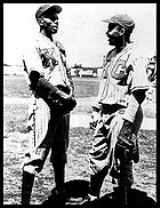
Leroy Robert "Satchel" Paige (July 7, 1906 – June 8, 1982) was an
AmericanThe United States of America is a federal constitutional republic comprising fifty states and a federal district...
baseballBaseball is a bat-and-ball sport played between two teams of nine players each. The aim is to score runs by hitting a thrown ball with a bat and touching a series of four bases arranged at the corners of a ninety-foot diamond...
player whose
pitchingIn baseball, the pitcher is the player who throwsthe baseball from the pitcher's mound toward the catcher to begin each play, with the goal of retiring a batter, who attempts to either make contact with the pitched ball or draw a walk. In the numbering system used to record defensive plays, the...
in the
Negro leaguesThe Negro leagues were United States professional baseball leagues comprising teams predominantly made up of African Americans. The term may be used broadly to include professional black teams outside the leagues and it may be used narrowly for the seven relatively successful leagues beginning in...
and in
Major League BaseballMajor League Baseball is the highest level of professional baseball in the United States and Canada, consisting of teams that play in the National League and the American League...
made him a legend in his own lifetime. He was elected to the Baseball Hall of Fame in 1971, the first player to be inducted from the Negro leagues.
Paige was a right-handed pitcher and was the oldest rookie to play
Major League BaseballMajor League Baseball is the highest level of professional baseball in the United States and Canada, consisting of teams that play in the National League and the American League...
at the age of 42. He played with the
St. Louis BrownsThe Baltimore Orioles are a professional baseball team based in Baltimore, Maryland in the United States. They are a member of the Eastern Division of Major League Baseball's American League. One of the American League's eight charter franchises in 1901, it spent its first year as a major league...
until age 47, and represented them in the
Major League All-Star GameThe Major League Baseball All-Star Game, also known as the "Midsummer Classic", is an annual baseball game between players from the National League and the American League, currently selected by a combination of fans, players, coaches, and managers...
in
1952-Major League Baseball:*World Series: New York Yankees over Brooklyn Dodgers *All-Star Game, July 8 at Shibe Park: National League, 3-2 -Other champions:*Caribbean World Series: La Habana *College World Series: Holy Cross...
and
1953-Major League Baseball:*World Series: New York Yankees over Brooklyn Dodgers *All-Star Game, July 14 at Crosley Field: National League, 5-1-Other champions:*Caribbean World Series: Cangrejeros de Santurce *College World Series: Michigan...
. He first played for the semi-professional
Mobile TigersThe Mobile Tigers, a semi-professional baseball team composed entirely of African-American players based in Mobile, Alabama, was among the leading teams in the Negro League...
from 1924 to 1926. Paige began his professional career in 1926 with the
Chattanooga Black LookoutsThe Chattanooga Black Lookouts was a professional baseball team based in Chattanooga, Tennessee, which played in the Negro Leagues. They were established in 1920, only to play for one season. They were reestablished in 1926 to play for two seasons, serving as a farm team of the Homestead Grays of...
of the
Negro Southern LeagueThe Negro Southern League was a Negro baseball league organized in 1920 that lasted into the 1940s. Negro leagues in Southern United States were far less organized and lucrative than those in the north due to Jim Crow laws. Tom Wilson organized the Negro Southern League in .For most of its...
, and played his last professional game on June 21, 1966, for the Peninsula Grays of the
Carolina LeagueThe Carolina League is a minor league baseball affiliation which operates in the South Atlantic Coast of the United States. Before 2002, it was classified as a "High A" league, indicating its status as a Class A league with the highest level of competition within that classification, and the fifth...
.
Early life
Satchel was born Leroy Robert Page to John Page, a gardener, and Lula Page (née Coleman), a domestic worker, in a section of Mobile, Alabama, known as Down the Bay. Lula and her children changed the spelling of their name from Page to Paige in the mid-1920s, just before the start of Satchel's baseball career. Lula said, "Page looked too much like a page in a book," whereas Satchel explained, "My folks started out by spelling their name 'Page' and later stuck in the 'i' to make themselves sound more high-tone." The introduction of the new spelling coincided with the death of Satchel's father, and may have suggested a desire for a new start.
According to Paige, his nickname originated from childhood work toting bags at the train station. He said he was not making enough money at a dime a bag, so he used a pole and rope to build a contraption that allowed him to cart up to four bags at once. Another kid supposedly yelled, "You look like a walking satchel tree." A different story was told by boyhood friend and neighbor, Wilber Hines, who said he gave Paige the nickname after he was caught trying to steal a bag.
Two weeks before his twelfth birthday, Paige was arrested for
shopliftingShoplifting is theft of goods from a retail establishment. It is one of the most common property crimes dealt with by police and courts....
. Because this incident followed several earlier incidents of theft and
truancyTruancy is any intentional unauthorized absence from compulsory schooling. The term typically describes absences caused by students of their own free will, and usually does not refer to legitimate "excused" absences, such as ones related to medical conditions...
, he was committed to the Industrial School for Negro Children in
Mount Meigs, AlabamaMount Meigs is an unincorporated community in Montgomery County in the state of Alabama. The Mount Meigs Campus, a juvenile correctional facility and the headquarters of the Alabama Department of Youth Services, is in Mount Meigs. Mount Meigs is located at .-History:The area's major export in the...
, the state reform school, until the age of eighteen. During the more than five years he spent at the school, he developed his pitching skills under the guidance of Edward Byrd. Byrd taught Paige to kick his front foot high and to swing his arm around so it looked like his hand was in the batter's face when he released the ball. Paige was released from the reform school in December 1923, six months early.
After his release, Paige played for several Mobile semi-pro teams. He joined the semi-pro
Mobile TigersThe Mobile Tigers, a semi-professional baseball team composed entirely of African-American players based in Mobile, Alabama, was among the leading teams in the Negro League...
where his brother Wilson was already pitching. He also pitched for a semi-pro team named the Down the Bay Boys, and he recalled that he once got into a jam in the ninth inning of a 1–0 ballgame when his teammates made three consecutive errors, loading the bases for the other team with two outs. Angry, Paige said he stomped around the mound, kicking up dirt. The fans started booing him, so he decided that “somebody was going to have to be showed up for that.” He called in his outfielders and had them sit down in the infield. With the fans and his own teammates howling, Paige struck out the final batter, winning the game.
Chattanooga and Birmingham: 1926–29
A former friend from the Mobile slums, Alex Herman, was the player/manager for the
Chattanooga White SoxThe Chattanooga Black Lookouts was a professional baseball team based in Chattanooga, Tennessee, which played in the Negro Leagues. They were established in 1920, only to play for one season. They were reestablished in 1926 to play for two seasons, serving as a farm team of the Homestead Grays of...
of the minor
Negro Southern LeagueThe Negro Southern League was a Negro baseball league organized in 1920 that lasted into the 1940s. Negro leagues in Southern United States were far less organized and lucrative than those in the north due to Jim Crow laws. Tom Wilson organized the Negro Southern League in .For most of its...
. In 1926 he discovered Paige and offered to pay him $250 per month, of which Paige would collect $50 with the rest going to his mother. He also agreed to pay Lula Paige a $200 advance, and she agreed to the contract.
The local newspapers—the
Chattanooga News and
Chattanooga Times—recognized from the beginning that Paige was special. In April 1926, shortly after his arrival, he recorded nine strikeouts over six innings against the
Atlanta Black CrackersThe Atlanta Black Crackers were a professional Negro league baseball team which played during the early to mid 20th century.- Founding :The Crackers were founded in 1919...
. Partway through the 1927 season, Paige's contract was sold to the
Birmingham Black BaronsThe Birmingham Black Barons played professional baseball for Birmingham, Alabama, in the Negro Leagues from 1920 to 1960 when the Major Leagues successfully integrated...
of the major Negro National League (NNL). According to Paige's first memoir, his contract was for $450 per month, but in his second he said it was for $275.
Pitching for the Black Barons, Paige threw hard but was wild and awkward. In his first big game in late June 1927, against the
St. Louis StarsThe St. Louis Stars were a Negro League baseball team that competed in the Negro National League from 1922 to 1931. Founded when Dick Kent and Dr. Sam Sheppard took over the St...
, Paige incited a brawl when his fastball hit the hand of St. Louis catcher Mitchell Murray. Murray then charged the mound and Paige raced for the dugout, but Murray flung his bat and struck Paige above the hip. The police were summoned, and the headline of the
Birmingham Reporter proclaimed a "Near Riot." Paige improved and matured as a pitcher with help from his teammates, Sam Streeter and Harry Salmon, and his manager,
Bill GatewoodWilliam "Big Bill" Gatewood was a Negro Leagues pitcher and manager for several years before the founding of the first Negro National League, and in its first few seasons. He pitched for the Leland Giants, Chicago Giants, Chicago American Giants, New York Lincoln Giants, Cuban X-Giants,...
. He finished the 1927 season 7–1 with 69 strikeouts and 26 walks in 89 innings.
Over the next two seasons, Paige went 12–5 and 10–9 while recording 176 strikeouts in 1929. (Several sources credit his 1929 strikeout total as the all-time single-season record for the Negro leagues, though there is variation among the sources about the exact number of strikeouts.) On April 29 of that season he recorded 17 strikeouts in a game against the
Cuban StarsThe Cuban Stars were a team of Cuban professional baseball players that competed in the United States Negro leagues from 1907 to 1932. The team was also sometimes known as the Stars of Cuba, the Cuban All-Stars, the Havana Reds, the Almendares Blues, or simply as the Cubans. For one season, 1921,...
, which exceeded what was then the
major leagueMajor League Baseball is the highest level of professional baseball in the United States and Canada, consisting of teams that play in the National League and the American League...
record of 16 held by
Noodles HahnFrank George Hahn was a starting pitcher in Major League Baseball who played for the Cincinnati Reds and New York Highlanders . Hahn batted and threw left-handed...
and
Rube WaddellGeorge Edward Waddell was an American southpaw pitcher in Major League Baseball. In his thirteen-year career he played for the Louisville Colonels , Pittsburgh Pirates and Chicago Orphans in the National League, and the Philadelphia Athletics and St. Louis Browns in the American League...
. Six days later he struck out 18
Nashville Elite GiantsThe Baltimore Elite Giants were a professional baseball team that played in the Negro leagues from to . The team was established by Thomas T. Wilson, in Nashville, Tennessee as the semi-pro Nashville Standard Giants on March 26, 1920. The team was renamed the Elite Giants in , and would move to...
, a number that was tied in the white majors by
Bob FellerOn December 8, 1941, Feller enlisted in the Navy, volunteering immediately for combat service, becoming the first Major League Baseball player to do so following the attack on Pearl Harbor on December 7. Feller served as Gun Captain aboard the USS Alabama, and missed four seasons during his service...
in 1938. Due to his increased earning potential, Barons owner R. T. Jackson would “rent” Paige out to other ball clubs for a game or two to draw a decent crowd, with both Jackson and Paige taking a cut.
Cuba, Baltimore, and Cleveland: 1929–31
Abel Linares offered Paige $100 per game to play winter ball for the Santa Clara team in the
Cuban LeagueThe Cuban League was one of the earliest and longest lasting professional baseball leagues outside of the United States, operating in Cuba from 1878 to 1961...
.
GamblingSports betting is the activity of predicting sports results and placing a wager on the outcome.-United States of America:Aside from simple wagers such as betting a friend that one's favorite baseball team will win its division or buying a football "square" for the Super Bowl, sports betting is...
on baseball games in Cuba was such a huge pastime that players were not allowed to drink alcohol, so they could stay ready to play. Paige—homesick for carousing, hating the food, despising the constant inspections and being thoroughly baffled by the language—went 6–5 in Cuba. He left Cuba abruptly before the end of the season, with several stories told about the circumstances. Paige told one version in which the mayor of a small hamlet asked him, in
SpanishSpanish , also known as Castilian , is a Romance language in the Ibero-Romance group that evolved from several languages and dialects in central-northern Iberia around the 9th century and gradually spread with the expansion of the Kingdom of Castile into central and southern Iberia during the...
if he had intentionally lost a particular game. Paige, not understanding a word the man said, nodded and smiled, thinking the man was fawning over him, and then had to flee from the furious mayor. Another version, also told by Paige, says that when he called on an attractive local girl at her home, she and her family interpreted his attentions as an official
engagementAn engagement or betrothal is a promise to marry, and also the period of time between proposal and marriage which may be lengthy or trivial. During this period, a couple is said to be betrothed, affianced, engaged to be married, or simply engaged...
and sent the police to enforce it, leading Paige to flee the island with police in pursuit. A third version, told by the general manager of the Santa Clara Leopards, says that he left Cuba in haste after legal charges were brought against him regarding an amorous incident with "a young lady from the provincial mulatto bourgeoisie."
When Paige returned to the
United StatesThe United States of America is a federal constitutional republic comprising fifty states and a federal district...
, he and Jackson revived their practice of renting him out to various teams. In the spring of 1930, Jackson leased him to the
Baltimore Black SoxThe Baltimore Black Sox were a professional Negro league baseball team based in Baltimore, Maryland.- Founding :The Black Sox started as an independent team in 1916 by George Rossiter and Charles Spedden...
, who had won the 1929
American Negro LeagueThe American Negro League was one of several Negro leagues which were established during the period in the United States in which organized baseball was segregated...
championship led by their bowlegged third baseman
Jud “Boojum” WilsonErnest Judson Wilson , nicknamed "Boojum," was an American third baseman, first baseman, and manager in Negro league baseball. Born in Remington, Virginia, he served in World War I, and during his career played primarily for the Baltimore Black Sox , Homestead Grays , and Philadelphia Stars...
. Paige, as a Southerner, found that he was an outsider on the Black Sox, and his teammates considered him a hick. Moreover, he was the team's number two pitcher behind Lamon Yokely, and Paige did not like being overshadowed.
In mid-summer Paige returned to Birmingham, where he pitched well the rest of the summer, going 7–4. In September he was leased to the
Chicago American GiantsChicago American Giants were a Chicago-based Negro league baseball team, owned and managed from 1911 to 1926 by player-manager Andrew "Rube" Foster. From 1910 until the mid-1930s, the American Giants were the most dominant team in black baseball...
of the NNL for a home-and-home series with the Houston Black Buffaloes of the Texas-Oklahoma League. Paige won one and lost one in the series and then returned to Birmingham.
By the spring of 1931, the
DepressionThe Great Depression was a severe worldwide economic depression in the decade preceding World War II. The timing of the Great Depression varied across nations, but in most countries it started in about 1929 and lasted until the late 1930s or early 1940s...
was taking its toll on the Negro leagues, and the Black Barons had temporarily disbanded. Few teams could afford Paige, but Tom Wilson, who was moving the
Nashville Elite GiantsThe Baltimore Elite Giants were a professional baseball team that played in the Negro leagues from to . The team was established by Thomas T. Wilson, in Nashville, Tennessee as the semi-pro Nashville Standard Giants on March 26, 1920. The team was renamed the Elite Giants in , and would move to...
to
ClevelandCleveland is a city in the U.S. state of Ohio and is the county seat of Cuyahoga County, the most populous county in the state. The city is located in northeastern Ohio on the southern shore of Lake Erie, approximately west of the Pennsylvania border...
as the Cleveland Cubs, thought he could. Playing in the same city as a white major league team, Paige recalled, "I'd look over at the
Cleveland IndiansThe Cleveland Indians are a professional baseball team based in Cleveland, Ohio. They are in the Central Division of Major League Baseball's American League. Since , they have played in Progressive Field. The team's spring training facility is in Goodyear, Arizona...
' stadium, called
League ParkLeague Park was a baseball park located in Cleveland, Ohio, United States. It was situated at the northeast corner of Lexington Avenue and E. 66th Street in the Hough neighborhood. It was home to the National League Cleveland Spiders, the American League Cleveland Indians, and the Cleveland...
...All season long it burned me, playing there in the shadow of that stadium. It didn't hurt my pitching, but it sure didn't do me any good."
Pittsburgh, California, and North Dakota: 1931–36
In June 1931, the
Crawford Colored GiantsThe Pittsburgh Crawfords, popularly known as the Craws, were a professional Negro league baseball team based in Pittsburgh, Pennsylvania. Named after the Crawford Grill, a club in the Hill District of Pittsburgh owned by Gus Greenlee, the Crawfords were originally a youth semipro team sponsored by...
, an independent club owned by
PittsburghPittsburgh is the second-largest city in the US Commonwealth of Pennsylvania and the county seat of Allegheny County. Regionally, it anchors the largest urban area of Appalachia and the Ohio River Valley, and nationally, it is the 22nd-largest urban area in the United States...
underworld figure
Gus GreenleeWilliam Augustus "Gus" Greenlee was a Negro League baseball owner and an African American businessman....
, made Paige an offer of $250 a month. On August 6, Paige made his Crawford debut against their hometown rivals, the
Homestead GraysThe Homestead Grays were a professional baseball team that played in the Negro leagues in the United States. The team was formed in 1912 by Cumberland Posey, and would remain in continuous operation for 38 seasons. The team was based in Homestead, Pennsylvania, adjacent to Pittsburgh.-Franchise...
. Entering the game in the fourth inning, Paige held the Grays scoreless and had six
strikeoutIn baseball or softball, a strikeout or strike-out occurs when a batter receives three strikes during his time at bat. A strikeout is a statistic recorded for both pitchers and batters....
s and no
walksA base on balls is credited to a batter and against a pitcher in baseball statistics when a batter receives four pitches that the umpire calls balls. It is better known as a walk. The base on balls is defined in Section 2.00 of baseball's Official Rules, and further detail is given in 6.08...
in five innings of
reliefA relief pitcher or reliever is a baseball or softball pitcher who enters the game after the starting pitcher is removed due to injury, ineffectiveness, fatigue, ejection, or for other strategic reasons, such as being substituted by a pinch hitter...
work to get the win.
In September, Paige joined a Negro all-star team organized by Tom Wilson, called the Philadelphia Giants, to play in the
California Winter LeagueCalifornia Winter League is a former baseball Winter League. It is the first integrated league in the 20th century as players from Major League Baseball and Negro League Baseball played each other in training games. The league existed for almost 50 years during the first half of the 20th century...
. This was the first of nine winters that he played in a league that provided ongoing competition between elite black and white baseball players, including major and minor league players. On October 24 Paige won his first California game 8–1, allowing five hits and striking out 11, including
Babe HermanFloyd Caves "Babe" Herman was an American right fielder in Major League Baseball who was best known for his several seasons with the Brooklyn Robins ....
four times. He finished the winter with a 6–0 record and 70 strikeouts in 58 innings.
In 1932, Greenlee signed
Josh GibsonJoshua Gibson was an American catcher in baseball's Negro leagues. He played for the Homestead Grays from 1930 to 1931, moved to the Pittsburgh Crawfords from 1932 to 1936, and returned to the Grays from 1937 to 1939 and 1942 to 1946...
,
Oscar CharlestonOscar McKinley Charleston was an American center fielder and manager in baseball's Negro leagues from to ....
and
Ted "Double Duty" RadcliffeTheodore Roosevelt "Double Duty" Radcliffe was at his death thought to be the oldest living professional baseball player , one of only a handful of major league players who lived past their 100th birthdays, and a former star in the...
away from
Cumberland PoseyCumberland Willis "Cum" Posey, Jr. was an American baseball player, manager, and team owner in the Negro leagues, as well as a star professional basketball player and team owner....
's Homestead Grays to assemble one of the finest baseball clubs in history. Paige took the mound when the Crawfords opened the season on April 30 in their newly built stadium,
Greenlee FieldGreenlee Field in Pittsburgh, Pennsylvania, USA, was the first black-built and black-owned major league baseball field in the United States.The field was the dream of Gus Greenlee, owner of the Pittsburgh Crawfords. In 1931, construction started on Bedford Avenue between Chauncy and Duff in...
, the first completely black-owned stadium in the country. Paige lost the opener to the
New York Black YankeesThe New York Black Yankees was a professional baseball team based in New York City, Paterson, NJ, and Rochester, NY which played in the Negro National League from 1936 to 1948. The Black Yankees played in Paterson, New Jersey from 1933-1937 and then from 1939-1945. The 1938 season saw the Black...
in a pitching duel with Jesse "Mountain" Hubbard, but got even with them by beating them twice that season, including Paige’s first Negro league
no-hitterA no-hitter is a baseball game in which one team has no hits. In Major League Baseball, the team must be without hits during the entire game, and the game must be at least nine innings. A pitcher who prevents the opposing team from achieving a hit is said to have "thrown a no-hitter"...
in July. Paige went 10–4, allowing 3.19 runs per game and striking out 92 in 132 innings.
In the midst of the Depression, Cum Posey's new
East-West LeagueThe East-West League was an American Negro baseball league that operated during the period when professional baseball in the United States was segregated. Cum Posey organized the league in 1932, but it didn't last the full year and folded in June of that year...
had collapsed by mid-season, and Greenlee was able to obtain many of the best players in black baseball. By the end of the season, Greenlee had signed to contracts
Cool Papa Bell, John Henry Russell, Leroy Matlock, Jake Stephens, "Boojum" Wilson,
Jimmie CrutchfieldJohn William Crutchfield, born May 25, 1910 in Ardmore, Missouri, United States – died March 31, 1993 in Chicago, Illinois, was an All-Star baseball player in Negro League baseball....
, Ted Page,
Judy JohnsonWilliam Julius "Judy" Johnson was an American third baseman in Negro league baseball.Johnson was born in Snow Hill, Maryland. Although his father wanted him to be a boxer, Johnson, who was 5 ft 11 in and only 150 lb , was far better suited for a career in baseball...
and
Rap DixonHerbert Allen "Rap" Dixon was an American outfielder in Negro League baseball for a number of teams. He was born in Kingston, Georgia....
. With the Crawfords playing five future Hall of Famers, many Negro league historians regard the 1930s Crawfords as the greatest team in Negro league history.
The next season Greenlee organized a new Negro National League, which survived for 16 years. Despite Greenlee's efforts to control his biggest star, Paige followed his own schedule and was often late to games that he was scheduled to pitch. In August, he jumped the Crawfords, accepting an offer from
Neil ChurchillNeil O. Churchill was a car dealer in Bismarck, North Dakota who funded an integrated baseball team in the mid-thirties more than a decade before Jackie Robinson broke the color barrier in Major League Baseball....
’s
North DakotaNorth Dakota is a state located in the Midwestern region of the United States of America, along the Canadian border. The state is bordered by Canada to the north, Minnesota to the east, South Dakota to the south and Montana to the west. North Dakota is the 19th-largest state by area in the U.S....
semi-pro team, the
BismarcksThe Bismarck Churchills were an integrated semi-professional baseball team based in Bismarck, North Dakota in the 1930s. Led by Satchel Paige, Moose Johnson, and Double Duty Radcliffe, the club won the 1935 national semi-pro baseball tournament in Wichita, Kansas.The Churchills played...
(sometimes known as the "Bismarck Churchills" today), of $400 and a late model car for just one month’s work. It was Paige's first experience playing with an integrated team in the United States. He helped Bismarck beat their local rivals in
JamestownAs of the census of 2000, there were 15,527 people, 6,505 households, and 3,798 families residing in the city. The population density was 1,246.7 per square mile . There were 6,970 housing units at an average density of 559.6 per square mile...
, who were also featuring a Negro league ace pitcher, Barney Brown. Paige was unapologetic when he returned to Pittsburgh in September to help the Crawfords win the second-half championship. Paige was snubbed by other Negro league players and fans when he was not selected for the first ever East-West All-Star Game.
1934 was perhaps the best season of Paige's career, as he went 14–2 in league games while allowing 2.16 runs per game, recording 144 strikeouts, and giving up only 26 walks. On July 4, Paige threw his second no-hitter, this time against the Homestead Grays. He struck out 17, and only a first inning walk to future Hall of Famer
Buck LeonardWalter Fenner "Buck" Leonard was an American first baseman in Negro league baseball. He was elected to the Baseball Hall of Fame in along with his long-time teammate Josh Gibson.-Biography:...
and an error in the fourth inning prevented it from being a
perfect gameA perfect game is defined by Major League Baseball as a game in which a pitcher pitches a victory that lasts a minimum of nine innings and in which no opposing player reaches base. Thus, the pitcher cannot allow any hits, walks, hit batsmen, or any opposing player to reach base safely for any...
. Leonard, unnerved by the rising swoop of the ball, repeatedly asked the
umpireIn baseball, the umpire is the person charged with officiating the game, including beginning and ending the game, enforcing the rules of the game and the grounds, making judgment calls on plays, and handling the disciplinary actions. The term is often shortened to the colloquial form ump...
to check the ball for scuffing. When the umpire removed one ball from play, Paige hollered, "You may as well thrown 'em all out 'cause they're all gonna jump like that."
The Denver Post-Ownership:The Post is the flagship newspaper of MediaNews Group Inc., founded in 1983 by William Dean Singleton and Richard Scudder. MediaNews is today one of the nation's largest newspaper chains, publisher of 61 daily newspapers and more than 120 non-daily publications in 13 states. MediaNews...
conducted an annual baseball tournament (sometimes known as the "Little World Series") that attracted semi-pro and independent professional teams from across the country. In 1934 it was open, for the first time, to black players. Greenlee leased Paige to the Colored House of David, a prominent barnstorming team of white men who represented a religious commune and wore beards. Their manager was Hall of Fame pitcher
Grover Cleveland AlexanderGrover Cleveland Alexander , nicknamed "Old Pete", was an American Major League Baseball pitcher. He played for the Philadelphia Phillies, Chicago Cubs, and St. Louis Cardinals and was elected into the Baseball Hall of Fame in 1938.-Career:Alexander was born in Elba, Nebraska, one of thirteen...
. Paige pitched shutouts in his first two starts, striking out 14 and 18. The final, championship game was his third start in five days and he faced the
Kansas City MonarchsThe Kansas City Monarchs were the longest-running franchise in the history of baseball's Negro Leagues. Operating in Kansas City, Missouri and owned by J.L. Wilkinson, they were charter members of the Negro National League from 1920 to 1930. J.L. Wilkinson was the first Caucasian owner at the time...
—at the time an independent, barnstorming team—who were participating in the tournament with a lineup augmented by Negro league stars
Turkey StearnesNorman Thomas "Turkey" Stearnes was an African American center fielder in the Negro leagues. He was elected to the Baseball Hall of Fame in 2000.-Early Life and career:...
and
Sam BankheadSamuel Howard Bankhead was a baseball player in the Negro Leagues. He played pitcher, infielder, and outfielder from 1930 to 1950. He also played for the Dragones de Ciudad Trujillo along with Satchel Paige and Josh Gibson. His brother Dan Bankhead played in the Major Leagues.-References:*...
. Paige faced
Chet BrewerChester Arthur "Chet" Brewer was an American right-handed pitcher in baseball's Negro Leagues. Born in Leavenworth, Kansas, he played for the Kansas City Monarchs, and from 1957 to 1974 he scouted for the Pittsburgh Pirates....
before a crowd of 11,120. Paige won the pitchers' duel 2–1, striking out 12 Monarchs for a tournament total of 44 strikeouts in 28 innings. The 1934 tournament was Paige's first major exposure in front of the white press.
Paige received his first East–West All Star Game selection in 1934. Playing for the East, Paige came in during the sixth inning with a man on second and the score tied 0–0, and proceeded to strike out Alec Radcliffe and retire
Turkey StearnesNorman Thomas "Turkey" Stearnes was an African American center fielder in the Negro leagues. He was elected to the Baseball Hall of Fame in 2000.-Early Life and career:...
and
Mule SuttlesGeorge "Mule" Suttles was an American first baseman and outfielder in Negro league baseball, most prominently with the Birmingham Black Barons, St. Louis Stars and Newark Eagles...
on soft fly balls. The East scored one run in the top of the eighth and Paige held the West scoreless the rest of the way, giving him his first All-Star Game victory.
Despite an outstanding season, Paige had a strong competitor for best Negro league pitcher of 1934, the 21-year old Slim Jones of the
Philadelphia StarsThe Philadelphia Stars were a Negro league baseball team from Philadelphia, Pennsylvania. The Stars were founded in 1933 when Ed Bolden returned to professional black baseball after being idle since early 1930...
, who went 22–3 in league games. In September, a four-team charity benefit doubleheader was played at Yankee Stadium, with the second game featuring a faceoff between Paige and Jones. Paige recalled driving all night from Pittsburgh and parking near the stadium, then falling asleep in the car. A batboy found and woke him, and he got into uniform just in time for his scheduled start. In a game that was sometimes described as the greatest game in Negro league history, Paige and Jones battled to a 1–1 tie that was called because of darkness. A rematch was scheduled, and this time Paige and the Crawfords beat Jones and the Stars 3–1.
That fall, Paige faced off against major league star
Dizzy DeanJay Hanna "Dizzy" Dean was an American Major League Baseball pitcher. He was the last National League pitcher to win 30 games in one season. Dean was elected to the Baseball Hall of Fame in 1953....
, who that season had won 30 regular season games plus two more in the
World SeriesThe World Series is the annual championship series of Major League Baseball, played between the American League and National League champions since 1903. The winner of the World Series championship is determined through a best-of-seven playoff and awarded the Commissioner's Trophy...
, in several exhibition games. In Cleveland, Paige struck out 13 while beating Dean 4–1, although for that game Dean was playing with a minor league team. Later, while playing in the
California Winter LeagueCalifornia Winter League is a former baseball Winter League. It is the first integrated league in the 20th century as players from Major League Baseball and Negro League Baseball played each other in training games. The league existed for almost 50 years during the first half of the 20th century...
, Paige faced Dean in front of 18,000 fans in Los Angeles, with Dean's team including major league stars like
Wally BergerWalter Anton Berger was an American center fielder in Major League Baseball who played for four National League teams, primarily the Boston Braves. One of the league's top sluggers of the early 1930s, in his initial season he hit 38 home runs, a record for rookies which stood until . He still...
. The two teams battled for thirteen innings, with Paige's team finally winning 1–0.
Bill VeeckWilliam Louis Veeck, Jr. , also known as "Sport Shirt Bill", was a native of Chicago, Illinois, and a franchise owner and promoter in Major League Baseball. He was best known for his publicity stunts to raise attendance. Veeck was at various times the owner of the Cleveland Indians, St. Louis...
, future owner of the
Cleveland IndiansThe Cleveland Indians are a professional baseball team based in Cleveland, Ohio. They are in the Central Division of Major League Baseball's American League. Since , they have played in Progressive Field. The team's spring training facility is in Goodyear, Arizona...
, St. Louis Browns, and
Chicago White SoxThe Chicago White Sox are a Major League Baseball team located in Chicago, Illinois.The White Sox play in the American League's Central Division. Since , the White Sox have played in U.S. Cellular Field, which was originally called New Comiskey Park and nicknamed The Cell by local fans...
, was watchng the game and many years later described it as "the greatest pitchers' battle I have ever seen." Paige and Dean would continue to barnstorm against each other until 1945. Later, when Dean was a sports columnist for the
Chicago TribuneThe Chicago Tribune is a major daily newspaper based in Chicago, Illinois, and the flagship publication of the Tribune Company. Formerly self-styled as the "World's Greatest Newspaper" , it remains the most read daily newspaper of the Chicago metropolitan area and the Great Lakes region and is...
, he called Paige "the pitcher with the greatest stuff I ever saw."
In the spring of 1935, Greenlee refused Paige's request to raise his $250 per month salary, so Paige decided to return to Bismarck for the same $400 per month and late model used car that he got before. Churchill added other Negro league players to the team—pitchers
Barney MorrisBarney Morris was a baseball player in the Negro Leagues. A skillful pitcher, he played for the Monroe Monarchs, the Bismarck Churchills, the Pittsburgh Crawfords, and the New York Cubans.-References:*...
, and
Hilton SmithHilton Lee Smith was an American right-handed pitcher in Negro league baseball. In 2001 he was inducted into the National Baseball Hall of Fame.-Biography:...
, catcher
Quincy TrouppeQuincy Thomas Trouppe was an American professional baseball player and an amateur boxing champion. He was a catcher in the Negro Leagues from 1930 to 1949. He was a native of Dublin, Georgia....
, and pitcher/catcher Double Duty Radcliffe. Paige dominated the competition, with a 29–2 record, 321 strikeouts, and only 16 walks. In Wichita, Ray "Hap" Dumont was establishing a new national baseball tournament, the
National Baseball CongressThe National Baseball Congress of Wichita, Kansas is an organization of 15 amateur and semi-professional baseball leagues operating in the United States and Canada...
. Dumont invited 32 semi-pro teams, paying $1,000 for Paige and his Bismarck teammates to attend. The tournament was held at
Lawrence-Dumont StadiumLawrence-Dumont Stadium is a stadium in Wichita, Kansas. It is primarily used for baseball, and is the home field of the Wichita Wingnuts independent baseball team. It was built in 1934, underwent renovations in 2001 which brought improvements to the stadium sound system, new infield turf, a new...
in
Wichita, KansasWichita is the largest city in the U.S. state of Kansas.As of the 2010 census, the city population was 382,368. Located in south-central Kansas on the Arkansas River, Wichita is the county seat of Sedgwick County and the principal city of the Wichita metropolitan area...
and offered a $7,000 purse. Churchill added yet another Negro league star to his team—Chet Brewer, the Kansas City Monarchs' ace pitcher. Bismarck swept the tournament in seven straight games. Paige won the four games he started, pitched in relief in a fifth game, and struck out 60 batters—a record that still held 74 years later.
In September, Paige could not return to the NNL because he was banned from the league for the 1935 season for jumping to the Bismarck team.
J. L. WilkinsonJames Leslie Wilkinson was an American sports executive who founded the barnstorming All Nations baseball club in 1912, and the Negro league baseball team Kansas City Monarchs in 1920....
, owner of the independent Kansas City Monarchs, signed Paige on a game-by-game basis through the end of the season.
That winter, a northern California promoter, Johnny Burton, hired Paige to front a team called the "Satchel Paige All-Stars," in a game to be held on February 7, 1936 in Oakland against a white all-star squad. The opposing team included a number of major league players out of the
Bay AreaSan Francisco , officially the City and County of San Francisco, is the financial, cultural, and transportation center of the San Francisco Bay Area, a region of 7.15 million people which includes San Jose and Oakland...
, including
Ernie LombardiErnesto Natali "Ernie" Lombardi , was a Major League Baseball catcher for the Brooklyn Robins, the Cincinnati Reds, the Boston Braves and the New York Giants during a Hall of Fame career that spanned 17 years, from 1931 to 1947. He had several nicknames, including "Schnozz", "Lumbago", "Bocci",...
,
Augie GalanAugust John Galan was a left fielder in Major League Baseball. From 1934 through 1949, he played for the Chicago Cubs , Brooklyn Dodgers , Cincinnati Reds , New York Giants and Philadelphia Athletics . Galan threw right-handed and began his career as a switch hitter...
,
Cookie LavagettoHarry Arthur "Cookie" Lavagetto was a third baseman, manager and coach in American Major League Baseball. He is most widely known as the pinch hitter whose double ruined Bill Bevens' no-hitter in Game 4 of the 1947 World Series and gave his Brooklyn Dodgers a breathtaking victory over the New...
, and
Gus SuhrAugust Richard "Gus" Suhr was a Major League Baseball first baseman. Suhr was born in San Francisco, California, USA...
, as well as
Pacific Coast LeagueThe Pacific Coast League is a minor-league baseball league operating in the Western, Midwestern and Southeastern United States. Along with the International League and the Mexican League, it is one of three leagues playing at the Triple-A level, which is one step below Major League Baseball.The...
star
Joe DiMaggioJoseph Paul "Joe" DiMaggio , nicknamed "Joltin' Joe" and "The Yankee Clipper," was an American Major League Baseball center fielder who played his entire 13-year career for the New York Yankees. He is perhaps best known for his 56-game hitting streak , a record that still stands...
, who was making his last stop as a minor leaguer before joining the
New York YankeesThe New York Yankees are a professional baseball team based in the The Bronx, New York. They compete in Major League Baseball in the American League's East Division...
. Other than Negro league catcher, Ebel Brooks, Paige's team was composed of local semi-pro players. Despite the imbalance in talent, Paige kept the game to a 1–1 tie through nine innings, striking out 12 and giving up one run on three hits. In the bottom of the tenth inning, he struck out two more, then gave up a single to
Dick BartellRichard William Bartell , nicknamed "Rowdy Richard," was an American shortstop in Major League Baseball. One of the most ferocious competitors of his era, he won both admirers and critics at each stop during a career which saw him traded every few seasons, often under acrimonious circumstances...
, bringing up DiMaggio. Bartell stole second on the first pitch, then went to third on a wild pitch. DiMaggio then hit a hard hopper to the mound that Paige deflected; DiMaggio beat the second baseman's throw to drive in the winning run. A Yankee scout watching the game wired the club that day a report that read, "DiMaggio everything we'd hoped he'd be: Hit Satch one for four." DiMaggio later said that Paige was the best pitcher he had ever faced.
In 1936, Paige returned to Pittsburgh where Greenlee acquiesced to Paige’s salary demands and gave him a $600-per-month contract, by far the highest in the Negro leagues. In games for which complete box scores are available, Paige went 5–0, allowed 3.21 runs per game, and struck out 47 in 47 innings. At the end of the season, Tom Wilson arranged with the other NNL owners to assemble an all-star team that would enter the lucrative
Denver Post tournament. The team included Paige, Josh Gibson, Cool Papa Bell, Leroy Matlock, Buck Leonard,
Felton SnowFelton Snow was a Negro League professional baseball player who played for the Nashville Elite Giants that later became the Columbus Elite Giants, the Washington Elite Giants, and the Baltimore Elite Giants. Mr. Snow played on the West Squad in the East-West All-Star games of 1935 and 1936...
,
Bill WrightBurnis "Bill" Wright is a retired baseball player in the Negro Leagues. He would play outfielder and played from 1932 to 1945.-References:*...
and Sammy Hughes. They swept the tournament in seven straght games to win the $5,000 prize, with Paige winning three of them. In the title game against an overmatched semi-pro team from
Borger, TexasBorger is the largest city in Hutchinson County, Texas, United States. The population was 14,302 at the 2000 census. Borger is named for businessman Asa Philip "Ace" Borger, who also established the Hutchinson County seat of Stinnett and several other small towns in Texas and Oklahoma.- History...
, Paige pitched a 7–0 shutout, striking out 18. The Negro league all-stars then barnstormed, playing a series against a team of major leaguers led by
Rogers HornsbyRogers Hornsby, Sr. , nicknamed "The Rajah", was an American baseball infielder, manager, and coach who played 23 seasons in Major League Baseball . He played for the St. Louis Cardinals , New York Giants , Boston Braves , Chicago Cubs , and St. Louis Browns...
. One matchup featured Paige facing the 17-year-old
Bob FellerOn December 8, 1941, Feller enlisted in the Navy, volunteering immediately for combat service, becoming the first Major League Baseball player to do so following the attack on Pearl Harbor on December 7. Feller served as Gun Captain aboard the USS Alabama, and missed four seasons during his service...
, who had just finished a half season with the Cleveland Indians. Each pitched three innings and gave up one hit, with Feller striking out eight and Paige seven. Later in the game, the Negro league team pulled out a win.
Dominican Republic: 1937
In the spring of 1937 the Crawfords were training in New Orleans, and Paige was approached by Dr. José Enrique Aybar, dean of the
University of Santo DomingoThe Universidad Autónoma de Santo Domingo is the public university system in the Dominican Republic with its main campus in Santo Domingo and regional centers across the Republic...
, deputy of the
Dominican RepublicThe Dominican Republic is a nation on the island of La Hispaniola, part of the Greater Antilles archipelago in the Caribbean region. The western third of the island is occupied by the nation of Haiti, making Hispaniola one of two Caribbean islands that are shared by two countries...
’s national congress and director of Los Dragones, a baseball team operated by Rafael Trujillo,
dictatorA dictator is a ruler who assumes sole and absolute power but without hereditary ascension such as an absolute monarch. When other states call the head of state of a particular state a dictator, that state is called a dictatorship...
of the Dominican Republic. Aybar hired Paige to act as an agent for Trujillo in recruiting other Negro league players to play for
Los Dragones. Aybar gave Paige $30,000 to hire as many players as he could. Paige recruited five of his Crawfords teammates—Cool Papa Bell, Leroy Matlock,
Sam BankheadSamuel Howard Bankhead was a baseball player in the Negro Leagues. He played pitcher, infielder, and outfielder from 1930 to 1950. He also played for the Dragones de Ciudad Trujillo along with Satchel Paige and Josh Gibson. His brother Dan Bankhead played in the Major Leagues.-References:*...
, Harry Williams and Herman Andrews—as well as Josh Gibson, who had recently been traded to the Homestead Grays. Other Dominican teams were also recruiting Negro league players. Greenlee and his fellow owners banned Paige and the other jumpers from the organized Negro leagues, but failed to dissuade the players.
In the Dominican Republic, the American players were shadowed by armed guards. Although the purpose of the guards was to protect the players, the players were fearful that Trujillo would unleash them in anger if his team lost the championship. The season ended with an eight game series between the two top teams, Paige's Dragones of "Ciudad Trujillo" (as Trujillo had renamed the capital city of
Santo DomingoSanto Domingo, known officially as Santo Domingo de Guzmán, is the capital and largest city in the Dominican Republic. Its metropolitan population was 2,084,852 in 2003, and estimated at 3,294,385 in 2010. The city is located on the Caribbean Sea, at the mouth of the Ozama River...
) and the
Águilas Cibaeñas of
SantiagoSantiago de los Caballeros is a city in the Dominican Republic. Founded in 1495 during the first wave of European colonization of the New World, today Santiago is the second largest metropolis in the Dominican Republic, located in the north-central region of the Republic known as Cibao valley...
. The Dragones won the first four, with Paige contributing two of them. The Águilas came back to win the next two and still had a chance to win the championship if they won the final two games. In Paige's memoirs, he recalled finishing the game with two shutout innings to hold onto a 6–5 win while soldiers looked on "like a firing squad." In reality, however, Paige did not enter the game until there was one out in the ninth inning, with his team leading 8–3. He proceeded to give up three runs on three hits before he got the third out on a great throw by Bankhead. Paige had an excellent season overall, however, leading the league with an 8–2 record.
Paige and the other players returning from the Dominican Republic faced a Negro league ban for jumping their teams. In response, they formed a barnstorming team called "Trujillo’s All-Stars," which was later known as the "Satchel Paige All-Stars." Wilkinson evaded the ban by having promoter Ray Dean schedule games between the All-Stars and the House of David. In August, the All-Stars won the
Denver Post tournament. In late September, Paige faced a team of Negro league all-stars at the
Polo GroundsThe Polo Grounds was the name given to four different stadiums in Upper Manhattan, New York City, used by many professional teams in both baseball and American football from 1880 until 1963...
. Despite striking out eight and allowing only two runs, he lost when the opposing pitcher, Johnny "Schoolboy" Taylor, tossed a no-hitter. A week later a rematch was held at Yankee Stadium, and this time Paige beat Taylor handily.
Mexico: 1938
In 1938, Greenlee, who still held Paige's NNL contract, again made an unsuccessful attempt to sign Paige. Greenlee then sold his contract to the
Newark EaglesThe Newark Eagles was a professional Negro league baseball team that played in the second Negro National League from 1936 to 1948.- Formation :...
for $5,000, but they could not sign him either. Paige instead went to play in the Mexican League.
Jorge Pasquel, a Mexican baseball executive and businessman, and his four brothers wanted the Mexican League to compete with the major leagues. Their plan to do that was to hire the best Negro league players who were ignored by the big leagues, then raid big league teams and field integrated clubs in the name of international baseball. With this goal, they hired Paige for $2,000 per month to play for the moribund Club Agrario of
Mexico CityMexico City is the Federal District , capital of Mexico and seat of the federal powers of the Mexican Union. It is a federal entity within Mexico which is not part of any one of the 31 Mexican states but belongs to the federation as a whole...
, to create a rivalry for Club Azules of
VeracruzVeracruz, officially known as Heroica Veracruz, is a major port city and municipality on the Gulf of Mexico in the Mexican state of Veracruz. The city is located in the central part of the state. It is located along Federal Highway 140 from the state capital Xalapa, and is the state's most...
, a powerhouse bunch led by
Martín DihigoMartín Magdaleno Dihigo Llanos was a Cuban player in baseball's Negro leagues and Latin American leagues who excelled at several positions, primarily as a pitcher and second baseman...
. Back in the states, Greenlee, out $5,000, declared Paige "banned forever from baseball."
Pitching in Venezuela, Paige felt pain in his right shoulder. After he arrived in Mexico, the pain developed into the first major injury of his career. He tried to pitch through the pain, and managed to beat Dihigo in their first matchup in early September, allowing one run in eight innings. Two weeks later they faced off again, and this time Paige could barely lift his arm. He managed to go six-plus innings in a game that Paige's team ultimately lost 10 to 3. One sportswriter wrote that Paige looked like a "squeezed lemon."
Paige returned to his hotel room. He recalled that the next morning, "My stomach got sick with the pain that shot up my right arm. Sweat popped out all over me. The pain wouldn't quit. I tried lifting my arm. I couldn't. I just sat there, sweating, hurting enough to want to cry, getting sicker in the stomach and getting scared—real scared. My arm. I couldn't lift it." He was examined by physicians in Mexico and in the United States; one expert told him that he would never pitch again.
Kansas City Travelers: 1939
With his arm injured, Paige suddenly found himself unemployable. He looked for work as a manager or coach, but was unsuccessful. One ballclub owner was willing to give him a chance to play ball again—J.L. Wilkinson of the Monarchs. Wilkinson offered him the modest opportunity to play, not for the
Negro American LeagueThe Negro American League was one of the several Negro leagues which were created during the time organized baseball was segregated. The league was established in 1937, and continued to exist until 1960...
Monarchs, but for a second-string barnstorming team called the Travelers, which was now renamed the Satchel Paige All-Stars. Paige would pitch when he could and play first base when he could not.
Managed by Newt Joseph, the team included Byron "Mex" Johnson, but otherwise it mostly functioned as a minor-league team staffed by marginal, aging, or young players. Playing throughout Kansas, Missouri, and Illinois, large crowds turned out to see Paige throw an inning or two, relying on junkballs. Paige recalled, "Everybody'd heard I was a fastballer and here I was throwing Alley Oops and bloopers and underhand and sidearm and any way I could to get the ball up to the plate and get it over, maybe even for a strike. But even that made my arm ache like a tooth was busting every time I threw. And the balls I was throwing never would fool anybody in the Negro leagues, not without a fast ball to go with them."
Sometime that summer Paige's fast ball returned. Paige's catcher, Frazier "Slow" Robinson, recalled that one afternoon Paige told him, "You better be ready because I'm ready today." Paige then surprising him when, with Robinson expecting a lob, Paige "threw that baseball so hard that he knocked the mitt off my hand." Modern sports medicine specialists suggest that Paige suffered from a partially torn rotator cuff in his shoulder caused by repetitive stress. Paige's recovery was assisted by the Monarch's long-time trainer, Frank "Jewbaby" Floyd, who was sent by Wilkinson to work with Paige. Floyd worked with massage, hot and cold water, ointments, and chiropractics. He had Paige rest his arm by pitching fewer innings and playing other positions.
By late fall his team was playing well against major Negro league teams. On September 22, 1939, in the second game of a double-header against the powerful
American GiantsChicago American Giants were a Chicago-based Negro league baseball team, owned and managed from 1911 to 1926 by player-manager Andrew "Rube" Foster. From 1910 until the mid-1930s, the American Giants were the most dominant team in black baseball...
, Paige won a 1–0 game, striking out 10 men in the seven innings before the game was called on account of darkness.
Buck O'NeilJohn Jordan "Buck" O'Neil was a first baseman and manager in the Negro American League, mostly with the Kansas City Monarchs. After his playing days, he worked as a scout, and became the first African American coach in Major League Baseball...
, who had batted against Paige in 1935 and 1936 and faced him again in a game against the parent Monarchs, recalled a dropoff in speed but an improvement in deception. "He could still throw hard. Not as hard as he had thrown, but you're talkin' about somebody thrown' ninety-eight, a hundred miles an hour. But now he's throwin' maybe ninety—which is still more than the average guy... He was the best and, actually, he was so deceptive! You'd look at that big ol' slow arm movin' and—
chooo— that ball's just right by you. And then he'd come up and throw you a change of pace and, oh, man."
Puerto Rico: 1939–40
Paige arrived in
Puerto RicoPuerto Rico , officially the Commonwealth of Puerto Rico , is an unincorporated territory of the United States, located in the northeastern Caribbean, east of the Dominican Republic and west of both the United States Virgin Islands and the British Virgin Islands.Puerto Rico comprises an...
in late October, four weeks after the start of the 1939/40 winter season. He joined the Guayama Witches (
Brujos). The Witches, with a team that featured shortstop Perucho Cepeda and outfielder
Tetelo VargasJuan Esteban Vargas , better known as Tetelo Vargas, was an internationally known baseball player from the Dominican Republic.-Baseball career:...
, were the previous season's champion and in September had won the semi-pro baseball "World Series" in Puerto Rico against the Duncan Cementeers. On November 5, Paige pitched a shut out against rival Santurce, which featured player-manager Josh Gibson, by a lopsided score of 23 to 0.
In a December game against
MayagüezThe Indios de Mayagüez are a baseball team in the Puerto Rican Professional Baseball League . Normally based in Mayagüez, the Indios have won 16 national championships and two Caribbean World Series...
, Paige set a league record by striking out 17. He ended the season with a 19–3 record, a 1.93
ERAIn baseball statistics, earned run average is the mean of earned runs given up by a pitcher per nine innings pitched. It is determined by dividing the number of earned runs allowed by the number of innings pitched and multiplying by nine...
, and 208 strikeouts in 205 innings. The 19 wins and 208 strikeouts set league single-season records that have never been broken. Paige helped his team win the league championship playoff series, winning two games against the San Juan Senadores.
Puerto Rican pitcher, Ramón Bayron, recalled, "It took special eyes to see his pitches." Luis Olmo, who later played with the Brooklyn Dodgers, described Paige that winter as "the best I've ever seen."
1940–42
Paige returned to the Travelers for the 1940 season.
AbeAbraham L. "Abe" Manley was an American sports executive and husband of the first woman inducted into the National Baseball Hall of Fame and Museum, Effa Manley...
and
Effa ManleyEffa L. Manley was an American sports executive, and the first woman inducted into the Baseball Hall of Fame. She co-owned the Newark Eagles baseball franchise in the Negro leagues with her husband Abe from 1935 to 1946 and was sole owner through 1948 after his death...
, owners of the Newark Eagles, still claimed that they still held the rights to Paige's Negro league contract, and retaliated against Wilkinson by signing players from Wilkinson's Negro American League. In late June, the NNL and NAL leaders met to discuss the situation and reached an agreement that allowed Paige to advance to the
Kansas City MonarchsThe Kansas City Monarchs were the longest-running franchise in the history of baseball's Negro Leagues. Operating in Kansas City, Missouri and owned by J.L. Wilkinson, they were charter members of the Negro National League from 1920 to 1930. J.L. Wilkinson was the first Caucasian owner at the time...
and let the Manleys keep the players they had recruited in violation of the inter-league rules. Late in the 1940 season, Paige was promoted to the Monarchs. On September 12, Paige made his debut with the Monarchs against the American Giants and pitched a five-inning darkness-shortened complete game. The Monarchs won 9–3 and Paige struck out ten.
Because of Paige's strong gate appeal, there was considerable demand by outside teams to lease Paige's services to pitch for a single game. With infrequent league games, Wilkinson booked Paige to pitch for small-town teams or other Negro league teams at rates ranging from a third of the total receipts to a fixed fee $250 to $2,000 per game, plus expenses. Wilkinson purchased a
Douglas DC-3The Douglas DC-3 is an American fixed-wing propeller-driven aircraft whose speed and range revolutionized air transport in the 1930s and 1940s. Its lasting impact on the airline industry and World War II makes it one of the most significant transport aircraft ever made...
airplane just to ferry Paige around to these outside appearances. Because of the larger gate when Paige pitched, the Monarchs' owners could also insist on a larger share of the receipts from their road games. Wilkinson and Paige each kept a share of the fees. By the early 1940s, Paige's estimated annual earnings were $40,000, which was four times the pay of the average player on the major league New York Yankees and nearly matched the pay of their top star, Joe DiMaggio.
Hoping for some publicity for Paige, who had received relatively little coverage while pitching in the hinterlands with the Travelers, Wilkinson arranged for Paige to pitch on opening day of 1941 for the
New York Black YankeesThe New York Black Yankees was a professional baseball team based in New York City, Paterson, NJ, and Rochester, NY which played in the Negro National League from 1936 to 1948. The Black Yankees played in Paterson, New Jersey from 1933-1937 and then from 1939-1945. The 1938 season saw the Black...
. Appearing in front of a crowd of 20,000 fans at Yankee Stadium, Paige pitched a complete game, 5–3 victory, striking out eight. As intended, the contest brought considerable coverage from both the black and white media, including a pictorial by
Life magazine.
Paige took over the role of
aceIn baseball, an ace is the best starting pitcher of any team and nearly always the first pitcher in his starting rotation. Barring injury or exceptional circumstances, an ace usually always starts on Opening Day...
pitcher for the Monarchs, while
Hilton SmithHilton Lee Smith was an American right-handed pitcher in Negro league baseball. In 2001 he was inducted into the National Baseball Hall of Fame.-Biography:...
, their former ace, dropped to number two pitcher and sometimes was relegated to relieving Paige. Because of Paige's ability to draw a crowd, he would often be scheduled to start a game and pitch for three innings, with Smith or another teammate assigned to pitch the last six. In addition to Smith, Paige's teammates included first baseman
Buck O'NeilJohn Jordan "Buck" O'Neil was a first baseman and manager in the Negro American League, mostly with the Kansas City Monarchs. After his playing days, he worked as a scout, and became the first African American coach in Major League Baseball...
, shortstop and manager
Newt AllenNewton Henry "Newt" Allen was an American second baseman and manager in baseball's Negro Leagues.Born in Austin, Texas, he began his Negro League career late in 1922 with the Kansas City Monarchs and, except for brief stints with other teams in 1931 and 1932, stayed with the Monarchs until his...
, and center fielder
Willard BrownWillard Jessie Brown , nicknamed "Home Run" Brown, was an American outfielder in the Negro Leagues, Major League Baseball, and inducted into the baseball Hall of Fame.- Negro league :...
. In 1941 the Monarchs won their third consecutive Negro American League championship. Though no standings were published, according to historian John Holway, they had a 24–6 team record for a winning percentage of .800, placing them five games ahead of the second-place
New Orleans/St. Louis StarsThe St. Louis Stars were a Negro League baseball team that competed in the Negro National League from 1922 to 1931. Founded when Dick Kent and Dr. Sam Sheppard took over the St...
.
On August 1, 1941, Paige made his first appearance in the East–West All Star Game in five years, collecting 305,311 votes, 40,000 more than the next highest player, Buck Leonard. Paige entered the game at the start of the eighth inning with the East leading 8–1 and pitched the last two innings. The only hit he gave up was a slow roller to the NNL’s new starting catcher, the
Baltimore Elite GiantsThe Baltimore Elite Giants were a professional baseball team that played in the Negro leagues from to . The team was established by Thomas T. Wilson, in Nashville, Tennessee as the semi-pro Nashville Standard Giants on March 26, 1920. The team was renamed the Elite Giants in , and would move to...
’
Roy CampanellaRoy Campanella , nicknamed "Campy", was an American baseball player, primarily at the position of catcher, in the Negro leagues and Major League Baseball...
.
With America’s entrance into
World War IIWorld War II, or the Second World War , was a global conflict lasting from 1939 to 1945, involving most of the world's nations—including all of the great powers—eventually forming two opposing military alliances: the Allies and the Axis...
,
Dizzy DeanJay Hanna "Dizzy" Dean was an American Major League Baseball pitcher. He was the last National League pitcher to win 30 games in one season. Dean was elected to the Baseball Hall of Fame in 1953....
came out of retirement, forming an all-star team consisting of recently drafted white major league and minor league players. On May 24, Dean faced Paige and the Monarchs in an exhibition game at
Wrigley FieldWrigley Field is a baseball stadium in Chicago, Illinois, United States that has served as the home ballpark of the Chicago Cubs since 1916. It was built in 1914 as Weeghman Park for the Chicago Federal League baseball team, the Chicago Whales...
, the first time a black team ever played at Wrigley. The Monarchs defeated Dean's All-Stars 3–1 in front of a crowd of 29,775. On May 31, Paige teamed up with the
Homestead GraysThe Homestead Grays were a professional baseball team that played in the Negro leagues in the United States. The team was formed in 1912 by Cumberland Posey, and would remain in continuous operation for 38 seasons. The team was based in Homestead, Pennsylvania, adjacent to Pittsburgh.-Franchise...
to face Dean's All-Stars again before 22,000 fans at
Griffith StadiumGriffith Stadium was a sports stadium that stood in Washington, D.C. from 1911 to 1965, between Georgia Avenue and 5th Street, and between W Street and Florida Avenue, NW. An earlier wooden baseball park had been built on the same site in 1891...
. The Grays won 8–1, with Paige striking out seven (including
Washington SenatorsThe Minnesota Twins are a professional baseball team based in Minneapolis, Minnesota. They play in the Central Division of Major League Baseball's American League. The team is named after the Twin Cities area of Minneapolis and St. Paul. They played in Metropolitan Stadium from 1961 to 1981 and the...
star
Cecil TravisCecil Howell Travis was an American shortstop and third baseman in Major League Baseball from 1933 to 1947 who spent his entire career with the Washington Senators. He led the American League in hits in before missing nearly the next four seasons due to military service in World War II...
) in five innings of work.
In the 1942 East-West All-Star Game, Paige entered in the top of the seventh with the score tied 2–2. Pitching the last three innings, he allowed three runs on five hits and was charged with the loss in the 5–2 game.
1942 Colored World Series
The Monarchs won the Negro American League pennant again in 1942. For the first time since 1927, the champions of the two leagues, Kansas City and
Washington/HomesteadThe Homestead Grays were a professional baseball team that played in the Negro leagues in the United States. The team was formed in 1912 by Cumberland Posey, and would remain in continuous operation for 38 seasons. The team was based in Homestead, Pennsylvania, adjacent to Pittsburgh.-Franchise...
, met in the
Colored World SeriesThe Colored World Series was a best-of-seven match-up between the Negro American League champion Kansas City Monarchs and the Negro National League champion Washington-Homestead Grays. In a six-game series, the Monarchs swept the Grays four games to none, with two additional games not counted in...
. Paige started game one in Washington and pitched five shutout innings. The Monarchs scored their first run in the top of the sixth. In the bottom of the frame, Jack Matchett relieved Paige and finished the game, with Kansas City adding seven more runs to win 8–0.
Game two was played two days later in Pittsburgh, and a highlight was Paige's dramatic showdown with Josh Gibson. In the bottom of the sixth, Paige relieved starter Hilton Smith with the Monarchs ahead 2–0. In the seventh inning, he gave up three singles and faced Gibson with the bases loaded and two outs. Gibson fouled off the first two pitches, then whiffed on the third. When Paige told the story in his autobiography, he mythologized the story. According to Paige, the strikeout came in the ninth inning with a one-run lead, and he walked the three batters ahead of Gibson in order to face him. The mythical version was retold by
Buck LeonardWalter Fenner "Buck" Leonard was an American first baseman in Negro league baseball. He was elected to the Baseball Hall of Fame in along with his long-time teammate Josh Gibson.-Biography:...
and Buck O'Neil in their memoirs. In the actual game, the Monarchs added three runs in the top of the eighth to take a 5–0 lead, then Paige gave up four in the bottom of the frame to make it 5–4. The Monarchs added another three in the top of the ninth and won 8–4.
After two days rest, Paige started game three, which was played in Yankee Stadium. Paige gave up two runs in the first and was pulled after two innings. Matchett pitched the remainder of the game, which the Monarchs won, 9–3, giving them a 3–0 lead in the series. The next series game was played a week later in Kansas City. When the injury-plagued Grays brought in star players from other teams, including pitcher
Leon DayLeon Day was an American right-handed pitcher in the Negro leagues. He played for the Baltimore Black Sox, the Brooklyn & Newark Eagles, and the Baltimore Elite Giants.He was elected to the Baseball Hall of Fame in 1995....
, second baseman Lenny Pearson, and outfielder Ed Stone of the
Newark EaglesThe Newark Eagles was a professional Negro league baseball team that played in the second Negro National League from 1936 to 1948.- Formation :...
and shortstop
Bus ClarksonJames Buster Clarkson , better known as Buster or Bus Clarkson, was a baseball player who played briefly in the major leagues and had a long career in the Negro leagues, the minor leagues, and the Puerto Rican Professional Baseball League...
of the
Philadelphia StarsThe Philadelphia Stars were a Negro league baseball team from Philadelphia, Pennsylvania. The Stars were founded in 1933 when Ed Bolden returned to professional black baseball after being idle since early 1930...
, the Monarchs played under protest. Day and Paige both pitched complete games, with Paige giving up four runs on eight hits and Day giving up one run on five hits for a Grays victory. The Monarchs' protest was upheld and the game was disallowed. Game four took place in Shibe Park in Philadelphia, and Paige was scheduled to start, but he did not show up until the fourth inning. According to his autobiography, Paige was delayed in
Lancaster, PennsylvaniaLancaster is a city in the south-central part of the Commonwealth of Pennsylvania. It is the county seat of Lancaster County and one of the older inland cities in the United States, . With a population of 59,322, it ranks eighth in population among Pennsylvania's cities...
by an arrest for speeding. The Grays had taken a 5–4 lead, and Paige immediately entered the game. In the remainder of the game, he did not allow a hit or a run and struck out six, while the Monarchs' hitters scored two runs in the seventh to take the lead and three more in the eighth to win, 9–5, and sweep the series. Paige had pitched in all four official games in the Series (as well as one unofficial one), going 16 innings, striking out 18, and giving up eight hits and six runs.
1943–46
Paige was the West's starting pitcher in the 1943 East-West All-Star Game, played before a record 51,723 fans in Comiskey Park. He pitched three scoreless innings without giving up a hit, struck out four, walked one, and was credited as the winning pitcher in the West's 2–1 victory. As a batter, he hit a double to lead off the bottom of the third, then was lifted for a pitch runner to "thunderous applause."
In the midst of World War II, by 1943 many Negro league players were leaving baseball for the military. Among Paige's Kansas City teammates,
Connie JohnsonConnie Johnson, born Clifford Johnson Jr. , was an American professional baseball player, a pitcher in the Negro Leagues and Major League Baseball.-Kansas City Monarchs:...
, Buck O'Neil, and Ted Strong entered military service that year, and Willard Brown followed them the following season. Paige's Selective Service records show that during the war his draft status evolved from 1-A (available to be drafted) to 2-A ("deferred in support of national health, safety, or interest") to the final 4-A (too old for service, even though when he registered he gave a birth date of 1908, two years younger than his actual birth date). Paige continued to play, and the available statistics show a slip in performance in 1943, with a 6–8 record and a 4.59
run averageIn baseball statistics, run average refers to measures of the rate at which runs are allowed or scored. For pitchers, the run average is the number of runs—earned or unearned—allowed per nine innings...
(his highest average since 1929) reported for the Monarchs. The Monarchs' string of four straight pennants ended, as the Negro American League title was captured by the Birmingham Black Barons in 1943 and 1944 and by the
Cleveland BuckeyesThe Cleveland Buckeyes were a professional baseball team that played in the Negro Leagues. They were established in 1942 in Cincinnati, Ohio . The following season, the team moved to Cleveland, Ohio, where they played their games at League Park...
in 1945.
Before the 1944 East-West All-Star Game—black baseball's most lucrative event—Paige grabbed headlines when he demanded that the owners contribute the receipts to the war relief fund, threatening a player strike if they did not accede. The owners were able to turn the other players and fans against Paige, however, when they revealed that Paige had received $800 for participating in the 1943 game (in contrast to the $50 paid to the other players) and had demanded an extra cut for the 1944 game as well. Paige was removed from the roster and the a strike was averted when the owners agreed to raise the player payments (the East's team accepted $200 each, while the West's players agreed to $100).
In 1946, many of the Monarchs' players, including Willard Brown, Connie Johnson, Buck O'Neil, Ford Smith, and Ted Strong, returned from military service, and the team led the NAL in both the first and second halves, capturing the league pennant. O'Neil led the league in batting average, Brown in home runs, Johnson in wins, and Paige in
total run averageIn baseball statistics, run average refers to measures of the rate at which runs are allowed or scored. For pitchers, the run average is the number of runs—earned or unearned—allowed per nine innings...
.
1946 Colored World Series
The Monarchs faced the Newark Eagles in the Colored World Series. The first game was played at the Polo Grounds and Hilton Smith started for the Monarchs. The Monarchs held a 1–0 lead in the bottom of the sixth, when Smith walked
Larry DobyLawrence Eugene "Larry" Doby was an American professional baseball player in the Negro leagues and Major League Baseball....
to lead off the inning, and Paige was called in to relieve. Paige struck out
Monte IrvinMonford Merrill "Monte" Irvin is a former left fielder and right-handed batter in the Negro leagues and Major League Baseball who played with the Newark Eagles , New York Giants and Chicago Cubs .-Biography:Although born in Haleburg, Alabama, Irvin grew up in Orange, New Jersey, one of five...
and Lenny Pearson, but Doby stole second and Paige gave up a single to Johnny Davis, which tied the game. In the top of the seventh, the Monarchs got the lead back when Paige hit a single, advanced to second on an error, and scored on a hit by Herb Souell. Paige shut down the Eagles for the rest of the game, striking out eight and allowing four hits over four innings, and was credited with the win.
Two days later, Paige came into the second game in a similar situation as the first, but the result was quite different. Ford Smith started the game for the Monarchs, and he had a 4–1 lead entering the bottom of the seventh. After allowing two runs and with Irvin on first, Paige was brought in to protect the 4–3 lead. This time, however, Paige gave up four hits before the end of the inning, and four runs crossed the plate. Paige finished the game, but was charged with the loss in the 7–4 game.
The next two games were played in Kansas City, and the Monarchs won game three, getting a complete game from Jim LaMarque. Ted Alexander started game four, but gave way to Paige in the top of the sixth with the Monarchs trailing 4–1. Paige gave up three runs on three hits in the sixth, including a home run to Irvin. He went on to finish the game, giving up one more run in the seventh, and the Monarchs lost 8 to 1.
Kansas City won the fifth game and Newark won the sixth. For the deciding game seven, Paige was missing. Buck O'Neil believed Paige was meeting with Bob Feller about their upcoming barnstorming tour. With Ford Smith pitching, the Monarchs lost 3 to 2, and the Eagles claimed the championship.
Barnstorming with Feller: 1946–47
In 1946, Bob Feller organized the first barnstorming tour to use airplanes to travel from site to site. His tour has been described as "the most ambitious baseball undertaking since
John McGrawJohn McGraw may refer to:* John McGraw , , New York lumber tycoon, and one of the founding trustees of Cornell University* John McGraw , , Governor of Washington state from 1893–1897...
and
Charles ComiskeyCharles Albert "The Old Roman" Comiskey was a Major League Baseball player, manager and team owner. He was a key person in the formation of the American League and later owned the Chicago White Sox...
dreamed up their round-the-world junket in 1913." For his team, Feller recruited all-stars from both major leagues. As his main opponent, he asked Paige to head a team of Negro league all-stars.
Bob Feller's team included 1946 American League batting champion,
Mickey VernonJames Barton "Mickey" Vernon was an American first baseman in Major League Baseball who played for the Washington Senators for the majority of his career, as well as four other teams: the Cleveland Indians , Boston Red Sox , Milwaukee Braves and Pittsburgh Pirates...
, at first base,
Johnny BerardinoJohn Beradino was an American infielder in Major League Baseball and an actor. Known as Johnny Berardino during his baseball career, he was also credited during his acting career as John Baradino, John Barardino or John Barradino.-Early life and education:He was born Giovanni Berardino in Los...
at second,
Phil RizzutoPhilip Francis Rizzuto , nicknamed "The Scooter", was an American Major League Baseball shortstop. He spent his entire 13-year baseball career for the New York Yankees...
at shortstop, and
Ken KeltnerKenneth Frederick Keltner was an American professional baseball player. He played almost his entire Major League Baseball career as a third baseman with the Cleveland Indians, until his final season when he played 13 games for the Boston Red Sox. He batted and threw right-handed...
at third. The outfielders were
Jeff HeathJohn Geoffrey Heath was a Canadian left fielder in Major League Baseball who played most of his career for the Cleveland Indians. He was one of the American League's most promising power hitters of the late 1930s and early 1940s, twice leading the AL in triples, and batting at least .340 with over...
,
Charlie KellerCharles Ernest "Charlie" Keller was a left fielder in Major League Baseball. From 1939 through 1952, Keller played for the New York Yankees and Detroit Tigers...
, and
Sam ChapmanSamuel Blake Chapman was an American two-sport athletic star who played as a center fielder in Major League Baseball, spending nearly his entire career with the Philadelphia Athletics . He batted and threw right-handed, leading the American League in putouts four times...
; after the
World Series-Game 1:Sunday, October 6, 1946 at Sportsman's Park in St. Louis, MissouriThe Red Sox won Game 1 when Rudy York hit a home run into the left field bleachers.-Game 2:Monday, October 7, 1946 at Sportsman's Park in St...
was over, National League batting champion
Stan MusialStanley Frank "Stan" Musial is a retired professional baseball player who played 22 seasons in Major League Baseball for the St. Louis Cardinals . Nicknamed "Stan the Man", Musial was a record 24-time All-Star selection , and is widely considered to be one of the greatest hitters in baseball...
would also join the tour. Catching was shared by
Jim HeganJames Edward Hegan was an American professional baseball player, coach and scout. He played for seventeen seasons as a catcher in Major League Baseball from to and from to , most notably for the Cleveland Indians. After his playing career was over, he became a coach and scout in a baseball...
and
Frankie HayesFrank Witman Hayes was an American professional baseball player. He played as a catcher in Major League Baseball from to and, was highly regarded for his defensive abilities. He played most of his career for Connie Mack's Philadelphia Athletics and also spent time with the St. Louis Browns,...
. In addition to Feller, the pitching staff included
Bob LemonRobert Granville Lemon was an American right-handed pitcher in Major League Baseball. He was elected to the Baseball Hall of Fame in 1976....
,
Dutch LeonardEmil John "Dutch" Leonard was an American professional baseball player. He played in in Major League Baseball as a right-handed knuckleball pitcher for the Brooklyn Dodgers , Washington Senators , Philadelphia Phillies , and Chicago Cubs...
,
Johnny SainJohn Franklin Sain was an American right-handed pitcher in Major League Baseball who was best known for teaming with left-hander Warren Spahn on the Boston Braves teams from 1946 to 1951...
,
Spud ChandlerSpurgeon Ferdinand "Spud" Chandler was an American right-handed starting pitcher in major league baseball, who played his entire career for the New York Yankees from 1937 through 1947...
, and
Fred HutchinsonFrederick Charles Hutchinson was an American professional baseball player, a major league pitcher for the Detroit Tigers. He also was a manager for three major league teams...
.
With help from J.L. Wilkinson and Tom Baird, Paige assembled a team that included first basemen Buck O'Neil, second baseman Hank Thompson, shortstops Chico Renfroe and
Artie WilsonArthur Lee Wilson was a shortstop in Major League and Negro league baseball who was an all-star for the Birmingham Black Barons of the Negro leagues before playing one season in the major leagues for the New York Giants...
, third basemen Howard Easterling and Herb Souell, outfielders Gene Benson and Johnny Davis, catcher Quincy Trouppe, and pitchers Barney Brown, Gentry Jessup, Rufus Lewis, Hilton Smith, and Neck Stanley.
Feller scheduled 35 games in 31 cities in 17 different states, all to be played in 27 days. The tour would require 13,000 miles of travel. Several same-day multicity doubleheaders were to be played. Feller leased two
DC-3The Douglas DC-3 is an American fixed-wing propeller-driven aircraft whose speed and range revolutionized air transport in the 1930s and 1940s. Its lasting impact on the airline industry and World War II makes it one of the most significant transport aircraft ever made...
airplanes, with "Bob Feller All-Stars" painted on one fuselage and "Satchel Paige All-Stars" on the other. While Feller's team would face several other opponents, the majority of the games were against Paige's team. Feller and Paige would start each game whenever possible and usually pitch one to five innings.
The first game was played at Forbes Field in Pittsburgh on September 30, two days after the end of the major league season and one day after the final game of the Colored World Series. Paige and Feller each pitched three innings and left the game with the score tied 1–1. Feller struck out three and gave up two hits, while Paige struck out four and gave up only one hit. Paige's team broke the tie in the seventh inning when Hank Thompson walked and stole second and Souell drove him home with a single up the middle.
Over the next six days, Feller's team won games in Youngstown, Cleveland, Chicago, Cincinnati, New York, and Newark, before Paige's team won a second game in New York. Paige pitched five shutout innings in Yankee Stadium before a crowd of 27,462. After the game they flew to Baltimore, where that same evening Paige's team beat Feller's. The next day, Paige's team won again in Columbus. From there, Feller's team won games in
Dayton, OhioDayton is the 6th largest city in the U.S. state of Ohio and the county seat of Montgomery County, the fifth most populous county in the state. The population was 141,527 at the 2010 census. The Dayton Metropolitan Statistical Area had a population of 841,502 in the 2010 census...
,
Richmond, IndianaRichmond is a city largely within Wayne Township, Wayne County, in east central Indiana, United States, which borders Ohio. The city also includes the Richmond Municipal Airport, which is in Boston Township and separated from the rest of the city...
,
Council Bluffs, IowaCouncil Bluffs, known until 1852 as Kanesville, Iowathe historic starting point of the Mormon Trail and eventual northernmost anchor town of the other emigrant trailsis a city in and the county seat of Pottawattamie County, Iowa, United States and is on the east bank of the Missouri River across...
, and
Wichita, KansasWichita is the largest city in the U.S. state of Kansas.As of the 2010 census, the city population was 382,368. Located in south-central Kansas on the Arkansas River, Wichita is the county seat of Sedgwick County and the principal city of the Wichita metropolitan area...
. They then played two games in Kansas City, with Paige's team winning the first game on a three-run
walk-off home runIn baseball, a walk-off home run is a home run that ends the game. It must be a home run that gives the home team the lead in the bottom of the final inning of the game—either the ninth inning, or any extra inning, or any other regularly scheduled final inning...
by Johnny Davis, and Feller's team winning the second. After that series, Feller's team continued on to Denver and California, while most of Paige's team left the tour. Paige, however, continued on to California where he joined a lesser team, Chet Brewer's Kansas City Royals, which was scheduled to play Feller's All-Stars.
Paige faced Feller in Los Angeles and in San Diego and lost both games. Another scheduled matchup was cancelled when Paige filed a lawsuit against Feller, claiming that Feller had not paid some of the money he was owed. Overall, Feller had pitched 54 innings against Paige's team and given up 15 runs, an average of 2.50 per nine innings. Paige had pitched 42 innings and allowed 18 runs, or 3.86 per nine innings.
After the 1947 season, Feller organized another all-star team for a barnstorming tour. This time, Paige was not invited to tour with him, with Feller opting to play more games in the South against white opponents. Paige did face Feller twice, however, while playing with Chet Brewer's Kansas City Royals in Los Angeles. In the first game, on October 15, both pitchers went four innings. Feller gave up four hits and one walk and struck out two, while Paige gave up just two hits and one walk and struck out seven. Nevertheless, Paige took the loss when he gave up a run in the fourth when Keltner singled and later scored on a sacrifice fly by Heath. On October 19, they again faced each other in front of a crowd of 12,000-plus. Both pitchers went five innings. Paige allowed three hits and no walks, and struck out eight, including
Ralph KinerRalph McPherran Kiner is an American former Major League Baseball player and has been an announcer for the New York Mets since the team's inception. Though injuries forced his retirement from active play after 10 seasons, Kiner's tremendous slugging outpaced nearly all of his National League...
twice. He left the game with a 1–0 lead, but Feller's team came back in the late innings to win 2–1.
Integration in baseball
When
Branch RickeyWesley Branch Rickey was an innovative Major League Baseball executive elected to the Baseball Hall of Fame in 1967...
signed
Jackie RobinsonJack Roosevelt "Jackie" Robinson was the first black Major League Baseball player of the modern era. Robinson broke the baseball color line when he debuted with the Brooklyn Dodgers in 1947...
, a teammate of Paige, Paige realized that it was for the better that he himself was not the
first black in major league baseballThe color line in American baseball excluded players of black African descent from Organized Baseball, or the major leagues and affiliated minor leagues, until Jackie Robinson signed with the Brooklyn Dodgers organization for the 1946 season...
. Robinson started in the minors, and had a major league team started him in its minor league affiliate, Paige would have probably seen this as an insult. Paige eventually realized that by integrating baseball in the minor leagues first with Robinson, the white major league players got the chance to “get used to” the idea of playing alongside black players. Understanding that, Paige said in his autobiography that, “Signing Jackie like they did still hurt me deep down. I’d been the guy who’d started all that big talk about letting us in the big time. I’d been the one who’d opened up the major league parks to colored teams. I’d been the one who the white boys wanted to go barnstorming against.” Paige, and all other black players, knew that quibbling about the choice of the first black player in the major leagues would do nothing productive, so, despite his inner feelings, Paige said of Robinson, “He’s the greatest colored player I’ve ever seen.”
Finally, on July 7, 1948, with his
Cleveland IndiansThe Cleveland Indians are a professional baseball team based in Cleveland, Ohio. They are in the Central Division of Major League Baseball's American League. Since , they have played in Progressive Field. The team's spring training facility is in Goodyear, Arizona...
in a pennant race and in desperate need of pitching, Indians owner
Bill VeeckWilliam Louis Veeck, Jr. , also known as "Sport Shirt Bill", was a native of Chicago, Illinois, and a franchise owner and promoter in Major League Baseball. He was best known for his publicity stunts to raise attendance. Veeck was at various times the owner of the Cleveland Indians, St. Louis...
brought Paige in to try out with Indians player/manager
Lou BoudreauLouis "Lou" Boudreau was an American Major League Baseball player and manager. He was elected to the Baseball Hall of Fame in 1970...
. On that same day, his 42nd birthday, Paige signed his first major league contract, for $40,000 for the three months remaining in the season, becoming the first Negro pitcher in the American League and the seventh Negro big leaguer overall.
The Cleveland Indians
On July 9, 1948, Paige became the oldest man ever to debut in the major leagues, at the age of 42 years and two days. With the
St. Louis BrownsThe Baltimore Orioles are a professional baseball team based in Baltimore, Maryland in the United States. They are a member of the Eastern Division of Major League Baseball's American League. One of the American League's eight charter franchises in 1901, it spent its first year as a major league...
beating the Indians 4–1 in the bottom of the fourth inning, Boudreau pulled his starting pitcher,
Bob LemonRobert Granville Lemon was an American right-handed pitcher in Major League Baseball. He was elected to the Baseball Hall of Fame in 1976....
, and sent Paige in. Paige, not knowing the signs and not wanting to cross his catcher up, did not put too much on his first pitch, which
Chuck StevensCharles Augustus Stevens, Jr. is a former first baseman in Major League Baseball who played for the St. Louis Browns in parts of three seasons . Listed at 6' 1", 180 lb., Stevens was a switch-hitter and threw left-handed...
lined for a single into left field.
Jerry PriddyGerald Edward "Jerry" Priddy , was a second baseman in Major League Baseball for 11 years. He played for the New York Yankees , Washington Senators , St. Louis Browns , and Detroit Tigers .-Career overview:Priddy appeared in 1,296 major league baseball games...
bunted Stevens over to second. Up next was
Whitey PlattMizell George "Whitey" Platt was a right-handed Major League Baseball outfielder who played from 1942 to 1943 for the Chicago Cubs, in 1946 for the Chicago White Sox and from 1948 to 1949 for the St...
, and Paige had had enough. He threw an overhand server for a strike and one sidearm for another strike. Paige then threw his Hesitation Pitch which put Platt in such a funk that he threw his bat forty feet up the third base line. Browns manager
Zack TaylorJames Wren "Zack" Taylor was an American Major League Baseball catcher with the Brooklyn Robins, Boston Braves, New York Giants, Chicago Cubs, New York Yankees, and again with the Brooklyn Dodgers....
bolted from the dugout to talk to umpire
Bill McGowanWilliam Aloysius McGowan was an American umpire in Major League Baseball who worked in the American League from 1925 to 1954. During his career, he umpired in eight World Series: 1928, 1931, 1935, 1939, 1941, 1944, 1947, and 1950.McGowan was born and grew up in Wilmington, Delaware...
about the pitch, claiming it was a
balkIn baseball, a pitcher can commit a number of illegal motions or actions that constitute a balk. In games played under the Official Baseball Rules, a balk results in a dead ball or delayed dead ball. In certain other circumstances, a balk may be wholly or partially disregarded...
, but McGowan let it stand as a strike. Paige then got
Al ZarillaAllen Lee Zarilla was a right fielder in Major League Baseball who played for the St. Louis Browns , Boston Red Sox and Chicago White Sox . Zarilla batted left-handed and threw right-handed...
to fly out to end the inning. The next inning, he gave up a leadoff single, but with his catcher having simplified his signals, Paige got the next batter to hit into a double play, followed by a pop fly.
Larry DobyLawrence Eugene "Larry" Doby was an American professional baseball player in the Negro leagues and Major League Baseball....
pinch hit for Paige the following inning.
Paige got his first big league victory on July 15, 1948, the night after he pitched in an exhibition game against the
Brooklyn DodgersThe Los Angeles Dodgers are a professional baseball team based in Los Angeles, California. The Dodgers are members of Major League Baseball's National League West Division. Established in 1883, the team originated in Brooklyn, New York, where it was known by a number of nicknames before becoming...
in front of 65,000 people in Cleveland’s
Municipal StadiumCleveland Stadium was a multi-purpose stadium, located in Cleveland, Ohio. In its final years, the stadium seated 74,438, for baseball and 81,000, for football. It was one of the early multi-purpose stadiums, built to accommodate both baseball and football...
. It came at
PhiladelphiaThe Oakland Athletics are a Major League Baseball team based in Oakland, California. The Athletics are a member of the Western Division of Major League Baseball's American League. From to the present, the Athletics have played in the O.co Coliseum....
’s Shibe Park. The Indians were up 5–3 and the bases were loaded in the sixth inning of the second game of a double header. He got
Eddie JoostEdwin David Joost was a shortstop and manager in American Major League Baseball. In 1954, Joost became the third and last manager in the 54-year history of the Philadelphia Athletics. Under Joost, the A's finished last in the American League and lost over 100 games...
to fly out to end the inning, but gave up two runs the next inning when
Ferris FainFerris Roy Fain was an American first baseman in Major League Baseball who played for nine seasons in the American League with the Philadelphia Athletics, Chicago White Sox, Detroit Tigers and Cleveland Indians...
doubled and
Hank MajeskiHenry Majeski was an American professional baseball player, coach and minor league manager. He played as a third baseman in Major League Baseball from to for the Boston Bees/Boston Braves , New York Yankees , Philadelphia Athletics , Chicago White Sox , Cleveland Indians and Baltimore Orioles...
hit a
home runIn baseball, a home run is scored when the ball is hit in such a way that the batter is able to reach home safely in one play without any errors being committed by the defensive team in the process...
. Paige buckled down and gave up only one more hit the rest of the game, getting five of the next six outs on fly balls. Larry Doby and
Ken KeltnerKenneth Frederick Keltner was an American professional baseball player. He played almost his entire Major League Baseball career as a third baseman with the Cleveland Indians, until his final season when he played 13 games for the Boston Red Sox. He batted and threw right-handed...
hit home runs in the ninth to give the Indians an 8–5 victory.
Longtime
Chicago CubsThe Chicago Cubs are a professional baseball team located in Chicago, Illinois. They are members of the Central Division of Major League Baseball's National League. They are one of two Major League clubs based in Chicago . The Cubs are also one of the two remaining charter members of the National...
broadcaster
Jack BrickhouseJohn Beasley "Jack" Brickhouse was an American sportscaster. Known primarily for his play-by-play coverage of Chicago Cubs games on WGN-TV from 1948 to 1981, he received the Ford C. Frick Award from the Baseball Hall of Fame in 1983...
once said with amusement that Paige "threw a lot of pitches that were not quite 'legal' and not quite 'illegal'".
American League President
Will HarridgeWilliam Harridge was an American executive in professional baseball whose most significant role was as president of the American League from 1931 to 1958...
eventually ruled the Hesitation Pitch definitely illegal and if thrown again, it would result in a balk. Paige said, “I guess Mr. Harridge did not want me to show up those boys who were young enough to be my sons.”
On August 3, 1948, with the Indians one game behind the Athletics, Boudreau started Paige against the
Washington SenatorsThe Minnesota Twins are a professional baseball team based in Minneapolis, Minnesota. They play in the Central Division of Major League Baseball's American League. The team is named after the Twin Cities area of Minneapolis and St. Paul. They played in Metropolitan Stadium from 1961 to 1981 and the...
in Cleveland. The 72,562 people that saw the game set a new attendance record for a major league night game. Nervous, Paige walked two of the first three batters and then gave up a triple to
Bud StewartEdward Perry "Bud" Stewart was an American professional baseball player. He had a nine-season career in Major League Baseball as an outfielder and pinch hitter for the Pittsburgh Pirates, New York Yankees, Washington Senators and Chicago White Sox...
to fall behind 2–0. By the time he came out in the seventh, the Indians were up 4–2 and held on to give him his second victory.
His next start was at
Comiskey ParkComiskey Park was the ballpark in which the Chicago White Sox played from 1910 to 1990. It was built by Charles Comiskey after a design by Zachary Taylor Davis, and was the site of four World Series and more than 6,000 major league games...
in
ChicagoChicago is the largest city in the US state of Illinois. With nearly 2.7 million residents, it is the most populous city in the Midwestern United States and the third most populous in the US, after New York City and Los Angeles...
. 51,013 people paid to see the game, but many thousands more stormed the turnstiles and crashed into the park, overwhelming the few dozen ticket-takers. Paige went the distance, shutting out the
White SoxThe Chicago White Sox are a Major League Baseball team located in Chicago, Illinois.The White Sox play in the American League's Central Division. Since , the White Sox have played in U.S. Cellular Field, which was originally called New Comiskey Park and nicknamed The Cell by local fans...
5–0, debunking the assumption that nine innings of pitching was now beyond his capabilities.
The Indians were in a heated pennant race on August 20, 1948. Coming into the game against the White Sox,
Bob LemonRobert Granville Lemon was an American right-handed pitcher in Major League Baseball. He was elected to the Baseball Hall of Fame in 1976....
,
Gene BeardenHenry Eugene "Gene" Bearden was a left-handed knuckleball pitcher in Major League Baseball who completed a remarkable rookie season by closing out the Cleveland Indians' last World Series championship in 1948....
and
Sam ZoldakSamuel Walter Zoldak was a Major League Baseball pitcher for nine seasons. He was nicknamed "Sad Sam". He played for the St. Louis Browns from 1944 to 1948, the Cleveland Indians from 1948 to 1950, and the Philadelphia Athletics from 1951 to 1952.-Early life:He was born in Brooklyn, New York...
had thrown shutouts to run up a thirty-inning scoreless streak, eleven shy of the big league record. 201,829 people had come to see his last three starts. For this game in Cleveland, 78,382 people came to see Paige, a full 6,000 more people than when he last broke the night attendance record. Paige went the distance, giving up two singles and one double for his second consecutive three hit shutout. At that point in the season, Paige was 5–1 with an astoundingly low 1.33 ERA. He made one appearance in the
1948 World SeriesThe 1948 World Series matched the Cleveland Indians against the Boston Braves. The Braves had won the National League pennant for the first time since the "Miracle Braves" team of . The Indians spoiled a chance for the only all-Boston World Series by winning a one-game playoff against the Boston...
. He pitched for two-thirds of an inning in Game Two while the Indians were trailing the
Boston BravesThe Atlanta Braves are a professional baseball club based in Atlanta, Georgia. The Braves are a member of the Eastern Division of Major League Baseball's National League. The Braves have played in Turner Field since 1997....
, giving up a
sacrifice flyIn baseball, a sacrifice fly is a batted ball that satisfies four criteria:* There are fewer than two outs when the ball is hit.* The ball is hit to the outfield....
to
Warren SpahnWarren Edward Spahn was an American Major League Baseball left-handed pitcher. He played his entire 21-year baseball career in the National League. He won 20 games each in 13 seasons, including a 23-7 record when he was age 42...
, got called for a balk and struck out
Tommy HolmesThomas Francis Holmes was an American right and center fielder and manager in Major League Baseball who played nearly his entire career for the Boston Braves...
. The Indians ended up winning the series in six games.
Paige ended the 1948 season with a 6–1 record with a 2.48 ERA, 2 shutouts, 43 strikeouts, 22 walks and 61 base hits allowed in 72 innings. There was some discussion of Paige possibly winning the Rookie of the Year Award. While technically a "rookie" to the majors, the 20-plus-year veteran Paige regarded such an idea with disdain and considered rejecting the award if it were to be given. The issue proved moot, as both versions of the award (by Major League Baseball and by
The Sporting NewsThe Sporting News Rookie of the Year Award was established in 1946 by The Sporting News .*In 1947-48, and again in 1950, a single award was given for all of Major League Baseball....
) were given to other players.
The year 1949 was not nearly as good for Paige as 1948. He ended the season with a 4–7 record and was 1–3 in his starts with a 3.04 ERA. After the season, with Veeck selling the team to pay for his divorce, the Indians gave Paige his unconditional release.
The St. Louis Browns
Paige, penniless, returned to his barnstorming days after being released from the Indians. In 1950, he signed with the
Philadelphia StarsThe Philadelphia Stars were a Negro league baseball team from Philadelphia, Pennsylvania. The Stars were founded in 1933 when Ed Bolden returned to professional black baseball after being idle since early 1930...
in the Eastern Division of the
Negro American LeagueThe Negro American League was one of the several Negro leagues which were created during the time organized baseball was segregated. The league was established in 1937, and continued to exist until 1960...
for $800 per game.
When Veeck bought an 80% interest in the St. Louis Browns, the first thing he did was sign Paige. In his first game back in the major leagues, on July 18, 1951, against the Washington Senators, Paige pitched six innings of shutout baseball, but was roughed up in the seventh, giving up three runs. He ended the season with a 3–4 record and a 4.79 ERA.
In 1952,
Rogers HornsbyRogers Hornsby, Sr. , nicknamed "The Rajah", was an American baseball infielder, manager, and coach who played 23 seasons in Major League Baseball . He played for the St. Louis Cardinals , New York Giants , Boston Braves , Chicago Cubs , and St. Louis Browns...
, an alleged former member of the
Ku Klux KlanKu Klux Klan, often abbreviated KKK and informally known as the Klan, is the name of three distinct past and present far-right organizations in the United States, which have advocated extremist reactionary currents such as white supremacy, white nationalism, and anti-immigration, historically...
, took over as manager of the Browns. Despite past accusations of racism, Hornsby was less hesitant to use Paige than Boudreau was four years before. Paige was so effective that when Hornsby was fired by Veeck, his successor
Marty MarionMartin Whiteford Marion was an American professional baseball player and manager. He played as a shortstop in Major League Baseball from to . Marion played with the St. Louis Cardinals for the majority of his career before ending with the St. Louis Browns as a player-manager...
seemed not to want to risk going more than three games without using Paige in some form. By July 4, with Paige having worked in 25 games,
Casey StengelCharles Dillon "Casey" Stengel , nicknamed "The Old Perfessor", was an American Major League Baseball outfielder and manager. He was elected to the Baseball Hall of Fame in ....
named him to the American League
All-StarThe Major League Baseball All-Star Game, also known as the "Midsummer Classic", is an annual baseball game between players from the National League and the American League, currently selected by a combination of fans, players, coaches, and managers...
team, making him the first black pitcher on an AL All-Star team. The All-Star game was cut short after five innings due to rain and Paige never got in. Stengel resolved to name him to the team the following year. Paige finished the year 12–10 with a 3.07 ERA for a team that lost ninety games.
Stengel kept his word and named Paige to the 1953 All-Star team despite Paige not having a very good year. He got in the game in the eighth inning. First, Paige got
Gil HodgesGilbert Ray Hodges was an American Major League Baseball first baseman and manager. During an 18-year baseball career, he played in 1943 and from 1947–63, spending most of his career with the Brooklyn and Los Angeles Dodgers...
to line out, then after Roy Campanella singled up the middle,
Eddie MathewsEdwin Lee "Eddie" Mathews was an American Major League Baseball third baseman. He is regarded as one of the greatest third basemen ever to play the game.-Early life:...
popped out. He then walked
Duke SniderEdwin Donald "Duke" Snider , nicknamed "The Silver Fox" and "The Duke of Flatbush", was a Major League Baseball center fielder and left-handed batter who played for the Brooklyn and Los Angeles Dodgers , New York Mets , and San Francisco Giants .Snider was elected to the National Baseball Hall of...
, and
Enos SlaughterEnos Bradsher Slaughter , nicknamed "Country", was an American Major League Baseball right fielder. During a 19-year baseball career, he played from 1938–1942 and 1946-1959 for four different teams, but is noted primarily for his time with the St...
lined a hit to center to score Campanella. National League pitcher
Murry DicksonMurry Monroe Dickson was an American right-handed pitcher in Major League Baseball during the 1940s and 1950s...
drove in Snider, but was thrown out at second base trying to stretch the hit into a double. Paige ended the year with a disappointing 3–9 record, but a respectable 3.53 ERA. Paige was released after the season when Veeck once again had to sell the team.
Paige once again returned to his barnstorming days with
Abe SapersteinAbraham M. Saperstein was an owner and coach of the Savoy Big Five, which later became the Harlem Globetrotters...
. They formed a baseball version of Saperstein’s
Harlem GlobetrottersThe Harlem Globetrotters are an exhibition basketball team that combines athleticism, theater and comedy. The executive offices for the team are currently in downtown Phoenix, Arizona; the team is owned by Shamrock Holdings, which oversees the various investments of the Roy E. Disney family.Over...
. Paige then joined the real Globetrotters when he joined one of their most popular “reams”—the “baseball routine”. Paige would “pitch” the basketball to Goose Tatum, who would “bat” the ball with his arms, run around the “bases” and slide “home” safely. Paige never actually played on the team, though. Although he was making a decent living, Paige grew tired of the constant travel. His family had grown with the birth of his fourth child and first son, Robert Leroy.
Paige then signed for $300 a month and a percentage of the gate to play for the Monarchs again. Then, on August 14, 1955, Paige signed a contract with the Greensboro Patriots of the
Carolina LeagueThe Carolina League is a minor league baseball affiliation which operates in the South Atlantic Coast of the United States. Before 2002, it was classified as a "High A" league, indicating its status as a Class A league with the highest level of competition within that classification, and the fifth...
. He was scheduled to pitch at home three days later against the
Philadelphia PhilliesThe Philadelphia Phillies are a Major League Baseball team. They are the oldest continuous, one-name, one-city franchise in all of professional American sports, dating to 1883. The Phillies are a member of the Eastern Division of Major League Baseball's National League...
farm team, the Reidsville Luckies, but before he could suit up, Phillies farm director
Eddie CollinsEdward Trowbridge Collins, Sr. , nicknamed "Cocky", was an American Major League Baseball second baseman, manager and executive...
wired
George TrautmanGeorge M. "Red" Trautman was an American baseball executive and college men's basketball coach.-Ohio State:...
, president of the
National Association of Professional Baseball LeaguesMinor league baseball is a hierarchy of professional baseball leagues in the Americas that compete at levels below Major League Baseball and provide opportunities for player development. All of the minor leagues are operated as independent businesses...
, to protest Paige’s appearance. Trautman, dealing with the integration of southern baseball against a
Jim CrowThe Jim Crow laws were state and local laws in the United States enacted between 1876 and 1965. They mandated de jure racial segregation in all public facilities, with a supposedly "separate but equal" status for black Americans...
backdrop, ruled that the signing was invalid, but the
GreensboroGreensboro is a city in the U.S. state of North Carolina. It is the third-largest city by population in North Carolina and the largest city in Guilford County and the surrounding Piedmont Triad metropolitan region. According to the 2010 U.S...
team reminded him that the Carolina League had already approved the contract. Trautman then ruled that Greensboro could only use Paige in exhibition games. Unfortunately, Greensboro had already scheduled Paige to pitch in a regular season game which was sold out in advance and could not change it to an exhibition. In the end, the game was canceled when
Hurricane DianeHurricane Diane was one of three hurricanes to hit North Carolina during the 1955 Atlantic hurricane season, striking an area that had been hit by Hurricane Connie five days earlier...
hit the Carolinas.
Bill Veeck once again came to Paige’s rescue when, after taking control of the Phillies' triple-A farm team, the
Miami MarlinsThe Miami Marlins was the name of a Class AAA American minor league baseball franchise based in Miami, Florida, that played in the International League from 1956 through 1960.The Marlins were a transplanted version of the original Syracuse Chiefs...
of the
International LeagueThe International League is a minor league baseball league that operates in the eastern United States. Like the Pacific Coast League and the Mexican League, it plays at the Triple-A level, which is one step below Major League Baseball. It was so named because it had teams in both the United States...
, he signed Paige to a contract for $15,000 and a percentage of the gate. Marlins manager
Don OsbornDonald Edwin Osborn was an American pitcher and manager in minor league baseball and a scout, farm system official and pitching coach at the major league level...
did not want Paige and said that he would only use him in exhibition games. Veeck made a deal with Osborn that he could line up his best nine hitters, rotating them in from their positions in the field, and Veeck agreed to pay ten dollars to any of them who get a clean hit off of Paige. Paige retired all nine and Osborn agreed to make Paige a roster player. In Paige’s first game as a Marlin, he pitched a complete-game, four-hit shutout. Osborn, a former minor league pitcher, taught Paige the proper way to throw a curveball, which allowed Paige to tear through the International League. Paige finished the season 11–4 with an ERA of 1.86 with 79 strikeouts and only 28 walks. This time, when Veeck left the team, Paige was allowed to stay on, for two more years.
In 1957, the Marlins finished in sixth place, but Paige had a 10–8 record with 76 strikeouts versus 11 walks and 2.42 ERA. The following year, Osborn was replaced as manager by
Kerby FarrellMajor Kerby Farrell was a longtime minor league baseball manager who spent but a single season — 1957 — as a manager in American Major League Baseball...
, who was not as forgiving when it came to Paige missing curfews or workouts. He was fined several times throughout the year and finished 10–10, saying that he would not return to Miami the following season.
Paige was in and out of baseball, pitching sporadically, over the next decade.
At the age of 56, in 1961, Paige signed on with the Triple-A
Portland BeaversThe Tucson Padres are a minor league baseball team, representing Tucson, Arizona, in the Pacific Coast League . They are the Triple-A affiliate for the San Diego Padres. The team was formerly known as the Portland Beavers and played its last home game at PGE Park on September 6, 2010...
of the
Pacific Coast LeagueThe Pacific Coast League is a minor-league baseball league operating in the Western, Midwestern and Southeastern United States. Along with the International League and the Mexican League, it is one of three leagues playing at the Triple-A level, which is one step below Major League Baseball.The...
, pitching twenty-five innings, striking out 19 and giving up eight earned runs. He failed to record a single decision in his stint with the Beavers.
In 1965,
Kansas City AthleticsThe Oakland Athletics are a Major League Baseball team based in Oakland, California. The Athletics are a member of the Western Division of Major League Baseball's American League. From to the present, the Athletics have played in the O.co Coliseum....
owner
Charles O. FinleyCharles Oscar Finley , nicknamed Charlie O or Charley O, was an American businessman who is best remembered for his tenure as the owner of the Oakland Athletics Major League Baseball team. Finley purchased the franchise while it was located in Kansas City, moving it to Oakland in 1968...
signed Paige, 59 at the time, for one game. On September 25, against the
Boston Red SoxThe Boston Red Sox are a professional baseball team based in Boston, Massachusetts, and a member of Major League Baseball’s American League Eastern Division. Founded in as one of the American League's eight charter franchises, the Red Sox's home ballpark has been Fenway Park since . The "Red Sox"...
, Finley invited several Negro league veterans including
Cool Papa Bell to be introduced before the game. Paige was in the bullpen, sitting on a rocking chair, being served coffee by a “nurse” between innings. He started the game by getting
Jim GosgerJames Charles Gosger is an American former Major League Baseball outfielder and first baseman. He played from 1963-1974 for six different teams. Gosger was listed at and and batted and threw left-handed...
out on a pop foul. The next man,
Dalton JonesJames Dalton Jones is a former Major League Baseball player who played nine seasons in the big leagues for the Boston Red Sox , Detroit Tigers , and Texas Rangers .-Biography:...
, reached first and went to second on an infield error, but was thrown out trying to reach third on a pitch in the dirt.
Carl YastrzemskiCarl Michael Yastrzemski is a former American Major League Baseball left fielder and first baseman. He was elected to the Baseball Hall of Fame in 1989. Yastrzemski played his entire 23-year baseball career with the Boston Red Sox . He was primarily a left fielder, with part of his later career...
doubled and
Tony ConigliaroAnthony Richard Conigliaro , nicknamed "Tony C" and "Conig", was a Major League Baseball outfielder and right-handed batter who played for the Boston Red Sox and California Angels . He was born in Revere, Massachusetts, and was a 1962 graduate of St. Mary's High School...
hit a fly ball to end the inning. The next six batters went down in order, including a strikeout of
Bill MonbouquetteWilliam Charles Monbouquette is an American former Major League Baseball right-handed pitcher...
. In the fourth inning, Paige took the mound, to be removed according to plan by
Haywood SullivanHaywood Cooper Sullivan was an American college and professional baseball player who was a catcher, manager, general manager and club owner in Major League Baseball...
. He walked off to a boisterous ovation despite the small crowd of 9,000. The lights dimmed and, led by the PA announcer, the fans lit matches and cigarette lighters while singing “The Old Gray Mare”.
In 1966, Paige pitched in his last game in organized baseball, getting some measure of revenge when he pitched for the
Carolina LeagueThe Carolina League is a minor league baseball affiliation which operates in the South Atlantic Coast of the United States. Before 2002, it was classified as a "High A" league, indicating its status as a Class A league with the highest level of competition within that classification, and the fifth...
’s Peninsula Grays of
Hampton, VirginiaHampton is an independent city that is not part of any county in Southeast Virginia. Its population is 137,436. As one of the seven major cities that compose the Hampton Roads metropolitan area, it is on the southeastern end of the Virginia Peninsula. Located on the Hampton Roads Beltway, it hosts...
, against the very same Greensboro Patriots who had been forced to release him before his first pitch back in 1955. Paige gave up two runs in the first, threw a scoreless second and then left, never to return as a player in organized baseball again. (Interestingly, Peninsula used their backup catcher that day, rather than play their regular starter, young
Johnny BenchJohnny Lee Bench is a former professional baseball catcher who played in the Major Leagues for the Cincinnati Reds from 1967 to 1983 and is a member of the National Baseball Hall of Fame...
.)
Also in 1966, Paige pitched for the semipro Anchorage Earthquakers, a team that barnstormed through Canada. In 1967, Paige appeared with the Globetrotters in Chicago and lowered himself to play with the
Indianapolis ClownsThe Indianapolis Clowns were a professional baseball team in the Negro American League.- Founding :They began operation in Cincinnati in , and operated between Cincinnati and Indianapolis in 1944 and 1945 before officially moving in...
for $1,000 a month.
Post-playing career
After the 1957 season, Paige went to the Mexican state of
DurangoDurango officially Estado Libre y Soberano de Durango is one of the 31 states which, with the Federal District, comprise the 32 Federal Entities of Mexico. The state is located in Northwest Mexico. With a population of 1,632,934, it has Mexico's second-lowest population density, after Baja...
to appear in a
United ArtistsUnited Artists Corporation is an American film studio. The original studio of that name was founded in 1919 by D. W. Griffith, Charles Chaplin, Mary Pickford and Douglas Fairbanks....
movie,
The Wonderful CountryThe Wonderful Country is a 1952 Western novel written by Tom Lea. The book is set in Chihuahua and Sonora, Mexico, and Texas and New Mexico in the United States...
, starring
Robert MitchumRobert Charles Durman Mitchum was an American film actor, author, composer and singer and is #23 on the American Film Institute's list of the greatest male American screen legends of all time...
and
Julie LondonJulie London was an American singer and actress. She was best known for her smoky, sensual voice. London was at her singing career's peak in the 1950s. Her acting career lasted more than 35 years...
. Paige played Sgt. Tobe Sutton, a hard-bitten Union army cavalry sergeant of a segregated black unit. He was paid $10,000 to be in it, and the movie became the pride of his life.
Late in 1960, Paige began collaborating with writer David Lipman on his autobiography, which was to be published by Doubleday in April 1962. It was so successful that Doubleday issued three printings.
In 1968, Paige assumed the position of deputy sheriff in
Kansas CityKansas City, Missouri is the largest city in the U.S. state of Missouri and is the anchor city of the Kansas City Metropolitan Area, the second largest metropolitan area in Missouri. It encompasses in parts of Jackson, Clay, Cass, and Platte counties...
, with the understanding that he need not bother to actually come to work in the sheriff’s office. The purpose of the charade was to set up Paige with political credentials. Soon after, he was running for a
MissouriMissouri is a US state located in the Midwestern United States, bordered by Iowa, Illinois, Kentucky, Tennessee, Arkansas, Oklahoma, Kansas and Nebraska. With a 2010 population of 5,988,927, Missouri is the 18th most populous state in the nation and the fifth most populous in the Midwest. It...
state assembly seat with the support of the local
DemocraticThe Democratic Party is one of two major contemporary political parties in the United States, along with the Republican Party. The party's socially liberal and progressive platform is largely considered center-left in the U.S. political spectrum. The party has the lengthiest record of continuous...
club against incumbent Representative Leon Jordan. Candidate Paige never gave a speech, and was never taken seriously. Jordan defeated Paige by the margin of 1870 votes to 382 (83%–17%).
In August 1968, the owner of the
Atlanta BravesThe Atlanta Braves are a professional baseball club based in Atlanta, Georgia. The Braves are a member of the Eastern Division of Major League Baseball's National League. The Braves have played in Turner Field since 1997....
,
William BartholomayWilliam C. Bartholomay is a Chicago executive who made his living in the insurance industry. In 1962 he was the leader of a consortioum who bought the Milwaukee Braves, a National League Baseball franchise, from the previous Braves owner Lou Perini....
, signed Paige to a contract running through the 1969 season as a pitching coach/pitcher, although it was mainly done so that Paige could gain service time to receive a major league pension. Paige did most of his coaching from his living room in Kansas City, but he did pitch in at least one pre-season exhibition game in April 1969, striking out Don Drysdale.
Bowie KuhnBowie Kent Kuhn was an American lawyer and sports administrator who served as the fifth Commissioner of Major League Baseball from February 4, , to September 30,...
replaced
William EckertWilliam Dole "Spike" Eckert was a lieutenant general in the United States Air Force, and later the fourth Commissioner of Major League Baseball from 1965 to 1968.-Before baseball:...
as the
Commissioner of BaseballThe Commissioner of Baseball is the chief executive of Major League Baseball and its associated minor leagues. Under the direction of the Commissioner, the Office of the Commissioner of Baseball hires and maintains the sport's umpiring crews, and negotiates marketing, labor, and television contracts...
in 1969. In the wake of Ted Williams' 1966 Hall of Fame induction speech urging induction of Negro leaguers, and on the recommendation of the
Baseball Writers Association of AmericaThe Baseball Writers' Association of America is a professional association for baseball journalists writing for daily newspapers, magazines and qualifying Web sites. The BBWAA was founded on October 14, 1908, to improve working conditions for sportswriters in the early part of the 20th century...
, Kuhn empowered a ten-man committee to sift through hundreds of names and nominate the first group of four Negro league players to go to the Hall of Fame. Because Paige pitched in Greensboro in 1966, he would not have been eligible for enshrinement until 1971, as players have to be out of professional baseball for at least five years before they can be elected. All of the men on the committee agreed that Paige had to be the first Negro league player to get elected, so this gave Kuhn plenty of time to create some sort of Negro league branch in the Hall of Fame. On February 9, 1971, Kuhn announced that Paige would be the first member of the Negro wing of the Hall of Fame. Because many in the press saw the suggestion of a "Negro wing" as separate-but-equal and blasted major league baseball for the idea, by the time that Paige’s induction came around on August 9, Kuhn convinced the owners and the private trust of the Hall of Fame that there should be no separate wing after all. It was decided that all who had been chosen and all who would be chosen would get their plaques in the “regular” section of the Hall of Fame. Paige could not get a job in the major leagues after part of his HOF induction speech was interpreded as angry instead of grateful by the still largely white baseball elite. Satchel enjoyed a brief run of renewed popularity after his HOF induction appearing on a few TV shows and making the rounds of the Major Leagues Old Timers Games Circuit. After the buzz died down he took a job with the Tulsa Oilers minor league team in the early 1970s as their pitching coach. During the mid-to-late 1970s he finally slowed down his traveling ways making only occasional personal appearances at mostly minor league stadiums and banquets. In 1980 Satchel was named vice-president of the AAA Springfield Redbirds a mostly honorary position. It was the last official stop on his baseball highway, a road he had trod from Mobile, AL in the 1920s throughout hundreds of small towns and big cities in every state and much of Latin America for 55 years.
Personal life
On October 26, 1934, Paige married his longtime sweetheart Janet Howard. After a few years they separated and she had him served with divorce papers while he was walking onto the field during a game at
Wrigley FieldWrigley Field is a baseball stadium in Chicago, Illinois, United States that has served as the home ballpark of the Chicago Cubs since 1916. It was built in 1914 as Weeghman Park for the Chicago Federal League baseball team, the Chicago Whales...
. At his court date, on August 4, 1943, Paige’s divorce was finalized with him paying a one time payment of $1,500 plus $300 for attorney’s fees to Janet.
In 1946 or 1947, Paige married his longtime girlfriend Lahoma Brown. Paige and Lahoma had seven children together; Lahoma also had a daughter from an earlier marriage.
Death
During a power failure on June 8, 1982, Paige died of a
heart attackMyocardial infarction or acute myocardial infarction , commonly known as a heart attack, results from the interruption of blood supply to a part of the heart, causing heart cells to die...
at his home in
Kansas CityKansas City, Missouri is the largest city in the U.S. state of Missouri and is the anchor city of the Kansas City Metropolitan Area, the second largest metropolitan area in Missouri. It encompasses in parts of Jackson, Clay, Cass, and Platte counties...
, a month before his 76th birthday. He is buried on Paige Island in the Forest Hill Memorial Park Cemetery in Kansas City.
Legacy
In 2010, Sportswriter
Joe PosnanskiJoe Posnanski is an American journalist and senior columnist for Sports Illustrated and former columnist for the The Kansas City Star. He writes extensively on his personal site, Joe Blogs and his SI blog Curiously Long Posts.-Journalism:Posnanski began his journalism career as a multi-use...
, writing for Sports Illustrated, named Satchel Paige as the hardest thrower in the history of baseball. He based this, in part, on the fact that: "
Joe DiMaggioJoseph Paul "Joe" DiMaggio , nicknamed "Joltin' Joe" and "The Yankee Clipper," was an American Major League Baseball center fielder who played his entire 13-year career for the New York Yankees. He is perhaps best known for his 56-game hitting streak , a record that still stands...
would say that Paige was the best he ever faced.
Bob FellerOn December 8, 1941, Feller enlisted in the Navy, volunteering immediately for combat service, becoming the first Major League Baseball player to do so following the attack on Pearl Harbor on December 7. Feller served as Gun Captain aboard the USS Alabama, and missed four seasons during his service...
would say that Paige was the best he ever saw.
Hack WilsonLewis Robert "Hack" Wilson was an American professional baseball player who played 12 seasons with the New York Giants, Chicago Cubs, Brooklyn Dodgers and Philadelphia Phillies...
would say that the ball looked like a marble when it crossed the plate.
Dizzy DeanJay Hanna "Dizzy" Dean was an American Major League Baseball pitcher. He was the last National League pitcher to win 30 games in one season. Dean was elected to the Baseball Hall of Fame in 1953....
would say that Paige’s fastball made his own look like a changeup." Posnanksi further noted that: "for most of his career Satchel Paige threw nothing but fastballs. Nothing. Oh, he named them different names — Bat Dodger, Midnight Rider, Midnight Creeper, Jump Ball, Trouble Ball — but essentially they were all fastballs. And he was still unhittable for the better part of 15 years. One pitch. It's a lot like
Mariano RiveraMariano Rivera is a Panamanian right-handed baseball pitcher who has played 17 years in Major League Baseball for the New York Yankees. Nicknamed "Mo", Rivera has served as a relief pitcher for most of his career, and since 1997, he has been the Yankees' closer...
, except he wasn't doing it for one inning at a time. He was pitching complete games day after day. That had to be some kind of incredible fastball.... [he was] perhaps the most precise pitcher in baseball history — he threw ludicrously hard. And he also threw hundreds and hundreds of innings."
In an article in
EsquireEsquire is a men's magazine, published in the U.S. by the Hearst Corporation. Founded in 1932, it flourished during the Great Depression under the guidance of founder and editor Arnold Gingrich.-History:...
magazine in 1976, sportswriter Harry Stein published an article called the "All Time All-Star Argument Starter", a list of five ethnic baseball teams. Paige, a choice Stein meant more out of sentiment than anything else, was the relief pitcher on his black team.
On May 31, 1981, a made-for-television movie titled
Don’t Look Back, starring Louis Gossett Jr. as Paige and
Beverly ToddBeverly Todd is an American actress, producer and writer. Todd gained major work during the 1970s, appearing in notable films such as The Lost Man , They Call Me MISTER Tibbs! , Brother John and A Piece of the Action . This eventually led to other distinguished and more important work...
as Lahoma, aired. Paige was paid $10,000 for his story and technical advice. In August, with great difficulty because of health problems, he attended a reunion of Negro league players held in
Ashland, KentuckyAshland, formerly known as Poage Settlement, is a city in Boyd County, Kentucky, United States, nestled along the banks of the Ohio River. The population was 21,981 at the 2000 census. Ashland is a part of the Huntington-Ashland, WV-KY-OH, Metropolitan Statistical Area . As of the 2000 census, the...
that paid special tribute to him and Cool Papa Bell. Attending the reunion were
Willie MaysWillie Howard Mays, Jr. is a retired American professional baseball player who played the majority of his major league career with the New York and San Francisco Giants before finishing with the New York Mets. Nicknamed The Say Hey Kid, Mays was elected to the Baseball Hall of Fame in 1979, his...
, Buck Leonard,
Monte IrvinMonford Merrill "Monte" Irvin is a former left fielder and right-handed batter in the Negro leagues and Major League Baseball who played with the Newark Eagles , New York Giants and Chicago Cubs .-Biography:Although born in Haleburg, Alabama, Irvin grew up in Orange, New Jersey, one of five...
,
Judy JohnsonWilliam Julius "Judy" Johnson was an American third baseman in Negro league baseball.Johnson was born in Snow Hill, Maryland. Although his father wanted him to be a boxer, Johnson, who was 5 ft 11 in and only 150 lb , was far better suited for a career in baseball...
,
Chet BrewerChester Arthur "Chet" Brewer was an American right-handed pitcher in baseball's Negro Leagues. Born in Leavenworth, Kansas, he played for the Kansas City Monarchs, and from 1957 to 1974 he scouted for the Pittsburgh Pirates....
,
Gene BensonEugene Benson was an American center fielder in baseball's Negro Leagues. He played for the Philadelphia Stars in 1937, moved to the Homestead Grays in 1938, and returned to the Stars from 1939 to 1948...
, Bob Feller and
Happy ChandlerAlbert Benjamin "Happy" Chandler, Sr. was a politician from the US state of Kentucky. He represented the state in the U.S. Senate and served as its 44th and 49th governor. Aside from his political positions, he also served as the second Commissioner of Major League Baseball from 1945 to 1951 and...
.
Buck O'NeilJohn Jordan "Buck" O'Neil was a first baseman and manager in the Negro American League, mostly with the Kansas City Monarchs. After his playing days, he worked as a scout, and became the first African American coach in Major League Baseball...
, a former teammate and longtime friend of Paige, claimed in the 1994 documentary
Baseball that
Babe RuthGeorge Herman Ruth, Jr. , best known as "Babe" Ruth and nicknamed "the Bambino" and "the Sultan of Swat", was an American Major League baseball player from 1914–1935...
batted against Paige once. According to O'Neil's story, the two men opposed each other in a barnstorming game after the Babe's retirement, and that Ruth hit a 500 foot home run off Paige. O'Neil said that Paige was so awestruck by the shot that he met Ruth at the plate to shake his hand, and later had Ruth sign the ball. However, Paige stated in the 1948 book,
Pitchin' Man by Hal Lebovitz, that one of his greatest disappointments was, "I never pitched to Babe Ruth." While the Babe Ruth All-Stars did play exhibition games against Negro leagues teams, there is no documented evidence that Paige and Ruth ever faced each other. In addition, there is no mention of this claim in any of the biographies on Ruth, which would surely have been worth discussing.
In 1996, Paige was played by
Delroy LindoDelroy George Lindo is an English actor and theatre director. Lindo has been nominated for the Tony and Screen Actors Guild awards and has won a Satellite Award...
in the made-for-cable film
Soul of the GameSoul of the Game is a 1996 made-for-television movie about Negro league baseball.It starred Blair Underwood as Jackie Robinson, Delroy Lindo as Satchel Paige and Mykelti Williamson as Josh Gibson. The film depicts Paige and Gibson as the pitching and hitting stars, respectively, of the Negro...
, which also starred
Mykelti WilliamsonMichael T. "Mykelti" Williamson is an American actor best known for his role as Benjamin Buford Blue in the 1994 film Forrest Gump, as Detective Bobby "Fearless" Smith in the critically acclaimed but commercially unsuccessful crime drama Boomtown, and recently for appearing as the head of CTU for...
as
Josh GibsonJoshua Gibson was an American catcher in baseball's Negro leagues. He played for the Homestead Grays from 1930 to 1931, moved to the Pittsburgh Crawfords from 1932 to 1936, and returned to the Grays from 1937 to 1939 and 1942 to 1946...
,
Blair UnderwoodBlair Underwood is an American television and film actor. He is perhaps best known as headstrong attorney Jonathan Rollins from the NBC legal drama L.A. Law, a role he portrayed for seven years. He has gained critical acclaim throughout his career, receiving numerous Golden Globe Award...
as
Jackie RobinsonJack Roosevelt "Jackie" Robinson was the first black Major League Baseball player of the modern era. Robinson broke the baseball color line when he debuted with the Brooklyn Dodgers in 1947...
,
Harvey Williams of
Kansas CityKansas City, Missouri is the largest city in the U.S. state of Missouri and is the anchor city of the Kansas City Metropolitan Area, the second largest metropolitan area in Missouri. It encompasses in parts of Jackson, Clay, Cass, and Platte counties...
, as "Cat" Mays, the father of
Willie MaysWillie Howard Mays, Jr. is a retired American professional baseball player who played the majority of his major league career with the New York and San Francisco Giants before finishing with the New York Mets. Nicknamed The Say Hey Kid, Mays was elected to the Baseball Hall of Fame in 1979, his...
,
Edward HerrmannEdward Kirk Herrmann is a U.S. television and film actor. He is best known for his Emmy-nominated portrayals of Franklin D...
as
Branch RickeyWesley Branch Rickey was an innovative Major League Baseball executive elected to the Baseball Hall of Fame in 1967...
and
Jerry HardinJerry Hardin is an American actor who has made many television and film appearances. He played illegitimate heir, Wild Bill Westchester, in the failed 1982 television series Filthy Rich. One of his most recognizable roles was that of the character Deep Throat in the series The X-Files...
as Commissioner
Happy ChandlerAlbert Benjamin "Happy" Chandler, Sr. was a politician from the US state of Kentucky. He represented the state in the U.S. Senate and served as its 44th and 49th governor. Aside from his political positions, he also served as the second Commissioner of Major League Baseball from 1945 to 1951 and...
.
In 1999, he ranked Number 19 on
The Sporting NewsSporting News is an American-based sports magazine. It was established in 1886, and it became the dominant American publication covering baseball — so much so that it acquired the nickname "The Bible of Baseball"...
list of the 100 Greatest Baseball Players, and was nominated as a finalist for the
Major League Baseball All-Century TeamIn 1999, the Major League Baseball All-Century Team was chosen by popular vote of fans. To select the team, a panel of experts first compiled a list of the 100 greatest Major League Baseball players from the past century...
.
On July 28, 2006, a statue of Satchel Paige was unveiled in Cooper Park, Cooperstown, New York commemorating the contributions of the Negro leagues to baseball.
"Rules for Staying Young"
Paige's rules originally appeared in the June 13, 1953 issue of
Collier's. The version below is taken from his autobiography
Maybe I'll Pitch Forever (as told to David Lipman, 1962):
- "Avoid fried meats which angry up the blood."
- "If your stomach disputes you, lie down and pacify it with cool thoughts."
- "Keep the juices flowing by jangling around gently as you move."
- "Go very light on the vices, such as carrying on in society—the social ramble ain't restful."
- "Avoid running at all times."
- "And don't look back—something might be gaining on you."
The Great American Baseball Card Flipping, Trading and Bubble Gum BookThe Great American Baseball Card Flipping, Trading and Bubble Gum Book is a book written by Brendon C. Boyd & Fred C. Harris about baseball cards, primarily ones issued during the 1950s and 1960s, and the players on the cards....
, Brendan C. Boyd & Fred C. Harris, Little Brown & Co, 1973, restates these rules on p. 48, and adds the following:
"Satchel Paige could have been the greatest pitcher in major league history, if he'd been given the chance. Don't look back, America, something might be gaining on you."
Negro leagues
The first official statistics for the Negro leagues were compiled as part of a statistical study sponsored by the
National Baseball Hall of FameThe National Baseball Hall of Fame and Museum is an American history museum and hall of fame, located at 25 Main Street in Cooperstown, New York, operated by private interests serving as the central point for the study of the history of baseball in the United States and beyond, the display of...
and supervised by Larry Lester and Dick Clark, in which a research team collected statistics from thousands of boxscores of league-sanctioned games. The first results from this study were the statistics for Negro league Hall of Famers elected prior to 2006, which were published in
Shades of Glory by Lawrence D. Hogan. These statistics include the official Negro league statistics for Satchel Paige:
| Year |
Team |
League |
W In professional baseball, there are two types of decisions: a win and a loss . In each game, one pitcher on the winning team is awarded a win and one pitcher on the losing team is given a loss in their respective statistics. These pitchers are collectively known as the pitchers of record. Only...
|
L |
Pct In sports, a winning percentage is the fraction of games or matches a team or individual has won. It is defined as wins divided by wins plus losses . Ties count as a ½ loss and a ½ win...
|
G In baseball statistics, games pitched is the number of games in which a player appears as a pitcher; a player who is announced as the pitcher must face at least one batter, although exceptions are made if the pitcher announced in the starting lineup is injured before facing a batter, perhaps while...
|
CG In baseball, a complete game is the act of a pitcher pitching an entire game without the benefit of a relief pitcher.As demonstrated by the charts below, in the early 20th century, it was common for most good Major League Baseball pitchers to pitch a complete game almost every start. Pitchers were...
|
IP In baseball, innings pitched are the number of innings a pitcher has completed, measured by the number of batters and baserunners that are put out while the pitcher on the pitching mound in a game. Three outs made is equal to one inning pitched. One out counts as one-third of an inning, and two...
|
HIn baseball statistics, a hit , also called a base hit, is credited to a batter when the batter safely reaches first base after hitting the ball into fair territory, without the benefit of an error or a fielder's choice....
|
BB A base on balls is credited to a batter and against a pitcher in baseball statistics when a batter receives four pitches that the umpire calls balls. It is better known as a walk. The base on balls is defined in Section 2.00 of baseball's Official Rules, and further detail is given in 6.08...
|
SOIn baseball or softball, a strikeout or strike-out occurs when a batter receives three strikes during his time at bat. A strikeout is a statistic recorded for both pitchers and batters....
|
RA In baseball statistics, run average refers to measures of the rate at which runs are allowed or scored. For pitchers, the run average is the number of runs—earned or unearned—allowed per nine innings...
|
ERA In baseball statistics, earned run average is the mean of earned runs given up by a pitcher per nine innings pitched. It is determined by dividing the number of earned runs allowed by the number of innings pitched and multiplying by nine...
|
| 1927 |
Birmingham The Birmingham Black Barons played professional baseball for Birmingham, Alabama, in the Negro Leagues from 1920 to 1960 when the Major Leagues successfully integrated...
|
NNL (first) |
7 |
1 |
.875 |
18 |
5 |
89.3 |
69 |
26 |
69 |
3.32 |
2.12 |
| 1928 |
Birmingham |
NNL |
12 |
5 |
.706 |
26 |
11 |
134.3 |
109 |
21 |
112 |
2.95 |
2.01 |
| 1929 |
Birmingham |
NNL |
10 |
9 |
.526 |
30 |
15 |
188.3 |
188 |
31 |
176 |
4.92 |
3.73 |
| 1930 |
Baltimore The Baltimore Black Sox were a professional Negro league baseball team based in Baltimore, Maryland.- Founding :The Black Sox started as an independent team in 1916 by George Rossiter and Charles Spedden...
|
Independent |
3 |
1 |
.750 |
4 |
3 |
31.0 |
35 |
6 |
17 |
3.48 |
2.32 |
| 1930 |
Birmingham |
NNL |
7 |
4 |
.636 |
14 |
9 |
96.3 |
74 |
9 |
69 |
3.27 |
2.62 |
| 1931 |
Cleveland The Baltimore Elite Giants were a professional baseball team that played in the Negro leagues from to . The team was established by Thomas T. Wilson, in Nashville, Tennessee as the semi-pro Nashville Standard Giants on March 26, 1920. The team was renamed the Elite Giants in , and would move to...
|
NNL |
1 |
2 |
.333 |
6 |
1 |
32.7 |
26 |
4 |
18 |
3.31 |
2.48 |
| 1931 |
Pittsburgh The Pittsburgh Crawfords, popularly known as the Craws, were a professional Negro league baseball team based in Pittsburgh, Pennsylvania. Named after the Crawford Grill, a club in the Hill District of Pittsburgh owned by Gus Greenlee, the Crawfords were originally a youth semipro team sponsored by...
|
Independent |
0 |
1 |
.000 |
1 |
1 |
8.0 |
5 |
1 |
0 |
3.38 |
2.25 |
| 1932 |
Pittsburgh |
Independent |
10 |
4 |
.714 |
22 |
12 |
132.7 |
92 |
35 |
92 |
3.19 |
1.70 |
| 1933 |
Pittsburgh p |
NNL (second) |
5 |
7 |
.417 |
13 |
8 |
95.0 |
54 |
12 |
55 |
3.69 |
1.89 |
| 1934 |
Pittsburgh |
NNL |
14 |
2 |
.875 |
22 |
15 |
154.0 |
103 |
26 |
144 |
2.16 |
1.40 |
| 1935 |
Kansas CityThe Kansas City Monarchs were the longest-running franchise in the history of baseball's Negro Leagues. Operating in Kansas City, Missouri and owned by J.L. Wilkinson, they were charter members of the Negro National League from 1920 to 1930. J.L. Wilkinson was the first Caucasian owner at the time...
|
Independent |
0 |
0 |
.000 |
2 |
1 |
9.0 |
5 |
1 |
11 |
0.00 |
0.00 |
| 1936 |
Pittsburgh p |
NNL |
5 |
0 |
1.000 |
7 |
5 |
47.7 |
41 |
9 |
47 |
3.21 |
2.08 |
| 1937 |
Trujillo All-Stars |
Independent |
0 |
1 |
.000 |
2 |
1 |
11.0 |
16 |
1 |
11 |
4.09 |
4.09 |
| 1940 |
Kansas City p |
NAL The Negro American League was one of the several Negro leagues which were created during the time organized baseball was segregated. The league was established in 1937, and continued to exist until 1960...
|
1 |
0 |
1.000 |
2 |
1 |
11.0 |
6 |
0 |
8 |
0.82 |
0.00 |
| 1941 |
Kansas City p |
NAL |
4 |
0 |
1.000 |
12 |
2 |
55.0 |
42 |
6 |
42 |
3.44 |
1.64 |
| 1941 |
New York The New York Black Yankees was a professional baseball team based in New York City, Paterson, NJ, and Rochester, NY which played in the Negro National League from 1936 to 1948. The Black Yankees played in Paterson, New Jersey from 1933-1937 and then from 1939-1945. The 1938 season saw the Black...
|
NNL |
1 |
0 |
1.000 |
1 |
1 |
9.0 |
5 |
0 |
8 |
3.00 |
0.00 |
| 1942 |
Kansas City c |
NAL |
4 |
5 |
.444 |
18 |
5 |
95.0 |
68 |
11 |
79 |
2.84 |
1.80 |
| 1943 |
Kansas City |
NAL |
6 |
8 |
.429 |
23 |
3 |
102.0 |
90 |
22 |
74 |
4.59 |
2.65 |
| 1943 |
Memphis The Memphis Red Sox were a professional Negro League baseball team based in Memphis, Tennessee from the 1920s until the end of segregated baseball....
|
NAL |
1 |
0 |
1.000 |
1 |
0 |
5.0 |
0 |
2 |
7 |
0.00 |
0.00 |
| 1944 |
Kansas City |
NAL |
4 |
5 |
.444 |
14 |
5 |
82.7 |
51 |
13 |
76 |
1.96 |
0.54 |
| 1945 |
Kansas City |
NAL |
2 |
4 |
.333 |
11 |
2 |
51.7 |
48 |
14 |
54 |
5.05 |
1.05 |
| 1946 |
Kansas City p |
NAL |
5 |
1 |
.833 |
11 |
2 |
47.0 |
40 |
3 |
45 |
2.11 |
1.15 |
| 1947 |
Kansas City |
NAL |
1 |
1 |
.500 |
3 |
2 |
19.0 |
7 |
0 |
17 |
0.95 |
0.47 |
| Total |
19 seasons |
103 |
61 |
.628 |
263 |
110 |
1506.7 |
1174 |
253 |
1231 |
3.31 |
2.02 |
| p = pennant; c = Negro League World Series championship. |
Source:
North Dakota
| Year |
Team |
W In professional baseball, there are two types of decisions: a win and a loss . In each game, one pitcher on the winning team is awarded a win and one pitcher on the losing team is given a loss in their respective statistics. These pitchers are collectively known as the pitchers of record. Only...
|
L |
Pct In sports, a winning percentage is the fraction of games or matches a team or individual has won. It is defined as wins divided by wins plus losses . Ties count as a ½ loss and a ½ win...
|
CG In baseball, a complete game is the act of a pitcher pitching an entire game without the benefit of a relief pitcher.As demonstrated by the charts below, in the early 20th century, it was common for most good Major League Baseball pitchers to pitch a complete game almost every start. Pitchers were...
|
IP In baseball, innings pitched are the number of innings a pitcher has completed, measured by the number of batters and baserunners that are put out while the pitcher on the pitching mound in a game. Three outs made is equal to one inning pitched. One out counts as one-third of an inning, and two...
|
BB A base on balls is credited to a batter and against a pitcher in baseball statistics when a batter receives four pitches that the umpire calls balls. It is better known as a walk. The base on balls is defined in Section 2.00 of baseball's Official Rules, and further detail is given in 6.08...
|
SOIn baseball or softball, a strikeout or strike-out occurs when a batter receives three strikes during his time at bat. A strikeout is a statistic recorded for both pitchers and batters....
|
RA In baseball statistics, run average refers to measures of the rate at which runs are allowed or scored. For pitchers, the run average is the number of runs—earned or unearned—allowed per nine innings...
|
| 1933 |
Bismarck The Bismarck Churchills were an integrated semi-professional baseball team based in Bismarck, North Dakota in the 1930s. Led by Satchel Paige, Moose Johnson, and Double Duty Radcliffe, the club won the 1935 national semi-pro baseball tournament in Wichita, Kansas.The Churchills played...
|
6 |
0 |
1.000 |
7 |
72.0 |
11 |
119 |
1.25 |
| 1935 |
Bismarck |
29 |
2 |
.935 |
18 |
229.7 |
16 |
321 |
1.96 |
| Total |
2 seasons |
35 |
2 |
.946 |
25 |
301.7 |
27 |
440 |
1.79 |
Source
Note: Compiled by Tye from newspaper clippings; some clipping did not include complete stats.
Dominican League
| Year |
Team |
League |
W In professional baseball, there are two types of decisions: a win and a loss . In each game, one pitcher on the winning team is awarded a win and one pitcher on the losing team is given a loss in their respective statistics. These pitchers are collectively known as the pitchers of record. Only...
|
L |
Pct In sports, a winning percentage is the fraction of games or matches a team or individual has won. It is defined as wins divided by wins plus losses . Ties count as a ½ loss and a ½ win...
|
| 1937 |
Ciudad Trujillo |
Dominican League |
8 |
2 |
.800 |
Source:
Mexican League
| Year |
Team |
League |
W In professional baseball, there are two types of decisions: a win and a loss . In each game, one pitcher on the winning team is awarded a win and one pitcher on the losing team is given a loss in their respective statistics. These pitchers are collectively known as the pitchers of record. Only...
|
L |
Pct In sports, a winning percentage is the fraction of games or matches a team or individual has won. It is defined as wins divided by wins plus losses . Ties count as a ½ loss and a ½ win...
|
G In baseball statistics, games pitched is the number of games in which a player appears as a pitcher; a player who is announced as the pitcher must face at least one batter, although exceptions are made if the pitcher announced in the starting lineup is injured before facing a batter, perhaps while...
|
CG In baseball, a complete game is the act of a pitcher pitching an entire game without the benefit of a relief pitcher.As demonstrated by the charts below, in the early 20th century, it was common for most good Major League Baseball pitchers to pitch a complete game almost every start. Pitchers were...
|
IP In baseball, innings pitched are the number of innings a pitcher has completed, measured by the number of batters and baserunners that are put out while the pitcher on the pitching mound in a game. Three outs made is equal to one inning pitched. One out counts as one-third of an inning, and two...
|
HIn baseball statistics, a hit , also called a base hit, is credited to a batter when the batter safely reaches first base after hitting the ball into fair territory, without the benefit of an error or a fielder's choice....
|
BB A base on balls is credited to a batter and against a pitcher in baseball statistics when a batter receives four pitches that the umpire calls balls. It is better known as a walk. The base on balls is defined in Section 2.00 of baseball's Official Rules, and further detail is given in 6.08...
|
SOIn baseball or softball, a strikeout or strike-out occurs when a batter receives three strikes during his time at bat. A strikeout is a statistic recorded for both pitchers and batters....
|
ERA In baseball statistics, earned run average is the mean of earned runs given up by a pitcher per nine innings pitched. It is determined by dividing the number of earned runs allowed by the number of innings pitched and multiplying by nine...
|
| 1938 |
Agrario de México |
Mexican League |
1 |
1 |
.500 |
3 |
0 |
19.3 |
28 |
12 |
7 |
5.12 |
Source:
Note: Paige suffered a serious arm injury while playing in Mexico.
Cuban (Winter) League
| Year |
Team |
League |
W In professional baseball, there are two types of decisions: a win and a loss . In each game, one pitcher on the winning team is awarded a win and one pitcher on the losing team is given a loss in their respective statistics. These pitchers are collectively known as the pitchers of record. Only...
|
L |
Pct In sports, a winning percentage is the fraction of games or matches a team or individual has won. It is defined as wins divided by wins plus losses . Ties count as a ½ loss and a ½ win...
|
G In baseball statistics, games pitched is the number of games in which a player appears as a pitcher; a player who is announced as the pitcher must face at least one batter, although exceptions are made if the pitcher announced in the starting lineup is injured before facing a batter, perhaps while...
|
CG In baseball, a complete game is the act of a pitcher pitching an entire game without the benefit of a relief pitcher.As demonstrated by the charts below, in the early 20th century, it was common for most good Major League Baseball pitchers to pitch a complete game almost every start. Pitchers were...
|
| 1929/30 |
Santa Clara |
Cuban LeagueThe Cuban League was one of the earliest and longest lasting professional baseball leagues outside of the United States, operating in Cuba from 1878 to 1961...
|
6 |
5 |
.545 |
15 |
8 |
Source:
California Winter League
| Year |
Team |
League |
W In professional baseball, there are two types of decisions: a win and a loss . In each game, one pitcher on the winning team is awarded a win and one pitcher on the losing team is given a loss in their respective statistics. These pitchers are collectively known as the pitchers of record. Only...
|
L |
Pct In sports, a winning percentage is the fraction of games or matches a team or individual has won. It is defined as wins divided by wins plus losses . Ties count as a ½ loss and a ½ win...
|
CG In baseball, a complete game is the act of a pitcher pitching an entire game without the benefit of a relief pitcher.As demonstrated by the charts below, in the early 20th century, it was common for most good Major League Baseball pitchers to pitch a complete game almost every start. Pitchers were...
|
IP In baseball, innings pitched are the number of innings a pitcher has completed, measured by the number of batters and baserunners that are put out while the pitcher on the pitching mound in a game. Three outs made is equal to one inning pitched. One out counts as one-third of an inning, and two...
|
BB A base on balls is credited to a batter and against a pitcher in baseball statistics when a batter receives four pitches that the umpire calls balls. It is better known as a walk. The base on balls is defined in Section 2.00 of baseball's Official Rules, and further detail is given in 6.08...
|
SOIn baseball or softball, a strikeout or strike-out occurs when a batter receives three strikes during his time at bat. A strikeout is a statistic recorded for both pitchers and batters....
|
| 1931/32 |
Philadelphia Giants |
California Winter California Winter League is a former baseball Winter League. It is the first integrated league in the 20th century as players from Major League Baseball and Negro League Baseball played each other in training games. The league existed for almost 50 years during the first half of the 20th century...
|
6 |
0 |
1.000 |
6 |
58 |
— |
70 |
| 1932/33 |
Tom Wilson's Elite Giants The Baltimore Elite Giants were a professional baseball team that played in the Negro leagues from to . The team was established by Thomas T. Wilson, in Nashville, Tennessee as the semi-pro Nashville Standard Giants on March 26, 1920. The team was renamed the Elite Giants in , and would move to...
|
California Winter |
7 |
0 |
1.000 |
7 |
63 |
— |
91 |
| 1933/34 |
Wilson's Elite Giants |
California Winter |
16 |
2 |
.889 |
18 |
172 |
47 |
244 |
| 1934/35 |
Wilson's Elite Giants |
California Winter |
8 |
0 |
1.000 |
7 |
69 |
20 |
104 |
| 1935/36 |
Wilson's Elite Giants |
California Winter |
13 |
0 |
1.000 |
6 |
94 |
28 |
113 |
| 1943/44 |
Baltimore Elite Giants The Baltimore Elite Giants were a professional baseball team that played in the Negro leagues from to . The team was established by Thomas T. Wilson, in Nashville, Tennessee as the semi-pro Nashville Standard Giants on March 26, 1920. The team was renamed the Elite Giants in , and would move to...
|
California Winter |
3 |
1 |
.750 |
1 |
36 |
10 |
39 |
| 1945 |
Kansas City Royals |
California Winter |
1 |
1 |
.500 |
1 |
27 |
12 |
27 |
| 1946 |
Kansas City Royals |
California Winter |
0 |
2 |
.000 |
0 |
15 |
7 |
21 |
| 1947 |
Kansas City Royals |
California Winter |
2 |
1 |
.667 |
1 |
35 |
14 |
60 |
| Total |
9 seasons |
56 |
7 |
.889 |
47 |
569 |
— |
769 |
Source:
Puerto Rican (Winter) League
| Year |
Team |
League |
W In professional baseball, there are two types of decisions: a win and a loss . In each game, one pitcher on the winning team is awarded a win and one pitcher on the losing team is given a loss in their respective statistics. These pitchers are collectively known as the pitchers of record. Only...
|
L |
Pct In sports, a winning percentage is the fraction of games or matches a team or individual has won. It is defined as wins divided by wins plus losses . Ties count as a ½ loss and a ½ win...
|
IP In baseball, innings pitched are the number of innings a pitcher has completed, measured by the number of batters and baserunners that are put out while the pitcher on the pitching mound in a game. Three outs made is equal to one inning pitched. One out counts as one-third of an inning, and two...
|
BB A base on balls is credited to a batter and against a pitcher in baseball statistics when a batter receives four pitches that the umpire calls balls. It is better known as a walk. The base on balls is defined in Section 2.00 of baseball's Official Rules, and further detail is given in 6.08...
|
SOIn baseball or softball, a strikeout or strike-out occurs when a batter receives three strikes during his time at bat. A strikeout is a statistic recorded for both pitchers and batters....
|
ERA In baseball statistics, earned run average is the mean of earned runs given up by a pitcher per nine innings pitched. It is determined by dividing the number of earned runs allowed by the number of innings pitched and multiplying by nine...
|
| 1939/40* |
Guayama p |
Puerto Rico |
19† |
3 |
.864 |
205 |
54 |
208† |
1.93 |
| 1940/41 |
Guayama |
Puerto Rico |
4 |
5 |
.444 |
— |
26 |
70 |
3.89 |
| 1947/48 |
Santurce |
Puerto Rico |
0 |
3 |
.000 |
34 |
13 |
26 |
2.91 |
| Total |
3 seasons |
23 |
11 |
.676 |
— |
93 |
304 |
— |
| * – league MVP; † – single-season league record; p = pennant. |
Sources:
The above venues aggregate a total of 232 victories and 89 losses, for a winning percentage of .723.
External links