
Encyclopedia
- For the Major League Baseball World Series award named the 'Babe Ruth Award', see Babe Ruth Award.
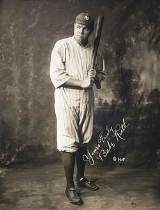
George Herman Ruth , better known as "
Babe" Ruth, also known by the nicknames "
The Bambino" and "
The Sultan of Swat", was an
American baseball player and a national icon. Consistently referred as the greatest baseball player in history, his home run hitting exploits and titanic appetite for living made him one of the representative figures of the
Roaring Twenties. He was one of the first five players elected to the
Baseball Hall of Fame, and he was the first player to hit over 30, 40 and 50 home runs in one season. His record of 60 home runs in the 1927 season stood for 34 years until it was broken by
Roger Maris in 1961. He was a member of the original
American League All-Star team in 1933. In 1969, he was named baseball's Greatest Player Ever in a ballot commemorating the 100th anniversary of professional baseball. In 1998,
The Sporting News is an American [i]-based sports [i] weekly magazine, book publisher, ...
ranked Ruth No. 1 in its list of "Baseball's 100 Greatest Players." In 1999, Ruth was elected to the Major League Baseball All-Century Team by fans.
As Lawrence Ritter and Mark Rucker discuss in their book
The Babe: A Life in Pictures, it is more than mere statistical records that make Babe Ruth unequivocally the greatest baseball player of all time. In several ways, he changed the nature of the game itself. His use of the "power game" compelled other teams to follow suit, breaking the monopoly of the "inside game" that had been the primary strategy for decades. Ruth was the focal point of the start of arguably the greatest sports dynasty in history, the
New York Yankees. His international fame helped to fuel the rising interest in sports in the 1920s and 30s. He significantly expanded the fan base of baseball and triggered the major expansion of nearly all of the ballparks in the major leagues.
Yankee Stadium is often called "The House That Ruth Built." Though in discussions of whether he is the greatest player of all time it should be noted that Babe Ruth statistical accomplishments happened during the time of baseball's color barrier which prevented African-Americans from playing in the big leagues.
Early life
Ruth was born at 216 Emory Street in southern
Baltimore, Maryland. The house, only a block from where
Oriole Park at Camden Yards now stands, was rented by his maternal grandfather, Pius Schamberger, a
German immigrant who was an upholsterer. Ruth's parents, Kate and George, Sr., lived above the saloon they owned and operated on Camden Street, coincidentally located where center field of the Oriole Park is today. Kate would walk to her father's home each time she gave birth to a child, eight in all. Only Babe and his sister, Mary , survived infancy.
Young George was known for mischievous behavior. He skipped school, ran the streets, and committed petty crimes. By age seven, he was drinking, chewing
tobacco, and had become difficult for his parents to control. Mary recalled how their father would beat Babe in a desperate attempt to bring the boy into line, but to no avail. He was finally sent to St. Mary's Industrial School for Boys, a school run by
Catholic brothers. Brother Matthias, a
Roman Catholic brother and the school's disciplinarian, became a major influence in his life, the one man Babe respected above all others. It was Brother Matthias who taught him baseball, working with him for countless hours on hitting, fielding and, later, pitching.
Because of his "toughness", George became the team's
catcher. He liked the position because he was involved in every play. One day, as his team was losing, George started mocking his own pitcher. Brother Matthias promptly switched him from catcher to
pitcher to teach him a lesson, but instead of getting his comeuppance, George shut the other team down.
Brother Gilbert brought George to the attention of
Jack Dunn, owner and manager of the minor-league
Baltimore Orioles, and the man often credited with discovering him. In 1914 Dunn signed 19-year-old Ruth to pitch for his club, and took him to spring training in
Florida, where a strong performance with both bat and ball saw him make the club, while his precocious talent and childlike personality saw him nicknamed "Dunn's Babe." On April 22, 1914, "The Babe" pitched his first professional game, a 6-0 victory over the Buffalo Bisons, also of the International League.
On July 4 the Orioles had a record of 47-22, but their finances were in poor condition. In 1914 the breakaway Federal League, a rebel major league which would last only two years, placed a team in Baltimore, across the street from the minor league Orioles, and the competition hurt Orioles' attendance significantly. To make ends meet, Dunn was obliged to dispose of his stars for cash, and he sold Ruth's contract with two other players to Joseph Lannin, owner of the
Boston Red Sox, for a sum rumored to be between $20,000 and $35,000.
The Red Sox years
Ruth the pitcher
Ruth was a skillful pitcher, but the Red Sox's starting rotation was already stacked with lefties, so they initially made little use of him. With a 1 - 1 record, he sat on the bench for several weeks before being sent down to the minor league Providence Grays of
Providence, Rhode Island. Pitching in combination with the young Carl Mays, Ruth helped the Grays win the pennant. At the end of the season, the Red Sox called him back to the majors, and Ruth would stay in the majors permanently. Shortly after the season, Ruth proposed to Helen Woodford, a waitress he met in
Boston, and they were married in
Baltimore on October 14, 1914.
During spring training in 1915, Ruth secured a spot as a starter. He joined a fine pitching staff that included Rube Foster, Dutch Leonard, and a rejuvenated
Smokey Joe Wood, and their pitching carried the Red Sox to the pennant. Ruth won 18 games and lost 8, and helped himself with the bat by hitting .315 and hitting his first four major league home runs. The Red Sox won the 1915 World Series, defeating the
Philadelphia Phillies 4 games to 1, but because manager
Bill Carrigan preferred right-handers, Ruth did not pitch and grounded out in his only at bat.
Ruth continued to improve in 1916. After a slightly shaky spring, he would make a case as the best pitcher in the American League. He went 23 - 12, with a 1.75 ERA and 9 shutouts; the shutout mark is still tied for the best mark for an A.L. left hander, Ron Guidry having accomplished the feat in 1978. The Red Sox offense had been weakened by the sale of
Tris Speaker to the
Cleveland Indians, but their strong pitching again took them to the
World Series, where they met the
Brooklyn Robins. In game 2 of the series, Ruth pitched a 14-inning complete game victory, helping the Red Sox to another World Series title, 4 games to 1 over the Robins. He repeated his strong performance in 1917, going 24 - 13, but the Red Sox could not keep pace with the
Chicago White Sox and their 100 wins, and they missed out on a postseason appearance.
Emergence as a hitter
After the 1917 season, in which he hit .325, albeit with limited at bats, teammate
Harry Hooper suggested that Ruth might be more valuable in the lineup as an everyday player. In 1918, he began playing in the outfield more and pitching less. His contemporaries thought this was ridiculous; former teammate
Tris Speaker speculated that the move would shorten Ruth's career, but Ruth himself wanted to hit more and pitch less. In 1918, Ruth batted .300 and led the A.L. in home runs with 11 despite having only 317 at bats, well below the total for an everyday player. He also pitched well, going 13 - 7 with a 2.22 ERA. Ruth's quality as hitter and pitcher made a strong case for him being the best player in baseball that season. He also led the Red Sox to another World Series, where they met the
Chicago Cubs.
1918 is noted as the only time a war directly shortened the season.
WWI dominated the news, and baseball, which escaped any sacrifice in 1917, was not as fortunate in the next year. A number of ballplayers were drafted into the
armed forces in 1918, and some players left their teams to work in war production facilities to escape
the draft. Since he was a married man, Ruth was exempt from the draft. After U.S. Provost Marshal General
Enoch Crowder carried out the government's official "work or fight" order in June of 1918, baseball, qualified by the government as "nonessential", was forced to end the season in the middle of August. A 2-week grace period allowed the World Series to be played, but it was done in the heat of early September, the earliest ever. The 1918 World Series was marred not only by the specter of World War I, but by abysmal attendance, with such little revenue sharing that the players threatened to strike before Game 5. The Red Sox winning share of $1102 per player would be the lowest winning share in World Series history.
In the series, Ruth as a pitcher went 2-0 with a 1.06 ERA, helping the Red Sox to a 4-2 series victory over the Cubs. Ruth extended his World Series consecutive scoreless inning streak to 29? innings . Since the Cubs top left-handers
Hippo Vaughn and Lefty Tyler pitched nearly all the innings, Ruth's left-hand batting kept him from the regular lineup, and he batted just five times. The Red Sox had won their fourth World Series in seven years and fifth overall, and Ruth had played a major part in three of them.
By 1919, Ruth was basically a full-time outfielder, pitching in only 17 of the 130 games in which he appeared. He set his first single-season home run record that year, hitting 29 home runs, breaking the previous record of 27 set by
Ned Williamson in 1884, as well as batting .322 and driving in 114 runs. News of his batting feats spread rapidly, and wherever he played, large crowds turned out to see him. As his fame spread, so did his waistline. Since his time as an Oriole, teammates had marveled at Ruth's capacity for food, and by 1919 his physique had changed from a tall athletic frame to more of a rotund shape, although Ruth's weight would have wide fluctuations until the mid-1920s. Beneath his barrel-shaped body, his powerful muscular legs seemed strangely thin, but he was still a capable baserunner and outfielder. His contemporary
Ty Cobb, noted for his cruel bench jockeying of Ruth, would later remark that Ruth "ran okay for a fat man."
Growing problems
Despite his success on the field, Ruth had started to become a problem for the Red Sox. In July 1918, Ruth ignored a sign from manager
Ed Barrow during an at bat that led to a heated verbal spat when Ruth reached the dugout. Barrow fined Ruth $500 when Ruth threatened to punch him in the nose. Ruth threw a tantrum and quit the team for a few days, and it was reported he had signed a new contract with the Chester Shipyards, a
Pennsylvania-based pro team. It was also during the 1918 season that he started to refuse his pitching turns in the starting rotation, often citing injuries that Barrow would question. By this time, Ruth considered himself an everyday outfielder and had no more desire to pitch. "I'll win more games playing everyday in the outfield than I will pitching every fourth day", Ruth remarked. Ruth had the leverage of knowing he had become baseball's biggest star, and before the 1919 season, he was blunt with the Red Sox—he wanted to play every day and not pitch at all. Initially, Barrow and the Red Sox acquiesced, but injuries to the pitching staff forced a balking Ruth back into the rotation for spot starts.
There were also Ruth's off-the-field indiscretions. His late nights of partying and boozing were further sources of irritation to the franchise, and he had numerous fights with Barrow over curfew violations. Eventually Ruth was forced to write Barrow notes on what time he came in each night . He signed a 3-year contract in 1919 for $10,000 a year, but at the end of the season, he demanded $20,000 a year and threatened to sit out the 1920 season if he did not receive a new contract. Ruth was certainly worth the price, but he also needed more money to finance what he spent on fast automobiles, fine clothes, and entertaining his many women "friends." Red Sox owner
Harry Frazee commented, "If Ruth doesn't want to work for the Red Sox, we can work out an advantageous trade." To some people, Ruth had become an
enfant terrible, although after his 1919 season, it seemed almost inconceivable that anyone would seriously recommend trading him.
Sold to New York
Despite Ruth's box office appeal, the Red Sox were in a perilous financial position. After he took over the club in 1916, Red Sox owner
Harry Frazee paid large salaries to attract the best players . But because of
World War I, Red Sox attendance, as with every other major league team, fell off badly. Revenue was down, and the financial failure of the 1918 World Series did not help either. Frazee, whose true passion was the
theater, owned several theaters and financed his own shows, but at that time his shows were also losing money. Having overextended himself financially, Frazee was desperate for cash, and his players were his only way to raise money. The Red Sox championship run from 1912 to 1918 ended in 1919 when the 1919 team finished 66–71, and over the next few years, Frazee began selling off his best players. He sold many of them to the
New York Yankees who until then were a perennial losing club. The Yankees had improved in 1919 with a 80-59 record, but thanks in large part to Frazee, they reached championship level Knowing he could never meet Ruth's salary demands and coupled with the other problems Frazee believed Ruth caused, Frazee worked out a deal with Yankees owner Jacob Ruppert. For $125,000 and a loan of more than $300,000 , Frazee sold Ruth to the Yankees on January 3, completing what was at the time the largest sum ever paid for a baseball player.
There was uneasiness in the Boston sports world just after the sale was announced, although a number of sportswriters supported the move. On January 5, 1920, Frazee faced the press and answered his critics with calmness and assurance. He justified his actions with these comments:
- "It would be impossible to start next season with Ruth and have a smooth-working machine. Ruth had become simply impossible, and the Boston club could no longer put up with his eccentricities. I think the Yankees are taking a gamble. While Ruth is undoubtedly the greatest hitter the game has ever seen, he is likewise one of the most selfish and inconsiderate men ever to put on a baseball uniform."
The trading of Ruth sent the Red Sox franchise into a downward spiral. While the Red Sox were the most successful team in baseball since the 1903 inception of the World Series , from 1920 to 1934, during Ruth's tenure as a Yankee, the Boston Red Sox were by far the worst team in the
American League. During this span, they finished last 10 times, never finished above 5th place, and did not have a single winning season. Boston's failure to win even a single World Series for the next 86 years , in contrast to the Yankees' overwhelming success, led to a superstition that was dubbed the "
Curse of the Bambino."
Ruth the Yankee
Almost immediately, the Yankees' investment in Ruth began to pay off. He trained extensively over the winter, and in 1920, turned up at spring training physically fit. It soon became clear that the more hitter-friendly
Polo Grounds suited him, and Ruth's 1920 season turned into one that no one had ever seen before. He hit 54
home runs, smashing his year-old record of 29, batted .376, and led the league in runs , RBIs , bases on balls ; and his slugging average of .847 was a major league record for over 80 years, until
Barry Bonds eclipsed it with a .863 mark in 2001. Ruth's season was so dominant that it led to one of the most amazing statistics in baseball history: In 1920, Ruth out-homered all but one team in baseball .
His remarkable season had the Yankees in a serious pennant chase for the first time since 1904 . The Yankees battled the entire season with the
Cleveland Indians, led by player-manager
Tris Speaker, Ruth's old Red Sox teammate, and the
Chicago White Sox, the team well known for the infamous "
Black Sox scandal". In the end, the Cleveland Indians won the pennant and then took the World Series title.
Ruth was a natural fit in
New York City—the biggest star in the game needed the largest stage, the largest crowds, the largest
media coverage. His flamboyance, vitality, and obvious flaws symbolized New York. His persona transcended baseball, and he was one of the enduring emblems of the carefree spirit of the
roaring '20s. The large immigrant communities of
New York City were drawn to him, and the
Italian enclave of New York gave him the nickname
bambino . Even the black community adopted him as one of their own; Ruth was falsely reported as having a "secret" black heritage, a story propagated with pride among players in the
Negro Leagues. To many people, Ruth was more than a baseball player, he was a national
icon. He became the dominant name in the storied
New York Yankees franchise, whose winning tradition he inaugurated. Ruth and New York in 1920 were a perfect fit.
Although Ruth is seen as an iconic figure of New York City, he enjoyed frequent trips to the Carolinas to hunt game and fish, most notably Beaufort, North Carolina, where he resided on Gordon Street during his numerous stays.
Impact on Baseball
Ruth's impact on baseball went beyond his statistics. Attendance, which had stagnated in the 1910s, greatly increased because of the attention Ruth brought to the game, and he was at the forefront of the new live ball era that revolutionized how the game was played. Some people even gave Ruth credit for "saving" baseball after the 1919
Black Sox scandal.
Increased AttendanceRuth was not the only reason more fans were coming to the ballpark; some people wished to escape the post–
World War I angst and wanted a "
Return to Normalcy", as a 1920 Presidential campaign slogan of
Warren G. Harding put it. The dramatic increase in home runs and scoring was also getting fans' attention. However, it is no coincidence that the Ruth-led 1920 Yankees shattered the league attendance mark. The Yankees drew nearly 1.3 million fans, breaking the old mark of the 1908 New York Giants by nearly 400,000 fans. Attendance dramatically increased in every major league city in 1920, and seven teams set their own attendance records. The attention Ruth generated for the game with all his home runs, playing in New York, his personality, and even his off-the-field activities , were bringing an unprecedented spotlight to baseball. One reporter wrote, "This new fan didn't know where first base was, but he had heard of Babe Ruth and wanted to see him hit a home run. When the Babe hit one, the fan went back the next day and knew not only where first base was, but second base as well." Baseball still had problems - a segregated game, competitive imbalance, and owners with complete control over the players - but the popularity of the game increased so much that the 1920s has often been called baseball's first
Golden Age, and Babe Ruth can justifiably be given a large share of the credit.
Beginning of the live ball eraRuth's home runs were also at the center of an offensive explosion in baseball. In 1918, the major league
batting average was .254; in 1921 it was .291. The league ERA went from 2.77 to 4.02, runs increased 25% and home runs increased 300% over the same time span. In just a few years, baseball had gone from the most anemic hitting era in baseball history to one of the greatest hitting eras—the 1920s.
A few factors have been cited for the dramatic increase in offense. One major reason was that baseball in 1920 outlawed the spitball, emery ball, and all unorthodox pitching deliveries. Another factor for increased scoring was the league mandate to regularly replace the baseball during a game. Previously, the same discolored, tobacco-stained ball was used over and over until it was falling apart. The overused ball would lose its resiliency, making it much more difficult to hit it for distance. The impetus for this change was the death of
Ray Chapman in 1920, who was killed when he was hit in the head with a dirty, darkened ball thrown by Carl Mays. The darkened ball may have contributed to Chapman losing it in the hitting background.
Another reason given for the increase in home runs was that more players were emulating Ruth's full, free swing. Before Ruth and the Live Ball Era, the emphasis was for batters to choke up on the bat and hit for direction, not distance . With his swing, Ruth showed it was possible to hit a prodigious number of home runs, and more players started to swing for the fences. With the home run now a weapon, more managers lessened their previous absolute control of the offense, and started to play for more runs by giving their players freedom to swing away. By 1921,
stolen bases were half the total from just a few years earlier, and the use of the
sacrifice and hit and run, other overused dead-ball strategies, also decreased.
Skeptical of the new offense in the game, some writers of the time claimed the ball was livened . This assertion even became accepted as a fact over time, even without scientific evidence that the ball had changed. A 1920 study confirmed the ball was the same as in previous years, and early in 1921, also hearing rumors about the "juiced" ball,
National League President John Heydler launched his own investigation and also concluded the ball was no different. Heydler's findings stated the outlawing of the spitball was the predominant factor for the increased scoring. Those who claimed the ball was livened may not have had hard evidence, but they may have had history and statistics on their side, as only one other time in baseball history had there been such a quantum leap in offense over such a short time.
The greatest season ever
As historic as Ruth's 1920 season was, his 1921 season was even better. In fact, it is statistically the greatest season by any batter in major league history. In 152 games, Ruth batted .378, had 204 hits, 44 doubles, 16 triples, 59
home runs , scored 177 runs , had 171 RBIs , 144 bases on balls, with 119 extra base hits , an .846 slugging average , and amassed 457 total bases . Using advanced statistical methods to measure a player's value, present-day baseball statistical researchers have shown that Ruth's season is unmatched. The
Stats Major League Baseball Handbook, a massive, encyclopedic work compiled by noted baseball researchers Bill James, Neil Munro, Don Zminda, and John Dewan, developed a runs created formula to value how many runs a player produces. Using their formula, the 233 runs created by Ruth in 1921 is the highest total for any player in any season.
Ruth's season was monumental on its own, but the Yankees had many quality players who helped lead the team to its first-ever pennant.
Bob Meusel,
Frank Baker, and
Wally Pipp were part of a lineup that batted .300 and scored 948 runs. The pitching was led by Carl Mays, who won 27 games, with fine seasons by
Waite Hoyt and Bob Shawkey.
The Yankees met the
New York Giants in the
World Series, managed by John McGraw. The Giants excelled at McGraw's time-tested strategy, using hit-and-run, stolen base, and bunt, and despite hitting only 75 home runs, they led the N.L. in runs scored. Their star was slick-fielding Frankie Frisch, who batted .341 and led the league with 49 stolen bases. The Giants lineup also included future Hall of Fame players George Kelly,
Ross Youngs, and
Dave Bancroft.
The Yankees were up 3–2 in the series, but Ruth had badly scraped his elbow in Game 2 sliding into third. He continued to play, but his arm eventually became swollen and infected, and he was told by the team
physician not to play the rest of the series . Without him, the Yankees seemed mentally beaten, and they lost the last 3 games. Ruth had a respectable series, going 5 for 16 for a .316 average, driving in 5 runs and hitting his first World Series home run, but he also struck out 8 times. The Giants had a measure of revenge on the Yankees, who were also using the
Polo Grounds as their home and had been embarrassed by being outdrawn in attendance by the Yankees.
During the year, Ruth was invited to
Columbia University for a battery of tests. Doctors discovered that the pitch he could hit hardest was just above the knees, on the outside corner of the plate. And when he hit perfectly, in still air, the ball would carry 450 to 500 feet. In a test of steadiness, Ruth's eyes responded to flashing electric bulbs in a darkened chamber 2/100th of a second quicker than the average person's. Science corroborated what fans already knew: Babe Ruth possessed preternatural gifts. Perhaps Jumping Joe Dugan put it best: "Born? Hell, Babe Ruth wasn't born! The son of a bitch fell from a tree!"
Fall from grace
The 1921 World Series appearance would indirectly lead to problems for Ruth. Seeking to avoid diminishing the meaning of the fall classic, organized baseball instituted a rule in 1911 that prohibited World Series players from playing in exhibition games during the off-season. Ruth, typically, decided this rule did not apply to him, and even though Baseball Commissioner
Kenesaw Mountain Landis had warned Ruth about the trip, Ruth went ahead and embarked on his usual lucrative
barnstorming tour with two teammates. Landis came down hard on the recalcitrant players, and he suspended Ruth and teammate
Bob Meusel for the first six weeks of what was to be a turbulent 1922 season for Ruth. When he returned to the Yankees on May 20, Yankee management named Ruth their first on-field captain, but just five days after his return, he was ejected for arguing an umpire's call at third, and exacerbated the situation by climbing into the seats to confront a heckling fan. The captaincy was stripped, and Ruth's temper would see him suspended three more times in 1922 for arguing with umpires.
While Ruth suffered his first professional setback, his personal life was worse. Helen disliked the celebrity lifestyle to which the Babe was drawn. With his wife on their farm near Boston with their adopted daughter, Dorothy, Ruth indulged his hedonism as never before. His love of fine food was matched only by his appetite for
alcohol, the nightlife, and casual sex. Helen and Babe's marital problems compromised her delicate health. She was frequently ill, and reportedly had several
nervous breakdowns.
The suspension at the beginning of the season affected Ruth at the plate. He struggled all year, and his batting, on-base and slugging averages fell dramatically . He hit 35 home runs with 99 runs batted in, but suspensions and some injuries limited his playing time to just 110 games. All the time he missed on the field hurt the Yankees, but they had barely enough to get past the .420-hitting
George Sisler and the rest of the heavy-hitting
St. Louis Browns for the pennant.
Ruth's struggles continued into the
World Series against the Giants. John McGraw instructed his pitchers to throw Ruth nothing but curve balls, and Ruth never adjusted. He went just 2 for 17 - .118 average - and the Yankees were defeated by the Giants for the second straight year, 4–0, with one tie. Compared to his first two incredible seasons as a Yankee, the 1922 season was a major disappointment.
"The House That Ruth Built"
Ruth regrouped from his troubled 1922 season. He worked out hard in the off-season and he came into the 1923 season in good physical shape, and it would show in his play all season. He batted .393, which would be the highest of his career , and his home run total of 41, a modest total for him, led the majors. Ruth also led the A.L. in walks ; runs , RBIs , extra-base hits , and slugging average . He also missed only two games, compared to over 40 games the previous season. Ruth had returned to his dominant form, and the Yankees easily returned to the
World Series.
The 1923 season also saw the opening of
Yankee Stadium. The Yankees had been sharing the
Polo Grounds with the Giants since 1913, but since Ruth's arrival, the Yankees had been significantly outdrawing the Giants. With the increased revenue and team success, as well as a threat of eviction by the Giants, the Yankees needed a new home. In 1921, Yankee owner Jacob Ruppert bought a small piece of land in the
Bronx for $600,000 from the Astor estate. After a year of construction and a cost of $2.5 million , the 62,000-seat Yankee Stadium opened on April 18, 1923. In the first game played there, Ruth fittingly hit the stadium's first home run, and sportswriter Fred Lieb soon nicknamed Yankee Stadium "The House That Ruth Built."
Detractors of the stadium would call it "The House Built for Ruth", and "Ruthville", as the short 295-foot distance to right field seemed tailor-made for some "cheap" home runs for the
left-handed, pull-hitting Ruth. The stadium's short distance to right was not built to accommodate Ruth, contrary to urban legend. Undoubtedly the short distance to right helped Ruth , but from 1923 to 1932, in his prime home-run-hitting years at Yankee Stadium, Ruth hit more home runs on the road, and in his 60 home run season of 1927, he hit 32 of those on the road. Ruth even said he had preferred hitting at the
Polo Grounds more than the "house that Ruth built", saying the former had a better hitting background.
For the third straight year the Yankees faced the Giants in the
World Series. Injured during the 1921 World Series, and completely ineffective in the 1922 series, Ruth was the best player on the field in the 1923 World Series. He went 7 for 19, a .368 average, slugged 1.000, walked 8 times, scored 8 runs, hit 3 home runs, and led the Yankees to a 4–2 series victory. The legacy of Harry Frazee unloading his Red Sox players had came to fruition for the Yankees. In addition to Ruth as a former Red Sox, the Yankees four best pitchers of 1923 were all former Red Sox.
Herb Pennock , Sad Sam Jones , Bullet Joe Bush , and
Waite Hoyt went a combined 76-38 in 1923. The Yankees had their first World Series title, and the start of what became the most successful major sports team in
North America. From 1923 to the present, the Yankees have appeared in 37 World Series, winning 26 of those series.
"The Bellyache Heard Around the World"
During
spring training in 1925, Ruth began suffering severe
stomach cramps and a
fever. His condition gradually became worse, and on April 7 while the Yankees were staying in
Asheville,
North Carolina, a weakened Ruth collapsed in a bathroom. It was agreed Ruth needed to return to
New York to recover, and he was accompanied by Paul Krichell, a noted Yankees scout. Ruth's collapse was not newsworthy until a
London newspaper ran a headline that Ruth was dead, a story Krichell quickly quelled when Ruth's train reached
Washington, D.C. By the time the train reached Pennsylvania Station in New York, Ruth was wrapped in blankets and unconscious, and his body had to be lifted out of a train window. During the wait for an ambulance, Ruth briefly opened his eyes and saw his wife Helen and
Ed Barrow, his former Red Sox manager and now the Yankees general manager. Shortly thereafter, Ruth became delirious and flailed his arms and legs uncontrollably, and needed to be held down by those around him. On the ambulance ride to St. Vincent's hospital, Ruth again suffered more convulsive attacks that were so violent it took six assistants to hold him down. He was given a sedative, and by the time the ambulance reached the hospital he was calm.
Examined by Dr. Edward King, Ruth's personal physician, Dr. King diagnosed him as having a touch of the
flu as well as an
intestinal attack. Dr. King agreed to let Ruth rejoin the team, but after another week, Ruth's fever became worse, and after another examination, Dr. King now diagnosed him as having an "intestinal
abscess", and he would need surgery. The surgery, performed on April 17, took only 20 minutes and was called a complete success.
Dr. King stated Ruth's diet was the problem, as Ruth had not watched how much he ate and drank. Ruth's weight was high at this time, up to about 256 pounds. It was writer W.O. McGeehan who invented the story that Ruth's collapse was caused by overindulging on hot dogs and soda pop before a game, a fanciful story which led to Ruth's illness being dubbed "the bellyache heard around the world." Ruth, noted for episodes of
gluttony, frequently did eat hot dogs before games, and he would wash them down with
bicarbonate of soda to keep from feeling bloated.
Some newspaper reporters whispered that Ruth actually had
gonorrhea, but no one put this assertion in print. An old teammate of Ruth's vouched for the
venereal disease story, saying it was the entire reason for Ruth's problems. A case of gonorrhea would not have been out of the question for the promiscuous Ruth, and some of his symptoms of chills,
fever, and general pain are associated with some more complicated symptoms of gonorrhea. Still,
abdominal surgery is a very unusual treatment for venereal disease, even during this medical age, and Ruth did have a clear visible
scar running from just under his
rib cage to his left lower
abdomen. Evidence suggested Ruth's illness was what physicians had stated, but it is possible Ruth may have had both problems, with physicians intentionally not mentioning venereal problems.
In the book
Yankees Century it is speculated Ruth's 1925 health problems may have been related to his drinking, and the authors state that Ruth's intestinal abscess was actually surgery to repair a
hernia which Ruth incurred during a spring training game. Certainly dangerous health problems from binge drinking were a more likely occurrence during
Prohibition, where thousands of
bootleggers were making and selling their own cheap and often dangerous
alcohol that could be laced with
methanol and other toxins that could cause
blindness, the "
jake leg", and even death from an accidental poisoning. Ruth, who usually reserved his heavy drinking to the off-season, may have drunk some tainted alcohol, which compromised his health.
Treatment of alcoholism and its ill effects during this age could be as bad or even worse than the illness itself. Ruth may have been subjected to a "therapy" of forced
stomach pumping, heavy use of sedatives, hot baths, and the ingestion of substances such as ‘double chloride of gold' . These treatments could last weeks and leave the patient weakened and dazed. During his 6-week stay at St. Vincent's, Ruth was allowed supervised workouts at the stadium for a week, where he then returned to the hospital and the end of each workout. This perhaps suggested he was undergoing some regular treatments at the hospital. Whatever the real reason for Ruth's 1925 health problems, it remains to the present day as one of the most guarded mysteries of his life.
After his recovery, Ruth rejoined the Yankees on May 26. He had lost 30 pounds , was weak and out of condition, but he was insistent on being back in the lineup. He clearly came back too soon. In July, he was hitting about .250 as he struggled miserably trying to find his swing. Eventually he regained some strength and managed to get somewhat on track, but finished with a .290 average and 25 home runs in 98 games. Except for the last couple of years at the end of his career, the 1925 season was easily Ruth's worst season in the majors.
The Yankees 1925 season went as badly as Ruth's. Injuries, age, and poor play had them at the bottom of the standings all year, and they finished next to last in the A.L. with a 69–85 mark. Later in the season, Ruth had a well-publicized fight with manager Miller Huggins, who fined Ruth $5,000 and suspended him nine days for numerous curfew violations. Only after an apology to Huggins and the team he was allowed to play again, and he would never again question Huggins's authority. One bright spot of the season was on June 2 when
first baseman Wally Pipp