

Canterbury and Whitstable Railway

Encyclopedia
The Canterbury and Whitstable Railway, sometimes referred to colloquially as the Crab and Winkle Line, was an early British railway that opened in 1830 between Canterbury
and Whitstable
in the county of Kent
, England
.
, the Swansea and Mumbles Railway and the Surrey Iron Railway
amongst others. From the beginning it was a public railway, intended for passengers as well as freight. Indeed, the world's first season ticket
was issued for use on the line in 1834, to take Canterbury passengers to the Whitstable beaches for the summer season. Unlike the public Liverpool and Manchester Railway
which opened four months later, it used cable haulage
by stationary steam engine
s over much of its length, with steam locomotive
s restricted to the level stretch.
Until the early nineteenth century Canterbury's line of supply for goods had been along the River Stour
which flows to Pegwell Bay, near Ramsgate
on the eastern cost of Kent. Although this is only seventeen miles as the crow flies, the meandering river journey is around seventy miles. The river was continually silting up, and the cost of dredging such a length was prohibitive. Although turnpikes had been built, four or five carts were needed to carry the load of a single barge.
Whitstable, on the coast about seven miles due north, was at that time a small fishing village and port with a trade in iron pyrites from the Isle of Sheppey
. The idea for the line came from William James
who surveyed the route and produced plans for improving the harbour. The immediate problem was that the land between Whitstable and Canterbury rose to a height of two hundred feet (70m), and railway haulage on steep gradients was technically very difficult at that time. The only alternative would have been a much longer route through Sturry, Herne and Swalecliffe and land acquisition would have been a major cost.
Accordingly the direct route was chosen with three steep gradients, two of them to be worked by ropes from stationary steam engines. Leaving Canterbury, there was a steep incline to near the top of Tyler Hill, followed by an 828 yards (757.1 m) tunnel, then a descent through Clowes Wood to Bogshole Brook. From there the final two miles were substantially level apart from a short incline down to Whitstable. The line received its Act of Parliament in 1825. Construction began in 1828 with George Stephenson
as the engineer, with the assistance of John Dixon and Joseph Locke
. The line cost far more than predicted and the promoters returned to Parliament three more times to obtain authorisation for the raising of additional funds. The construction of Whitstable Harbour, under the direction of Thomas Telford
, was completed in 1832.
The line finally opened on 3 May 1830, with a single track throughout and passing loops at Clowes Wood and the entrance to Tyler Hill tunnel. The track consisted of fifteen foot fish-bellied iron rails on wooden sleepers at three foot intervals, the more usual alternative of stone blocks being considered too expensive. Initially Stephenson had recommended the use of stationary engines for the three inclines, with horses for the level sections. However the promoters insisted on use of a locomotive for the least difficult incline, and Invicta
was procured from Robert Stephenson and Company
, the twentieth they had produced, and it was brought to Whitstable by sea. Unfortunately the short gradient from Whitstable proved too much for it, and a third stationary engine was installed in 1832.
The line was visited by Isambard Kingdom Brunel
in 1835. The purpose of his visit was to conduct some experiments in order to silence some of the criticism he had received in relation to his proposals for the Great Western Railway
, particularly the perceived problems of working a tunnel on a steep gradient, which Brunel wished to do at Box Tunnel
.
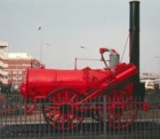
Also in 1835, the "Invicta" was modified in order to improve its performance. The modification was unsuccessful and led to the locomotive being taken out of service, and trains being hauled only by the stationary engines. The C&WR tried to sell the "Invicta" in 1839 in order to clear some of its debts, but no buyers were found. The "Invicta" was later given to the Canterbury City Corporation and for many years stood on a plinth in the Dane John Gardens beside the Riding Gate.
 The line was bedevilled by financial problems and was facing bankruptcy when the South Eastern Railway
, which had received the Royal Assent in 1844, agreed to take it over, operating it in isolation from their own line. Invicta by now was virtually useless and horse traction was being used.
When the South Eastern Railway's own network eventually reached Canterbury in 1846, it decided to convert the line for use with its own locomotives throughout, after upgrading the track. Under George Stephenson
's influence the track had been built to standard gauge, but the loading gauge was small, the height of Tyler Hill Tunnel being only twelve feet and the South Eastern locomotives were modified with shorter chimneys and lowered boilers. Canterbury North Lane station closed in 1846, Canterbury West
served the line after that date.
The line was never prosperous, even under South Eastern management, and there was a new setback when the London, Chatham and Dover Railway
opened in 1860 offering a better passenger service from Whitstable to London
. At the turn of the century work started on building a spur line at Whitstable to connect with the Herne Bay to Faversham line and a bay platform at Whitstable & Tankerton station but the work was never completed. In the early 1900s halts were built at Blean & Tyler Hill, South Street and Tankerton which brought some increased patronage.
. By 1948, when it became part of British Rail
ways, Whitstable Harbour had fallen into disuse and what was left of the line's trade had disappeared.
that had been built on the hill above. The resulting voids were filled over the next year, using fly-ash from Richborough
power station.
The Winding Pond, which formerly supplied water for the static winding engine which brought trains up the hill from Whitstable, was incorporated into a picnic and rest area for cyclists and walkers on the route.
Canterbury
Canterbury is a historic English cathedral city, which lies at the heart of the City of Canterbury, a district of Kent in South East England. It lies on the River Stour....
and Whitstable
Whitstable
Whitstable is a seaside town in Northeast Kent, Southeast England. It is approximately north of the city of Canterbury and approximately west of the seaside town of Herne Bay. It is part of the City of Canterbury district and has a population of about 30,000.Whitstable is famous for its oysters,...
in the county of Kent
Kent
Kent is a county in southeast England, and is one of the home counties. It borders East Sussex, Surrey and Greater London and has a defined boundary with Essex in the middle of the Thames Estuary. The ceremonial county boundaries of Kent include the shire county of Kent and the unitary borough of...
, England
England
England is a country that is part of the United Kingdom. It shares land borders with Scotland to the north and Wales to the west; the Irish Sea is to the north west, the Celtic Sea to the south west, with the North Sea to the east and the English Channel to the south separating it from continental...
.
Early history
There are a number of claimants to the title "first railway in Britain", including the Middleton RailwayMiddleton Railway
The Middleton Railway is the world's oldest continuously working railway. It was founded in 1758 and is now a heritage railway run by volunteers from The Middleton Railway Trust Ltd...
, the Swansea and Mumbles Railway and the Surrey Iron Railway
Surrey Iron Railway
The Surrey Iron Railway was a horse drawn plateway whose width approximated to a standard gauge railway that linked the former Surrey towns of Wandsworth and Croydon via Mitcham...
amongst others. From the beginning it was a public railway, intended for passengers as well as freight. Indeed, the world's first season ticket
Season ticket
A season ticket is a ticket that grants privileges over a defined period of time.-Sport:In sport, a season ticket grants the holder access to all regular-season home games for one season without additional charges. The ticket usually offers a discounted price over purchasing a ticket for each of...
was issued for use on the line in 1834, to take Canterbury passengers to the Whitstable beaches for the summer season. Unlike the public Liverpool and Manchester Railway
Liverpool and Manchester Railway
The Liverpool and Manchester Railway was the world's first inter-city passenger railway in which all the trains were timetabled and were hauled for most of the distance solely by steam locomotives. The line opened on 15 September 1830 and ran between the cities of Liverpool and Manchester in North...
which opened four months later, it used cable haulage
Cable railway
A cable railway is a steeply graded railway that uses a cable or rope to haul trains.-Introduction:...
by stationary steam engine
Steam engine
A steam engine is a heat engine that performs mechanical work using steam as its working fluid.Steam engines are external combustion engines, where the working fluid is separate from the combustion products. Non-combustion heat sources such as solar power, nuclear power or geothermal energy may be...
s over much of its length, with steam locomotive
Steam locomotive
A steam locomotive is a railway locomotive that produces its power through a steam engine. These locomotives are fueled by burning some combustible material, usually coal, wood or oil, to produce steam in a boiler, which drives the steam engine...
s restricted to the level stretch.
Until the early nineteenth century Canterbury's line of supply for goods had been along the River Stour
River Stour, Kent
The River Stour is the river in Kent, England that flows into the English Channel at Pegwell Bay. Above Plucks Gutter, where the Little Stour joins it, the river is normally known as the Great Stour. The upper section of the river, above its confluence with the East Stour at Ashford is sometimes...
which flows to Pegwell Bay, near Ramsgate
Ramsgate
Ramsgate is a seaside town in the district of Thanet in east Kent, England. It was one of the great English seaside towns of the 19th century and is a member of the ancient confederation of Cinque Ports. It has a population of around 40,000. Ramsgate's main attraction is its coastline and its main...
on the eastern cost of Kent. Although this is only seventeen miles as the crow flies, the meandering river journey is around seventy miles. The river was continually silting up, and the cost of dredging such a length was prohibitive. Although turnpikes had been built, four or five carts were needed to carry the load of a single barge.
Whitstable, on the coast about seven miles due north, was at that time a small fishing village and port with a trade in iron pyrites from the Isle of Sheppey
Isle of Sheppey
The Isle of Sheppey is an island off the northern coast of Kent, England in the Thames Estuary, some to the east of London. It has an area of . The island forms part of the local government district of Swale...
. The idea for the line came from William James
William James (railway promoter)
William James was an English lawyer, surveyor, land agent and pioneer promoter of rail transport. "He was the original projector of the Liverpool & Manchester and other railways, and may with truth be considered as the father of the railway system, as he surveyed numerous lines at his own expense...
who surveyed the route and produced plans for improving the harbour. The immediate problem was that the land between Whitstable and Canterbury rose to a height of two hundred feet (70m), and railway haulage on steep gradients was technically very difficult at that time. The only alternative would have been a much longer route through Sturry, Herne and Swalecliffe and land acquisition would have been a major cost.
Accordingly the direct route was chosen with three steep gradients, two of them to be worked by ropes from stationary steam engines. Leaving Canterbury, there was a steep incline to near the top of Tyler Hill, followed by an 828 yards (757.1 m) tunnel, then a descent through Clowes Wood to Bogshole Brook. From there the final two miles were substantially level apart from a short incline down to Whitstable. The line received its Act of Parliament in 1825. Construction began in 1828 with George Stephenson
George Stephenson
George Stephenson was an English civil engineer and mechanical engineer who built the first public railway line in the world to use steam locomotives...
as the engineer, with the assistance of John Dixon and Joseph Locke
Joseph Locke
Joseph Locke was a notable English civil engineer of the 19th century, particularly associated with railway projects...
. The line cost far more than predicted and the promoters returned to Parliament three more times to obtain authorisation for the raising of additional funds. The construction of Whitstable Harbour, under the direction of Thomas Telford
Thomas Telford
Thomas Telford FRS, FRSE was a Scottish civil engineer, architect and stonemason, and a noted road, bridge and canal builder.-Early career:...
, was completed in 1832.
The line finally opened on 3 May 1830, with a single track throughout and passing loops at Clowes Wood and the entrance to Tyler Hill tunnel. The track consisted of fifteen foot fish-bellied iron rails on wooden sleepers at three foot intervals, the more usual alternative of stone blocks being considered too expensive. Initially Stephenson had recommended the use of stationary engines for the three inclines, with horses for the level sections. However the promoters insisted on use of a locomotive for the least difficult incline, and Invicta
Invicta (locomotive)
Invicta is an early steam locomotive built by Robert Stephenson and Company in Newcastle-upon-Tyne in 1829. She was the twentieth locomotive built by Stephenson, being built immediately after Rocket.-History:...
was procured from Robert Stephenson and Company
Robert Stephenson and Company
Robert Stephenson and Company was a locomotive manufacturing company founded in 1823. It was the first company set up specifically to build railway engines.- Foundation and early success :...
, the twentieth they had produced, and it was brought to Whitstable by sea. Unfortunately the short gradient from Whitstable proved too much for it, and a third stationary engine was installed in 1832.
The line was visited by Isambard Kingdom Brunel
Isambard Kingdom Brunel
Isambard Kingdom Brunel, FRS , was a British civil engineer who built bridges and dockyards including the construction of the first major British railway, the Great Western Railway; a series of steamships, including the first propeller-driven transatlantic steamship; and numerous important bridges...
in 1835. The purpose of his visit was to conduct some experiments in order to silence some of the criticism he had received in relation to his proposals for the Great Western Railway
Great Western Railway
The Great Western Railway was a British railway company that linked London with the south-west and west of England and most of Wales. It was founded in 1833, received its enabling Act of Parliament in 1835 and ran its first trains in 1838...
, particularly the perceived problems of working a tunnel on a steep gradient, which Brunel wished to do at Box Tunnel
Box Tunnel
Box Tunnel is a railway tunnel in Western England, between Bath and Chippenham, dug through Box Hill, and is one of the most significant structures on the Great Western Main Line...
.
Also in 1835, the "Invicta" was modified in order to improve its performance. The modification was unsuccessful and led to the locomotive being taken out of service, and trains being hauled only by the stationary engines. The C&WR tried to sell the "Invicta" in 1839 in order to clear some of its debts, but no buyers were found. The "Invicta" was later given to the Canterbury City Corporation and for many years stood on a plinth in the Dane John Gardens beside the Riding Gate.
South Eastern Railway
South Eastern Railway (UK)
The South Eastern Railway was a railway company in south-eastern England from 1836 until 1922. The company was formed to construct a route from London to Dover. Branch lines were later opened to Tunbridge Wells, Hastings, Canterbury and other places in Kent...
, which had received the Royal Assent in 1844, agreed to take it over, operating it in isolation from their own line. Invicta by now was virtually useless and horse traction was being used.
When the South Eastern Railway's own network eventually reached Canterbury in 1846, it decided to convert the line for use with its own locomotives throughout, after upgrading the track. Under George Stephenson
George Stephenson
George Stephenson was an English civil engineer and mechanical engineer who built the first public railway line in the world to use steam locomotives...
's influence the track had been built to standard gauge, but the loading gauge was small, the height of Tyler Hill Tunnel being only twelve feet and the South Eastern locomotives were modified with shorter chimneys and lowered boilers. Canterbury North Lane station closed in 1846, Canterbury West
Canterbury West railway station
Canterbury West railway station is one of two stations in Canterbury in Kent. It is north-northwest of the city centre. It is served by Southeastern....
served the line after that date.
The line was never prosperous, even under South Eastern management, and there was a new setback when the London, Chatham and Dover Railway
London, Chatham and Dover Railway
The London, Chatham and Dover Railway was a railway company in south-eastern England from 1859 until the 1923 grouping which united it with other companies to form the Southern Railway. Its lines ran through London and northern and eastern Kent to form a significant part of the Greater London...
opened in 1860 offering a better passenger service from Whitstable to London
London
London is the capital city of :England and the :United Kingdom, the largest metropolitan area in the United Kingdom, and the largest urban zone in the European Union by most measures. Located on the River Thames, London has been a major settlement for two millennia, its history going back to its...
. At the turn of the century work started on building a spur line at Whitstable to connect with the Herne Bay to Faversham line and a bay platform at Whitstable & Tankerton station but the work was never completed. In the early 1900s halts were built at Blean & Tyler Hill, South Street and Tankerton which brought some increased patronage.
Twentieth century operations
In 1923 the line became part of the Southern Railway and like many other lines around the country it suffered from competition from bus services. Passenger services were withdrawn on 1 January 1931. It continued to carry coal, grain and roadstone, with munitions to the harbour during World War IIWorld War II
World War II, or the Second World War , was a global conflict lasting from 1939 to 1945, involving most of the world's nations—including all of the great powers—eventually forming two opposing military alliances: the Allies and the Axis...
. By 1948, when it became part of British Rail
British Rail
British Railways , which from 1965 traded as British Rail, was the operator of most of the rail transport in Great Britain between 1948 and 1997. It was formed from the nationalisation of the "Big Four" British railway companies and lasted until the gradual privatisation of British Rail, in stages...
ways, Whitstable Harbour had fallen into disuse and what was left of the line's trade had disappeared.
Closure and lifting
The line closed with effect from 1 December 1952, albeit with a short reprieve during the floods of February 1953, the line being reopened from 5 February to 1 March. Track was lifted almost immediately and the associated infrastructure was removed.Remains today (correct to 2011)
All trace of Whitstable Harbour station has been removed and the site occupied by a medical centre. The former goods shed still stands adjacent to the harbour with the former entrance gates still displaying the intials "SE&CR". The track bed leading from the site of the bridge adjacent to Whitstable railway station to the site of South Street Halt is now a footpath. There is no trace of South Street Halt. A section of trackbed through Clowes Wood is also a footpath where the site of the winding house can be found. The site of Tyler Hill Halt is occupied by a bungalow with the driveway on the site of the trackbed. The blocked up tunnel mouths of Tyler Hill Tunnel are visible. The site of Canterbury North Lane station was a goods yard until around 1980 when it was sold for housing development. The original weighbridge house and a level crossing gate into the former goods yard are preserved in the development. Invicta, however, has been preserved and can be seen in the Museum of Canterbury. The locomotive is not in its original form, since various modifications were made around 1836 in an effort to improve its performance. Part of the Tyler Hill tunnel collapsed at the beginning of July 1974, causing severe subsidence to some buildings at the University of Kent at CanterburyUniversity of Kent
The University of Kent, previously the University of Kent at Canterbury, is a public research university based in Kent, United Kingdom...
that had been built on the hill above. The resulting voids were filled over the next year, using fly-ash from Richborough
Richborough
Richborough is a settlement north of Sandwich on the east coast of the county of Kent, England. Richborough lies close to the Isle of Thanet....
power station.
Restoration
In 1997, a charity, The Crab and Winkle Line Trust, was formed to reopen the route as a footpath and cycleway. In 1999, a footpath and cycleway was opened between Canterbury and Whitstable, running along part of the original trackbed. There are plans to allow public access to more of the line.The Winding Pond, which formerly supplied water for the static winding engine which brought trains up the hill from Whitstable, was incorporated into a picnic and rest area for cyclists and walkers on the route.