


Burh

Encyclopedia
Hill fort
A hill fort is a type of earthworks used as a fortified refuge or defended settlement, located to exploit a rise in elevation for defensive advantage. They are typically European and of the Bronze and Iron Ages. Some were used in the post-Roman period...
though always intended as a place of permanent settlement, its origin was in military defence; "it represented only a stage, though a vitally important one, in the evolution of the medieval English borough
Borough
A borough is an administrative division in various countries. In principle, the term borough designates a self-governing township although, in practice, official use of the term varies widely....
and of the medieval town", H. R. Loyn
H. R. Loyn
Henry Royston Loyn , FBA, was a British historian specialising in the history of Anglo-Saxon England. His eminence in his field made him a natural candidate to run the Sylloge of the Coins of the British Isles, which he chaired from 1979 to 1993.-Works:The Sylloge's natural emphasis is on...
asserted. The boundaries of ancient burhs can often still be traced to modern urban borough
Borough
A borough is an administrative division in various countries. In principle, the term borough designates a self-governing township although, in practice, official use of the term varies widely....
limits. Most of these were founded by Alfred the Great
Alfred the Great
Alfred the Great was King of Wessex from 871 to 899.Alfred is noted for his defence of the Anglo-Saxon kingdoms of southern England against the Vikings, becoming the only English monarch still to be accorded the epithet "the Great". Alfred was the first King of the West Saxons to style himself...
in a consciously planned policy that was continued under his son Edward the Elder
Edward the Elder
Edward the Elder was an English king. He became king in 899 upon the death of his father, Alfred the Great. His court was at Winchester, previously the capital of Wessex...
and his daughter, Aethelflaed, the lady of the Mercians and her husband Ethelred
Ethelred
Æthelred, also Ethelred, is an Old English personal name and may refer to:-Anglo-Saxon England:* Æthelred of Mercia , King of Mercia...
; the Mercian Register tells of the building of ten burhs by Aethelflaed, some as important as Tamworth
Tamworth
Tamworth is a town and local government district in Staffordshire, England, located north-east of Birmingham city centre and north-west of London. The town takes its name from the River Tame, which flows through the town, as does the River Anker...
and Stafford
Stafford
Stafford is the county town of Staffordshire, in the West Midlands region of England. It lies approximately north of Wolverhampton and south of Stoke-on-Trent, adjacent to the M6 motorway Junction 13 to Junction 14...
, others now unidentifiable: Some were based on pre-existing Roman
Roman Britain
Roman Britain was the part of the island of Great Britain controlled by the Roman Empire from AD 43 until ca. AD 410.The Romans referred to the imperial province as Britannia, which eventually comprised all of the island of Great Britain south of the fluid frontier with Caledonia...
structures, some newly built, though some may have been built later. Athelstan granted these burhs the right to mint coinage, and in the tenth and eleventh century the firm rule was that no coin was to be struck outside a burh.
A 10th century document called the Burghal Hidage
Burghal Hidage
The Burghal Hidage is an Anglo-Saxon document providing a list of the fortified burhs in Wessex and elsewhere in southern England. It offers an unusually detailed picture of the network of burhs that Alfred the Great designed to defend his kingdom from the predations of Viking invaders.-Burhs and...
cites 30 burhs in Wessex
Wessex
The Kingdom of Wessex or Kingdom of the West Saxons was an Anglo-Saxon kingdom of the West Saxons, in South West England, from the 6th century, until the emergence of a united English state in the 10th century, under the Wessex dynasty. It was to be an earldom after Canute the Great's conquest...
and three in Mercia
Mercia
Mercia was one of the kingdoms of the Anglo-Saxon Heptarchy. It was centred on the valley of the River Trent and its tributaries in the region now known as the English Midlands...
(then under the domination of the West Saxon kings), built to defend the region against Viking
Viking
The term Viking is customarily used to refer to the Norse explorers, warriors, merchants, and pirates who raided, traded, explored and settled in wide areas of Europe, Asia and the North Atlantic islands from the late 8th to the mid-11th century.These Norsemen used their famed longships to...
raids.
Only eight of the burhs achieved municipal status in the Middle Age: Chester
Chester
Chester is a city in Cheshire, England. Lying on the River Dee, close to the border with Wales, it is home to 77,040 inhabitants, and is the largest and most populous settlement of the wider unitary authority area of Cheshire West and Chester, which had a population of 328,100 according to the...
, Bridgnorth
Bridgnorth
Bridgnorth is a town in Shropshire, England, along the Severn Valley. It is split into Low Town and High Town, named on account of their elevations relative to the River Severn, which separates the upper town on the right bank from the lower on the left...
, Tamworth
Tamworth
Tamworth is a town and local government district in Staffordshire, England, located north-east of Birmingham city centre and north-west of London. The town takes its name from the River Tame, which flows through the town, as does the River Anker...
, Stafford
Stafford
Stafford is the county town of Staffordshire, in the West Midlands region of England. It lies approximately north of Wolverhampton and south of Stoke-on-Trent, adjacent to the M6 motorway Junction 13 to Junction 14...
, Hertford
Hertford
Hertford is the county town of Hertfordshire, England, and is also a civil parish in the East Hertfordshire district of the county. Forming a civil parish, the 2001 census put the population of Hertford at about 24,180. Recent estimates are that it is now around 28,000...
, Warwick
Warwick
Warwick is the county town of Warwickshire, England. The town lies upon the River Avon, south of Coventry and just west of Leamington Spa and Whitnash with which it is conjoined. As of the 2001 United Kingdom census, it had a population of 23,350...
, Buckingham
Buckingham
Buckingham is a town situated in north Buckinghamshire, England, close to the borders of Northamptonshire and Oxfordshire. The town has a population of 11,572 ,...
and Maldon
Maldon
-Placenames:* Maldon, Essex is a town on the Blackwater estuary in England** Maldon , a local government district based in Maldon, Essex** Maldon Town F.C., an English football club** Maldon *The Battle of Maldon...
., The largest were at Winchester
Winchester
Winchester is a historic cathedral city and former capital city of England. It is the county town of Hampshire, in South East England. The city lies at the heart of the wider City of Winchester, a local government district, and is located at the western end of the South Downs, along the course of...
, Wallingford and Warwick
Warwick
Warwick is the county town of Warwickshire, England. The town lies upon the River Avon, south of Coventry and just west of Leamington Spa and Whitnash with which it is conjoined. As of the 2001 United Kingdom census, it had a population of 23,350...
, whilst Wallingford and Wareham
Wareham, Dorset
Wareham is an historic market town and, under the name Wareham Town, a civil parish, in the English county of Dorset. The town is situated on the River Frome eight miles southwest of Poole.-Situation and geography:...
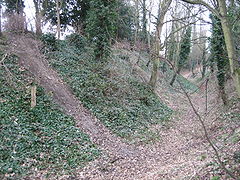
are the best preserved examples, with substantial ditches and banks still visible. It has been estimated that construction of Wallingford's 9,000 feet of bank would have taken more than 120,000 man hours. Burh towns also usually had regular street layouts, some of which are also preserved.