

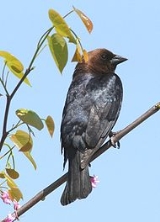
Brown-headed Cowbird

Encyclopedia
The Brown-headed Cowbird (Molothrus ater) is a small brood parasitic
icterid
of temperate
to subtropical North America
. They are permanent residents in the southern parts of their range; northern birds migrate
to the southern United States
and Mexico
in winter, returning to their summer habitat around March or April.
They resemble New World oriole
s in general shape but have a finch
-like head and beak. The adult male is mainly iridescent
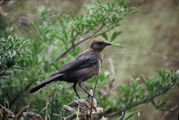
black with a brown head while the adult female is grey with a pale throat and fine streaking on the underparts.
 They occur in open or semi-open country and often travel in flocks, sometimes mixed with Red-winged Blackbird
s (particularly in spring) and Bobolink
s (particularly in fall), as well as Common Grackle
or European Starling
s. These birds forage on the ground, often following grazing animals such as horse
s and cow
s to catch insect
s stirred up by the larger animals. They mainly eat seed
s and insects.
Before European settlement, the Brown-headed Cowbird followed bison
herds across the prairies
. Their parasitic nesting behaviour complemented this nomad
ic lifestyle. Their numbers expanded with the clearing of forested areas and the introduction of new grazing animals by settlers across North America. Brown-headed Cowbirds are now commonly seen at suburban birdfeeders.
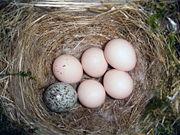
 This bird
is a brood parasite
: it lays its egg
s in the nests of other small passerine
s (perching birds), particularly those that build cup-like nests. The Brown-headed Cowbird eggs have been documented in nests of at least 220 host species, including hummingbirds and raptors. The young cowbird is fed by the host parents at the expense of their own young. Brown-headed Cowbird females can lay 36 eggs in a season. More than 140 different species
of birds are known to have raised young cowbirds.
Unlike the Common Cuckoo
, it has no gentes
whose eggs imitate those of a particular host.
Host birds sometimes notice the cowbird egg, to which different host species react in different ways. Rejection manifests in three forms: nest desertion (e.g., Blue-gray Gnatcatcher), burying of the egg under nest material (e.g., Yellow Warbler), and physical ejection of the egg from the nest (e.g., Brown Thrasher). Brown-headed cowbird nestlings are also sometimes expelled from the nest.
Some species, such as the House Finch
feed their young a vegetarian diet. This is unsuitable for young Brown-headed Cowbirds, meaning almost none survive to fledge.
behavior". According to a study by the Florida Museum of Natural History
published in 1983, the cowbird returned to ransack the nests of a range of host species 56% of the time when their egg was removed. In addition, the cowbird also destroyed nests in a type of "farming behavior" to force the hosts to build new ones. The cowbirds then laid their eggs in the new nests 85% of the time.
Brood parasite
Brood parasites are organisms that use the strategy of brood parasitism, a kind of kleptoparasitism found among birds, fish or insects, involving the manipulation and use of host individuals either of the same or different species to raise the young of the brood-parasite...
icterid
Icterid
The Icterids are a group of small to medium-sized, often colorful passerine birds restricted to the New World. Most species have black as a predominant plumage color, often enlivened by yellow, orange or red. The family is extremely varied in size, shape, behavior and coloration...
of temperate
Temperate
In geography, temperate or tepid latitudes of the globe lie between the tropics and the polar circles. The changes in these regions between summer and winter are generally relatively moderate, rather than extreme hot or cold...
to subtropical North America
North America
North America is a continent wholly within the Northern Hemisphere and almost wholly within the Western Hemisphere. It is also considered a northern subcontinent of the Americas...
. They are permanent residents in the southern parts of their range; northern birds migrate
Bird migration
Bird migration is the regular seasonal journey undertaken by many species of birds. Bird movements include those made in response to changes in food availability, habitat or weather. Sometimes, journeys are not termed "true migration" because they are irregular or in only one direction...
to the southern United States
United States
The United States of America is a federal constitutional republic comprising fifty states and a federal district...
and Mexico
Mexico
The United Mexican States , commonly known as Mexico , is a federal constitutional republic in North America. It is bordered on the north by the United States; on the south and west by the Pacific Ocean; on the southeast by Guatemala, Belize, and the Caribbean Sea; and on the east by the Gulf of...
in winter, returning to their summer habitat around March or April.
They resemble New World oriole
New World oriole
New World orioles, comprising the genus Icterus, are a group of birds in the blackbird family. They are not related to Old World orioles which are in the family Oriolidae, but are strikingly similar in size, diet, behaviour and in their strongly contrasting plumage, and are a good example of...
s in general shape but have a finch
Finch
The true finches are passerine birds in the family Fringillidae. They are predominantly seed-eating songbirds. Most are native to the Northern Hemisphere, but one subfamily is endemic to the Neotropics, one to the Hawaiian Islands, and one subfamily – monotypic at genus level – is found...
-like head and beak. The adult male is mainly iridescent
Iridescence
Iridescence is generally known as the property of certain surfaces which appear to change color as the angle of view or the angle of illumination changes...
black with a brown head while the adult female is grey with a pale throat and fine streaking on the underparts.
Ecology
Red-winged Blackbird
The Red-winged Blackbird is a passerine bird of the family Icteridae found in most of North and much of Central America. It breeds from Alaska and Newfoundland south to Florida, the Gulf of Mexico, Mexico, and Guatemala, with isolated populations in western El Salvador, northwestern Honduras, and...
s (particularly in spring) and Bobolink
Bobolink
The Bobolink is a small New World blackbird and the only member of genus Dolichonyx.-Description:Adults are 16–18 cm long with short finch-like bills. They weigh about . Adult males are mostly black, although they do display creamy napes, and white scapulars, lower backs and rumps...
s (particularly in fall), as well as Common Grackle
Common Grackle
The Common Grackle, Quiscalus quiscula, is a large icterid.-Description:The long adult has a long dark bill, pale yellowish eyes and a long tail; its feathers appear black with purple, green or blue iridescence on the head, and primarily bronze shine in the body plumage...
or European Starling
European Starling
The Common Starling , also known as the European Starling or just Starling, is a passerine bird in the family Sturnidae.This species of starling is native to most of temperate Europe and western Asia...
s. These birds forage on the ground, often following grazing animals such as horse
Horse
The horse is one of two extant subspecies of Equus ferus, or the wild horse. It is a single-hooved mammal belonging to the taxonomic family Equidae. The horse has evolved over the past 45 to 55 million years from a small multi-toed creature into the large, single-toed animal of today...
s and cow
Cattle
Cattle are the most common type of large domesticated ungulates. They are a prominent modern member of the subfamily Bovinae, are the most widespread species of the genus Bos, and are most commonly classified collectively as Bos primigenius...
s to catch insect
Insect
Insects are a class of living creatures within the arthropods that have a chitinous exoskeleton, a three-part body , three pairs of jointed legs, compound eyes, and two antennae...
s stirred up by the larger animals. They mainly eat seed
Seed
A seed is a small embryonic plant enclosed in a covering called the seed coat, usually with some stored food. It is the product of the ripened ovule of gymnosperm and angiosperm plants which occurs after fertilization and some growth within the mother plant...
s and insects.
Before European settlement, the Brown-headed Cowbird followed bison
American Bison
The American bison , also commonly known as the American buffalo, is a North American species of bison that once roamed the grasslands of North America in massive herds...
herds across the prairies
Prairie
Prairies are considered part of the temperate grasslands, savannas, and shrublands biome by ecologists, based on similar temperate climates, moderate rainfall, and grasses, herbs, and shrubs, rather than trees, as the dominant vegetation type...
. Their parasitic nesting behaviour complemented this nomad
Nomad
Nomadic people , commonly known as itinerants in modern-day contexts, are communities of people who move from one place to another, rather than settling permanently in one location. There are an estimated 30-40 million nomads in the world. Many cultures have traditionally been nomadic, but...
ic lifestyle. Their numbers expanded with the clearing of forested areas and the introduction of new grazing animals by settlers across North America. Brown-headed Cowbirds are now commonly seen at suburban birdfeeders.
Reproduction
Bird
Birds are feathered, winged, bipedal, endothermic , egg-laying, vertebrate animals. Around 10,000 living species and 188 families makes them the most speciose class of tetrapod vertebrates. They inhabit ecosystems across the globe, from the Arctic to the Antarctic. Extant birds range in size from...
is a brood parasite
Brood parasite
Brood parasites are organisms that use the strategy of brood parasitism, a kind of kleptoparasitism found among birds, fish or insects, involving the manipulation and use of host individuals either of the same or different species to raise the young of the brood-parasite...
: it lays its egg
Egg (biology)
An egg is an organic vessel in which an embryo first begins to develop. In most birds, reptiles, insects, molluscs, fish, and monotremes, an egg is the zygote, resulting from fertilization of the ovum, which is expelled from the body and permitted to develop outside the body until the developing...
s in the nests of other small passerine
Passerine
A passerine is a bird of the order Passeriformes, which includes more than half of all bird species. Sometimes known as perching birds or, less accurately, as songbirds, the passerines form one of the most diverse terrestrial vertebrate orders: with over 5,000 identified species, it has roughly...
s (perching birds), particularly those that build cup-like nests. The Brown-headed Cowbird eggs have been documented in nests of at least 220 host species, including hummingbirds and raptors. The young cowbird is fed by the host parents at the expense of their own young. Brown-headed Cowbird females can lay 36 eggs in a season. More than 140 different species
Species
In biology, a species is one of the basic units of biological classification and a taxonomic rank. A species is often defined as a group of organisms capable of interbreeding and producing fertile offspring. While in many cases this definition is adequate, more precise or differing measures are...
of birds are known to have raised young cowbirds.
Unlike the Common Cuckoo
Common Cuckoo
The Common Cuckoo is a member of the cuckoo order of birds, Cuculiformes, which includes the roadrunners, the anis and the coucals....
, it has no gentes
Gens (behaviour)
In animal behaviour, a gens or host race is a host-specific lineage of a brood parasite species. Brood parasites such as cuckoos, which use multiple host species to raise their chicks, evolve different gentes, each one specific to its host species...
whose eggs imitate those of a particular host.
Host birds sometimes notice the cowbird egg, to which different host species react in different ways. Rejection manifests in three forms: nest desertion (e.g., Blue-gray Gnatcatcher), burying of the egg under nest material (e.g., Yellow Warbler), and physical ejection of the egg from the nest (e.g., Brown Thrasher). Brown-headed cowbird nestlings are also sometimes expelled from the nest.
Some species, such as the House Finch
House Finch
The House Finch is a bird in the finch family Fringillidae, which is found in North America. This species and the other "American rosefinches" are usually placed in the rosefinch genus Carpodacus...
feed their young a vegetarian diet. This is unsuitable for young Brown-headed Cowbirds, meaning almost none survive to fledge.
Parasite response
It seems that Brown-headed Cowbirds periodically check on their eggs and young after they have deposited them. Removal of the parasitic egg may trigger a retaliatory reaction termed "mafiaMafia
The Mafia is a criminal syndicate that emerged in the mid-nineteenth century in Sicily, Italy. It is a loose association of criminal groups that share a common organizational structure and code of conduct, and whose common enterprise is protection racketeering...
behavior". According to a study by the Florida Museum of Natural History
Florida Museum of Natural History
The Florida Museum of Natural History is the State of Florida's official state-sponsored and chartered natural history museum. Its main facilities are located on the campus of the University of Florida in Gainesville, Florida....
published in 1983, the cowbird returned to ransack the nests of a range of host species 56% of the time when their egg was removed. In addition, the cowbird also destroyed nests in a type of "farming behavior" to force the hosts to build new ones. The cowbirds then laid their eggs in the new nests 85% of the time.