

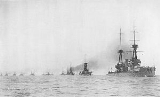
British Home Fleet

Encyclopedia
The Home Fleet was a fleet
of the Royal Navy
which operated in the United Kingdom
's territorial waters
from 1902 with intervals until 1967.
Gerard Noel, was given the additional appointment of Commander-in-Chief, Home Fleet, and allotted a rear-admiral
to serve under him as commander of the Home Squadron. '...the nucleus of the Home Fleet would consist of the four Port Guard ships, which would be withdrawn from their various scattered dockyards and turned into a unified and permanent sea-going command – the Home Squadron – based on Portland. Also under the direction of the commander-in-chief of the Home Fleet would be the Coast Guard ships, which would continue to be berthed for the most part in their respective district harbours in order to carry out their local duties, but would join the Home Squadron for sea work at least three times per year, at which point the assembled force – the Home Squadron and the Coast Guard vessels – would be known collectively as the Home Fleet.' HMS Empress of India
became flagship for Rear-Admiral George Atkinson-Willes
, commanding the Home Squadron.
On 14 December 1904 the Channel Fleet was re-styled the Atlantic Fleet and the Home Fleet became the Channel Fleet. In 1909 the Home Fleet was reformed with Admiral Sir William May in command. He was succeeded in 1911 by Admiral Sir George Callaghan
. On 4 August 1914, as the First World War was breaking out, John Jellicoe
was ordered to take command of the Fleet, which by his appointment order was renamed the Grand Fleet.
. The Commander-in-Chief, Home Fleet in 1933 was Admiral Sir John Kelly, GCVO, KCB. The Home Fleet comprised the flagship HMS Nelson leading a force which included the 2nd Battle Squadron (United Kingdom)
(five more battleships), the Battlecruiser Squadron
(HMS Hood
and HMS Renown
), the 2nd Cruiser Squadron (Vice-Admiral E. A. Astley Rushton, CB, CMG aboard Dorsetshire
(three cruisers)), three destroyer flotillas (27), a submarine flotilla (six), two aircraft carriers and associated vessels.
Commanders in-Chief During the Inter War Period were:
an waters during the Second World War. On 3 September 1939, under Admiral Forbes flying his flag in at Scapa Flow
, it consisted of the 2nd Battle Squadron
, the Battle Cruiser Squadron, 18th Cruiser Squadron, Rear-Admiral, Destroyers, Rear-Admiral, Submarines (2nd Submarine Flotilla, Dundee, 6th Submarine Flotilla, Blyth, Northumberland
), Vice-Admiral, Aircraft Carriers (Vice-Admiral L.V. Wells, with , , and HMS Pegasus
), and the Orkney and Shetlands force. Its chief responsibility was to keep the German Navy
from breaking out of the North Sea
. For this purpose the First World War base at Scapa Flow
was reactivated as it was well-placed for interceptions of ships trying to run the blockade.
The two most surprising losses of the Home Fleet during the early part of the war were the sinking of the old battleship by the German submarine while supposedly safe in Scapa Flow and the loss of the pride of the Navy, the battlecruiser
, to the German battleship Bismarck
.
The operational areas of the Home Fleet were not circumscribed, and units were detached to other zones quite freely. However the southern parts of the North Sea and the English Channel
were made separate commands for light forces, and the growing intensity of the Battle of the Atlantic
led to the creation of Western Approaches Command
. Only with the final destruction of the Tirpitz
in 1944 did the Home Fleet assume a lower priority, and most of its heavy units were withdrawn to be sent to the Far East
.
Commanders-in-Chief during the Second World War were:
, greater emphasis was placed on protecting the North Atlantic from the Soviet Union
in concert with other countries as part of NATO.
Admiral Sir Rhoderick McGrigor
took command of the Fleet in 1948 from Admiral Edward Syfret
and in June–July 1949 supervised combined Western Union
exercises involving ships from the British, French, and Netherlands Navies. Admiral McGrigor flew his flag from the aircraft carrier HMS Implacable
. Also taking part in the exercises was HMS Victorious
and HMS Anson along with cruisers and destroyers. During the exercise the combined force paid a visit to Mount's Bay
in Cornwall
from 30 June to 4 July 1949. Admiral Sir Philip Vian
was Commander-in-Chief from 1950 to 1952, flying his flag in HMS Vanguard
. In late 1951 HMS Theseus
joined the fleet as flagship of the 2nd Aircraft Carrier Squadron.
The Commander-in-Chief, Home Fleet, gained an additional NATO responsibility as Commander-in-Chief, Eastern Atlantic, as part of SACLANT
, when the NATO military command structure was established in 1953 at the Northwood Headquarters
in northwest London. The Commander-in-Chief Home Fleet still flew his flag however in HMS Tyne at Portsmouth. During Exercise Mainbrace
in 1952, NATO naval forces came together for the first time to practice the defence of northern Europe; Denmark and Norway. The resulting McMahon Act difficulties caused by potential British control of the United States Navy
's attack carriers armed with nuclear weapons led to the creation of a separate Striking Fleet Atlantic, directly responsible to the commander of the U.S. Navy's Atlantic Fleet, in his NATO position as SACLANT, by the end of 1952. In early January 1954 Admiral Sir Michael Denny
took over as Commander-in-Chief, Home Fleet from Admiral Sir George Creasy
. The submarine tender HMS Maidstone
was the fleet's flagship in 1956.
In 1960 C-in-C Home Fleet moved to Northwood and in 1966 the NATO Channel Command (a post also held by C-in-C Home Fleet) moved to Northwood from Portsmouth. In 1963 Admiral Sir Charles Madden
took command. In April 1963 the naval unit at the Northwood Headquarters
was commissioned as HMS Warrior under the command of the then Captain of the Fleet.
The Home Fleet was amalgamated with the Mediterranean Fleet
in 1967. With its area of responsibility greatly increased and no longer being just responsible for the defence of home waters of the UK, the name of the fleet was changed to the Western Fleet, consigning the famous, historic name of the Home Fleet to history. Admiral Sir John Frewen
had taken command of the Fleet from Admiral Madden in 1965 and was the Fleet's last Commander-in-Chief.
Flag Officers in the Home Fleet in the 1950s and 1960s included:
Commanders-in-Chief after the Second World War were:
Naval fleet
A fleet, or naval fleet, is a large formation of warships, and the largest formation in any navy. A fleet at sea is the direct equivalent of an army on land....
of the Royal Navy
Royal Navy
The Royal Navy is the naval warfare service branch of the British Armed Forces. Founded in the 16th century, it is the oldest service branch and is known as the Senior Service...
which operated in the United Kingdom
United Kingdom
The United Kingdom of Great Britain and Northern IrelandIn the United Kingdom and Dependencies, other languages have been officially recognised as legitimate autochthonous languages under the European Charter for Regional or Minority Languages...
's territorial waters
Territorial waters
Territorial waters, or a territorial sea, as defined by the 1982 United Nations Convention on the Law of the Sea, is a belt of coastal waters extending at most from the baseline of a coastal state...
from 1902 with intervals until 1967.
Pre–First World War
On 1 October 1902, the Admiral Superintendent Naval Reserves, then Vice-AdmiralVice Admiral (Royal Navy)
Vice admiral is a flag officer rank of the British Royal Navy. It equates to the NATO rank code OF-8 and is immediately superior to rear admiral and is subordinate to the full admiral rank.The Royal Navy has had vice admirals since at least the 16th century...
Gerard Noel, was given the additional appointment of Commander-in-Chief, Home Fleet, and allotted a rear-admiral
Rear Admiral (Royal Navy)
Rear Admiral is a flag officer rank of the British Royal Navy. It is immediately superior to Commodore and is subordinate to Vice Admiral. It is a two-star rank and has a NATO ranking code of OF-7....
to serve under him as commander of the Home Squadron. '...the nucleus of the Home Fleet would consist of the four Port Guard ships, which would be withdrawn from their various scattered dockyards and turned into a unified and permanent sea-going command – the Home Squadron – based on Portland. Also under the direction of the commander-in-chief of the Home Fleet would be the Coast Guard ships, which would continue to be berthed for the most part in their respective district harbours in order to carry out their local duties, but would join the Home Squadron for sea work at least three times per year, at which point the assembled force – the Home Squadron and the Coast Guard vessels – would be known collectively as the Home Fleet.' HMS Empress of India
HMS Empress of India (1891)
HMS Empress of India was a pre-dreadnought battleship of the Royal Navy and part of the eight-ship Royal Sovereign class. She was laid down at Pembroke Dockyard on 9 July 1889 and launched by the Duchess of Connaught on 7 May 1891. Initially known as HMS Renown, her name was changed before...
became flagship for Rear-Admiral George Atkinson-Willes
George Atkinson-Willes
Admiral Sir George Lambart Atkinson-Willes KCB was a Royal Navy officer who went on to be Commander-in-Chief, East Indies Station.-Naval career:...
, commanding the Home Squadron.
On 14 December 1904 the Channel Fleet was re-styled the Atlantic Fleet and the Home Fleet became the Channel Fleet. In 1909 the Home Fleet was reformed with Admiral Sir William May in command. He was succeeded in 1911 by Admiral Sir George Callaghan
George Callaghan
Admiral of the Fleet Sir George Astley Callaghan GCB GCVO was a senior officer in the Royal Navy.-Naval career:...
. On 4 August 1914, as the First World War was breaking out, John Jellicoe
John Jellicoe, 1st Earl Jellicoe
Admiral of the Fleet John Rushworth Jellicoe, 1st Earl Jellicoe, GCB, OM, GCVO was a British Royal Navy admiral who commanded the Grand Fleet at the Battle of Jutland in World War I...
was ordered to take command of the Fleet, which by his appointment order was renamed the Grand Fleet.
Interwar
The name "Home Fleet" was resurrected in March 1932, as the new name for the Atlantic Fleet, following the Invergordon MutinyInvergordon Mutiny
The Invergordon Mutiny was an industrial action by around 1,000 sailors in the British Atlantic Fleet, that took place on 15–16 September 1931...
. The Commander-in-Chief, Home Fleet in 1933 was Admiral Sir John Kelly, GCVO, KCB. The Home Fleet comprised the flagship HMS Nelson leading a force which included the 2nd Battle Squadron (United Kingdom)
2nd Battle Squadron (United Kingdom)
The British Royal Navy 2nd Battle Squadron was a naval squadron consisting of battleships. The 2nd Battle Squadron was initially part of the Royal Navy's Grand Fleet. After World War I the Grand Fleet was reverted back to its original name, the Atlantic Fleet...
(five more battleships), the Battlecruiser Squadron
Battlecruiser Squadron (United Kingdom)
The Battlecruiser Squadron was a Royal Navy squadron of battlecruisers that saw service from 1919 to the early part of the Second World War.- Formation :...
(HMS Hood
HMS Hood (51)
HMS Hood was the last battlecruiser built for the Royal Navy. One of four s ordered in mid-1916, her design—although drastically revised after the Battle of Jutland and improved while she was under construction—still had serious limitations. For this reason she was the only ship of her class to be...
and HMS Renown
HMS Renown (1916)
HMS Renown was the lead ship of her class of battlecruisers of the Royal Navy built during the First World War. She was originally laid down as an improved version of the s. Her construction was suspended on the outbreak of war on the grounds she would not be ready in a timely manner...
), the 2nd Cruiser Squadron (Vice-Admiral E. A. Astley Rushton, CB, CMG aboard Dorsetshire
HMS Dorsetshire (40)
HMS Dorsetshire was a heavy cruiser of the County class of the Royal Navy, named after the English county . She was launched on 29 January 1929 at Portsmouth Dockyard, UK. During the Second World War, she was last commanded by Captain Augustus Agar V.C....
(three cruisers)), three destroyer flotillas (27), a submarine flotilla (six), two aircraft carriers and associated vessels.
Commanders in-Chief During the Inter War Period were:
- Admiral Sir John Kelly (1932–1933)
- Admiral Sir William BoyleWilliam Boyle, 12th Earl of CorkAdmiral of the Fleet William Henry Dudley Boyle, 12th Earl of Cork, 12th Earl of Orrery GCB GCVO RN was a career Royal Navy officer who had achieved the rank of full Admiral before succeeding a cousin in 1934 to the family titles, chief of which is Earl of Cork...
(1933–1935) - Admiral Sir Roger BackhouseRoger BackhouseAdmiral of the Fleet Sir Roger Roland Charles Backhouse GCB GCVO CMG was an Admiral of the Fleet in the Royal Navy and First Sea Lord of the British Admiralty from 1938 to 1939.-Family:...
(1935–1938)
Second World War
The Home Fleet was the Royal Navy's main battle force in EuropeEurope
Europe is, by convention, one of the world's seven continents. Comprising the westernmost peninsula of Eurasia, Europe is generally 'divided' from Asia to its east by the watershed divides of the Ural and Caucasus Mountains, the Ural River, the Caspian and Black Seas, and the waterways connecting...
an waters during the Second World War. On 3 September 1939, under Admiral Forbes flying his flag in at Scapa Flow
Scapa Flow
right|thumb|Scapa Flow viewed from its eastern endScapa Flow is a body of water in the Orkney Islands, Scotland, United Kingdom, sheltered by the islands of Mainland, Graemsay, Burray, South Ronaldsay and Hoy. It is about...
, it consisted of the 2nd Battle Squadron
2nd Battle Squadron (United Kingdom)
The British Royal Navy 2nd Battle Squadron was a naval squadron consisting of battleships. The 2nd Battle Squadron was initially part of the Royal Navy's Grand Fleet. After World War I the Grand Fleet was reverted back to its original name, the Atlantic Fleet...
, the Battle Cruiser Squadron, 18th Cruiser Squadron, Rear-Admiral, Destroyers, Rear-Admiral, Submarines (2nd Submarine Flotilla, Dundee, 6th Submarine Flotilla, Blyth, Northumberland
Blyth, Northumberland
Blyth is a town and civil parish in southeast Northumberland, England. It lies on the coast, to the south of the River Blyth and is approximately 21 kilometres northeast of Newcastle upon Tyne...
), Vice-Admiral, Aircraft Carriers (Vice-Admiral L.V. Wells, with , , and HMS Pegasus
HMS Ark Royal (1914)
HMS Ark Royal was the first ship in history designed and built as a seaplane carrier. She was purchased by the Royal Navy in 1914 shortly after her keel had been laid and the ship was only in frames; this allowed the ship's design to be modified almost totally to accommodate seaplanes...
), and the Orkney and Shetlands force. Its chief responsibility was to keep the German Navy
Kriegsmarine
The Kriegsmarine was the name of the German Navy during the Nazi regime . It superseded the Kaiserliche Marine of World War I and the post-war Reichsmarine. The Kriegsmarine was one of three official branches of the Wehrmacht, the unified armed forces of Nazi Germany.The Kriegsmarine grew rapidly...
from breaking out of the North Sea
North Sea
In the southwest, beyond the Straits of Dover, the North Sea becomes the English Channel connecting to the Atlantic Ocean. In the east, it connects to the Baltic Sea via the Skagerrak and Kattegat, narrow straits that separate Denmark from Norway and Sweden respectively...
. For this purpose the First World War base at Scapa Flow
Scapa Flow
right|thumb|Scapa Flow viewed from its eastern endScapa Flow is a body of water in the Orkney Islands, Scotland, United Kingdom, sheltered by the islands of Mainland, Graemsay, Burray, South Ronaldsay and Hoy. It is about...
was reactivated as it was well-placed for interceptions of ships trying to run the blockade.
The two most surprising losses of the Home Fleet during the early part of the war were the sinking of the old battleship by the German submarine while supposedly safe in Scapa Flow and the loss of the pride of the Navy, the battlecruiser
Battlecruiser
Battlecruisers were large capital ships built in the first half of the 20th century. They were developed in the first decade of the century as the successor to the armoured cruiser, but their evolution was more closely linked to that of the dreadnought battleship...
, to the German battleship Bismarck
German battleship Bismarck
Bismarck was the first of two s built for the German Kriegsmarine during World War II. Named after Chancellor Otto von Bismarck, the primary force behind the German unification in 1871, the ship was laid down at the Blohm & Voss shipyard in Hamburg in July 1936 and launched nearly three years later...
.
The operational areas of the Home Fleet were not circumscribed, and units were detached to other zones quite freely. However the southern parts of the North Sea and the English Channel
English Channel
The English Channel , often referred to simply as the Channel, is an arm of the Atlantic Ocean that separates southern England from northern France, and joins the North Sea to the Atlantic. It is about long and varies in width from at its widest to in the Strait of Dover...
were made separate commands for light forces, and the growing intensity of the Battle of the Atlantic
Second Battle of the Atlantic
The Battle of the Atlantic was the longest continuous military campaign in World War II, running from 1939 to the defeat of Germany in 1945. At its core was the Allied naval blockade of Germany, announced the day after the declaration of war, and Germany's subsequent counter-blockade. It was at its...
led to the creation of Western Approaches Command
Western Approaches Command
Commander-in-Chief, Western Approaches was the commander of a major operational command of the Royal Navy during World War II. The admiral commanding, and his forces, sometimes informally known as 'Western Approaches Command,' were responsible for the safety of British shipping in the Western...
. Only with the final destruction of the Tirpitz
German battleship Tirpitz
Tirpitz was the second of two s built for the German Kriegsmarine during World War II. Named after Grand Admiral Alfred von Tirpitz, the architect of the Imperial Navy, the ship was laid down at the Kriegsmarinewerft in Wilhelmshaven in November 1936 and launched two and a half years later in April...
in 1944 did the Home Fleet assume a lower priority, and most of its heavy units were withdrawn to be sent to the Far East
Far East
The Far East is an English term mostly describing East Asia and Southeast Asia, with South Asia sometimes also included for economic and cultural reasons.The term came into use in European geopolitical discourse in the 19th century,...
.
Commanders-in-Chief during the Second World War were:
- Admiral Sir Charles Forbes (1939–1940),
- Admiral Sir John ToveyJohn Tovey, 1st Baron ToveyAdmiral of the Fleet John Cronyn "Jack" Tovey, 1st Baron Tovey GCB, KBE, DSO, DCL was a Royal Navy admiral who served in both World Wars. He signed himself as "Jack", not "John". Tovey joined the Royal Navy before World War I, and commanded destroyers in that war. He rose, with several senior...
(1940–1942), - Admiral Sir Bruce FraserBruce Fraser, 1st Baron Fraser of North CapeAdmiral of the Fleet Bruce Austin Fraser, 1st Baron Fraser of North Cape GCB, KBE was a senior British admiral during World War II.-Early naval career:Fraser joined the Royal Navy as a Cadet on 15 January 1904...
(1942–1944) - Admiral Sir Henry Moore (14 June 1944–24 November 1945)
Post-Second World War
After the Second World War, the Home Fleet took back all of its peacetime responsibilities for the Royal Navy forces in home waters and also in the North and South Atlantic. With the Cold WarCold War
The Cold War was the continuing state from roughly 1946 to 1991 of political conflict, military tension, proxy wars, and economic competition between the Communist World—primarily the Soviet Union and its satellite states and allies—and the powers of the Western world, primarily the United States...
, greater emphasis was placed on protecting the North Atlantic from the Soviet Union
Soviet Union
The Soviet Union , officially the Union of Soviet Socialist Republics , was a constitutionally socialist state that existed in Eurasia between 1922 and 1991....
in concert with other countries as part of NATO.
Admiral Sir Rhoderick McGrigor
Rhoderick McGrigor
Admiral of the Fleet Sir Rhoderick Robert McGrigor GCB was a Royal Navy officer and the British First Sea Lord from 1951 to 1955. During his years as professional head of the Royal Navy, he is most remembered as a leading proponent of carrier-based air power.-Early life:Rhoderick Robert McGrigor...
took command of the Fleet in 1948 from Admiral Edward Syfret
Edward Neville Syfret
Admiral Sir Edward Neville Syfret GCB, KBE was a British naval officer who served with the Royal Navy in World War I and World War II. He was knighted for his part in Operation Pedestal, the critical Malta convoy...
and in June–July 1949 supervised combined Western Union
Treaty of Brussels
The Treaty of Brussels was signed on 17 March 1948 between Belgium, France, Luxembourg, the Netherlands and the United Kingdom, as an expansion to the preceding year's defence pledge, the Dunkirk Treaty signed between Britain and France...
exercises involving ships from the British, French, and Netherlands Navies. Admiral McGrigor flew his flag from the aircraft carrier HMS Implacable
HMS Implacable (R86)
HMS Implacable was an Implacable-class aircraft carrier of the Royal Navy.- History :She was laid down at Fairfields Shipyard on Clydeside three months after her sister-ship Indefatigable and was clearly destined for the British Pacific Fleet once worked up...
. Also taking part in the exercises was HMS Victorious
HMS Victorious (R38)
HMS Victorious was the second Illustrious-class aircraft carrier ordered under the 1936 Naval Programme. She was laid down at the Vickers-Armstrong shipyard at Newcastle-Upon-Tyne in 1937 and launched two years later in 1939...
and HMS Anson along with cruisers and destroyers. During the exercise the combined force paid a visit to Mount's Bay
Mount's Bay
Mount's Bay is a large, sweeping bay on the English Channel coast of Cornwall in the United Kingdom, stretching from the Lizard Point to Gwennap Head on the eastern side of the Land's End peninsula. Towards the middle of the bay is St Michael's Mount...
in Cornwall
Cornwall
Cornwall is a unitary authority and ceremonial county of England, within the United Kingdom. It is bordered to the north and west by the Celtic Sea, to the south by the English Channel, and to the east by the county of Devon, over the River Tamar. Cornwall has a population of , and covers an area of...
from 30 June to 4 July 1949. Admiral Sir Philip Vian
Philip Vian
Admiral of the Fleet Sir Philip Louis Vian, GCB, KBE, DSO & Two Bars was a British naval officer who served in both World Wars....
was Commander-in-Chief from 1950 to 1952, flying his flag in HMS Vanguard
HMS Vanguard (23)
HMS Vanguard was a British fast battleship built during World War II and commissioned after the end of the war. She was the only ship of her class and was the biggest, fastest and last of the Royal Navy's dreadnoughts, and the final battleship to be launched in the world...
. In late 1951 HMS Theseus
HMS Theseus (R64)
HMS Theseus was a Colossus-class light fleet aircraft carrier of the Royal Navy. She was laid down in 1943 by Fairfield at Govan, and launched on 6 July 1944.-Workup and initial service:...
joined the fleet as flagship of the 2nd Aircraft Carrier Squadron.
The Commander-in-Chief, Home Fleet, gained an additional NATO responsibility as Commander-in-Chief, Eastern Atlantic, as part of SACLANT
Supreme Allied Commander Atlantic
The Supreme Allied Commander Atlantic was one of two supreme commanders of the North Atlantic Treaty Organisation , the other being the Supreme Allied Commander Europe . The SACLANT led Allied Command Atlantic, based at Norfolk, Virginia...
, when the NATO military command structure was established in 1953 at the Northwood Headquarters
Northwood Headquarters
Northwood Headquarters is a military headquarters facility of the British Armed Forces in Eastbury, Hertfordshire, England, adjacent to the London suburb of Northwood...
in northwest London. The Commander-in-Chief Home Fleet still flew his flag however in HMS Tyne at Portsmouth. During Exercise Mainbrace
Operation Mainbrace
Exercise Mainbrace was the first large-scale naval exercise undertaken by the newly established Allied Command Atlantic , one of the two principal military commands of the North Atlantic Treaty Organization . It was part of a series of NATO exerciseS jointly commanded by Supreme Allied Commander...
in 1952, NATO naval forces came together for the first time to practice the defence of northern Europe; Denmark and Norway. The resulting McMahon Act difficulties caused by potential British control of the United States Navy
United States Navy
The United States Navy is the naval warfare service branch of the United States Armed Forces and one of the seven uniformed services of the United States. The U.S. Navy is the largest in the world; its battle fleet tonnage is greater than that of the next 13 largest navies combined. The U.S...
's attack carriers armed with nuclear weapons led to the creation of a separate Striking Fleet Atlantic, directly responsible to the commander of the U.S. Navy's Atlantic Fleet, in his NATO position as SACLANT, by the end of 1952. In early January 1954 Admiral Sir Michael Denny
Michael Denny
Admiral Sir Michael Maynard Denny GCB CBE DSO was a Royal Navy officer who went on to be Third Sea Lord.-Naval career:...
took over as Commander-in-Chief, Home Fleet from Admiral Sir George Creasy
George Creasy
Admiral of the Fleet Sir George Elvey Creasy GCB CBE DSO MVO was a senior Royal Navy officer who went on to be Commander-in-Chief, Portsmouth.-Naval career:...
. The submarine tender HMS Maidstone
HMS Maidstone (1937)
HMS Maidstone was a submarine depot ship of the Royal Navy.-Facilities:She was built to support the increasing numbers of submarines, especially on distant stations, such as the Mediterranean and the Pacific Far East...
was the fleet's flagship in 1956.
In 1960 C-in-C Home Fleet moved to Northwood and in 1966 the NATO Channel Command (a post also held by C-in-C Home Fleet) moved to Northwood from Portsmouth. In 1963 Admiral Sir Charles Madden
Sir Charles Madden, 2nd Baronet
Admiral Sir Charles Edward Madden, 2nd Baronet, GCB , followed his father in a career with the Royal Navy that culminated in his serving as the Commander-in-Chief of the Home Fleet from 1963 to 1965....
took command. In April 1963 the naval unit at the Northwood Headquarters
Northwood Headquarters
Northwood Headquarters is a military headquarters facility of the British Armed Forces in Eastbury, Hertfordshire, England, adjacent to the London suburb of Northwood...
was commissioned as HMS Warrior under the command of the then Captain of the Fleet.
The Home Fleet was amalgamated with the Mediterranean Fleet
Mediterranean Fleet
Several countries have or have had a Mediterranean Fleet in their navy. See:* Mediterranean Fleet * French Mediterranean Fleet* Mediterranean Squadron * United States Sixth Fleet...
in 1967. With its area of responsibility greatly increased and no longer being just responsible for the defence of home waters of the UK, the name of the fleet was changed to the Western Fleet, consigning the famous, historic name of the Home Fleet to history. Admiral Sir John Frewen
John Frewen
Admiral Sir John Byng Frewen GCB was Commander-in-Chief Naval Home Command.-Naval career:Frewen joined the Royal Navy in 1924. He served in World War II in the Russian Convoys and as Squadron Navigating Officer for Aircraft Carriers in the Pacific...
had taken command of the Fleet from Admiral Madden in 1965 and was the Fleet's last Commander-in-Chief.
Flag Officers in the Home Fleet in the 1950s and 1960s included:
- Flag Officer, Training Squadron (HMS VictoriousHMS Victorious (R38)HMS Victorious was the second Illustrious-class aircraft carrier ordered under the 1936 Naval Programme. She was laid down at the Vickers-Armstrong shipyard at Newcastle-Upon-Tyne in 1937 and launched two years later in 1939...
1948-1950, 1954 spring cruise included HMS ImplacableHMS Implacable (R86)HMS Implacable was an Implacable-class aircraft carrier of the Royal Navy.- History :She was laid down at Fairfields Shipyard on Clydeside three months after her sister-ship Indefatigable and was clearly destined for the British Pacific Fleet once worked up...
and HMS IndefatigableHMS Indefatigable (R10)HMS Indefatigable was an Implacable-class aircraft carrier of the British Royal Navy. Indefatigable was present at the formal surrender of the Japanese on 2 September in Tokyo Bay. She later helped to repatriate Allied POWs held in Japan and was used as a spotting ship for later US nuclear tests in...
) - Flag Officer, Heavy Squadron (Rear-Admiral Caspar JohnCaspar JohnAdmiral of the Fleet Sir Caspar John GCB was the British First Sea Lord from 1960 to 1963. He was pioneer in the Fleet Air Arm, and rose to become Vice-Chief of Naval Staff to Sea Lord Louis Mountbatten, 1st Earl Mountbatten of Burma in 1957 and subsequently First Sea Lord from 1960 to 1963.-Early...
1951-52, Vice-Admiral John Hughes-HallettJohn Hughes-HallettVice-Admiral John Hughes-Hallett was a British naval commander and politician. He was the Naval Commander during the Dieppe Raid of 1942.-Biography:...
1952-53) - included HMS VanguardHMS Vanguard (23)HMS Vanguard was a British fast battleship built during World War II and commissioned after the end of the war. She was the only ship of her class and was the biggest, fastest and last of the Royal Navy's dreadnoughts, and the final battleship to be launched in the world...
? - Flag Officer Flotillas, Home Fleet - flew flag in HMS Tyne, July 1960-March 1961
Commanders-in-Chief after the Second World War were:
- Admiral Sir Edward SyfretEdward Neville SyfretAdmiral Sir Edward Neville Syfret GCB, KBE was a British naval officer who served with the Royal Navy in World War I and World War II. He was knighted for his part in Operation Pedestal, the critical Malta convoy...
(1945–1948) - Admiral Sir Rhoderick McGrigorRhoderick McGrigorAdmiral of the Fleet Sir Rhoderick Robert McGrigor GCB was a Royal Navy officer and the British First Sea Lord from 1951 to 1955. During his years as professional head of the Royal Navy, he is most remembered as a leading proponent of carrier-based air power.-Early life:Rhoderick Robert McGrigor...
(1948–1950) - Admiral Sir Philip VianPhilip VianAdmiral of the Fleet Sir Philip Louis Vian, GCB, KBE, DSO & Two Bars was a British naval officer who served in both World Wars....
(1950–1952) - Admiral Sir George CreasyGeorge CreasyAdmiral of the Fleet Sir George Elvey Creasy GCB CBE DSO MVO was a senior Royal Navy officer who went on to be Commander-in-Chief, Portsmouth.-Naval career:...
(1952–1954) - Admiral Sir Michael DennyMichael DennyAdmiral Sir Michael Maynard Denny GCB CBE DSO was a Royal Navy officer who went on to be Third Sea Lord.-Naval career:...
(1954–1955) - Admiral Sir John EcclesJohn Eccles (Royal Navy officer)Admiral Sir John Arthur Symons Eccles GCB KCVO CBE was a Royal Navy officer who went on to be Commander-in-Chief, Home Fleet.-Naval career:...
(1955–1958) - Admiral Sir William DavisWilliam Davis (Royal Navy officer)Admiral Sir William Wellclose Davis GCB DSO was a Royal Navy officer who went on to be Vice Chief of the Naval Staff.-Naval career:...
(1958–1960) - Admiral Sir Wilfrid WoodsWilfrid WoodsAdmiral Sir Wilfrid John Wentworth Woods, GBE, KCB, DSO and bar, DL was a Royal Navy officer who served in the Submarine Service in the Mediterranean.-Family:...
(1960–1963) - Admiral Sir Charles MaddenSir Charles Madden, 2nd BaronetAdmiral Sir Charles Edward Madden, 2nd Baronet, GCB , followed his father in a career with the Royal Navy that culminated in his serving as the Commander-in-Chief of the Home Fleet from 1963 to 1965....
(1963–1965) - Admiral Sir John FrewenJohn FrewenAdmiral Sir John Byng Frewen GCB was Commander-in-Chief Naval Home Command.-Naval career:Frewen joined the Royal Navy in 1924. He served in World War II in the Russian Convoys and as Squadron Navigating Officer for Aircraft Carriers in the Pacific...
(1965–1967)