

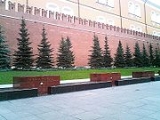
Hero City

Encyclopedia
Hero City is a Soviet
honorary title
awarded for outstanding heroism during the German-Soviet War (World War II
) of 1941 to 1945. It was awarded to twelve cities of the Soviet Union
. In addition the Brest Fortress
was awarded an equivalent title of Hero-Fortress
. This symbolic distinction for a city corresponds to the individual distinction Hero of the Soviet Union
.
According to the statute, the hero city is issued the Order of Lenin
, the Gold Star medal, and the certificate of the heroic deed (gramota) from the Presidium of the Supreme Soviet
of the USSR. Also, the corresponding obelisk
is installed in the city.
as early as in 1942. The first official usage of the title is dated by May 1, 1945, when Joseph Stalin
issued his Supreme Commander Order #20 commanding to fire salute
s in "hero cities Leningrad
, Stalingrad, Sevastopol
, and Odessa
."
On June 22, 1961 (20th anniversary of the beginning of the German-Soviet War) the term "Hero City" was applied to Kiev
in the ukases that awarded Kiev the Order of Lenin and introduced the Medal "For the Defence of Kiev"
.
The statute of the title was officially introduced on May 8, 1965 by the ukase
of the Presidium of the Supreme Soviet of USSR, on the occasion of the 20th anniversary of the victory in the German-Soviet War. The same day ukases were issued about awarding the cities mentioned above: Leningrad, Volgograd (former Stalingrad), Kiev, Sevastopol, and Odessa. (However traditionally for these cities the anniversaries of being Hero City correspond to the dates mentioned earlier.) Additionally, Moscow
was declared Hero City and Brest
declared Hero-Fortress.
Subsequent awards were issued as follows:
In 1988 the issuance of the award was officially discontinued.
On April 5, 2005 the State Duma
of Russian Federation passed the law in the first reading about the introduction of the honorary title "City of Military Glory
" (Город воинской славы). Potential candidates are places of fierce battles: Oryol
, Rzhev
, Yelnya
, Voronezh
, Vyazma
, and others.
was awarded the title Hero-Fortress
in 1965. It was located right on the recently established border between the Soviet Union and Nazi Germany
drawn in the secret appendix to the Molotov-Ribbentrop Pact
. As such, the fortress had little warning when the Axis
invaded on 22 June 1941, and became the site of the first major fighting between Soviet frontier guards and the invading German forces of Army Group Centre. German artillery heavily shelled the fortress; the subsequent attempt to quickly take it with infantry failed, however, and the Germans started a lengthy siege. The Brest garrison, although cut off from the outside world and having run out of food, water and ammunition, fought and counter-attacked until the very last minute. The Germans deployed tanks, tear gas and flame throwers. After the Germans had taken most of the ruined fortifications, taking heavy casualties, bloody fighting continued underground. The fighting ended only in late July. The actual front had by then already moved hundreds of kilometres further East. Even after the fortress was officially taken, the few surviving defenders continued to hide in the basements and to harass the Germans for several months.

 The city of Leningrad, now known as Saint Petersburg
, saw what is regarded as one of the greatest human tragedies of the entire War. Leningrad, one of the cities with a large amount of classical and baroque architecture on the Baltic Sea
, was a city with a pre-war population of three million inhabitants. By August 1941, the Germans had reached the city's southern outskirts. Finnish forces had meanwhile recaptured the Karelian Isthmus
North-West of the city, which they had lost after the Winter War
in 1940.
The city was completely cut off from all land access on 8 September 1941. As the Gulf of Finland
was blocked as well, Leningrad's only contact with the outer world was a vulnerable waterway across Lake Ladoga
, as Finnish command didn't agree to German requests to advance beyond the River Svir and to conquer the rest of the Lake's coastline. Since taking the city seemed too costly to the Germans, in the light of bitter Soviet resistance, they instead began the Siege of Leningrad
in order to starve the city to death. Soon, electricity, water and heating for civilian housing had to be shut down. All public transportation stopped in 1941-42 winter , but in 1942 city tramcars were relaunched (trolleys and buses were inoperable until end of the war).
Thousands of Leningrad citizens froze or starved to death in the first winter of the siege alone, dying at home in their beds or collapsing from exhaustion in the streets. Meanwhile, German artillery continued to bombard the city. Although the siege lasted for 900 days, the city did not surrender. When Lake Ladoga froze in the winter, the Road of Life
was opened to the Soviet-held southern shore of the Lake, with a long trail of trucks bringing food and supplies to the besieged city and evacuating citizens on their way back. Both the food and the civilian transports were constantly attacked by the Germans with artillery shelling and air raids.
When Soviet forces eventually lifted the siege in January 1944, over one million inhabitants of Leningrad had died from starvation, exposure and German shelling. 300,000 soldiers had perished in the defence and relief of Leningrad. Leningrad was awarded the title Hero City in 1945, being the first city to receive that distinction.
is the present-day name of the city of Stalingrad. The defence of Stalingrad from July to November 1942, the counter-offensive of 19 November 1942 that trapped the Axis forces in and around the ruined city, and the German surrender on 2 February 1943 marked the turning-point of the European Theatre of World War II
. The intensity and sheer scale of the battle of Stalingrad
illustrate the ferocity of the German-Soviet War. Heavy German bombardment, killing thousands of civilians, had turned the city into a landscape of ruins. Workers of the city's weapons factories started personally handing over arms and ammunition to the defending soldiers as the Germans closed in, and eventually continued the fight themselves. Ever more Soviet troops were shipped into the city across the Volga River
under enemy fire. German superiority in tanks became useless in the rubble of urban warfare. Fierce man-to-man fighting in streets, buildings and staircases continued for months. The Red Army
moved its strategic reserve from Moscow to the lower Volga, and transferred all available aircraft from the entire country to the Stalingrad area. The Germans eventually lost a quarter of their total forces deployed on the Eastern Front, and never fully recovered from the defeat. The total casualties on both sides are estimated at nearly 2 million, within a period of 200 days. Stalingrad was awarded the title Hero City in 1945.
port of Odessa
, located in present-day Ukraine
, was attacked and besieged by Romanian forces fighting alongside their German allies. The fierce battle in defense of the city lasted until 16 October, when the remaining Soviet troops, as well as 15,000 civilians were evacuated by sea. Partisan fighting continued, however, in the city's catacombs
. Odessa was awarded the title Hero City in 1945.
 The Black Sea port of Sevastopol
was a heavily defended fortress on the Crimean peninsula. German and Romanian troops had advanced to the outskirts of the city from the North and launched their attack
on 30 October 1941. Having failed to take the city, Axis forces began a siege and heavy bombardment, with such unusual pieces of ordnance as the Mörser Karl
self-propelled mortar, and the gigantic Schwerer Gustav
railroad cannon. A second Axis offensive against the city, launched in December 1941, failed as well, as the Soviet army and navy forces continued to fight fiercely. Eventually the city was taken in June 1942. It was liberated in bloody fighting in May 1944. Sevastopol was awarded the title Hero City in 1945.
came to a halt in late November 1941, at the outskirts of Moscow
itself. The Soviet Government had by then been evacuated, yet Joseph Stalin
remained in the city. Struggling between determination and despair, the city's population helped build defensive positions in the streets. The underground metro stations provided shelter during German air raids. General Georgy Zhukov
, who assumed command of the city's defence, largely left close combat tactics to the local commanders on the city's approaches, and focused on concentrating fresh troops from Siberia for an eventual counter-attack. The Soviet counter-offensive was launched on 5 and 6 December 1941. In the freezing cold of an unusually harsh winter, Soviet forces, including well-equipped ski battalions, drove the exhausted Germans back out of reach of Moscow and consolidated their positions on 7 January 1942. The victory in the battle provided an important boost in morale for the Soviet population. Moscow was awarded the title Hero City in 1965.
became the site of the largest encirclement battle
in the summer of 1941. When the Germans commenced their offensive on 7 July, Soviet forces concentrated in the Kiev
area were ordered to stand fast, and a breakout was prohibited. Defence of the pocket was fierce. Thousands of civilians volunteered to help defend the city. Eventually Kiev was taken on 19 September. Over 600,000 Soviet troops were taken captive when the pocket was cleared. The prolonged resistance effectively disrupted the German plans of blitzkrieg
. However, in military terms, the battle was a great victory for the German Army
and a disaster for the Soviets
. It had a huge effect on morale, and Adolf Hitler
praised the victory as the greatest battle in history.
During the German occupation of Kiev, hundreds of thousands of civilians were killed or deported for slave labour. Kiev again became a battlefield when advancing Soviet forces pushed the Germans back West, liberating
the city on 6 November 1943. Kiev was awarded the title Hero City in 1965.
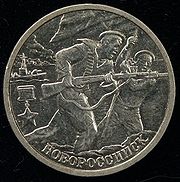 The city of Novorossiysk
on the Eastern coast of the Black Sea provided a stronghold against the German summer offensive of 1942. Intense fighting in and around the city lasted from August until September 1942. The Soviets however retained possession of the Eastern part of the bay, which prevented the Germans from using the port for supply shipments. Novorossiysk was awarded the title Hero City in 1973.
, a port in the East of the Crimean peninsula, formed a bridgehead at the strait dividing Crimea from the Southern Russian mainland. After fierce fighting, it was taken by the Germans in November 1941. On 30 December 1941 the Soviets recaptured the city in a naval landing operation. In May 1942 the Germans occupied the city again, yet Soviet partisan forces held out in the cliffs near the city until October 1942. On 31 October 1943 another Soviet naval landing was launched. The largely ruined city was finally liberated on 11 April 1944. Kerch was awarded the title Hero City in 1973.
, capital of present-day Belarus
, was encircled by advancing German forces in late June 1941. Trapped in a vast pocket, the Soviets defended their positions desperately. Their resistance was broken on 9 July, with over 300,000 Soviet troops taken captive. During the following three-year occupation, the Germans killed about 400,000 civilians in and around the city. The Minsk area became a centre for the Soviet partisan activity behind enemy lines. Minsk was awarded the title Hero City in 1974.
 Tula
Tula
, a historical Russian city with important military industry South of Moscow, became the target of a German offensive to break Soviet resistance in the Moscow area between 24 October and 5 December 1941. The heavily fortified city held out, however, and secured the Southern flank during the Soviet defence of Moscow
and the subsequent counter-offensive. Tula was awarded the title Hero City in 1976.
, located on the Kola Peninsula
close to the Norwegian and Finnish borders, was a strategically important sea port and industrial city. It was the only Soviet port on the Northern coast that did not freeze in the winter, and was vital for the transport of supplies to the South. German forces, including 800 Finns under German command, launched an offensive
against Murmansk on 29 June 1941. More than 180,000 grenades and inflammable shells were fired on the city itself. Fierce Soviet resistance in the tundra and several Soviet counter-attacks made an Axis breakthrough impossible, however. Axis forces discontinued their attacks in late October 1941, having failed to take Murmansk or to cut off the Karelian railway line. Murmansk was awarded the title Hero City in 1985.
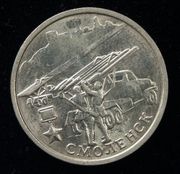 Located on the approaches to Moscow, the city of Smolensk
saw a fierce Battle of Smolensk
unfolding in the summer of 1941. German armoured divisions of Army Group Centre
began an offensive on July 10, 1941 to encircle Soviet forces in the Smolensk area. Soviet resistance was strong, and several counter-attacks were conducted. The Soviets even managed to temporarily break the German encirclement and to evacuate troops out of the pocket. The battle ended in early September. The bitter fighting had considerably delayed the overall German advance toward Moscow, so that defence lines further East could be strengthened. Smolensk was awarded the title Hero City in 1985.
.
In Italy, a number of cities have been awarded the Gold Medal of Military Valor
during and after the war (see Città decorate al valor militare per la guerra di liberazione).
In the British Empire
, George Cross
was awarded to Malta
in 1942.
The Communist Yugoslavia
n government awarded the Order of the National Hero to a number of cities in 1974-75. There were the total of eight Hero Cities in Yugoslavia (grad heroj in Serbian/Croatian): Belgrade
, Zagreb
, Ljubljana
, Novi Sad
, Prilep
, Pristina
, Titov Drvar, Cetinje
.
The Cuban Republic awards the title of Hero City to those cities with recognized military history, either in the 19th or 20th centuries. The most prominent example of this is the Hero City of Santiago de Cuba, awarded as such for its part in both Independence Wars against the Spanish, The Spanish–American War and the Cuban Revolution
.
By the end of the World War I, by the way after the Liberation War of Turkey, several cities cities had been honoured by the Parliament. The names of those cities had been changed:
Soviet Union
The Soviet Union , officially the Union of Soviet Socialist Republics , was a constitutionally socialist state that existed in Eurasia between 1922 and 1991....
honorary title
Title of honor
An honorary title or title of honor is a title bestowed upon individuals or organizations as an award in recognition of their merits.Sometimes the title bears the same or nearly the same name as a title of authority, but the person bestowed does not have to carry any duties, possibly except for...
awarded for outstanding heroism during the German-Soviet War (World War II
World War II
World War II, or the Second World War , was a global conflict lasting from 1939 to 1945, involving most of the world's nations—including all of the great powers—eventually forming two opposing military alliances: the Allies and the Axis...
) of 1941 to 1945. It was awarded to twelve cities of the Soviet Union
Soviet Union
The Soviet Union , officially the Union of Soviet Socialist Republics , was a constitutionally socialist state that existed in Eurasia between 1922 and 1991....
. In addition the Brest Fortress
Brest Fortress
Brest Fortress , formerly known as Brest-Litovsk Fortress , is a 19th century Russian fortress in Brest, Belarus. It is one of the most important Soviet World War II war monuments commemorating the Soviet resistance against the German invasion on June 22, 1941...
was awarded an equivalent title of Hero-Fortress
Hero-Fortress
Hero-Fortress is the honorary title awarded to the Soviet Brest Fortress, now in Brest, Belarus in 1965 for the defence of the frontier stronghold during the very first weeks of the German-Soviet War of 1941 to 1945...
. This symbolic distinction for a city corresponds to the individual distinction Hero of the Soviet Union
Hero of the Soviet Union
The title Hero of the Soviet Union was the highest distinction in the Soviet Union, awarded personally or collectively for heroic feats in service to the Soviet state and society.-Overview:...
.
According to the statute, the hero city is issued the Order of Lenin
Order of Lenin
The Order of Lenin , named after the leader of the Russian October Revolution, was the highest decoration bestowed by the Soviet Union...
, the Gold Star medal, and the certificate of the heroic deed (gramota) from the Presidium of the Supreme Soviet
Presidium of the Supreme Soviet
The Presidium of the Supreme Soviet was a Soviet governmental institution – a permanent body of the Supreme Soviets . This body was of the all-Union level , as well as in all Soviet republics and autonomous republics...
of the USSR. Also, the corresponding obelisk
Obelisk
An obelisk is a tall, four-sided, narrow tapering monument which ends in a pyramid-like shape at the top, and is said to resemble a petrified ray of the sun-disk. A pair of obelisks usually stood in front of a pylon...
is installed in the city.
History
The usage of the term "hero-city" is dated to articles in PravdaPravda
Pravda was a leading newspaper of the Soviet Union and an official organ of the Central Committee of the Communist Party between 1912 and 1991....
as early as in 1942. The first official usage of the title is dated by May 1, 1945, when Joseph Stalin
Joseph Stalin
Joseph Vissarionovich Stalin was the Premier of the Soviet Union from 6 May 1941 to 5 March 1953. He was among the Bolshevik revolutionaries who brought about the October Revolution and had held the position of first General Secretary of the Communist Party of the Soviet Union's Central Committee...
issued his Supreme Commander Order #20 commanding to fire salute
Salute
A salute is a gesture or other action used to display respect. Salutes are primarily associated with armed forces, but other organizations and civil people also use salutes.-Military salutes:...
s in "hero cities Leningrad
Saint Petersburg
Saint Petersburg is a city and a federal subject of Russia located on the Neva River at the head of the Gulf of Finland on the Baltic Sea...
, Stalingrad, Sevastopol
Sevastopol
Sevastopol is a city on rights of administrative division of Ukraine, located on the Black Sea coast of the Crimea peninsula. It has a population of 342,451 . Sevastopol is the second largest port in Ukraine, after the Port of Odessa....
, and Odessa
Odessa
Odessa or Odesa is the administrative center of the Odessa Oblast located in southern Ukraine. The city is a major seaport located on the northwest shore of the Black Sea and the fourth largest city in Ukraine with a population of 1,029,000 .The predecessor of Odessa, a small Tatar settlement,...
."
On June 22, 1961 (20th anniversary of the beginning of the German-Soviet War) the term "Hero City" was applied to Kiev
Kiev
Kiev or Kyiv is the capital and the largest city of Ukraine, located in the north central part of the country on the Dnieper River. The population as of the 2001 census was 2,611,300. However, higher numbers have been cited in the press....
in the ukases that awarded Kiev the Order of Lenin and introduced the Medal "For the Defence of Kiev"
Awards and decorations of the Soviet Union
Awards and decorations of the Soviet Union are decorations from the Former Soviet Union that recognised achievements and personal accomplishments, both military and civilian. Some of the awards, decorations and orders were discontinued after the dissolution of the Soviet Union, while others still...
.
The statute of the title was officially introduced on May 8, 1965 by the ukase
Ukase
A ukase , in Imperial Russia, was a proclamation of the tsar, government, or a religious leader that had the force of law...
of the Presidium of the Supreme Soviet of USSR, on the occasion of the 20th anniversary of the victory in the German-Soviet War. The same day ukases were issued about awarding the cities mentioned above: Leningrad, Volgograd (former Stalingrad), Kiev, Sevastopol, and Odessa. (However traditionally for these cities the anniversaries of being Hero City correspond to the dates mentioned earlier.) Additionally, Moscow
Moscow
Moscow is the capital, the most populous city, and the most populous federal subject of Russia. The city is a major political, economic, cultural, scientific, religious, financial, educational, and transportation centre of Russia and the continent...
was declared Hero City and Brest
Brest, Belarus
Brest , formerly also Brest-on-the-Bug and Brest-Litovsk , is a city in Belarus at the border with Poland opposite the city of Terespol, where the Bug River and Mukhavets rivers meet...
declared Hero-Fortress.
Subsequent awards were issued as follows:
- September 14, 1973: KerchKerchKerch is a city on the Kerch Peninsula of eastern Crimea, an important industrial, transport and tourist centre of Ukraine. Kerch, founded 2600 years ago, is considered as one of the most ancient cities in Ukraine.-Ancient times:...
and NovorossiyskNovorossiyskNovorossiysk is a city in Krasnodar Krai, Russia. It is the country's main port on the Black Sea and the leading Russian port for importing grain. It is one of the few cities honored with the title of the Hero City. Population: -History:...
. - June 26, 1974: MinskMinsk- Ecological situation :The ecological situation is monitored by Republican Center of Radioactive and Environmental Control .During 2003–2008 the overall weight of contaminants increased from 186,000 to 247,400 tons. The change of gas as industrial fuel to mazut for financial reasons has worsened...
- December 7, 1976: TulaTula, RussiaTula is an industrial city and the administrative center of Tula Oblast, Russia. It is located south of Moscow, on the Upa River. Population: -History:...
- May 6, 1985: MurmanskMurmanskMurmansk is a city and the administrative center of Murmansk Oblast, Russia. It serves as a seaport and is located in the extreme northwest part of Russia, on the Kola Bay, from the Barents Sea on the northern shore of the Kola Peninsula, not far from Russia's borders with Norway and Finland...
, SmolenskSmolenskSmolensk is a city and the administrative center of Smolensk Oblast, Russia, located on the Dnieper River. Situated west-southwest of Moscow, this walled city was destroyed several times throughout its long history since it was on the invasion routes of both Napoleon and Hitler. Today, Smolensk...
In 1988 the issuance of the award was officially discontinued.
On April 5, 2005 the State Duma
State Duma
The State Duma , common abbreviation: Госду́ма ) in the Russian Federation is the lower house of the Federal Assembly of Russia , the upper house being the Federation Council of Russia. The Duma headquarters is located in central Moscow, a few steps from Manege Square. Its members are referred to...
of Russian Federation passed the law in the first reading about the introduction of the honorary title "City of Military Glory
City of Military Glory
City of Military Glory is an honorary title bestowed upon the citizenry of Russian cities, where soldiers had displayed courage and heroism during the Great Patriotic War...
" (Город воинской славы). Potential candidates are places of fierce battles: Oryol
Oryol
Oryol or Orel is a city and the administrative center of Oryol Oblast, Russia, located on the Oka River, approximately south-southwest of Moscow...
, Rzhev
Rzhev
Rzhev is a town in Tver Oblast, Russia, southwest of Staritsa and from Tver, on the highway and railway connecting Moscow and Riga. It is the uppermost town situated on the Volga River. Population:...
, Yelnya
Yelnya
Yelnya is a town and the administrative center of Yelninsky District of Smolensk Oblast, Russia, situated on the Desna River from Smolensk. Population: -History:...
, Voronezh
Voronezh
Voronezh is a city in southwestern Russia, the administrative center of Voronezh Oblast. It is located on both sides of the Voronezh River, away from where it flows into the Don. It is an operating center of the Southeastern Railway , as well as the center of the Don Highway...
, Vyazma
Vyazma
Vyazma is a town and the administrative center of Vyazemsky District of Smolensk Oblast, Russia, located on the Vyazma River, about halfway between Smolensk and Mozhaysk. Throughout its turbulent history, the city defended western approaches to the city of Moscow...
, and others.
Brest Hero-Fortress
The fortress in Brest, BelarusBrest, Belarus
Brest , formerly also Brest-on-the-Bug and Brest-Litovsk , is a city in Belarus at the border with Poland opposite the city of Terespol, where the Bug River and Mukhavets rivers meet...
was awarded the title Hero-Fortress
Hero-Fortress
Hero-Fortress is the honorary title awarded to the Soviet Brest Fortress, now in Brest, Belarus in 1965 for the defence of the frontier stronghold during the very first weeks of the German-Soviet War of 1941 to 1945...
in 1965. It was located right on the recently established border between the Soviet Union and Nazi Germany
Nazi Germany
Nazi Germany , also known as the Third Reich , but officially called German Reich from 1933 to 1943 and Greater German Reich from 26 June 1943 onward, is the name commonly used to refer to the state of Germany from 1933 to 1945, when it was a totalitarian dictatorship ruled by...
drawn in the secret appendix to the Molotov-Ribbentrop Pact
Molotov-Ribbentrop Pact
The Molotov–Ribbentrop Pact, named after the Soviet foreign minister Vyacheslav Molotov and the German foreign minister Joachim von Ribbentrop, was an agreement officially titled the Treaty of Non-Aggression between Germany and the Soviet Union and signed in Moscow in the late hours of 23 August 1939...
. As such, the fortress had little warning when the Axis
Axis Powers
The Axis powers , also known as the Axis alliance, Axis nations, Axis countries, or just the Axis, was an alignment of great powers during the mid-20th century that fought World War II against the Allies. It began in 1936 with treaties of friendship between Germany and Italy and between Germany and...
invaded on 22 June 1941, and became the site of the first major fighting between Soviet frontier guards and the invading German forces of Army Group Centre. German artillery heavily shelled the fortress; the subsequent attempt to quickly take it with infantry failed, however, and the Germans started a lengthy siege. The Brest garrison, although cut off from the outside world and having run out of food, water and ammunition, fought and counter-attacked until the very last minute. The Germans deployed tanks, tear gas and flame throwers. After the Germans had taken most of the ruined fortifications, taking heavy casualties, bloody fighting continued underground. The fighting ended only in late July. The actual front had by then already moved hundreds of kilometres further East. Even after the fortress was officially taken, the few surviving defenders continued to hide in the basements and to harass the Germans for several months.
Leningrad (Saint Petersburg)
Saint Petersburg
Saint Petersburg is a city and a federal subject of Russia located on the Neva River at the head of the Gulf of Finland on the Baltic Sea...
, saw what is regarded as one of the greatest human tragedies of the entire War. Leningrad, one of the cities with a large amount of classical and baroque architecture on the Baltic Sea
Baltic Sea
The Baltic Sea is a brackish mediterranean sea located in Northern Europe, from 53°N to 66°N latitude and from 20°E to 26°E longitude. It is bounded by the Scandinavian Peninsula, the mainland of Europe, and the Danish islands. It drains into the Kattegat by way of the Øresund, the Great Belt and...
, was a city with a pre-war population of three million inhabitants. By August 1941, the Germans had reached the city's southern outskirts. Finnish forces had meanwhile recaptured the Karelian Isthmus
Karelian Isthmus
The Karelian Isthmus is the approximately 45–110 km wide stretch of land, situated between the Gulf of Finland and Lake Ladoga in northwestern Russia, to the north of the River Neva . Its northwestern boundary is the relatively narrow area between the Bay of Vyborg and Lake Ladoga...
North-West of the city, which they had lost after the Winter War
Winter War
The Winter War was a military conflict between the Soviet Union and Finland. It began with a Soviet offensive on 30 November 1939 – three months after the start of World War II and the Soviet invasion of Poland – and ended on 13 March 1940 with the Moscow Peace Treaty...
in 1940.
The city was completely cut off from all land access on 8 September 1941. As the Gulf of Finland
Gulf of Finland
The Gulf of Finland is the easternmost arm of the Baltic Sea. It extends between Finland and Estonia all the way to Saint Petersburg in Russia, where the river Neva drains into it. Other major cities around the gulf include Helsinki and Tallinn...
was blocked as well, Leningrad's only contact with the outer world was a vulnerable waterway across Lake Ladoga
Lake Ladoga
Lake Ladoga is a freshwater lake located in the Republic of Karelia and Leningrad Oblast in northwestern Russia, not far from Saint Petersburg. It is the largest lake in Europe, and the 14th largest lake by area in the world.-Geography:...
, as Finnish command didn't agree to German requests to advance beyond the River Svir and to conquer the rest of the Lake's coastline. Since taking the city seemed too costly to the Germans, in the light of bitter Soviet resistance, they instead began the Siege of Leningrad
Siege of Leningrad
The Siege of Leningrad, also known as the Leningrad Blockade was a prolonged military operation resulting from the failure of the German Army Group North to capture Leningrad, now known as Saint Petersburg, in the Eastern Front theatre of World War II. It started on 8 September 1941, when the last...
in order to starve the city to death. Soon, electricity, water and heating for civilian housing had to be shut down. All public transportation stopped in 1941-42 winter , but in 1942 city tramcars were relaunched (trolleys and buses were inoperable until end of the war).
Thousands of Leningrad citizens froze or starved to death in the first winter of the siege alone, dying at home in their beds or collapsing from exhaustion in the streets. Meanwhile, German artillery continued to bombard the city. Although the siege lasted for 900 days, the city did not surrender. When Lake Ladoga froze in the winter, the Road of Life
Road of Life
The Road of Life was the ice road transport route across the frozen Lake Ladoga, which provided the only access to the besieged city of Leningrad in the winter months during 1941–1944 while the perimeter in the siege was maintained by the German Army Group North and the Finnish Defence Forces. ...
was opened to the Soviet-held southern shore of the Lake, with a long trail of trucks bringing food and supplies to the besieged city and evacuating citizens on their way back. Both the food and the civilian transports were constantly attacked by the Germans with artillery shelling and air raids.
When Soviet forces eventually lifted the siege in January 1944, over one million inhabitants of Leningrad had died from starvation, exposure and German shelling. 300,000 soldiers had perished in the defence and relief of Leningrad. Leningrad was awarded the title Hero City in 1945, being the first city to receive that distinction.
Stalingrad (Volgograd)
VolgogradVolgograd
Volgograd , formerly called Tsaritsyn and Stalingrad is an important industrial city and the administrative center of Volgograd Oblast, Russia. It is long, north to south, situated on the western bank of the Volga River...
is the present-day name of the city of Stalingrad. The defence of Stalingrad from July to November 1942, the counter-offensive of 19 November 1942 that trapped the Axis forces in and around the ruined city, and the German surrender on 2 February 1943 marked the turning-point of the European Theatre of World War II
European Theatre of World War II
The European Theatre of World War II was a huge area of heavy fighting across Europe from Germany's invasion of Poland on September 1, 1939 until the end of the war with the German unconditional surrender on May 8, 1945...
. The intensity and sheer scale of the battle of Stalingrad
Battle of Stalingrad
The Battle of Stalingrad was a major battle of World War II in which Nazi Germany and its allies fought the Soviet Union for control of the city of Stalingrad in southwestern Russia. The battle took place between 23 August 1942 and 2 February 1943...
illustrate the ferocity of the German-Soviet War. Heavy German bombardment, killing thousands of civilians, had turned the city into a landscape of ruins. Workers of the city's weapons factories started personally handing over arms and ammunition to the defending soldiers as the Germans closed in, and eventually continued the fight themselves. Ever more Soviet troops were shipped into the city across the Volga River
Volga River
The Volga is the largest river in Europe in terms of length, discharge, and watershed. It flows through central Russia, and is widely viewed as the national river of Russia. Out of the twenty largest cities of Russia, eleven, including the capital Moscow, are situated in the Volga's drainage...
under enemy fire. German superiority in tanks became useless in the rubble of urban warfare. Fierce man-to-man fighting in streets, buildings and staircases continued for months. The Red Army
Red Army
The Workers' and Peasants' Red Army started out as the Soviet Union's revolutionary communist combat groups during the Russian Civil War of 1918-1922. It grew into the national army of the Soviet Union. By the 1930s the Red Army was among the largest armies in history.The "Red Army" name refers to...
moved its strategic reserve from Moscow to the lower Volga, and transferred all available aircraft from the entire country to the Stalingrad area. The Germans eventually lost a quarter of their total forces deployed on the Eastern Front, and never fully recovered from the defeat. The total casualties on both sides are estimated at nearly 2 million, within a period of 200 days. Stalingrad was awarded the title Hero City in 1945.
Оdessa
In early August 1941, the Black SeaBlack Sea
The Black Sea is bounded by Europe, Anatolia and the Caucasus and is ultimately connected to the Atlantic Ocean via the Mediterranean and the Aegean seas and various straits. The Bosphorus strait connects it to the Sea of Marmara, and the strait of the Dardanelles connects that sea to the Aegean...
port of Odessa
Odessa
Odessa or Odesa is the administrative center of the Odessa Oblast located in southern Ukraine. The city is a major seaport located on the northwest shore of the Black Sea and the fourth largest city in Ukraine with a population of 1,029,000 .The predecessor of Odessa, a small Tatar settlement,...
, located in present-day Ukraine
Ukraine
Ukraine is a country in Eastern Europe. It has an area of 603,628 km², making it the second largest contiguous country on the European continent, after Russia...
, was attacked and besieged by Romanian forces fighting alongside their German allies. The fierce battle in defense of the city lasted until 16 October, when the remaining Soviet troops, as well as 15,000 civilians were evacuated by sea. Partisan fighting continued, however, in the city's catacombs
Odessa Catacombs
The Odessa Catacombs are an estimated 2,500 kilometres of labyrinths stretching out under the city and surrounding region of Odessa, Ukraine. The majority of the catacombs are the result of stone mining....
. Odessa was awarded the title Hero City in 1945.
Sevastopol
Sevastopol
Sevastopol is a city on rights of administrative division of Ukraine, located on the Black Sea coast of the Crimea peninsula. It has a population of 342,451 . Sevastopol is the second largest port in Ukraine, after the Port of Odessa....
was a heavily defended fortress on the Crimean peninsula. German and Romanian troops had advanced to the outskirts of the city from the North and launched their attack
Battle of Sevastopol
The Siege of Sevastopol took place on the Eastern Front of the Second World War. The campaign was fought by the Axis powers of Germany, Romania and Italy against the Soviet Union for control of Sevastopol, a port in Crimea on the Black Sea. On 22 June 1941 the Axis invaded the Soviet Union under...
on 30 October 1941. Having failed to take the city, Axis forces began a siege and heavy bombardment, with such unusual pieces of ordnance as the Mörser Karl
Mörser Karl
"Karl-Gerät" , also known as Thor and Mörser Karl, was a World War II German self-propelled siege mortar designed and built by Rheinmetall. It was the largest self-propelled weapon to see service. Its heaviest munition was a diameter, shell, and the range for its lightest shell of was just over...
self-propelled mortar, and the gigantic Schwerer Gustav
Schwerer Gustav
Schwerer Gustav and Dora were the names of two massive World War II German 80 cm K railway siege guns. They were developed in the late 1930s by Krupp for the express purpose of destroying heavy fortifications, specifically those in the French Maginot Line...
railroad cannon. A second Axis offensive against the city, launched in December 1941, failed as well, as the Soviet army and navy forces continued to fight fiercely. Eventually the city was taken in June 1942. It was liberated in bloody fighting in May 1944. Sevastopol was awarded the title Hero City in 1945.
Moscow
At the gates of the Soviet capital, the German invaders suffered their first defeat in 1941. The advance of the German Army Group CentreArmy Group Centre
Army Group Centre was the name of two distinct German strategic army groups that fought on the Eastern Front in World War II. The first Army Group Centre was created on 22 June 1941, as one of three German Army formations assigned to the invasion of the Soviet Union...
came to a halt in late November 1941, at the outskirts of Moscow
Moscow
Moscow is the capital, the most populous city, and the most populous federal subject of Russia. The city is a major political, economic, cultural, scientific, religious, financial, educational, and transportation centre of Russia and the continent...
itself. The Soviet Government had by then been evacuated, yet Joseph Stalin
Joseph Stalin
Joseph Vissarionovich Stalin was the Premier of the Soviet Union from 6 May 1941 to 5 March 1953. He was among the Bolshevik revolutionaries who brought about the October Revolution and had held the position of first General Secretary of the Communist Party of the Soviet Union's Central Committee...
remained in the city. Struggling between determination and despair, the city's population helped build defensive positions in the streets. The underground metro stations provided shelter during German air raids. General Georgy Zhukov
Georgy Zhukov
Marshal of the Soviet Union Georgy Konstantinovich Zhukov , was a Russian career officer in the Red Army who, in the course of World War II, played a pivotal role in leading the Red Army through much of Eastern Europe to liberate the Soviet Union and other nations from the Axis Powers' occupation...
, who assumed command of the city's defence, largely left close combat tactics to the local commanders on the city's approaches, and focused on concentrating fresh troops from Siberia for an eventual counter-attack. The Soviet counter-offensive was launched on 5 and 6 December 1941. In the freezing cold of an unusually harsh winter, Soviet forces, including well-equipped ski battalions, drove the exhausted Germans back out of reach of Moscow and consolidated their positions on 7 January 1942. The victory in the battle provided an important boost in morale for the Soviet population. Moscow was awarded the title Hero City in 1965.
Kiev
The capital of present-day UkraineUkraine
Ukraine is a country in Eastern Europe. It has an area of 603,628 km², making it the second largest contiguous country on the European continent, after Russia...
became the site of the largest encirclement battle
Battle of Kiev (1941)
The Battle of Kiev was the German name for the operation that resulted in a very large encirclement of Soviet troops in the vicinity of Kiev during World War II. It is considered the largest encirclement of troops in history. The operation ran from 23 August – 26 September 1941 as part of Operation...
in the summer of 1941. When the Germans commenced their offensive on 7 July, Soviet forces concentrated in the Kiev
Kiev
Kiev or Kyiv is the capital and the largest city of Ukraine, located in the north central part of the country on the Dnieper River. The population as of the 2001 census was 2,611,300. However, higher numbers have been cited in the press....
area were ordered to stand fast, and a breakout was prohibited. Defence of the pocket was fierce. Thousands of civilians volunteered to help defend the city. Eventually Kiev was taken on 19 September. Over 600,000 Soviet troops were taken captive when the pocket was cleared. The prolonged resistance effectively disrupted the German plans of blitzkrieg
Blitzkrieg
For other uses of the word, see: Blitzkrieg Blitzkrieg is an anglicized word describing all-motorised force concentration of tanks, infantry, artillery, combat engineers and air power, concentrating overwhelming force at high speed to break through enemy lines, and, once the lines are broken,...
. However, in military terms, the battle was a great victory for the German Army
German Army
The German Army is the land component of the armed forces of the Federal Republic of Germany. Following the disbanding of the Wehrmacht after World War II, it was re-established in 1955 as the Bundesheer, part of the newly formed West German Bundeswehr along with the Navy and the Air Force...
and a disaster for the Soviets
Soviet Union
The Soviet Union , officially the Union of Soviet Socialist Republics , was a constitutionally socialist state that existed in Eurasia between 1922 and 1991....
. It had a huge effect on morale, and Adolf Hitler
Adolf Hitler
Adolf Hitler was an Austrian-born German politician and the leader of the National Socialist German Workers Party , commonly referred to as the Nazi Party). He was Chancellor of Germany from 1933 to 1945, and head of state from 1934 to 1945...
praised the victory as the greatest battle in history.
During the German occupation of Kiev, hundreds of thousands of civilians were killed or deported for slave labour. Kiev again became a battlefield when advancing Soviet forces pushed the Germans back West, liberating
Battle of Kiev (1943)
The 1943 Battle of Kiev describes three strategic operations by the Soviet Red Army, and one operational counterattack by the Wehrmacht which took place in the wake of the failed German offensive at Kursk during World War II...
the city on 6 November 1943. Kiev was awarded the title Hero City in 1965.
Novorossiysk
Novorossiysk
Novorossiysk is a city in Krasnodar Krai, Russia. It is the country's main port on the Black Sea and the leading Russian port for importing grain. It is one of the few cities honored with the title of the Hero City. Population: -History:...
on the Eastern coast of the Black Sea provided a stronghold against the German summer offensive of 1942. Intense fighting in and around the city lasted from August until September 1942. The Soviets however retained possession of the Eastern part of the bay, which prevented the Germans from using the port for supply shipments. Novorossiysk was awarded the title Hero City in 1973.
Kerch
KerchKerch
Kerch is a city on the Kerch Peninsula of eastern Crimea, an important industrial, transport and tourist centre of Ukraine. Kerch, founded 2600 years ago, is considered as one of the most ancient cities in Ukraine.-Ancient times:...
, a port in the East of the Crimean peninsula, formed a bridgehead at the strait dividing Crimea from the Southern Russian mainland. After fierce fighting, it was taken by the Germans in November 1941. On 30 December 1941 the Soviets recaptured the city in a naval landing operation. In May 1942 the Germans occupied the city again, yet Soviet partisan forces held out in the cliffs near the city until October 1942. On 31 October 1943 another Soviet naval landing was launched. The largely ruined city was finally liberated on 11 April 1944. Kerch was awarded the title Hero City in 1973.
Minsk
The city of MinskMinsk
- Ecological situation :The ecological situation is monitored by Republican Center of Radioactive and Environmental Control .During 2003–2008 the overall weight of contaminants increased from 186,000 to 247,400 tons. The change of gas as industrial fuel to mazut for financial reasons has worsened...
, capital of present-day Belarus
Belarus
Belarus , officially the Republic of Belarus, is a landlocked country in Eastern Europe, bordered clockwise by Russia to the northeast, Ukraine to the south, Poland to the west, and Lithuania and Latvia to the northwest. Its capital is Minsk; other major cities include Brest, Grodno , Gomel ,...
, was encircled by advancing German forces in late June 1941. Trapped in a vast pocket, the Soviets defended their positions desperately. Their resistance was broken on 9 July, with over 300,000 Soviet troops taken captive. During the following three-year occupation, the Germans killed about 400,000 civilians in and around the city. The Minsk area became a centre for the Soviet partisan activity behind enemy lines. Minsk was awarded the title Hero City in 1974.
Tula
Tula, Russia
Tula is an industrial city and the administrative center of Tula Oblast, Russia. It is located south of Moscow, on the Upa River. Population: -History:...
, a historical Russian city with important military industry South of Moscow, became the target of a German offensive to break Soviet resistance in the Moscow area between 24 October and 5 December 1941. The heavily fortified city held out, however, and secured the Southern flank during the Soviet defence of Moscow
Moscow
Moscow is the capital, the most populous city, and the most populous federal subject of Russia. The city is a major political, economic, cultural, scientific, religious, financial, educational, and transportation centre of Russia and the continent...
and the subsequent counter-offensive. Tula was awarded the title Hero City in 1976.
Murmansk
The city of MurmanskMurmansk
Murmansk is a city and the administrative center of Murmansk Oblast, Russia. It serves as a seaport and is located in the extreme northwest part of Russia, on the Kola Bay, from the Barents Sea on the northern shore of the Kola Peninsula, not far from Russia's borders with Norway and Finland...
, located on the Kola Peninsula
Kola Peninsula
The Kola Peninsula is a peninsula in the far northwest of Russia. Constituting the bulk of the territory of Murmansk Oblast, it lies almost completely to the north of the Arctic Circle and is washed by the Barents Sea in the north and the White Sea in the east and southeast...
close to the Norwegian and Finnish borders, was a strategically important sea port and industrial city. It was the only Soviet port on the Northern coast that did not freeze in the winter, and was vital for the transport of supplies to the South. German forces, including 800 Finns under German command, launched an offensive
Operation Silver Fox
Operation Silver Fox was a joint German–Finnish military operation plan during World War II, though it was mainly operated and engaged by Germans. Its main goal was the capture of the key Soviet port at Murmansk through attacks from Finnish and Norwegian territory.The operation had to be three...
against Murmansk on 29 June 1941. More than 180,000 grenades and inflammable shells were fired on the city itself. Fierce Soviet resistance in the tundra and several Soviet counter-attacks made an Axis breakthrough impossible, however. Axis forces discontinued their attacks in late October 1941, having failed to take Murmansk or to cut off the Karelian railway line. Murmansk was awarded the title Hero City in 1985.
Smolensk
Smolensk
Smolensk is a city and the administrative center of Smolensk Oblast, Russia, located on the Dnieper River. Situated west-southwest of Moscow, this walled city was destroyed several times throughout its long history since it was on the invasion routes of both Napoleon and Hitler. Today, Smolensk...
saw a fierce Battle of Smolensk
Battle of Smolensk (1941)
The Battle of Smolensk was a largely successful encirclement operation by the German Army Group Centre's 2nd Panzer Group led by Heinz Guderian and the 3rd Panzer Group led by Hermann Hoth against parts of four Soviet Fronts during World War II...
unfolding in the summer of 1941. German armoured divisions of Army Group Centre
Army Group Centre
Army Group Centre was the name of two distinct German strategic army groups that fought on the Eastern Front in World War II. The first Army Group Centre was created on 22 June 1941, as one of three German Army formations assigned to the invasion of the Soviet Union...
began an offensive on July 10, 1941 to encircle Soviet forces in the Smolensk area. Soviet resistance was strong, and several counter-attacks were conducted. The Soviets even managed to temporarily break the German encirclement and to evacuate troops out of the pocket. The battle ended in early September. The bitter fighting had considerably delayed the overall German advance toward Moscow, so that defence lines further East could be strengthened. Smolensk was awarded the title Hero City in 1985.
Similar awards in other countries
A number of other countries awarded their highest military decorations to cities or other territorial units as well in commemoration of the heroic deeds of the local residents and troops fighting in the area during World War IIWorld War II
World War II, or the Second World War , was a global conflict lasting from 1939 to 1945, involving most of the world's nations—including all of the great powers—eventually forming two opposing military alliances: the Allies and the Axis...
.
In Italy, a number of cities have been awarded the Gold Medal of Military Valor
Gold Medal of Military Valor
The Gold Medal of Military Valor is an Italian medal established on 21 May 1793 by King Victor Amadeus III of Sardinia "....per bassi ufficiali e soldati che avevano fatto azioni di segnalato valore in guerra" .The face of the medal displayed the profile of the king, and on its reverse was a flag...
during and after the war (see Città decorate al valor militare per la guerra di liberazione).
In the British Empire
British Empire
The British Empire comprised the dominions, colonies, protectorates, mandates and other territories ruled or administered by the United Kingdom. It originated with the overseas colonies and trading posts established by England in the late 16th and early 17th centuries. At its height, it was the...
, George Cross
George Cross
The George Cross is the highest civil decoration of the United Kingdom, and also holds, or has held, that status in many of the other countries of the Commonwealth of Nations...
was awarded to Malta
Award of the George Cross to Malta
The George Cross was awarded to the island of Malta by King George VI of the United Kingdom in a letter dated 15 April 1942 to the island's Governor Lieutenant-General Sir William Dobbie, so as to "bear witness to the heroism and devotion of its people" during the great siege it underwent in the...
in 1942.
The Communist Yugoslavia
Yugoslavia
Yugoslavia refers to three political entities that existed successively on the western part of the Balkans during most of the 20th century....
n government awarded the Order of the National Hero to a number of cities in 1974-75. There were the total of eight Hero Cities in Yugoslavia (grad heroj in Serbian/Croatian): Belgrade
Belgrade
Belgrade is the capital and largest city of Serbia. It is located at the confluence of the Sava and Danube rivers, where the Pannonian Plain meets the Balkans. According to official results of Census 2011, the city has a population of 1,639,121. It is one of the 15 largest cities in Europe...
, Zagreb
Zagreb
Zagreb is the capital and the largest city of the Republic of Croatia. It is in the northwest of the country, along the Sava river, at the southern slopes of the Medvednica mountain. Zagreb lies at an elevation of approximately above sea level. According to the last official census, Zagreb's city...
, Ljubljana
Ljubljana
Ljubljana is the capital of Slovenia and its largest city. It is the centre of the City Municipality of Ljubljana. It is located in the centre of the country in the Ljubljana Basin, and is a mid-sized city of some 270,000 inhabitants...
, Novi Sad
Novi Sad
Novi Sad is the capital of the northern Serbian province of Vojvodina, and the administrative centre of the South Bačka District. The city is located in the southern part of Pannonian Plain on the Danube river....
, Prilep
Prilep
Prilep is the fourth largest city in the Republic of Macedonia. It has a population of 66,246 citizens. Prilep is known as "the city under Marko's Towers" because of its proximity to the towers of Prince Marko.-Name:...
, Pristina
Pristina
Pristina, also spelled Prishtina and Priština is the capital and largest city of Kosovo. It is the administrative centre of the homonymous municipality and district....
, Titov Drvar, Cetinje
Cetinje
Cetinje , Цетиње / Cetinje , Italian: Cettigne, Greek: Κετίγνη, Ketígni) is a town and Old Royal Capital of Montenegro. It is also a historical and the secondary capital of Montenegro , with the official residence of the President of Montenegro...
.
The Cuban Republic awards the title of Hero City to those cities with recognized military history, either in the 19th or 20th centuries. The most prominent example of this is the Hero City of Santiago de Cuba, awarded as such for its part in both Independence Wars against the Spanish, The Spanish–American War and the Cuban Revolution
Cuban Revolution
The Cuban Revolution was an armed revolt by Fidel Castro's 26th of July Movement against the regime of Cuban dictator Fulgencio Batista between 1953 and 1959. Batista was finally ousted on 1 January 1959, and was replaced by a revolutionary government led by Castro...
.
By the end of the World War I, by the way after the Liberation War of Turkey, several cities cities had been honoured by the Parliament. The names of those cities had been changed:
- from Urfa to ŞanlıurfaSanliurfaŞanlıurfa, , often simply known as Urfa in daily language , in ancient times Edessa, is a city with 482,323 inhabitants Şanlıurfa, , often simply known as Urfa in daily language (Syriac ܐܘܪܗܝ Urhoy,Armenian Ուռհա Owr'ha, Arabic الرها ar-Ruhā), in ancient times Edessa, is a city with 482,323...
(Urfa the Glorious), - from Antep to GaziantepGaziantepGaziantep , Ottoman Turkish: Ayintab) previously and still informally called Antep; ʻayn tāb is a city in southeast Turkey and amongst the oldest continually inhabited cities in the world. The city is located 185 kilometres northeast of Adana and 127 kilometres by road north of Aleppo, Syria...
(Antep the Ghazi), - from Maraş to KahramanmaraşKahramanmaras-Industry:Kahramanmaraş's industry is mainly based on textile and ice cream. Kahramanmaraş is one of the biggest textile industry cities of Turkey. Companies like Kipaş, İskur, Arsan and Bozkurt are one of the richest companies in the city...
(Maraş the Hero) - from Koçhisar to ŞereflikoçhisarSereflikoçhisarŞereflikoçhisar is a town and district of Ankara Province in the Central Anatolia region of Turkey, 148 km south of the city of Ankara. According to 2010 census, population of the district is 35,9898 of which 29,091 live in the town of Şereflikoçhisar and the remainder in surrounding villages...
(Koçhisar the honorable).