


Bombing of Wielun

Encyclopedia
Wielun
Wieluń is a city in central Poland with 24,347 inhabitants . Situated in the Łódź Voivodeship , it was previously in Sieradz Voivodeship .- History :...
by the German
Germany
Germany , officially the Federal Republic of Germany , is a federal parliamentary republic in Europe. The country consists of 16 states while the capital and largest city is Berlin. Germany covers an area of 357,021 km2 and has a largely temperate seasonal climate...
Luftwaffe
Luftwaffe
Luftwaffe is a generic German term for an air force. It is also the official name for two of the four historic German air forces, the Wehrmacht air arm founded in 1935 and disbanded in 1946; and the current Bundeswehr air arm founded in 1956....
on 1 September 1939. The Luftwaffe started bombing Wielun at 4:40 am, five minutes before the shelling of Westerplatte
Westerplatte
Westerplatte is a peninsula in Gdańsk, Poland, located on the Baltic Sea coast mouth of the Dead Vistula , in the Gdańsk harbour channel...
, which has traditionally been considered the beginning of World War II
World War II
World War II, or the Second World War , was a global conflict lasting from 1939 to 1945, involving most of the world's nations—including all of the great powers—eventually forming two opposing military alliances: the Allies and the Axis...
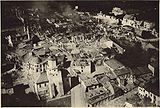
. It is considered to be one of the first terror bombings in history and first in Europe in this war. It killed an estimated 1,300 civilians, injured hundreds more and destroyed 90 percent of the town centre. There were no military targets of any importance in the area. The casualty rate was more than twice as high as Guernica
Bombing of Guernica
The bombing of Guernica was an aerial attack on the Basque town of Guernica, Spain, causing widespread destruction and civilian deaths, during the Spanish Civil War...
.
Events
According to German records 29 Junkers Ju 87B “Stukas” of Sturzkampfgeschwader 76 under the command of Captain Walter SigelWalter Sigel
Walter Sigel was a highly decorated Oberst in the Luftwaffe during World War II, and one of only 882 recipients of the Knight's Cross of the Iron Cross with Oak Leaves. The Knight's Cross of the Iron Cross and its higher grade Oak Leaves was awarded to recognise extreme battlefield bravery or...
started from Nieder-Ellguth
Ligota Dolna, Strzelce County
Ligota Dolna , German Nieder Ellguth is a village in the administrative district of Gmina Strzelce Opolskie, within Strzelce County, Opole Voivodeship, in south-western Poland...
airfield at 5:02 am on 1 September 1939. Some twenty minutes later they reached the town of Wieluń unopposed and dropped 29 500 kg bombs and 112 50 kg bombs. Among the first places bombed was the hospital, despite Red Cross markings; 26 patients were killed. The attack on the hospital was investigated by German prosecutors in 1978 and 1983, but the charges were dropped, since prosecutors felt that the pilots could not make out the nature of the target due to poor lighting conditions at dawn. Within the hour all 29 aircraft landed at Nieder-Ellguth, when Sigel reported no observation of enemy forces.
A second wave of 29 Stukas of Sturzkampfgeschwader 2 Immelmann
Sturzkampfgeschwader 2
Sturzkampfgeschwader 2 Immelmann was a Luftwaffe Dive bomber-wing of World War II. It was named after Max Immelmann in 1939.The unit was originally formed as Fliegergruppe Schwerin in 1934; the first Stuka wing of its type, attaining the sobriquet 'Immelmann' in 1935...
commanded by Major Oskar Dinort
Oskar Dinort
Oskar Dinort was a German World War II Luftwaffe Stuka pilot and first Stuka pilot to be awarded the coveted Knight's Cross with Oak Leaves...
attacked the town shortly afterwards, followed by a third wave at about 2:00 pm. In all, 380 bombs totalling 46,000 kg had been dropped on the town, hitting the hospital, killing more than 1,200 inhabitants and destroying 70 per cent of the buildings, up to 90 per cent in the center. According to German documents the town was burning at 06:00 – "Wielun brennt" - Wieluń is burning.
Journalists Sylwia Słomińska and Joachim Trenkner state that there were no military or industrial targets of note in the area, except for a small sugar factory in the outskirts of the town. According to the two journalists, German bombers also destroyed the historical gothic
Gothic architecture
Gothic architecture is a style of architecture that flourished during the high and late medieval period. It evolved from Romanesque architecture and was succeeded by Renaissance architecture....
church.
Other version of the events
German aviation historian Horst Boog claims that a Polish cavalry brigade as well as an Polish infantry division had been located in the town by German reconnaissance the day before the attack. From reports of Luftflotte 4Luftflotte 4
Luftflotte 4 was one of the primary divisions of the German Luftwaffe in World War II. It was formed on March 18, 1939 from Luftwaffenkommando Österreich in Vienna. The Luftflotte was redesignated on April 21, 1945 to Luftwaffenkommando 4, and became subordinated to Luftflotte 6. It was the...
, 2nd Air Division
2nd Air Division
The 2d Air Division is an inactive United States Air Force organization. Its last assignment was with Military Airlift Command, assigned to Twenty-Third Air Force, being stationed at Hurlburt Field, Florida...
, I./Sturzkampfgeschwader 76 and I./Sturzkampfgeschwader 77
Sturzkampfgeschwader 77
Sturzkampfgeschwader 77 was a Luftwaffe Dive bomber-wing of World War II.-History:Sturzkampfgeschwader 77 was formed on 1 May 1939, I. Group in Brieg, Stab and II. Group in Breslau-Schöngarten . The III. Group was formed from II...
he concludes that the bomb attacks had been directed against these military formations and can therefore not be considered terror bombings. Due to ground fog, he argues, the German pilots missed their targets and mistakenly bombed the town.
British aviation historian Peter C. Smith too, describes the bombing as collateral damage
Collateral damage
Collateral damage is damage to people or property that is unintended or incidental to the intended outcome. The phrase is prevalently used as an euphemism for civilian casualties of a military action.-Etymology:...
from bombs that missed their targets during ground support of the Wehrmacht
Wehrmacht
The Wehrmacht – from , to defend and , the might/power) were the unified armed forces of Nazi Germany from 1935 to 1945. It consisted of the Heer , the Kriegsmarine and the Luftwaffe .-Origin and use of the term:...
operations. Polish historian Jerzy B. Cynk, author of The Polish Air Force at War. The official history 1939-1943, wrote about the events: "Numerous direct support missions were also flown, with the heaviest attacks directed against the Polish cavalry and troop concentrations at Wielun."
At 13:00 a German dive bomber wing, I./StG 2 led by Major Oskar Dinort
Oskar Dinort
Oskar Dinort was a German World War II Luftwaffe Stuka pilot and first Stuka pilot to be awarded the coveted Knight's Cross with Oak Leaves...
via Nieder-Ellguth
Ligota Dolna, Strzelce County
Ligota Dolna , German Nieder Ellguth is a village in the administrative district of Gmina Strzelce Opolskie, within Strzelce County, Opole Voivodeship, in south-western Poland...
, were directed against this unit, followed a few hours later by Schwarzkopff with sixty Ju 87 Stukas of I./Sturzkampfgeschwader 77 Weather conditions were unfavourable during the day, with a visibility of only one kilometre and a practically closed layer of fog at 50 metres altitude. Fog, mist and poor visibility thwarted many of the Luftwaffe's sorties planned for the morning of the first day of the invasion. The dive bombers, facing intense anti aircraft fire, inflicted heavy losses on the Polish cavalry, and the advance was turned into a rout by 90 Stukas. On their return home, four of the German Junkers Ju 87
Junkers Ju 87
The Junkers Ju 87 or Stuka was a two-man German ground-attack aircraft...
bombers were shot down by the Polish 36 Academic Legion Infantry Regiment stationed nearby. Three waves of attacks were carried out during the day. The town was captured by the German Army on the first day of the invasion.
Further reading
- Bekker, Cajus. (1994). The Luftwaffe War Diaries. pp. 31–3. ISBN 9780306806049
- Bojarska B., Zniszczenie miasta Wielunia w dniu 1 września 1939 r., „Przegląd Zachodni” 1962, nr 2.
- Kulesza W., Pierwszy był Wieluń, „Rzeczpospolita” 1999, nr 211, 9 IX 1999.
- Olejnik T., Wieluń – na pięć minut przed Westerplatte. Pierwsi zginęli cywile, „Tygodnik Powszechny” nr 35, 31 VIII 2003 r.
- Olejnik T., Wieluń. Zniszczenie miasta 1 IX 1939 r., Kępno 1979.
- Olejnik T., Wieluń – polska Guernica, das polnische Guernica, Wieluń 2004.
- Pięciak W., Wieluń 1 września 1939 r., „Tygodnik Powszechny” nr 2, 12 I 2003.