


Bergen-Hohne Training Area

Encyclopedia
Bergen-Hohne Training Area (German: Truppenübungsplatz Bergen or Schießplatz Bergen-Hohne) is a NATO military training area in the southern part of the Lüneburg Heath
, in the state of Lower Saxony
in northern Germany
. It covers an area of 284 square kilometres (70,177.9 acre), which makes it the largest military training area in Germany.
It was established by the German armed forces, the Wehrmacht
, in 1935. At the end of the Second World War it was taken over by British
occupying forces and some of its facilities used as a liberation camp for survivors of the Bergen-Belsen concentration camp
, which was located on the edge of the training area near the town of Bergen
. Under British control, the training area was steadily expanded and, since the 1960s, has also been used by the German Armed Forces (Bundeswehr) and other NATO troops.
, roughly 70 kilometres (43.5 mi) southeast of Bremen
and around 80 kilometres (49.7 mi) south of Hamburg
. It is located between Bad Fallingbostel
in the west and Bergen in the east, and between the towns of Soltau
a few miles to the north and Wietze
to the south. Its extent roughly coincides with the geographical area known as the Heidmark
. The terrain is between 28 and .
und Osterheide
, which have not been under any local administrative control since 1945. Surrounding this are a number of areas of marsh known in German as a Moor. In the northern part of the training area is the small Wittenmoor. Just beyond its eastern boundary is the larger Großes Moor, in the south is the Ostenholz Moor
and on the southern boundary the Bannetzer Moor which adjoins the Meißendorf Lakes. The remaining areas consist of woodland.
Outside of and flowing parallel to the northwestern edge of the military training area is part of the middle course of the River Böhme. Similarly the Meiße
runs roughly along its southeastern and southern boundary (both are northeastern tributaries of the River Aller
). Near the centre of the area are the Sieben Steinhäuser
(literally: seven stone houses), a group of dolmens that may be visited at weekends. East-southeast of them and not far away is a small lake, the Meiersee, through which the Meierbach stream flows in a southwesterly direction. The central and southern parts of the training area are drained by this stream (which passes the Sieben Steinhäuser) and the Hohe Bach, both northeastern tributaries of the Meiße. Its southeastern part is drained by the Liehlbach (a northern tributary of the Meiße), along which several ponds are found and the northwest mainly by the Fischendorfer Bach (a southeastern tributary of the Böhme), which likewise has many ponds. The extreme northeast is drained by streams that flow eastwards into the Meiße
.
A heavily wooded moraine
ridge runs across the training area in roughly a southwest-to-northeast direction. These woods include the Becklinger Holz and amongst the elevations here are the: Falkenberg , Hakenberg (143 m), Staffelberg (127 m), Hengstberg (121 m), Hammberg (107 m), Großer Dellberg (107 m), Scharpenhorn (107 m), Fuhrberg (102 m), Horstberg (98 m), Söhrenberg (93 m) and Ziegenberg (63 m). The lowest point is on the southwest boundary of the area in the Ostenholz Moor
at about 28 m high.
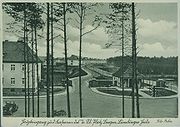 The first plans for establishing the military training area were laid in 1934 as part of the military re-armament of the German Reich. Due to the sparse population and the varied landscape this area was selected for creating the largest exercise area for Germany's armed forces, the Wehrmacht
. In spite of opposition from the local population, within a few years 3,635 inhabitants in 25 villages had to leave their homes.
After the end of the war the training area was taken over by the British Army
. During the Cold War
up to 50,000 British, American and, from the 1960s, German soldiers were stationed at Bergen-Hohne and it became the largest military training area in Europe and the main training area for NATO's ground forces in the Federal Republic of Germany. One feature is the permanent accommodation at Ostenholz in the southwest, that has an autobahn junction in the immediate vicinity. Ostenholz Camp (Kaserne Ostenholz) is only used for exercising troops, yet it has permanent accommodation as well as the massive buildings of the training area's headquarters and the permanent range staff.
After the end of the Cold War the number of soldiers significantly reduced. The facility still has considerable importance however. In all, there are still around 10,000 British soldiers and their families based in and around Bergen-Hohne, including the barracks in Celle
. In addition the area is still heavily used by the Bundeswehr
and other NATO troops.
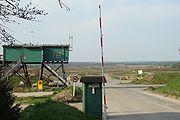
The original ranges and their purpose:
Today there are 22 firing ranges on the training area for main battle tank
s and infantry fighting vehicle
s, of which nine are also suitable for anti-tank guided missile
s. In addition there are 14 artillery fire positions, six of which are outside the boundaries of the training area. There are also five small arms ranges and three ranges for hand-held anti-tank weapons, as well as air defence training facilities, FIBUA villages, deep wading points and bivouac
sites.
The multinational troops of NATO member countries - Germany, Netherlands, Britain and Belgium - exercise regularly on the training area. Major combat equipment that uses the ranges include Challenger 2 and Leopard 2
tanks, WAH-64 Apache
attack helicopters and Panzerhaubitze 2000. The area is increasingly used by unmanned aerial vehicle
s (UAV) and it is the only training area in Germany which may be overflown by reconnaissance drones. Air-to-ground practice and live munitions may also be fired.
facility, on the eastern side of the training area. It is the headquarters of Bergen-Hohne Garrison, a large British
military garrison for the 7th Armoured Brigade (the Desert Rats) which is part of the British Forces Germany
.
Hohne Station is home to the 3rd Regiment Royal Horse Artillery
, 9th/12th Lancers, 32 Engineer Regiment, 2nd Medical Regiment
and HQ 7th Armoured Brigade & Signal Squadron.
Hohne Station also has quarters and facilities for the families of British forces stationed here including three Service Children's Education
schools - Gloucester Secondary School, Montgomery Primary School and Slim Primary School. The station amenities include 2 swimming pools, beauty & hair salons, medical & dental centres and several shops selling goods from sports equipment, art & crafts, telephones to furniture.
The Roberts Roundhouse building located in the barracks was formerly used as a ballroom and a hospital but is now used as a social gathering area, being located next to the NAAFI
, the base shop.
Not far from this barracks is the village of Belsen
which gave its name to the nearby concentration camp in the Second World War.
. He also has command of the training areas at Ehra-Lessien
and Lübtheen
.
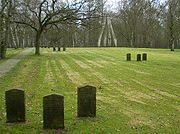 In and around Bergen-Hohne Training Area are the following cultural monuments and places of interest:
In the area of Lohheide
and its neighbourhood:
In the area of Osterheide
and its neighbourhood:
Lüneburg Heath
The Lüneburg Heath is a large area of heath, geest and woodland in northeastern part of the state of Lower Saxony in northern Germany. It forms part of the hinterland for the cities of Hamburg, Hanover, and Bremen and is named after the town of Lüneburg. Most of the area is a nature reserve...
, in the state of Lower Saxony
Lower Saxony
Lower Saxony is a German state situated in north-western Germany and is second in area and fourth in population among the sixteen states of Germany...
in northern Germany
Germany
Germany , officially the Federal Republic of Germany , is a federal parliamentary republic in Europe. The country consists of 16 states while the capital and largest city is Berlin. Germany covers an area of 357,021 km2 and has a largely temperate seasonal climate...
. It covers an area of 284 square kilometres (70,177.9 acre), which makes it the largest military training area in Germany.
It was established by the German armed forces, the Wehrmacht
Wehrmacht
The Wehrmacht – from , to defend and , the might/power) were the unified armed forces of Nazi Germany from 1935 to 1945. It consisted of the Heer , the Kriegsmarine and the Luftwaffe .-Origin and use of the term:...
, in 1935. At the end of the Second World War it was taken over by British
United Kingdom
The United Kingdom of Great Britain and Northern IrelandIn the United Kingdom and Dependencies, other languages have been officially recognised as legitimate autochthonous languages under the European Charter for Regional or Minority Languages...
occupying forces and some of its facilities used as a liberation camp for survivors of the Bergen-Belsen concentration camp
Bergen-Belsen concentration camp
Bergen-Belsen was a Nazi concentration camp in Lower Saxony in northwestern Germany, southwest of the town of Bergen near Celle...
, which was located on the edge of the training area near the town of Bergen
Bergen, Lower Saxony
Bergen is a town in the north of Celle district on the Lüneburg Heath, in Lower Saxony, Germany. Administratively it acts as a municipal borough divided into 12 subordinate parishes based on the town and its surrounding villages: Becklingen, Belsen, Bergen, Bleckmar, Diesten, Dohnsen, Eversen,...
. Under British control, the training area was steadily expanded and, since the 1960s, has also been used by the German Armed Forces (Bundeswehr) and other NATO troops.
Location
Bergen-Hohne Training Area is situated on both sides of the boundary between the districts of Heidekreis (formerly Soltau-Fallingbostel) and Celle, about 40 kilometres (24.9 mi) north of HanoverHanover
Hanover or Hannover, on the river Leine, is the capital of the federal state of Lower Saxony , Germany and was once by personal union the family seat of the Hanoverian Kings of Great Britain, under their title as the dukes of Brunswick-Lüneburg...
, roughly 70 kilometres (43.5 mi) southeast of Bremen
Bremen
The City Municipality of Bremen is a Hanseatic city in northwestern Germany. A commercial and industrial city with a major port on the river Weser, Bremen is part of the Bremen-Oldenburg metropolitan area . Bremen is the second most populous city in North Germany and tenth in Germany.Bremen is...
and around 80 kilometres (49.7 mi) south of Hamburg
Hamburg
-History:The first historic name for the city was, according to Claudius Ptolemy's reports, Treva.But the city takes its modern name, Hamburg, from the first permanent building on the site, a castle whose construction was ordered by the Emperor Charlemagne in AD 808...
. It is located between Bad Fallingbostel
Bad Fallingbostel
Bad Fallingbostel is the district town of the Heidekreis district in the German state of Lower Saxony. Since 1976 the town has had a state-recognised Kneipp spa and has held the title of Bad since 5 August 2002. It has close ties to Walsrode, a few miles to the west...
in the west and Bergen in the east, and between the towns of Soltau
Soltau
- Middle Ages :The region of the Lüneburg Heath had already been settled by the start of the New Stone Age about 4,000 years ago. The Soltau area was initially occupied by a few individual farms. The parish of Soltau was probably founded around 830 and the first wooden church Sante Johannis...
a few miles to the north and Wietze
Wietze
Wietze is a municipality in the district of Celle, in Lower Saxony, Germany. It is situated at the confluence of the river Aller and its tributary Wietze, approx. 15 km west of Celle....
to the south. Its extent roughly coincides with the geographical area known as the Heidmark
Heidmark
The Heidmark is an area of the Lüneburg Heath, much of which has not been accessible to the population since about 1935/1936. The establishment of a large military training area by the German armed forces, the Wehrmacht, as part of their rearmament and preparation for war resulted in the...
. The terrain is between 28 and .
Landscape
The central part of the training area consists of two areas of heathland (Heide) known as LohheideLohheide
Lohheide is an unincorporated area in the district of Celle, in Lower Saxony, Germany.It covers an area of and has 764 inhabitants...
und Osterheide
Osterheide
Osterheide is an unincorporated area in the district of Heidekreis, in Lower Saxony, Germany.The area has 815 inhabitants . Its administrative seat is the village of Oerbke; other villages are Ostenholz and Wense...
, which have not been under any local administrative control since 1945. Surrounding this are a number of areas of marsh known in German as a Moor. In the northern part of the training area is the small Wittenmoor. Just beyond its eastern boundary is the larger Großes Moor, in the south is the Ostenholz Moor
Ostenholz Moor
Ostenholz Moor is a high-moor bog on the Lüneburg Heath in the German state of Lower Saxony. It is named after the village of Ostenholz and is not far from Meißendorf. The moor is almost entirely within the Bergen-Hohne Military Training Area and, as a result, has been largely left to develop...
and on the southern boundary the Bannetzer Moor which adjoins the Meißendorf Lakes. The remaining areas consist of woodland.
Outside of and flowing parallel to the northwestern edge of the military training area is part of the middle course of the River Böhme. Similarly the Meiße
Meiße
The Meiße is a German river in the state of Lower Saxony, near the Lüneburg Heath, and a right-hand tributary of the River Aller.- Origin and course :The Meiße emerges south of Wietzendorf in the nature reserve of Großes Moor bei Becklingen...
runs roughly along its southeastern and southern boundary (both are northeastern tributaries of the River Aller
River Aller
The River Aller is a small river on Exmoor in Somerset, England.It rises as several small streams around Tivington and Huntscott and flows through the Holnicote Estate past Holnicote and through Allerford, where it passes under a packhorse bridge of medieval origin. It then joins the River Horner,...
). Near the centre of the area are the Sieben Steinhäuser
Sieben Steinhäuser
The Sieben Steinhäuser is a group of five dolmens on the Lüneburg Heath in the NATO training area of Bergen-Hohne, in the state of Lower Saxony in northern Germany. The stones are considered to be part of the funnelbeaker culture...
(literally: seven stone houses), a group of dolmens that may be visited at weekends. East-southeast of them and not far away is a small lake, the Meiersee, through which the Meierbach stream flows in a southwesterly direction. The central and southern parts of the training area are drained by this stream (which passes the Sieben Steinhäuser) and the Hohe Bach, both northeastern tributaries of the Meiße. Its southeastern part is drained by the Liehlbach (a northern tributary of the Meiße), along which several ponds are found and the northwest mainly by the Fischendorfer Bach (a southeastern tributary of the Böhme), which likewise has many ponds. The extreme northeast is drained by streams that flow eastwards into the Meiße
Meiße
The Meiße is a German river in the state of Lower Saxony, near the Lüneburg Heath, and a right-hand tributary of the River Aller.- Origin and course :The Meiße emerges south of Wietzendorf in the nature reserve of Großes Moor bei Becklingen...
.
A heavily wooded moraine
Moraine
A moraine is any glacially formed accumulation of unconsolidated glacial debris which can occur in currently glaciated and formerly glaciated regions, such as those areas acted upon by a past glacial maximum. This debris may have been plucked off a valley floor as a glacier advanced or it may have...
ridge runs across the training area in roughly a southwest-to-northeast direction. These woods include the Becklinger Holz and amongst the elevations here are the: Falkenberg , Hakenberg (143 m), Staffelberg (127 m), Hengstberg (121 m), Hammberg (107 m), Großer Dellberg (107 m), Scharpenhorn (107 m), Fuhrberg (102 m), Horstberg (98 m), Söhrenberg (93 m) and Ziegenberg (63 m). The lowest point is on the southwest boundary of the area in the Ostenholz Moor
Ostenholz Moor
Ostenholz Moor is a high-moor bog on the Lüneburg Heath in the German state of Lower Saxony. It is named after the village of Ostenholz and is not far from Meißendorf. The moor is almost entirely within the Bergen-Hohne Military Training Area and, as a result, has been largely left to develop...
at about 28 m high.
History
Wehrmacht
The Wehrmacht – from , to defend and , the might/power) were the unified armed forces of Nazi Germany from 1935 to 1945. It consisted of the Heer , the Kriegsmarine and the Luftwaffe .-Origin and use of the term:...
. In spite of opposition from the local population, within a few years 3,635 inhabitants in 25 villages had to leave their homes.
After the end of the war the training area was taken over by the British Army
British Army
The British Army is the land warfare branch of Her Majesty's Armed Forces in the United Kingdom. It came into being with the unification of the Kingdom of England and Scotland into the Kingdom of Great Britain in 1707. The new British Army incorporated Regiments that had already existed in England...
. During the Cold War
Cold War
The Cold War was the continuing state from roughly 1946 to 1991 of political conflict, military tension, proxy wars, and economic competition between the Communist World—primarily the Soviet Union and its satellite states and allies—and the powers of the Western world, primarily the United States...
up to 50,000 British, American and, from the 1960s, German soldiers were stationed at Bergen-Hohne and it became the largest military training area in Europe and the main training area for NATO's ground forces in the Federal Republic of Germany. One feature is the permanent accommodation at Ostenholz in the southwest, that has an autobahn junction in the immediate vicinity. Ostenholz Camp (Kaserne Ostenholz) is only used for exercising troops, yet it has permanent accommodation as well as the massive buildings of the training area's headquarters and the permanent range staff.
After the end of the Cold War the number of soldiers significantly reduced. The facility still has considerable importance however. In all, there are still around 10,000 British soldiers and their families based in and around Bergen-Hohne, including the barracks in Celle
Celle
Celle is a town and capital of the district of Celle, in Lower Saxony, Germany. The town is situated on the banks of the River Aller, a tributary of the Weser and has a population of about 71,000...
. In addition the area is still heavily used by the Bundeswehr
Bundeswehr
The Bundeswehr consists of the unified armed forces of Germany and their civil administration and procurement authorities...
and other NATO troops.
Current Use
The original ranges and their purpose:
| Range | Opened | Use |
|---|---|---|
| I | in 1936 | Tank firing range |
| II | in 1936 | Infantry firing range |
| III | in 1936 | Infantry + anti-aircraft range |
| IV | in 1936 | Infantry firing range |
| V | in 1936 | Infantry and artillery range |
| VI | in 1936 | Tank firing range |
| VII | in 1939 | Tank firing range |
| VIII | in 1939 | Tank firing range |
| IX | in 1939 | Tank firing range |
| X | in 1939 | Tank firing range |
| XI | in 1941 | Tank firing range |
| XII | in 1944 | Tank firing range |
Today there are 22 firing ranges on the training area for main battle tank
Main battle tank
A main battle tank , also known as a battle tank or universal tank, is a tank that fills the heavy direct fire role of many modern armies. They were originally conceived to replace the light, medium, heavy and super-heavy tanks. Development was spurred onwards in the Cold War with the development...
s and infantry fighting vehicle
Infantry fighting vehicle
An infantry fighting vehicle , also known as a mechanized infantry combat vehicle , is a type of armoured fighting vehicle used to carry infantry into battle and provide fire support for them...
s, of which nine are also suitable for anti-tank guided missile
Anti-tank guided missile
An anti-tank missile , anti-tank guided missile , anti-tank guided weapon or anti-armor guided weapon is a guided missile primarily designed to hit and destroy heavily-armored military vehicles....
s. In addition there are 14 artillery fire positions, six of which are outside the boundaries of the training area. There are also five small arms ranges and three ranges for hand-held anti-tank weapons, as well as air defence training facilities, FIBUA villages, deep wading points and bivouac
Bivouac
Bivouac may refer to:* Bivouac Peak, a mountain in the Teton Range, Grand Teton National Park, Wyoming, USA* A military camp** Bivouac shelter** Bivouac sack, or "bivy sack" or bivy bag, an extremely lightweight alternative to traditional tent systems...
sites.
The multinational troops of NATO member countries - Germany, Netherlands, Britain and Belgium - exercise regularly on the training area. Major combat equipment that uses the ranges include Challenger 2 and Leopard 2
Leopard 2
The Leopard 2 is a main battle tank developed by Krauss-Maffei in the early 1970s for the West German Army. The tank first entered service in 1979 and succeeded the earlier Leopard 1 as the main battle tank of the German Army. Various versions have served in the armed forces of Germany and twelve...
tanks, WAH-64 Apache
AH-64 Apache
The Boeing AH-64 Apache is a four-blade, twin-engine attack helicopter with a tailwheel-type landing gear arrangement, and a tandem cockpit for a two-man crew. The Apache was developed as Model 77 by Hughes Helicopters for the United States Army's Advanced Attack Helicopter program to replace the...
attack helicopters and Panzerhaubitze 2000. The area is increasingly used by unmanned aerial vehicle
Unmanned aerial vehicle
An unmanned aerial vehicle , also known as a unmanned aircraft system , remotely piloted aircraft or unmanned aircraft, is a machine which functions either by the remote control of a navigator or pilot or autonomously, that is, as a self-directing entity...
s (UAV) and it is the only training area in Germany which may be overflown by reconnaissance drones. Air-to-ground practice and live munitions may also be fired.
Hohne Station
Hohne Station is the main British Forces base and is located in Lager Hohne, a former WehrmachtWehrmacht
The Wehrmacht – from , to defend and , the might/power) were the unified armed forces of Nazi Germany from 1935 to 1945. It consisted of the Heer , the Kriegsmarine and the Luftwaffe .-Origin and use of the term:...
facility, on the eastern side of the training area. It is the headquarters of Bergen-Hohne Garrison, a large British
United Kingdom
The United Kingdom of Great Britain and Northern IrelandIn the United Kingdom and Dependencies, other languages have been officially recognised as legitimate autochthonous languages under the European Charter for Regional or Minority Languages...
military garrison for the 7th Armoured Brigade (the Desert Rats) which is part of the British Forces Germany
British Forces Germany
British Forces Germany , is the name for British Armed Forces service personnel and civilians based in Germany. It was first established following the Second World War as the British Army of the Rhine ....
.
Hohne Station is home to the 3rd Regiment Royal Horse Artillery
3rd Regiment Royal Horse Artillery
3rd Regiment Royal Horse Artillery is a regiment of the Royal Horse Artillery in the British Army. They are currently based in Caen Barracks, Hohne, Germany.-Current role:...
, 9th/12th Lancers, 32 Engineer Regiment, 2nd Medical Regiment
2nd Medical Regiment
2 Medical Regiment, is the task medical regiment of 7th Armoured Brigade, and officially formed on the 4th of July 2008, following the amalgamation of 29 Squadron and 28 Squadron of 1 Close Support Medical Regiment. The Regiment is based at the Bergen-Hohne garrison situated in north west Germany...
and HQ 7th Armoured Brigade & Signal Squadron.
Hohne Station also has quarters and facilities for the families of British forces stationed here including three Service Children's Education
SCE
SCE is an abbreviation with multiple meanings:* Short-channel effect, a secondary effect describing the reduction in threshold voltage Vth in MOSFETs with non-uniformly doped channel regions as the gate length increases...
schools - Gloucester Secondary School, Montgomery Primary School and Slim Primary School. The station amenities include 2 swimming pools, beauty & hair salons, medical & dental centres and several shops selling goods from sports equipment, art & crafts, telephones to furniture.
The Roberts Roundhouse building located in the barracks was formerly used as a ballroom and a hospital but is now used as a social gathering area, being located next to the NAAFI
Navy, Army and Air Force Institutes
The Navy, Army and Air Force Institutes is an organisation created by the British government in 1921 to run recreational establishments needed by the British Armed Forces, and to sell goods to servicemen and their families...
, the base shop.
Not far from this barracks is the village of Belsen
Belsen (Bergen)
Belsen is a village within the German borough of Bergen in the northern part of Celle district on the Lüneburg Heath in Lower Saxony. It lies about southwest of Bergen and has 331 inhabitants . The Belsen concentration camp was named after it...
which gave its name to the nearby concentration camp in the Second World War.
Command
The current German commandant of Bergen-Hohne Training Area, Colonel Gerd Ahrens, is also responsible for Munster Training AreaMunster Training Area
Munster Training Area is a military training area in Germany on the Lüneburg Heath. It comprises two separate areas with different purposes: Munster North and Munster South . The two areas are separated geographically by the town of Munster and several barracks...
. He also has command of the training areas at Ehra-Lessien
Ehra-Lessien
Ehra-Lessien is a municipality in the district of Gifhorn, in Lower Saxony, Germany.-Volkswagen Group test track:Volkswagen Group owns a test track facility in Ehra-Lessien...
and Lübtheen
Lübtheen
Lübtheen is a municipality in the Ludwigslust-Parchim district, in Mecklenburg-Western Pomerania, Germany. It is situated 28 km west of Ludwigslust, and 37 km southwest of Schwerin....
.
Cultural monuments and places of interest
In the area of Lohheide
Lohheide
Lohheide is an unincorporated area in the district of Celle, in Lower Saxony, Germany.It covers an area of and has 764 inhabitants...
and its neighbourhood:
- near BelsenBelsen (Bergen)Belsen is a village within the German borough of Bergen in the northern part of Celle district on the Lüneburg Heath in Lower Saxony. It lies about southwest of Bergen and has 331 inhabitants . The Belsen concentration camp was named after it...
:- Bergen-Belsen concentration campBergen-Belsen concentration campBergen-Belsen was a Nazi concentration camp in Lower Saxony in northwestern Germany, southwest of the town of Bergen near Celle...
memorial site - Bredebeck Castle at Liehlbach (part of Bergen-Hohne camp)
- Bergen-Belsen concentration camp
In the area of Osterheide
Osterheide
Osterheide is an unincorporated area in the district of Heidekreis, in Lower Saxony, Germany.The area has 815 inhabitants . Its administrative seat is the village of Oerbke; other villages are Ostenholz and Wense...
and its neighbourhood:
- in OerbkeOerbkeOerbke is an unparished German village in Soltau-Fallingbostel district in the southern part of the Lüneburg Heath in Lower Saxony. Oerbke lies on the A7 autobahn east of Bad Fallingbostel and is the seat of administration for the Osterheide area.- History :...
(to the west):- Cemetery of the unknown soldiers Friedhof der Namenlosen, a war cemetery in which about 30,000 Russian prisoners-of-war from the Second World War were buried in mass graves
- In and around Ostenholz (to the southwest):
- Timber-framed church with wooden tower dating back to 1724
- Hoher Stein, a monument to the evacuation of the local communities in 1936 in order to create a Nazi military training area
- Sieben SteinhäuserSieben SteinhäuserThe Sieben Steinhäuser is a group of five dolmens on the Lüneburg Heath in the NATO training area of Bergen-Hohne, in the state of Lower Saxony in northern Germany. The stones are considered to be part of the funnelbeaker culture...
, large dolmens (stone graves) from the New Stone Age in the south of the training area
- in Wense (to the northwest):
- Gutskapelle, a splendid church from the year 1558
See also
- British Forces GermanyBritish Forces GermanyBritish Forces Germany , is the name for British Armed Forces service personnel and civilians based in Germany. It was first established following the Second World War as the British Army of the Rhine ....
- British Army of the RhineBritish Army of the RhineThere have been two formations named British Army of the Rhine . Both were originally occupation forces in Germany, one after the First World War, and the other after the Second World War.-1919–1929:...
- Sieben SteinhäuserSieben SteinhäuserThe Sieben Steinhäuser is a group of five dolmens on the Lüneburg Heath in the NATO training area of Bergen-Hohne, in the state of Lower Saxony in northern Germany. The stones are considered to be part of the funnelbeaker culture...
Literature
- Olaf Mußmann: Geschichte des Truppenübungsplatzes Bergen. Münster 1996; ISBN 3-8258-2753-4
- Die Heidmark. Wandel einer Landschaft. Die Geschichte des Truppenübungsplatzes Bergen, Hinrich Baumann, Walsrode 2005, ISBN 3-00-017185-1
- Judaslohn, Andree Hesse, crime novel, (set on the military training area and in Eichendorf [= Meißendorf]), ISBN 9783805208000