
- Not to be confused with the Belzec extermination camp
Belzec, Polish spelling Bełżec , was the first of the Nazi German extermination camps created for implementing Operation Reinhard during the Holocaust...
.
- Belsen redirects here. For other meanings, see Belsen (disambiguation)
Belsen can mean:* Bergen-Belsen concentration camp* Bergen-Belsen DP camp* Belsen, a small village near Bergen, about 25 km north of Celle in Northern Germany...
.
Bergen-Belsen (or
Belsen) was a Nazi concentration camp in
Lower SaxonyLower Saxony lies in north-western Germany and is second in area and fourth in population among the sixteen Bundesländer of Germany...
in northwestern
GermanyGermany , officially the Federal Republic of Germany , is a country in Central Europe. It is bordered to the north by the North Sea, Denmark, and the Baltic Sea; to the east by Poland and the Czech Republic; to the south by Austria and Switzerland; and to the west by France, Luxembourg, Belgium,...
, southwest of the town of
BergenBergen is a town in the north of Celle district on the Lüneburg Heath, in Lower Saxony, Germany. Administratively it acts as a municipal borough divided into 12 subordinate municipalities based on the town and its surrounding villages: Becklingen, Belsen, Bergen, Bleckmar, Diesten, Dohnsen,...
near
CelleCelle is a town and capital of the district of Celle, in Lower Saxony, Germany. The town is situated on the banks of the River Aller, a tributary of the Weser and has a population of about 71,000...
. Originally established as the prisoner of war camp
Stalag XI-CStalg XI-C Bergen-Belsen, initially called Stalag 311, was a German Army prisoner-of-war camp located near the town of Bergen in Lower Saxony.-Timeline:...
, in 1943 it became also a concentration camp on the orders of
Heinrich HimmlerHeinrich Luitpold Himmler , one of the most powerful men in Nazi Germany, served as Chief of the German Police and Minister of the Interior...
, where Jewish hostages were held with the intention of exchanging them for German prisoners of war held overseas. Later still the name was applied to the
displaced persons campNear the Bergen-Belsen concentration camp, British forces established a displaced persons camp for refugees after World War II. The site used abandoned German army Panzer barracks for housing facilities, and after November 1945, Jewish refugees were given their own section...
established nearby, but it is most commonly associated with the concentration camp it became as conditions deteriorated between 1943-1945. During this time an estimated 50,000
RussianThe Russian people are an ethnic group of the East Slavic peoples, primarily living in Russia and neighboring countries....
prisoners of war and a further 50,000 inmates died there, up to 35,000 of them dying of
typhusEpidemic typhus is a form of typhus so named because the disease often causes epidemics following wars and natural disasters...
in the first few months of 1945.
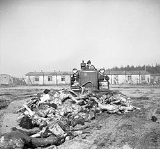
The camp was liberated on April 15, 1945 by the British 11th Armoured Division. 60,000 prisoners were found inside, most of them seriously ill, and another 13,000 corpses lay around the camp unburied. The scenes that greeted British troops were described by the
BBC'sThe British Broadcasting Corporation, usually referred to by its abbreviation as the "BBC", is the longest established and largest broadcaster in the world...
Richard DimblebyRichard Dimbleby CBE was an English journalist and broadcaster widely acknowledged as one of the greatest figures in British broadcasting history.-Early life:...
, who accompanied them:
"I could not believe the horror of these camps," said one liberator. "We found piles of bodies in train cars that had been dead for days."
Operation
In September 1939 a prisoner of war camp was established at Fallingbostel, and the nearby Bergen-Belsen site became a
Häftlingslager, or "prison camp", initially housing around 500 prisoners who were used as construction workers for the Fallingbostel project. In June 1940 it became a prisoner of war camp for around 600 French and Belgian soldiers, under the authority of the
WehrmachtWehrmacht was the name of the unified armed forces of Germany from 1935 to 1945. It consisted of the Heer , the Kriegsmarine and the Luftwaffe ....
, and in May 1941 it was designated prisoner of war camp
Stalag XI-CStalg XI-C Bergen-Belsen, initially called Stalag 311, was a German Army prisoner-of-war camp located near the town of Bergen in Lower Saxony.-Timeline:...
, (Stalag XI-C/311 for the Belgian and French POW's). Conditions in the camp were very basic, with inadequate food and little shelter. Around 20,000
SovietThe Union of Soviet Socialist Republics was a constitutionally socialist state that existed in Eurasia from 1922 to 1991. The name is a translation of the , tr. Soyuz Sovetskikh Sotsialisticheskikh Respublik, abbreviated СССР, SSSR. The common short name is Soviet Union, from , Sovetskiy Soyuz...
prisoners of war were sent to the camp between July 1941 and the spring of 1942, of whom about 18,000 died of hunger, cold and disease.
In 1942, Bergen-Belsen became a concentration camp, and part of it was placed under
SSThe , abbreviated SS- or - was a major Nazi organization under Adolf Hitler and the Nazi Party. The SS grew from a small paramilitary unit to a powerful force that served as the Führer's "Praetorian Guard," the Nazi Party's "Shield Squadron" and a force that, fielding almost a million men ,...
command in April 1943. Having initially been designated
Zivilinterniertenlager ("civilian internment camp"), in June 1943 it was redesignated
Aufenthaltslager ("holding camp"), since the
Geneva ConventionsThe Geneva Conventions consist of four treaties and three additional protocols that set the standards in international law for humanitarian treatment of the victims of war. The singular term Geneva Convention refers to the agreements of 1949, negotiated in the aftermath of World War II, updating...
stipulated that the former type of facility must be open to inspection by international committees. This was the "Star Camp" (so called because the inmates were made to wear the yellow star badge that designated them
JewThe Jews , also known as the Jewish people, are an ethnoreligious group originating in the Israelites or Hebrews of the Ancient Near East. The Jewish ethnicity, nationality, and religion are strongly interrelated, as Judaism is the traditional faith of the Jewish nation...
s). The Star Camp held several thousand Jews, mainly
DutchThe Dutch people are the dominant ethnic group of the Netherlands.Dutch people, or descendants of Dutch people, are also found in migrant communities world wide, notably in Canada, Australia, South Africa, New Zealand and the United States....
Jews, who were intended to be exchanged for German civilians interned in other countries. Star Camp inmates were made to work, many of them in the "shoe commando" which salvaged useable pieces of leather from shoes collected and brought to the camp from all over Germany and Occupied Europe. Families were permitted to meet during the day, and in general the Star Camp prisoners were treated less harshly than some other classes of Bergen-Belsen prisoner until fairly late in the war, due to their perceived potential exchange value. From September 1943 Italian military internees were also held at Bergen-Belsen. In March 1944, part of the camp was redesignated as an
Erholungslager ("recovery camp"), where prisoners too sick to work were brought from other camps. In August 1944, a shipment of approximately 8,000 female prisoners of various nationalities arrived from Auschwitz, most of whom were sent to Arbeitskommandos to work in factories, and from October 1944 captured Polish Home Army soldiers also began arriving at the camp. In all there were eight separate sections to the camp with different groups, treated differently according to their status.
December 1944 saw the completion of the change-over of Bergen-Belsen into a concentration camp when SS-
HauptsturmführerHauptsturmführer was a Nazi rank of the SS which was used between the years of 1934 and 1945. The rank of Hauptsturmführer was a mid-grade company level officer and was the equivalent of a Captain in the German Army and also the equivalent of captain in foreign armies...
Josef KramerJosef Kramer was the Commandant of the Bergen-Belsen concentration camp. Dubbed "The Beast of Belsen" by camp inmates; he was a notorious Nazi war criminal, directly responsible for the deaths of thousands of people...
, previously at Auschwitz-Birkenau, became the new camp commander. The number of inmates in the camp on December 1, 1944, was 15,257. In 1945, large numbers of prisoners were moved to Belsen from the eastern camps as the Soviet forces advanced. The resulting overcrowding led to a vast increase in deaths from disease (particularly
typhusEpidemic typhus is a form of typhus so named because the disease often causes epidemics following wars and natural disasters...
) and malnutrition in a camp originally designed to hold about 10,000 inmates. The number of inmates increased from 22,000 on February 1, 1945, to 41,520 on March 1, 43,042 on April 1 and ultimately to about 60,000 on April 15. The number of deaths increased from 7,000 in February to 18,168 during March and 9,000 during the first half of April. The bodies of these prisoners were buried in mass graves.
There were no gas chambers in Bergen-Belsen, since the mass executions took place in the camps further east. Nevertheless, an estimated 50,000
JewThe Jews , also known as the Jewish people, are an ethnoreligious group originating in the Israelites or Hebrews of the Ancient Near East. The Jewish ethnicity, nationality, and religion are strongly interrelated, as Judaism is the traditional faith of the Jewish nation...
s,
CzechsCzechs are a western Slavic people of Central Europe, living predominantly in the Czech Republic. Small populations of Czechs also live in Slovakia, Austria, U.S., Brazil, Argentina, Canada, Germany, Russia and other countries...
,
PolesThe Polish people, or Poles , are a Western Slavic ethnic group of Central Europe, living predominantly in Poland. Poles are sometimes defined as people who share a common Polish culture and are of Polish descent. Their religion is predominantly Roman Catholic...
, anti-Nazi
ChristianA Christian is a person who adheres to Christianity, an Abrahamic, monotheistic, religion based on the life and teachings of Jesus of Nazareth, who Christians believe was the Messiah prophesied in the Old Testament/Hebrew Bible, and the Son of God.The term "Christian" is also used adjectivally to...
s, homosexuals, and Roma and
SintiSinti or Sinta or Sinte is the name of a Romani or "gypsy" population in Europe. Traditionally nomadic, today only a small percentage of the group remains unsettled...
(Gypsies) died in the camp. Among them were Czech painter and writer
Josef ČapekJosef Čapek was a Czech artist who was best known as a painter, but who was also noted as a writer and a poet. He invented the word robot, which was introduced into literature by his brother, Karel Čapek.- Biography :...
(est. April 1945), as well as famous
AmsterdamAmsterdam is the capital and largest city of the Netherlands, located in the province of North Holland in the west of the country...
residents
Anne FrankAnnelies Marie "Anne" Frank was a Jewish girl who was born in the city of Frankfurt am Main in Weimar Germany, and who lived most of her life in or near Amsterdam, in the Netherlands...
(who died of typhus) and her sister
MargotMargot Betti Frank was the older sister of Anne Frank, whose deportation order from the Gestapo hastened the Frank family into hiding, and who subsequently perished in Bergen-Belsen. Margot was also keeping a diary as mentioned by Anne Frank in her diary...
, who died there in March 1945. The average life expectancy of an inmate was nine months.
After the war, there were allegations that the camp (or possibly a section of it), was "of a privileged nature", compared to others. A lawsuit filed by the Jewish community in
ThessalonikiThessaloniki , Thessalonica, or Salonica is the second-largest city in Greece and the capital of the Greek region of Macedonia. It is honorarily called the Συμπρωτεύουσα Symprotevousa of Greece, as it was once called the συμβασιλεύουσα symvasilevousa of the Byzantine Empire...
against 55 alleged collaborators claims that 53 of them were sent to Bergen-Belsen "as a special favor" granted by the Germans.
Liberation
When the British and Canadians advanced on Bergen-Belsen in 1945, the German army negotiated a truce and exclusion zone around the camp to prevent the spread of
typhusEpidemic typhus is a form of typhus so named because the disease often causes epidemics following wars and natural disasters...
. Under the agreement, Hungarian and regular German troops guarding the camp returned to German lines when Allied troops liberated the camp on April 15, 1945. Although many SS guards had fled the camp, a small number remained, wearing white armbands as a sign of surrender. As a final act of defiance, the retreating Germans sabotaged the water supply to the barracks, making it hard for the Allied troops to treat the ill prisoners.
When British and Canadian troops finally entered they found thousands of bodies unburied and approximately 55,000 inmates, most acutely sick and starving. Over the next days the surviving prisoners were deloused and moved to a nearby German
PanzerA Panzer is a German tank. Attributively, the term also refers to armoured military forces, as in panzer divisions or panzer battles.- Etymology :Panzer is a loanword from the German , meaning "armour"...
army camp, which became the
Bergen-Belsen DP campNear the Bergen-Belsen concentration camp, British forces established a displaced persons camp for refugees after World War II. The site used abandoned German army Panzer barracks for housing facilities, and after November 1945, Jewish refugees were given their own section...
. The remaining SS personnel were then forced by armed Allied troops to bury the bodies in pits.
Bergen-Belsen concentration camp was then burned to the ground by
flamethrowerA flamethrower is a mechanical device designed to project a long controllable stream of fire.Some flamethrowers project a stream of ignited flammable liquid; some project a long gas flame. Most military flamethrowers use liquids, but commercial flamethrowers tend to use high-pressure propane and...
s mounted on
Bren carriersThe Universal Carrier, also known as the Bren Gun Carrier is a common name describing a family of light armoured tracked vehicles built by Vickers-Armstrong. Produced between 1934 and 1960, the vehicle was used widely by Allied forces during the Second World War...
because of the typhus epidemic and
louseLice , , also known as fly babies, are an order of over 3,000 species of wingless insects; three of which are classified as human disease agents. They are obligate ectoparasites of every avian and most mammalian orders...
infestation. The name Belsen after this time refer to events at the
Bergen-Belsen DP campNear the Bergen-Belsen concentration camp, British forces established a displaced persons camp for refugees after World War II. The site used abandoned German army Panzer barracks for housing facilities, and after November 1945, Jewish refugees were given their own section...
.
In spite of massive efforts to help the survivors, about another 9,000 died in April, and by the end of June 1945 another 4,000 had died (after liberation a total of 13,994 people died). On the 13th day after liberation, the
LuftwaffeLuftwaffe is a generic German term for an air force. It is also the official name for two of the four historic German air forces, the Wehrmacht air arm founded in 1933 and disbanded in 1946; and the current Bundeswehr air arm founded in 1956.Schweizer Luftwaffe is also the name of the Swiss Air...
bombed one of the hospitals in the DP camp, injuring and killing several patient and Red Cross workers. The total number of deaths at Bergen-Belsen from 1943 to June 1945 was about 50,000.
The British troops and medical staff tried these diets to feed the prisoners, in this order:
- Bully beef from Army rations. Most of the prisoners' digestive systems were in too weak a state from long-term starvation to handle such food.
- Skimmed milk. The result was a bit better, but still far from acceptable.
- Bengal Famine Mixture. This is a rice-and-sugar-based mixture which had achieved good results after the Bengal famine of 1943
The Bengal famine of 1943 is one amongst the several famines that occurred in British administered Bengal. It is estimated that around 3 million people died from starvation and malnutrition during the period.-Possible Causes:...
, but it proved less suitable to Europeans than to Bengalis because of the differences in the food to which they were accustomed. Adding the common ingredient paprikaPaprika is a spice made from the grinding of dried fruits of Capsicum annuum . In many European countries, the word paprika also refers to bell peppers themselves. The seasoning is used in many cuisines to add color and flavor to dishes. Paprika can range from sweet to spicy...
to the mixture made it more palatable to these Europeans and recovery started.
Aftermath
Many of the former SS staff that survived the
typhusEpidemic typhus is a form of typhus so named because the disease often causes epidemics following wars and natural disasters...
epidemic were tried by the British at the
Belsen TrialThe Belsen Trial was one of several trials for war crimes and crimes against humanity that the Allied occupation forces conducted against former officials and functionaries of Nazi Germany after the end of World War II....
. At the trial, the world got its first view of
Irma GreseIrma Ida Ilse Grese was employed at the Nazi concentration camps of Ravensbrück, Auschwitz; and was a warden of the women's section of Bergen-Belsen.-Background:...
,
Elisabeth VolkenrathElisabeth Volkenrath was a female supervisor at several Nazi concentration camps during World War II...
,
Juana BormannJuana Bormann was a prison guard at several Nazi concentration camps, and was executed as a war criminal at Hameln after a trial in 1945...
,
Fritz KleinFritz Klein was a German physician hanged for his role in atrocities at Bergen-Belsen concentration camp during The Holocaust....
,
Josef KramerJosef Kramer was the Commandant of the Bergen-Belsen concentration camp. Dubbed "The Beast of Belsen" by camp inmates; he was a notorious Nazi war criminal, directly responsible for the deaths of thousands of people...
, and the rest of the SS men and women who before served at Mittelbau Dora, Ravensbrück, Auschwitz I, II, III, and Neuengamme. Many of the female guards had served at small Gross Rosen subcamps at Neusalz, Langenleuba, and the
Mittelbau-DoraMittelbau-Dora was a Nazi Germany labour camp that provided workers for the Mittelwerk V-2 rocket factory in the Kohnstein, situated near Nordhausen, Germany....
subcamp at Gross Werther. Dozens of the personnel of Bergen-Belsen were found guilty of murder and of crimes against humanity, and most of those were hanged.
After liberation in April 1945, the military training barracks became a camp for displaced persons. Jews awaited transport to America, Australia and to the new
IsraelIsrael officially the State of Israel , is a developed state in Western Asia located on the eastern shore of the Mediterranean Sea. It borders Lebanon in the north, Syria in the northeast, Jordan in the east, and Egypt on the southwest, and contains geographically diverse features within its...
. Some Jewish survivors inaugurated a theater company called
KazetAfter liberation of the Nazi concentration camps in April 1945, the camps held displaced persons including Jews awaited transport to America, Australia and to the new Israel...
(the name played on the German KZ, for concentration camp).
Bergen-Belsen fell into neglect after the burning of the buildings and the closure of the nearby displaced persons' camp. The area reverted to heath, with few traces of the camp remaining.
Ronald ReaganRonald Wilson Reagan was the 40th President of the United States and the 33rd Governor of California .Born in Tampico, Illinois, Reagan moved to Los Angeles, California in the 1930s...
's visit to West Germany in 1985 (see Bitburg) included a hastily-arranged stop at Bergen-Belsen which prompted the West Germans to put together a small documentation center. It soon became inadequate to the accumulating archives, to the general liberalizing process of German identity building after the wall fell, and to the growing public appetite abroad for Holocaust museums, along with the tourist economy they generated . On April 15 2005 there was a commemorative ceremony, and many ex-prisoners and ex-liberating troops attended.
In October 2007 the redesigned memorial site was opened, including a large new Documentation Centre and permanent exhibition on the edge of the newly redefined camp, whose structure and layout can now be traced. The site is open to the public and includes a monument to the dead, some individual memorial stones and a "House of Silence" for reflection.
Personal accounts
- Michael Bentine
Michael Bentine CBE was a comedian, comic actor, and founding member of The Goons.-Biography:Bentine was born Michael James Bentin in Watford, Hertfordshire, of Anglo-Peruvian parentage. and grew up in Folkestone, Kent, one of his friends being the young David Tomlinson. He was educated at Eton...
wrote this on his encounter with Belsen:
- We were headed for an airstrip outside
Celle Air Base is a military airbase of the German Army. The airfield is situated southwest of the city of Celle, Lower Saxony, Germany. It was opened in 1934 and has been in military use ever since...
CelleCelle is a town and capital of the district of Celle, in Lower Saxony, Germany. The town is situated on the banks of the River Aller, a tributary of the Weser and has a population of about 71,000...
, a small town, just of HanoverHanover or Hannover , on the river Leine, is the capital of the federal state of Lower Saxony , Germany and was once by personal union the family seat of the Hanoverian Kings of Great Britain, in their dignities as the dukes of Brunswick-Lüneburg Hanover or Hannover , on the river Leine, is...
. We had barely cranked to a halt and started to set up the ‘ops’ tent, when the TyphoonThe Typhoon was a British single-seat fighter-bomber, produced by Hawker Aircraft. While the Typhoon was designed to be a medium-high altitude interceptor, and a direct replacement for the Hawker Hurricane, several design problems were encountered and the Typhoon never completely satisfied this...
s thundered into the circuit and broke formation for their approach. As they landed on the hastily repaired strip – a ‘Jock’ [i.e. Scottish] doctor raced up to us in his jeep.
- ‘Got any medical orderlies
A medical orderly or orderly is a hospital attendant whose job consists of assisting medical and/or nursing staff with various nursing and/or medical interventions...
?’ he shouted above the roar of the aircraft engines. ‘Any K rationThe K-ration was an individual daily combat food ration which was introduced by the United States Army during World War II. It was originally intended as an individually packaged daily ration for issue to airborne troops, tank corps, motorcycle couriers, and other mobile forces for short durations...
s or vitaminised chocolate?’
- ‘What’s up?’ I asked for I could see his face was grey with shock.
- ‘Concentration camp up the road,’ he said shakily, lighting a cigarette. ‘It’s dreadful – just dreadful.’ He threw the cigarette away untouched. ‘I’ve never seen anything so awful in my life. You just won’t believe it 'til you see it – for God’s sake come and help them!’
- ‘What’s it called?’ I asked, reaching for the operations map to mark the concentration camp safely out of the danger area near the bomb line.
- ‘Belsen,’ he said, simply.
- Millions of words have been written about these horror camps, many of them by inmates of those unbelievable places. I’ve tried, without success, to describe it from my own point of view, but the words won’t come. To me Belsen was the ultimate blasphemy.
- After VE. Day I flew up to Denmark with Kelly, a West Indian pilot who was a close friend. As we climbed over Belsen, we saw the flame-throwing Bren carrier
The Universal Carrier, also known as the Bren Gun Carrier is a common name describing a family of light armoured tracked vehicles built by Vickers-Armstrong. Produced between 1934 and 1960, the vehicle was used widely by Allied forces during the Second World War...
s trundling through the camp – burning it to the ground. Our light Bf 108The Messerschmitt Bf 108 Taifun was a German single-engine sports and touring aircraft developed by Bayerische Flugzeugwerke . The Bf 108 was of all-metal construction...
rocked in the superheated air, as we sped above the curling smoke, and Kelly had the last words on it.
- ‘Thank Christ for that,’ he said, fervently.
- And his words sounded like a benediction.
- Banksy
Banksy is a quasi-anonymous English graffiti artist. He is believed to be a native of Yate, South Gloucestershire, near Bristol and to have been born in 1974, but there is substantial public uncertainty about his identity and personal and biographical details. According to Tristan Manco, Banksy...
's internet-based manifestoA manifesto is a public declaration of principles and intentions, often political in nature. However, manifestos relating to religious belief are rather referred to as credo. Manifestos may also be life stance-related.-Etymology:...
contained an account by Mervin Willett Gonin DSOThe Distinguished Service Order is a military decoration of the United Kingdom, and formerly of other Commonwealth countries, awarded for meritorious or distinguished service by officers of the armed forces during wartime, typically in actual combat.The DSO was instituted on 6 September 1886 by...
of the immediate aftermath to the liberation of Bergen-Belsen, including an extract from Gonin's diary sourced by the Imperial War MuseumThe Imperial War Museum is a British national museum organisation with branches at five locations in England, three of which are in London. The museum was founded during the First World War in 1917 and intended as a record of the war effort and sacrifice of Britain and her Empire...
.
- Leonard Webb
Leonard James Webb is a British World War II veteran who was present at the liberation of Bergen-Belsen concentration camp in 1945.- Early life :...
, British veteran from the liberation of the camp.
- Leslie Hardman
Reverend Leslie Henry Hardman MBE, HCF, , was an Orthodox Rabbi and the first Jewish British Army Chaplain to enter Bergen-Belsen concentration camp, an experience "that made him a public figure, both within his community and outside it".-Early life:Hardman was born in Glynneath, Wales to a Polish...
, British ArmyThe British Army is the land armed forces branch of the British Armed Forces. It came into being with the unification of the Kingdoms of England and Scotland into the Kingdom of Great Britain in 1707. The new British Army incorporated Regiments that had already existed in England and Scotland and...
Jewish ChaplainA military chaplain is a chaplain who ministers to soldiers, sailors, marines, airmen, and other members of the military.-Nomination:Chaplains are nominated in different ways in different countries. A military chaplain can be an army-trained soldier with additional theological training or a priest...
and RabbiRabbi is the term in Judaism for a religious teacher. The word rabbi derives from the Hebrew root word , rav, which in biblical Hebrew means ‘great’ in many senses, including "revered." The word comes from the Semitic root R-B-B, and is cognate to Arabic ربّ rabb, meaning "lord" Rabbi ' onMouseout='HidePop("72957")' href="http://www.absoluteastronomy.com/topics/Anne_Frank">Anne Frank
Annelies Marie "Anne" Frank was a Jewish girl who was born in the city of Frankfurt am Main in Weimar Germany, and who lived most of her life in or near Amsterdam, in the Netherlands...
, a book by Hannah Goslar
- In his book
From Belsen to Buckingham Palace Paul Oppenheimer tells of the events leading up to the internment of his whole family at the camp and their incarceration there between February 1944 and April 1945, when he was aged 14 – 15. Following publication of the book, Oppenheimer personally talked to many groups and schools about the events he witnessed. This work is now continued by his brother Rudi, who shared the experiences.
Media
- The Relief of Belsen
The Relief of Belsen is a feature-length drama that was first shown on Channel 4 in the United Kingdom on 15 October 2007. It depicts events that unfolded at Bergen-Belsen concentration camp following the liberation of the camp by British troops in April 1945...
(2007 film)
- Memorandum
Memorandum is a one-hour 1965 documentary co-directed by Donald Brittain and John Spotton, following a Jewish Holocaust survivor on an emotional pilgrimage back to the Bergen-Belsen concentration camp. Produced by John Kemeny for the National Film Board of Canada, the film received several awards...
(1965 film)
See also
- Holocaust Memorial Day
Holocaust Memorial Day or Holocaust Remembrance Day may refer to one of several commemorations of the Holocaust....
- List of Nazi-German concentration camps
- Holocaust memorial landscapes in Germany
Holocaust memorial landscapes in Germany encompass a large group of commemorative works dealing with the outdoor built environment. Most often these memorials attempt to keep the memory of Holocaust victims alive through dissemination of this memory to the public.- Theory :Since the end of World...
External links