

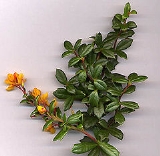
Berberidaceae

Encyclopedia
Berberidaceae are a family
of 15 genera flowering plant
s commonly called the barberry family. This family is in the order
Ranunculales
. The family contains about 570 species, of which the majority (450) are in Berberis
. The species include tree
s, shrub
s and perennial
herbaceous
plants.
The APG II system
of 2003 (unchanged from the APG system
of 1998) recognises the family and places it in the order Ranunculales
in the clade eudicots
.
In some older treatments of the family, Berberidaceae only included four genera (Berberis, Epimedium, Mahonia, Vancouveria), with the other genera treated in separate families, Leonticaceae (Bongardia, Caulophyllum, Gymnospermium, Leontice), Nandinaceae (Nandina), and Podophyllaceae (Achlys, Diphylleia, Dysosma, Jeffersonia, Podophyllum, Ranzania).
Mahonia is very closely related to Berberis, and some botanists include it within Berberis. Species in the two genera can be hybridised, with the hybrids being classified in the hybrid genus × Mahoberberis.
Family (biology)
In biological classification, family is* a taxonomic rank. Other well-known ranks are life, domain, kingdom, phylum, class, order, genus, and species, with family fitting between order and genus. As for the other well-known ranks, there is the option of an immediately lower rank, indicated by the...
of 15 genera flowering plant
Flowering plant
The flowering plants , also known as Angiospermae or Magnoliophyta, are the most diverse group of land plants. Angiosperms are seed-producing plants like the gymnosperms and can be distinguished from the gymnosperms by a series of synapomorphies...
s commonly called the barberry family. This family is in the order
Order (biology)
In scientific classification used in biology, the order is# a taxonomic rank used in the classification of organisms. Other well-known ranks are life, domain, kingdom, phylum, class, family, genus, and species, with order fitting in between class and family...
Ranunculales
Ranunculales
Ranunculales is an order of flowering plants. Of necessity it contains the family Ranunculaceae, the buttercup family, because the name of the order is based on the name of a genus in that family. Ranunculales belongs to a paraphyletic group known as the basal eudicots...
. The family contains about 570 species, of which the majority (450) are in Berberis
Berberis
Berberis , the barberries or pepperidge bushes, is a genus of about 450-500 species of deciduous and evergreen shrubs from 1-5 m tall with thorny shoots, native to the temperate and subtropical regions of Europe, Asia, Africa, North America and South America. They are closely related to the genus...
. The species include tree
Tree
A tree is a perennial woody plant. It is most often defined as a woody plant that has many secondary branches supported clear of the ground on a single main stem or trunk with clear apical dominance. A minimum height specification at maturity is cited by some authors, varying from 3 m to...
s, shrub
Shrub
A shrub or bush is distinguished from a tree by its multiple stems and shorter height, usually under 5–6 m tall. A large number of plants may become either shrubs or trees, depending on the growing conditions they experience...
s and perennial
Perennial plant
A perennial plant or simply perennial is a plant that lives for more than two years. The term is often used to differentiate a plant from shorter lived annuals and biennials. The term is sometimes misused by commercial gardeners or horticulturalists to describe only herbaceous perennials...
herbaceous
Herbaceous
A herbaceous plant is a plant that has leaves and stems that die down at the end of the growing season to the soil level. They have no persistent woody stem above ground...
plants.
Genera
- AchlysAchlys (plant)Achlys is a small genus of flowering plants in the barberry family, which it shares with genera such as Berberis and Vancouveria.-Species:...
- BerberisBerberisBerberis , the barberries or pepperidge bushes, is a genus of about 450-500 species of deciduous and evergreen shrubs from 1-5 m tall with thorny shoots, native to the temperate and subtropical regions of Europe, Asia, Africa, North America and South America. They are closely related to the genus...
- Barberry - BongardiaBongardiaBongardia is a monotypic genus in the berberry family native to North Africa to Greece, Central Asia and Middle Eastern areas. It is a tuberous, herbaceous plant with a large rounded tuber and attractive pinnate leaves. The flowers are hermaphrodite...
- CaulophyllumCaulophyllumCaulophyllum is a small genus of perennial herbs in the family Berberidaceae. It is native to eastern Asia and eastern North America. These plants are distinctive spring wildflowers, which grow in moist, rich woodland, it is known for its large triple-compound leaf, and large blue, berry-like fruits...
- DiphylleiaDiphylleiaDiphylleia is a genus of plant in Berberidaceae family.-Selected species:* Diphylleia cymosa* Diphylleia grayi* Diphylleia sinensis...
- Dysosma
- EpimediumEpimediumEpimedium, also known as Rowdy Lamb Herb, Barrenwort, Bishop's Hat, Fairy Wings, Horny Goat Weed, or Yin Yang Huo , is a genus of about 60 or more species of herbaceous flowering plants in the family Berberidaceae...
- GymnospermiumGymnospermiumGymnospermium is a genus of tuberous flowering plants in the barberry family....
- JeffersoniaJeffersoniaJeffersonia which is also known as twinleaf or rheumatism root, is a small genus of herbaceous perennial plants in the family Berberidaceae. The two species are native to eastern Asia and eastern North America. They are uncommon spring wildflowers, which grow in limestone soils of rich woodland...
- Twinleaf - Leontice
- MahoniaMahoniaMahonia is a genus of about 70 species of evergreen shrubs in the family Berberidaceae, native to eastern Asia, the Himalaya, North America and Central America. They are closely related to the genus Berberis. Botanists disagree on the acceptability of the genus name Mahonia...
- NandinaNandina-Description:Nandina domestica commonly known as nandina, heavenly bamboo or sacred bamboo, is a suckering shrub in the Barberry family, Berberidaceae. It is a monotypic genus, with this species as its only member. It is native to eastern Asia from the Himalaya east to Japan.Despite the common...
- PodophyllumPodophyllumPodophyllum is a genus of six species of herbaceous perennial plants in the family Berberidaceae, native to eastern Asia and eastern North America...
- Mayapple - RanzaniaRanzania (plant)Ranzania is a monotypic genus of perennial herbs in the family Berberidaceae, the only species is Ranzania japonica. It is native to woodlands in the mountains of Honshu, Japan. This genus is named in honor of Ono Ranzan, who has been called "the Japanese Linnaeus". Fleshy stems of Ranzania form...
- VancouveriaVancouveriaVancouveria is a small genus of plants belonging to the barberry family. The three plants in this genus are known generally as inside-out flowers, and they are endemic to western North America...
The APG II system
APG II system
The APG II system of plant classification is the second, now obsolete, version of a modern, mostly molecular-based, system of plant taxonomy that was published in April 2003 by the Angiosperm Phylogeny Group. It was a revision of the first APG system, published in 1998, and was superseded in 2009...
of 2003 (unchanged from the APG system
APG system
The APG system of plant classification is the first, now obsolete, version of a modern, mostly molecular-based, system of plant taxonomy that was published in 1998 by the Angiosperm Phylogeny Group. It was superseded in 2003 by a revision, the APG II system, and then in 2009 by a further...
of 1998) recognises the family and places it in the order Ranunculales
Ranunculales
Ranunculales is an order of flowering plants. Of necessity it contains the family Ranunculaceae, the buttercup family, because the name of the order is based on the name of a genus in that family. Ranunculales belongs to a paraphyletic group known as the basal eudicots...
in the clade eudicots
Eudicots
Eudicots and Eudicotyledons are botanical terms introduced by Doyle & Hotton to refer to a monophyletic group of flowering plants that had been called tricolpates or non-Magnoliid dicots by previous authors...
.
In some older treatments of the family, Berberidaceae only included four genera (Berberis, Epimedium, Mahonia, Vancouveria), with the other genera treated in separate families, Leonticaceae (Bongardia, Caulophyllum, Gymnospermium, Leontice), Nandinaceae (Nandina), and Podophyllaceae (Achlys, Diphylleia, Dysosma, Jeffersonia, Podophyllum, Ranzania).
Mahonia is very closely related to Berberis, and some botanists include it within Berberis. Species in the two genera can be hybridised, with the hybrids being classified in the hybrid genus × Mahoberberis.
External links
- Berberidaceae, Leonticaceae, Nandinaceae, Podophyllaceae in L. Watson and M.J. Dallwitz (1992 onwards), The families of flowering plants.
- Berberidaceae links
- NCBI Taxonomy Browser: Berberidaceae
- Flora of North America: Berberidaceae
- Chilean Berberidaceae, by Chileflora