

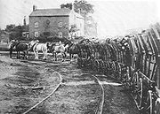
Benjamin Outram

Encyclopedia
Benjamin Outram was an English civil engineer
, surveyor and industrialist. He was a pioneer in the building of canal
s and tramways.
in Derbyshire, he began his career assisting his father Joseph Outram, who described himself as an "agriculturalist", but was also a land agent, an enclosure commissioner arbitrating in the many disputes which arose from the enclosures acts, an advisor on land management, a surveyor for new mines and served as a turnpike trustee.
In 1803 he had a son, James Outram
, who became an officer in the Indian Army and was later knighted.
He died of a "brain fever" (stroke) while visiting London in 1805. After his death, and some considerable litigation, in 1807 Benjamin Outram and Company was renamed the Butterley Company
.
After his death, his wife Margaret (1778–1863), daughter of James Anderson
, wrote that Outram "was hasty in his temper, feeling his own superiority over others. Accustomed to command, he had little toleration for stupidity and slowness, and none for meanness or littleness of any kind."
In spite of his prowess, Outram's wife and family were for a while reduced to near poverty after his death until his liabilities could be settled through the courts.
, and when William Jessop
was approached to design and build it he found an able assistant in 24 year-old Benjamin.
Construction of the canal, particularly Butterley Tunnel
, revealed substantial mineral deposits. The neighbouring Butterley Hall
and its 200 acre (0.809372 km²) estate came on the market at this time and Francis Beresford, solicitor to the canal company, bought the freehold of the hall and its estate. He leased it on a moiety
to Outram until the latter had acquired enough capital for a fifty percent holding.
 This was the beginning of the ironworks, 'Benjamin Outram & Company
' which began trading in 1790. The following year William Jessop and John Wright, a Nottingham banker, also became partners. Starting with a nominal capital of £6000, Outram was the only partner active in the management of the company, assisted by his younger brother, Joseph. Over time the business expanded to include a limestone quarry, limekilns, collieries and ironstone pits.
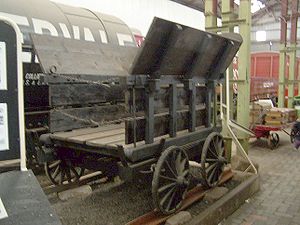
Outram became a leading advocate in the construction of tramways using L-section rails, which along with the wagons were manufactured at his Butterley Ironworks. His first tramway was a line slightly over 1 miles (1.6 km) in length, built to carry limestone from quarries at Crich
to Bullbridge Wharf on the Cromford Canal
, for use by his works.
In 1792 he became engineer for the Nottingham Canal
and in 1793 the Derby Canal
, working in the meantime on the Nutbrook Canal
.
One of his major works was the 44 feet (13.4 m) long single-span Holmes Aqueduct
on the Derby Canal, which opened in February 1796 and was one of the first cast-iron aqueducts. It was cast by Benjamin Outram & Company and predated Thomas Telford's
longer aqueduct on the Shrewsbury Canal
at Longdon-on-Tern
by one month. It proved troublesome and needed substantial remedial work in 1802, 1812 and 1930, eventually being demolished in 1971.
 An important extension to the Derby Canal was the Little Eaton Gangway
, a feeder for the Derby Canal
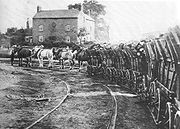
built on the pattern of that at Crich. Such tramways became an important part of his later canals. A common misconception is that the word "tramway" comes from Outram's surname but the word actually derives from the Low German word "traam" meaning "a beam" (of a wheelbarrow). Outram always referred to tramways as railways.
Outram was the consulting engineer for the construction of the Huddersfield Narrow Canal
, which included the pioneering Standedge Canal Tunnel
. In 1794 he was the engineer for the Peak Forest Canal
, which included the Marple Aqueduct
. The climb from Bugsworth
was negotiated by the 6 miles (9.7 km) Peak Forest Tramway
. Stodhart Tunnel on this tramway is believed to be the first railway tunnel in Derbyshire. In 1796 he reported on the extra funds needed to complete construction of the Manchester, Bolton and Bury Canal
. In 1798, he was retained to complete the final section of the Ashton Canal
which included the Store Street Aqueduct
, among the first to solve the problem of skew arch
es.
Outram also built railways for the Ashby-de-la-Zouch Canal
and was asked to advise on railways for the Monmouthshire & Brecon Canal
. He predicted within a few years of their introduction that railways would become the principal mode of transport. In 1799 he wrote, while building the Ashby-de-la-Zouch Canal
railway at four foot two inch gauge, "it appears that many hogsheads and packages require carriages . . . wider than those at Derby and Crich" and "it seems desirable that all extensive railways should be of the same width and that width should be sufficient to suit all the purposes of trade".
His sudden death, leaving no will, led to considerable confusion in resolving the company's affairs, and it was not until 1815 that the company's affairs and liabilities with his wife and family were settled.
Civil engineer
A civil engineer is a person who practices civil engineering; the application of planning, designing, constructing, maintaining, and operating infrastructures while protecting the public and environmental health, as well as improving existing infrastructures that have been neglected.Originally, a...
, surveyor and industrialist. He was a pioneer in the building of canal
Canal
Canals are man-made channels for water. There are two types of canal:#Waterways: navigable transportation canals used for carrying ships and boats shipping goods and conveying people, further subdivided into two kinds:...
s and tramways.
Personal life
Born at AlfretonAlfreton
Alfreton is a town and civil parish in Amber Valley, Derbyshire, England, adjoining the Bolsover and North East Derbyshire districts. It was formerly a Norman Manor and later an Urban District. The population of the Alfreton Ward was 7,928 at the 2001 Census...
in Derbyshire, he began his career assisting his father Joseph Outram, who described himself as an "agriculturalist", but was also a land agent, an enclosure commissioner arbitrating in the many disputes which arose from the enclosures acts, an advisor on land management, a surveyor for new mines and served as a turnpike trustee.
In 1803 he had a son, James Outram
Sir James Outram, 1st Baronet
Lieutenant General Sir James Outram, 1st Baronet GCB KSI was an English general who fought in the Indian Rebellion of 1857, and is considered a British hero.-Early life:...
, who became an officer in the Indian Army and was later knighted.
He died of a "brain fever" (stroke) while visiting London in 1805. After his death, and some considerable litigation, in 1807 Benjamin Outram and Company was renamed the Butterley Company
Butterley Company
Butterley Engineering was an engineering company based in Ripley, Derbyshire. The company was formed from the Butterley Company which began as Benjamin Outram and Company in 1790 and existed until 2009.-Origins:...
.
After his death, his wife Margaret (1778–1863), daughter of James Anderson
James Anderson of Hermiston
James Anderson FRSE FSA was a Scottish agriculturist, journalist and economist. A member of the Edinburgh Philosophical Society, Anderson was a prominent figure in the Scottish Enlightenment...
, wrote that Outram "was hasty in his temper, feeling his own superiority over others. Accustomed to command, he had little toleration for stupidity and slowness, and none for meanness or littleness of any kind."
In spite of his prowess, Outram's wife and family were for a while reduced to near poverty after his death until his liabilities could be settled through the courts.
Early career
Joseph Outram was a promoter of the Cromford CanalCromford Canal
The Cromford Canal ran 14.5 miles from Cromford to the Erewash Canal in Derbyshire, England with a branch to Pinxton. Built by William Jessop with the assistance of Benjamin Outram, its alignment included four tunnels and 14 locks....
, and when William Jessop
William Jessop
William Jessop was an English civil engineer, best known for his work on canals, harbours and early railways in the late 18th and early 19th centuries.-Early life:...
was approached to design and build it he found an able assistant in 24 year-old Benjamin.
Construction of the canal, particularly Butterley Tunnel
Butterley Tunnel
Butterley Tunnel is a one and three quarter mile long canal tunnel on the Cromford Canal below Ripley, in Derbyshire, England, opened to traffic in 1794.-Origins:...
, revealed substantial mineral deposits. The neighbouring Butterley Hall
Butterley Hall
Butterley Hall is an 18th century country house near Ripley, Derbyshire which now serves as the headquarters of the Derbyshire Constabulary. It is a Grade II listed building...
and its 200 acre (0.809372 km²) estate came on the market at this time and Francis Beresford, solicitor to the canal company, bought the freehold of the hall and its estate. He leased it on a moiety
Moiety title
Moiety title is legal term describing a portion other than a whole of ownership of property. The word derives from Old French moitié meaning "half" , from Latin medietas "middle", from medius....
to Outram until the latter had acquired enough capital for a fifty percent holding.
Established canal and railway engineer
Butterley Company
Butterley Engineering was an engineering company based in Ripley, Derbyshire. The company was formed from the Butterley Company which began as Benjamin Outram and Company in 1790 and existed until 2009.-Origins:...
' which began trading in 1790. The following year William Jessop and John Wright, a Nottingham banker, also became partners. Starting with a nominal capital of £6000, Outram was the only partner active in the management of the company, assisted by his younger brother, Joseph. Over time the business expanded to include a limestone quarry, limekilns, collieries and ironstone pits.
Outram became a leading advocate in the construction of tramways using L-section rails, which along with the wagons were manufactured at his Butterley Ironworks. His first tramway was a line slightly over 1 miles (1.6 km) in length, built to carry limestone from quarries at Crich
Crich
Crich is a village in Derbyshire in England. It has the National Tramway Museum inside the Crich Tramway Village, and at the summit of Crich Hill above, a Memorial Tower for those of the Sherwood Foresters regiment who died in battle, particularly in World War I.Built in 1923 on the site of an...
to Bullbridge Wharf on the Cromford Canal
Cromford Canal
The Cromford Canal ran 14.5 miles from Cromford to the Erewash Canal in Derbyshire, England with a branch to Pinxton. Built by William Jessop with the assistance of Benjamin Outram, its alignment included four tunnels and 14 locks....
, for use by his works.
In 1792 he became engineer for the Nottingham Canal
Nottingham Canal
The Nottingham Canal was a long canal between Langley Mill in Derbyshire and Nottingham, England. It opened in 1796, and most of it was closed in 1937. The southern section is now part of the River Trent Navigation, and the northern section is a nature reserve.-Origins:The idea for the canal first...
and in 1793 the Derby Canal
Derby Canal
The Derby Canal ran from the Trent and Mersey Canal at Swarkestone to Derby and Little Eaton, and to the Erewash Canal at Sandiacre, Derbyshire, England. The canal gained its Act of Parliament in 1793 and was fully completed in 1796...
, working in the meantime on the Nutbrook Canal
Nutbrook Canal
The Nutbrook Canal was a canal in England which ran between Shipley, Derbyshire and the Erewash Canal, joining it near Trowell. It was built to serve the collieries at Shipley and West Hallam, and was completed in 1796. It was initially profitable, but from 1846 faced competition from the railways,...
.
One of his major works was the 44 feet (13.4 m) long single-span Holmes Aqueduct
Aqueduct
An aqueduct is a water supply or navigable channel constructed to convey water. In modern engineering, the term is used for any system of pipes, ditches, canals, tunnels, and other structures used for this purpose....
on the Derby Canal, which opened in February 1796 and was one of the first cast-iron aqueducts. It was cast by Benjamin Outram & Company and predated Thomas Telford's
Thomas Telford
Thomas Telford FRS, FRSE was a Scottish civil engineer, architect and stonemason, and a noted road, bridge and canal builder.-Early career:...
longer aqueduct on the Shrewsbury Canal
Shrewsbury Canal
The Shrewsbury Canal was a canal in Shropshire, England. Authorised in 1793, the main line from Trench to Shrewsbury was fully open by 1797, but it remained isolated from the rest of the canal network until 1835, when the Birmingham and Liverpool Junction Canal built the Newport Branch from...
at Longdon-on-Tern
Longdon-on-Tern
Longdon-on-Tern is a village in east central Shropshire, England. It is in the unitary district of Telford and Wrekin, and is approximately east of Shrewsbury and north-west of Telford....
by one month. It proved troublesome and needed substantial remedial work in 1802, 1812 and 1930, eventually being demolished in 1971.
Little Eaton Gangway
The Little Eaton Gangway, or, to give it its official title, the Derby Canal Railway, was a narrow gauge industrial wagonway serving the Derby Canal, in England, at Little Eaton in Derbyshire.- The Derby Canal :...
, a feeder for the Derby Canal
Derby Canal
The Derby Canal ran from the Trent and Mersey Canal at Swarkestone to Derby and Little Eaton, and to the Erewash Canal at Sandiacre, Derbyshire, England. The canal gained its Act of Parliament in 1793 and was fully completed in 1796...
built on the pattern of that at Crich. Such tramways became an important part of his later canals. A common misconception is that the word "tramway" comes from Outram's surname but the word actually derives from the Low German word "traam" meaning "a beam" (of a wheelbarrow). Outram always referred to tramways as railways.
Outram was the consulting engineer for the construction of the Huddersfield Narrow Canal
Huddersfield Narrow Canal
The Huddersfield Narrow Canal is an inland waterway in northern England. It runs just under from Lock 1E at the rear of the University of Huddersfield campus, near Aspley Basin at Huddersfield to the junction with the Ashton Canal at Whitelands Basin in Ashton-under-Lyne...
, which included the pioneering Standedge Canal Tunnel
Standedge Tunnels
The Standedge Tunnels are four parallel tunnels that run beneath the Pennines at the traditional Standedge crossing point between Marsden and Diggle, on the edges of the conurbations of West Yorkshire and Greater Manchester respectively, in northern England.There are three railway tunnels and a...
. In 1794 he was the engineer for the Peak Forest Canal
Peak Forest Canal
The Peak Forest Canal, is a narrow locked artificial waterway in northern England. It is long and forms part of the connected English/Welsh inland waterway network.-General description:...
, which included the Marple Aqueduct
Marple Aqueduct
Marple Aqueduct, also known as the Grand Aqueduct, carries the lower level of the Peak Forest Canal across the River Goyt at Marple, Greater Manchester, in north-west England....
. The climb from Bugsworth
Buxworth
Buxworth is a village in the High Peak of Derbyshire, England. The area, which was once an important centre for the limestone industry, became the terminus of the Peak Forest Canal. Its pub, the Navigation Inn, was once owned by Coronation Street actress Pat Phoenix...
was negotiated by the 6 miles (9.7 km) Peak Forest Tramway
Peak Forest Tramway
The Peak Forest Tramway was an early horse- and gravity-powered industrial railway system in Derbyshire, England. Opened for trade on 31 August 1796, it remained in operation until the 1920s. Much of the route and the structures associated with the line remain...
. Stodhart Tunnel on this tramway is believed to be the first railway tunnel in Derbyshire. In 1796 he reported on the extra funds needed to complete construction of the Manchester, Bolton and Bury Canal
Manchester, Bolton and Bury Canal
The Manchester Bolton & Bury Canal is a disused canal in Greater Manchester, England, built to link Bolton and Bury with Manchester. The canal, when fully opened, was 15 miles 1 furlong long. It was accessed via a junction with the River Irwell in Salford...
. In 1798, he was retained to complete the final section of the Ashton Canal
Ashton Canal
The Ashton Canal is a canal built in Greater Manchester in North West England.-Route:The Ashton leaves the Rochdale Canal at Ducie St. Junction in central Manchester, and climbs for through 18 locks, passing through Ancoats, Holt Town, Bradford-with-Beswick, Clayton, Openshaw, Droylsden,...
which included the Store Street Aqueduct
Store Street Aqueduct
The Store Street Aqueduct in central Manchester, England was built in 1798 by Benjamin Outram on the Ashton Canal. A Grade II* listed building it is built on a skew of 45 degrees across Store Street, and is believed to be the first major aqueduct of its kind in Great Britain and the oldest still in...
, among the first to solve the problem of skew arch
Skew arch
A skew arch is a method of construction that enables an arch bridge to span an obstacle at some angle other than a right angle. This results in the faces of the arch not being perpendicular to its abutments and its plan view being a parallelogram, rather than the rectangle that is the plan view of...
es.
Outram also built railways for the Ashby-de-la-Zouch Canal
Ashby-de-la-Zouch Canal
The Ashby-de-la-Zouch Canal is a long canal in England which connected the mining district around Moira, just outside the town of Ashby-de-la-Zouch, with the Coventry Canal at Bedworth in Warwickshire. It was opened in 1804, and a number of tramways were constructed at its northern end, to service...
and was asked to advise on railways for the Monmouthshire & Brecon Canal
Monmouthshire & Brecon Canal
The Monmouthshire and Brecon Canal is a small network of canals in South Wales. For most of its length it runs through the Brecon Beacons National Park, and its present rural character and tranquillity belies its original purpose as an industrial corridor for coal and iron, which were brought to...
. He predicted within a few years of their introduction that railways would become the principal mode of transport. In 1799 he wrote, while building the Ashby-de-la-Zouch Canal
Ashby-de-la-Zouch Canal
The Ashby-de-la-Zouch Canal is a long canal in England which connected the mining district around Moira, just outside the town of Ashby-de-la-Zouch, with the Coventry Canal at Bedworth in Warwickshire. It was opened in 1804, and a number of tramways were constructed at its northern end, to service...
railway at four foot two inch gauge, "it appears that many hogsheads and packages require carriages . . . wider than those at Derby and Crich" and "it seems desirable that all extensive railways should be of the same width and that width should be sufficient to suit all the purposes of trade".
His sudden death, leaving no will, led to considerable confusion in resolving the company's affairs, and it was not until 1815 that the company's affairs and liabilities with his wife and family were settled.
See also
- CanalCanalCanals are man-made channels for water. There are two types of canal:#Waterways: navigable transportation canals used for carrying ships and boats shipping goods and conveying people, further subdivided into two kinds:...
- NarrowboatNarrowboatA narrowboat or narrow boat is a boat of a distinctive design, made to fit the narrow canals of Great Britain.In the context of British Inland Waterways, "narrow boat" refers to the original working boats built in the 18th, 19th, and 20th centuries for carrying goods on the narrow canals...
- National Tramway MuseumNational Tramway MuseumThe National Tramway Museum, at Crich, in Derbyshire, England, is situated within Crich Tramway Village, a period village containing a pub, cafe, old-style sweetshop, including the tram depots. The village is also home to the Eagle Press, a small museum dedicated to Letterpress Printing including...
- Little Eaton GangwayLittle Eaton GangwayThe Little Eaton Gangway, or, to give it its official title, the Derby Canal Railway, was a narrow gauge industrial wagonway serving the Derby Canal, in England, at Little Eaton in Derbyshire.- The Derby Canal :...
- Peak Forest TramwayPeak Forest TramwayThe Peak Forest Tramway was an early horse- and gravity-powered industrial railway system in Derbyshire, England. Opened for trade on 31 August 1796, it remained in operation until the 1920s. Much of the route and the structures associated with the line remain...