


Battle of Kokenhausen

Encyclopedia
The Battle of Kokenhausen (Kokenhuza ) was a major battle opening the Polish–Swedish War (1600–1611)
. It took place on the 23 June 1601 near Koknese
in Livonia
(now in Latvia
). In the battle, Polish forces defeated the Swedish relief force and captured the besieging force, relieving the Polish garrison. The battle is notable as one of the greatest victories of the Polish hussars, who defeated their numerically superior Swedish
adversaries.
had been blockading the fortified town of Koknese ( , located on Daugava River, between Riga
and Daugavpils
- see map) since 10 March - after the arrival of Duke Charles
with heavy artillery
- laying a siege to it since 28 March. On 1 April the Swedes had taken the town but not the inner castle
, which was still defended by a Polish garrison. Charles left about 2,500 strong besieging force, and moved north.
The Polish relief army under Krzysztof Mikołaj "the Thunderbolt" Radziwiłł arrived around 11 May and in turn started to besiege the Swedes; it grew from under 1,000 to over 4,000 by mid-June. At the same time, other Polish detachments reinforced nearby Polish strongholds and harassed the Swedish units. The Swedes decided to prioritize the relief of the Koknese siege force. A Swedish relief force of about 5,000 under Carl Gyllenhielm arrived on the morning of 23 June and attempted to break the Polish encirclement.
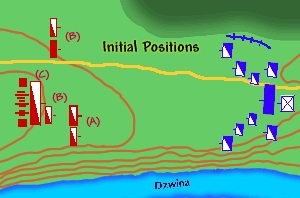
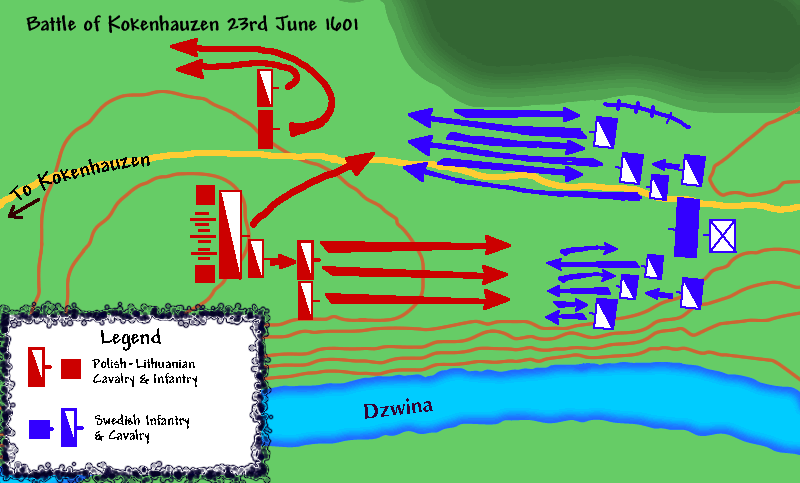 The field of battle was raised along its edge with the Daugava for some one and a half kilometers to a width of about half a kilometer with the side nearest the river being steep and falling more gently towards the field.
Gyllenhielm had about 900 infantry
, 4000 cavalry
and 17 cannons
. Radziwiłł left about 500 infantry with orders to maintain the siege, and took the field with the rest (around 3,000 men, of which some 400 were infantry, 1000 Polish hussars
, and 9 cannons).
Poles first broke the Swedish right flank, and then defeated the Swedish counterattack. Both the hussar charges and artillery fire proved decisive in this engagement.
Polish–Swedish War (1600–1611)
-Origins:This conflict between the Polish–Lithuanian Commonwealth and Sweden can trace its roots to the War against Sigismund, where Sigismund III Vasa, at one time king of both the Commonwealth and Sweden, lost the throne of Sweden during the civil war...
. It took place on the 23 June 1601 near Koknese
Koknese
Koknese is a historic town in Latvia, the administrative centre of Koknese municipality on the right bank of the Daugava River. It has a population of nearly 3,000.-History:...
in Livonia
Livonia
Livonia is a historic region along the eastern shores of the Baltic Sea. It was once the land of the Finnic Livonians inhabiting the principal ancient Livonian County Metsepole with its center at Turaida...
(now in Latvia
Latvia
Latvia , officially the Republic of Latvia , is a country in the Baltic region of Northern Europe. It is bordered to the north by Estonia , to the south by Lithuania , to the east by the Russian Federation , to the southeast by Belarus and shares maritime borders to the west with Sweden...
). In the battle, Polish forces defeated the Swedish relief force and captured the besieging force, relieving the Polish garrison. The battle is notable as one of the greatest victories of the Polish hussars, who defeated their numerically superior Swedish
Sweden
Sweden , officially the Kingdom of Sweden , is a Nordic country on the Scandinavian Peninsula in Northern Europe. Sweden borders with Norway and Finland and is connected to Denmark by a bridge-tunnel across the Öresund....
adversaries.
Prelude
Swedish forces of about 2,000 under Carl Carlsson GyllenhielmCarl Carlsson Gyllenhielm
Baron Carl Carlsson Gyllenhielm was a Swedish soldier and politician. He was appointed Field Marshal in 1616, Privy Councilor in 1617, Governor General of Ingria in 1617 and Lord High Admiral in 1620. He was an illegitimate son of Duke Carl, later King Charles IX of Sweden, and Karin Nilsdotter,...
had been blockading the fortified town of Koknese ( , located on Daugava River, between Riga
Riga
Riga is the capital and largest city of Latvia. With 702,891 inhabitants Riga is the largest city of the Baltic states, one of the largest cities in Northern Europe and home to more than one third of Latvia's population. The city is an important seaport and a major industrial, commercial,...
and Daugavpils
Daugavpils
Daugavpils is a city in southeastern Latvia, located on the banks of the Daugava River, from which the city gets its name. Daugavpils literally means "Daugava Castle". With a population of over 100,000, it is the second largest city in the country after the capital Riga, which is located some...
- see map) since 10 March - after the arrival of Duke Charles
Charles IX of Sweden
Charles IX of Sweden also Carl, was King of Sweden from 1604 until his death. He was the youngest son of King Gustav I of Sweden and his second wife, Margaret Leijonhufvud, brother of Eric XIV and John III of Sweden, and uncle of Sigismund III Vasa king of both Sweden and Poland...
with heavy artillery
Artillery
Originally applied to any group of infantry primarily armed with projectile weapons, artillery has over time become limited in meaning to refer only to those engines of war that operate by projection of munitions far beyond the range of effect of personal weapons...
- laying a siege to it since 28 March. On 1 April the Swedes had taken the town but not the inner castle
Castle
A castle is a type of fortified structure built in Europe and the Middle East during the Middle Ages by European nobility. Scholars debate the scope of the word castle, but usually consider it to be the private fortified residence of a lord or noble...
, which was still defended by a Polish garrison. Charles left about 2,500 strong besieging force, and moved north.
The Polish relief army under Krzysztof Mikołaj "the Thunderbolt" Radziwiłł arrived around 11 May and in turn started to besiege the Swedes; it grew from under 1,000 to over 4,000 by mid-June. At the same time, other Polish detachments reinforced nearby Polish strongholds and harassed the Swedish units. The Swedes decided to prioritize the relief of the Koknese siege force. A Swedish relief force of about 5,000 under Carl Gyllenhielm arrived on the morning of 23 June and attempted to break the Polish encirclement.
Battle
Gyllenhielm had about 900 infantry
Infantry
Infantrymen are soldiers who are specifically trained for the role of fighting on foot to engage the enemy face to face and have historically borne the brunt of the casualties of combat in wars. As the oldest branch of combat arms, they are the backbone of armies...
, 4000 cavalry
Cavalry
Cavalry or horsemen were soldiers or warriors who fought mounted on horseback. Cavalry were historically the third oldest and the most mobile of the combat arms...
and 17 cannons
Artillery
Originally applied to any group of infantry primarily armed with projectile weapons, artillery has over time become limited in meaning to refer only to those engines of war that operate by projection of munitions far beyond the range of effect of personal weapons...
. Radziwiłł left about 500 infantry with orders to maintain the siege, and took the field with the rest (around 3,000 men, of which some 400 were infantry, 1000 Polish hussars
Polish Hussars
The Polish Hussars were the main type of cavalry of the first Polish Army, later also introduced into the Army of the Grand Duchy of Lithuania, between the 16th and 18th centuries...
, and 9 cannons).
Poles first broke the Swedish right flank, and then defeated the Swedish counterattack. Both the hussar charges and artillery fire proved decisive in this engagement.