

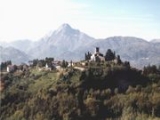
Barga

Encyclopedia
Barga is a medieval town and comune
of the province of Lucca
in Tuscany
, central Italy
. It is home to around 10,000 people and is the chief town of the "Media Valle" (mid valley) of the Serchio
.
. It is overlooked by the village of Albiano, a località
of Barga, which in the 10th century was the site of a castle protecting the town.
Pania della Croce
, a mountain of the Apuan Alps, dominates the surrounding chestnut trees, grape vines and olive groves.
 Founded by the Lombards
, the city grew as a castle surrounded by a line of walls, of which two gates (Porta Reale and Porta Macchiaia) have survived. The town was well known during the Middle Ages for the manufacture of silk threads which were exported to major centres such as Florence, its mills powered by the hydraulic power of the nearby creeks. In the Middle Ages, Lucca and Pisa
battled frequently to conquer the wealthy town and the surrounding territory, and for a time Barga was part of the Florentine dominion, later Duchy and Grand Duchy of Tuscany
. In 1847 it became part of the Duchy of Lucca
, maintaining a certain degree of autonomy, until it became part of the Kingdom of Italy in 1861. Between 1331 and 1859 Albiano owed its allegiance to the Florentine State. The region was part of the Gothic Line
in World War II
, and was the scene of fierce fighting between the Allies and Germans from October 1944 until April 1945.
". Recently, Barga has become the home of many painters, including John Bellany
who exhibit their work in some of the small galleries within the castle walls.
The "Sagra" is a feature of Tuscan rural culture; communal meals for several hundred people, eaten in the open air, often in orchards, vineyards or sports grounds. Originally religious celebrations, they are now often used to raise funds for local causes. Each town and village will have its own peculiar sagra: Around Barga from July to September it is possible to participate in a Sagra every night. In Barga itself there is the "Cena in Vignola" in the vineyard below the Duomo, and in August the "Sagra delle pesce e Patate" (Fish and Chips) in celebration of the Barga/Scottish connection. At nearby San Pietro in Campo, there is the "Sagra del Maiale" (Pork), at Filecchio the "Sagra della Polenta e Ucelli" (originally small wild birds, now pheasant), at Fornaci di Barga
the "1°Maggio expo".
The Italian Touring Club has recently assigned the "orange flag" of the "Migliori borghi d'Italia" ("Best Villages of Italy"), a distinguished sign recognizing the peculiarity of its beauty and of its quality.
Barga has also been, since 1999, the home of the "European Gnome Sanctuary" run by the Garden Gnome Liberation Front.
The frazione of Castelvecchio Pascoli was home to one of Italy's 19th century poet Giovanni Pascoli
.
In 2008 Barga became the first medieval historic centre in Italy to be mapped and equipped with QR codes (2D barcodes) for all of the churches, palazzo's statues, restaurants, bars and places of interest. After a two year trial, the project was released to the public in Dec 2010 under the name iBarga
. Visitors can now get precise up to date information about the city on their mobile telephones and in 10 different languages
, France
Gällivare
, Sweden
Prestonpans
, Scotland
Cockenzie, Scotland
Port Seton, Scotland
Longniddry
, Scotland
http://www.battleofprestonpans1745.org/prestonpans/html/barga/
Comune
In Italy, the comune is the basic administrative division, and may be properly approximated in casual speech by the English word township or municipality.-Importance and function:...
of the province of Lucca
Province of Lucca
The Province of Lucca is a province in the Tuscany region of Italy. Its capital is the city of Lucca.It has an area of 1,773 km², and a total population of 372,244...
in Tuscany
Tuscany
Tuscany is a region in Italy. It has an area of about 23,000 square kilometres and a population of about 3.75 million inhabitants. The regional capital is Florence ....
, central Italy
Italy
Italy , officially the Italian Republic languages]] under the European Charter for Regional or Minority Languages. In each of these, Italy's official name is as follows:;;;;;;;;), is a unitary parliamentary republic in South-Central Europe. To the north it borders France, Switzerland, Austria and...
. It is home to around 10,000 people and is the chief town of the "Media Valle" (mid valley) of the Serchio
Serchio
At 126 kilometres the Serchio is the third longest river in the Italian region of Tuscany, coming after the Arno and the Ombrone...
.
Geography
Barga lies 35 km north of the provincial capital, LuccaLucca
Lucca is a city and comune in Tuscany, central Italy, situated on the river Serchio in a fertile plainnear the Tyrrhenian Sea. It is the capital city of the Province of Lucca...
. It is overlooked by the village of Albiano, a località
Località
A località, in Italy, is the name given to inhabited places that are not accorded a more significant distinction in administrative law such as a frazione, comune, municipio, circoscrizione, or quartiere. The word is cognate to English locality...
of Barga, which in the 10th century was the site of a castle protecting the town.
Pania della Croce
Pania della Croce
Pania della Croce is a mountain in the Alpi Apuane, in Tuscany, central Italy. It is the highest peak in the Panie Group , located not far from the Tyrrhenian Sea coast....
, a mountain of the Apuan Alps, dominates the surrounding chestnut trees, grape vines and olive groves.
History
Lombards
The Lombards , also referred to as Longobards, were a Germanic tribe of Scandinavian origin, who from 568 to 774 ruled a Kingdom in Italy...
, the city grew as a castle surrounded by a line of walls, of which two gates (Porta Reale and Porta Macchiaia) have survived. The town was well known during the Middle Ages for the manufacture of silk threads which were exported to major centres such as Florence, its mills powered by the hydraulic power of the nearby creeks. In the Middle Ages, Lucca and Pisa
Pisa
Pisa is a city in Tuscany, Central Italy, on the right bank of the mouth of the River Arno on the Tyrrhenian Sea. It is the capital city of the Province of Pisa...
battled frequently to conquer the wealthy town and the surrounding territory, and for a time Barga was part of the Florentine dominion, later Duchy and Grand Duchy of Tuscany
Grand Duchy of Tuscany
The Grand Duchy of Tuscany was a central Italian monarchy that existed, with interruptions, from 1569 to 1859, replacing the Duchy of Florence. The grand duchy's capital was Florence...
. In 1847 it became part of the Duchy of Lucca
Duchy of Lucca
The Duchy of Lucca was an Italian state existing from 1815 to 1847. It was centered on the city of Lucca.The Duchy was formed in 1815 by the Congress of Vienna, out of the former Republic of Lucca and the Principality of Lucca and Piombino, which had been ruled by Elisa Bonaparte...
, maintaining a certain degree of autonomy, until it became part of the Kingdom of Italy in 1861. Between 1331 and 1859 Albiano owed its allegiance to the Florentine State. The region was part of the Gothic Line
Gothic Line
The Gothic Line formed Field Marshal Albert Kesselring's last major line of defence in the final stages of World War II along the summits of the Apennines during the fighting retreat of German forces in Italy against the Allied Armies in Italy commanded by General Sir Harold Alexander.Adolf Hitler...
in World War II
Italian Campaign (World War II)
The Italian Campaign of World War II was the name of Allied operations in and around Italy, from 1943 to the end of the war in Europe. Joint Allied Forces Headquarters AFHQ was operationally responsible for all Allied land forces in the Mediterranean theatre, and it planned and commanded the...
, and was the scene of fierce fighting between the Allies and Germans from October 1944 until April 1945.
Main sights
Main sights include:- Duomo (cathedral) (11th-16th centuries), the main example of Romanesque architectureRomanesque architectureRomanesque architecture is an architectural style of Medieval Europe characterised by semi-circular arches. There is no consensus for the beginning date of the Romanesque architecture, with proposals ranging from the 6th to the 10th century. It developed in the 12th century into the Gothic style,...
in the Serchio Valley. Of the original church, built in local limestone, parts of the façade remain. The interior has a nave and two aisles. It houses a large (3.5 m) wooden statue of St. Christopher, patron of the city. The pulpitPulpitPulpit is a speakers' stand in a church. In many Christian churches, there are two speakers' stands at the front of the church. Typically, the one on the left is called the pulpit...
(12th century) was designed by Guido Bigarelli da Como, with four red marble columns resting on lion sculptures. The campanile contains three bells, the oldest of which dates to the 16th century. - Arringo, a large lawn between the Duomo and the Palazzo Pretorio
- Loggia del PodestàPodestàPodestà is the name given to certain high officials in many Italian cities, since the later Middle Ages, mainly as Chief magistrate of a city state , but also as a local administrator, the representative of the Emperor.The term derives from the Latin word potestas, meaning power...
(14th century). - Church of San Francesco, with several works by Andrea della RobbiaAndrea della RobbiaAndrea della Robbia was an Italian Renaissance sculptor, especially in ceramics. He was the son of Marco della Robbia. Andrea della Robbia's uncle, Luca della Robbia, popularized the use of glazed terra-cotta for sculpture...
Culture
There is an annual international opera festival, called "Opera Barga Festival", and a long running and very successful jazz festival, "BargajazzBargajazz
Bargajazz is a long running jazz festival in the medieval Tuscan city of Barga in the north of Italy.The Jazz festival is based around a competition for arrangements and compositions for the Barga Jazz Orchestra....
". Recently, Barga has become the home of many painters, including John Bellany
John Bellany
John Bellany, CBE, RA is a Scottish painter.He was born in Port Seton. During the 1960s, he studied at Edinburgh College of Art and then at the Royal College of Art in London....
who exhibit their work in some of the small galleries within the castle walls.
The "Sagra" is a feature of Tuscan rural culture; communal meals for several hundred people, eaten in the open air, often in orchards, vineyards or sports grounds. Originally religious celebrations, they are now often used to raise funds for local causes. Each town and village will have its own peculiar sagra: Around Barga from July to September it is possible to participate in a Sagra every night. In Barga itself there is the "Cena in Vignola" in the vineyard below the Duomo, and in August the "Sagra delle pesce e Patate" (Fish and Chips) in celebration of the Barga/Scottish connection. At nearby San Pietro in Campo, there is the "Sagra del Maiale" (Pork), at Filecchio the "Sagra della Polenta e Ucelli" (originally small wild birds, now pheasant), at Fornaci di Barga
Fornaci di Barga
Fornaci di Barga is a frazione of Barga in the Province of Lucca, Tuscany, Italy. It is located 165 m above sea level, on the left bank of the river Serchio.- History :...
the "1°Maggio expo".
The Italian Touring Club has recently assigned the "orange flag" of the "Migliori borghi d'Italia" ("Best Villages of Italy"), a distinguished sign recognizing the peculiarity of its beauty and of its quality.
Barga has also been, since 1999, the home of the "European Gnome Sanctuary" run by the Garden Gnome Liberation Front.
The frazione of Castelvecchio Pascoli was home to one of Italy's 19th century poet Giovanni Pascoli
Giovanni Pascoli
Giovanni Placido Agostino Pascoli was an Italian poet and classical scholar.- Biography :Giovanni Pascoli was born at San Mauro di Romagna , into a well-to-do family. He was the fourth of ten children of Ruggero Pascoli and Caterina Vincenzi Alloccatelli...
.
In 2008 Barga became the first medieval historic centre in Italy to be mapped and equipped with QR codes (2D barcodes) for all of the churches, palazzo's statues, restaurants, bars and places of interest. After a two year trial, the project was released to the public in Dec 2010 under the name iBarga
IBarga
IIn 2008, Barga became the first medieval historic centre in Italy to be mapped and equipped with QR codes for all of the churches, palazzo's statues, restaurants, bars and places of interest. After a two year trial, the project was released to the public in Dec 2010 under the name iBarga. The...
. Visitors can now get precise up to date information about the city on their mobile telephones and in 10 different languages
Sport
In 1991 the local sport center named "Il Ciocco" hosted the second edition of UCI Mountain Bike & Trials World Championships.Sister cities
HayangeHayange
Hayange is a commune in the Moselle department in Lorraine in north-eastern France.Outlying villages include Marspich and Saint-Nicolas-en-Forêt, Konacker and Ranguevaux.-Economy:...
, France
France
The French Republic , The French Republic , The French Republic , (commonly known as France , is a unitary semi-presidential republic in Western Europe with several overseas territories and islands located on other continents and in the Indian, Pacific, and Atlantic oceans. Metropolitan France...
Gällivare
Gällivare
Gällivare is a locality and the seat of Gällivare Municipality in Norrbotten County, Sweden with 8,480 inhabitants in 2005. The town was founded in the 17th century...
, Sweden
Sweden
Sweden , officially the Kingdom of Sweden , is a Nordic country on the Scandinavian Peninsula in Northern Europe. Sweden borders with Norway and Finland and is connected to Denmark by a bridge-tunnel across the Öresund....
Prestonpans
Prestonpans
Prestonpans is a small town to the east of Edinburgh, Scotland, in the unitary council area of East Lothian. It has a population of 7,153 . It is the site of the 1745 Battle of Prestonpans, and has a history dating back to the 11th century...
, Scotland
Scotland
Scotland is a country that is part of the United Kingdom. Occupying the northern third of the island of Great Britain, it shares a border with England to the south and is bounded by the North Sea to the east, the Atlantic Ocean to the north and west, and the North Channel and Irish Sea to the...
Cockenzie, Scotland
Scotland
Scotland is a country that is part of the United Kingdom. Occupying the northern third of the island of Great Britain, it shares a border with England to the south and is bounded by the North Sea to the east, the Atlantic Ocean to the north and west, and the North Channel and Irish Sea to the...
Port Seton, Scotland
Scotland
Scotland is a country that is part of the United Kingdom. Occupying the northern third of the island of Great Britain, it shares a border with England to the south and is bounded by the North Sea to the east, the Atlantic Ocean to the north and west, and the North Channel and Irish Sea to the...
Longniddry
Longniddry
Longniddry is a village in East Lothian, Scotland, with a population of 2,613 .Longniddry is primarily a dormitory village for commuters to Edinburgh, with good transport links by road and rail to the capital...
, Scotland
Scotland
Scotland is a country that is part of the United Kingdom. Occupying the northern third of the island of Great Britain, it shares a border with England to the south and is bounded by the North Sea to the east, the Atlantic Ocean to the north and west, and the North Channel and Irish Sea to the...
http://www.battleofprestonpans1745.org/prestonpans/html/barga/
External links
- Official website
- Info website
- Tourism and Accommodations in Barga
- Orange Flags
- live weather data for Barga, Media Valle and Garfagnana (weather station based in Barga Vecchia)
- QR codes press conference
- BBC News item on Barga "Close-up: 'The most Scottish place in Italy'