

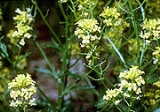
Barbarea vulgaris

Encyclopedia
Barbarea vulgaris, also called as Bittercress, Herb Barbara, Rocketcress, Yellow Rocketcress, Winter Rocket, and Wound Rocket, is a biennial herb of the genus Barbarea
, belonging to the family Brassicaceae
.
derives fron Saint Barbara, the patron saint of artillerymen and miners, as this plant in the past was used to soothe the wounds caused by explosions. The species Latin name vulgaris mens “common”.
grows to about 30–60 cm (11.8–23.6 ) of height, with a maximum of 1 metres (3.3 ft). The stem is ribbed and hairless, branched at the base. It has a basal rosette
s of shiny, dark green leaves. The basal leaves are stalked and lyre-pinnatifid, that is with a large terminal lobe and smaller lower lobes. The cauline leaves are smaller, ovate, toothed or lobed. The flowers are borne in spring in dense terminal clusters above the foliage
. They are 7–9 mm (0.275590551181102–0.354330708661417 ) long, with four bright yellow petals.The flowering period extends from about April through July. The fruit is a pod of about 15–30 mm (0.590551181102362–1.2 ).
s, flavonoid
s, and glucosinolate
s.
s. Glucosinolates such as glucobarbarin and glucobrassicin
are used as a cue for egg-laying by female cabbage white butterflies such as Pieris rapae. Indeed, the larvae of this butterfly thrive well on this plant. Diamond back moth females are also stimulated by these chemicals, but the larvae die due to the content of saponins which are apparently not sensed by the moths. This phenomenon has been tested for biological insect control: B. vulgaris plants are placed in a field and attract much of the diamondback moth egg load. As the larvae die shortly after hatching, this kind of insect control has been named "dead-end trap cropping".
it is naturalised
in many parts of North America
as a weed.
A chemotype with deviating glucosinolate content has been described from W. Europe and named the "NAS-type" (because it is dominated by the glucosinolate
glucoNASturtiin. This type has increased resistance to some specialized insects. In this context, the usual chemotype of B. vulgaris is called the "BAR" type (because it is dominated by glucoBARbarin).
Barbarea
Barbarea is a genus of about 22 species of flowering plants in the family Brassicaceae, native to temperate regions of the Northern Hemisphere, with the highest species diversity in southern Europe and southwest Asia.They are small herbaceous biennial or perennial plants with dark green, deeply...
, belonging to the family Brassicaceae
Brassicaceae
Brassicaceae, a medium sized and economically important family of flowering plants , are informally known as the mustards, mustard flowers, the crucifers or the cabbage family....
.
Etymology
The genus name BarbareaBarbarea
Barbarea is a genus of about 22 species of flowering plants in the family Brassicaceae, native to temperate regions of the Northern Hemisphere, with the highest species diversity in southern Europe and southwest Asia.They are small herbaceous biennial or perennial plants with dark green, deeply...
derives fron Saint Barbara, the patron saint of artillerymen and miners, as this plant in the past was used to soothe the wounds caused by explosions. The species Latin name vulgaris mens “common”.
Description
This plantPlant
Plants are living organisms belonging to the kingdom Plantae. Precise definitions of the kingdom vary, but as the term is used here, plants include familiar organisms such as trees, flowers, herbs, bushes, grasses, vines, ferns, mosses, and green algae. The group is also called green plants or...
grows to about 30–60 cm (11.8–23.6 ) of height, with a maximum of 1 metres (3.3 ft). The stem is ribbed and hairless, branched at the base. It has a basal rosette
Rosette (botany)
In botany, a rosette is a circular arrangement of leaves, with all the leaves at a single height.Though rosettes usually sit near the soil, their structure is an example of a modified stem.-Function:...
s of shiny, dark green leaves. The basal leaves are stalked and lyre-pinnatifid, that is with a large terminal lobe and smaller lower lobes. The cauline leaves are smaller, ovate, toothed or lobed. The flowers are borne in spring in dense terminal clusters above the foliage
Leaf
A leaf is an organ of a vascular plant, as defined in botanical terms, and in particular in plant morphology. Foliage is a mass noun that refers to leaves as a feature of plants....
. They are 7–9 mm (0.275590551181102–0.354330708661417 ) long, with four bright yellow petals.The flowering period extends from about April through July. The fruit is a pod of about 15–30 mm (0.590551181102362–1.2 ).
Characteristics
Chemical substances in this species include saponinSaponin
Saponins are a class of chemical compounds, one of many secondary metabolites found in natural sources, with saponins found in particular abundance in various plant species...
s, flavonoid
Flavonoid
Flavonoids , are a class of plant secondary metabolites....
s, and glucosinolate
Glucosinolate
The glucosinolates are a class of organic compounds that contain sulfur and nitrogen and are derived from glucose and an amino acid. They occur as secondary metabolites of almost all plants of the order Brassicales , but also in the genus Drypetes .-Chemistry:Glucosinolates are water-soluble...
s.
Natural insect resistance and its potential use in agriculture
Most Barbarea vulgaris genotypes are naturally resistant to some insect species that are otherwise specialized on the crucifer family. In the case of diamondback moth (Plutella xylostella) and the flea beetle Phyllotreta nemorum, the resistance is caused by saponinSaponin
Saponins are a class of chemical compounds, one of many secondary metabolites found in natural sources, with saponins found in particular abundance in various plant species...
s. Glucosinolates such as glucobarbarin and glucobrassicin
Glucobrassicin
Glucobrassicin is a type of glucosinolate that can be found in almost all cruciferous plants, such as cabbages , mustards, cress, and woad. As for other glucosinolates, degradation by the enzyme myrosinase is expected to produce an isothiocyanate, indol-3-ylmethylisothiocyanate...
are used as a cue for egg-laying by female cabbage white butterflies such as Pieris rapae. Indeed, the larvae of this butterfly thrive well on this plant. Diamond back moth females are also stimulated by these chemicals, but the larvae die due to the content of saponins which are apparently not sensed by the moths. This phenomenon has been tested for biological insect control: B. vulgaris plants are placed in a field and attract much of the diamondback moth egg load. As the larvae die shortly after hatching, this kind of insect control has been named "dead-end trap cropping".
Distribution
Native to EuropeEurope
Europe is, by convention, one of the world's seven continents. Comprising the westernmost peninsula of Eurasia, Europe is generally 'divided' from Asia to its east by the watershed divides of the Ural and Caucasus Mountains, the Ural River, the Caspian and Black Seas, and the waterways connecting...
it is naturalised
Naturalisation (biology)
In biology, naturalisation is any process by which a non-native organism spreads into the wild and its reproduction is sufficient to maintain its population. Such populations are said to be naturalised....
in many parts of North America
North America
North America is a continent wholly within the Northern Hemisphere and almost wholly within the Western Hemisphere. It is also considered a northern subcontinent of the Americas...
as a weed.
Habitat
The plant prefers fresh or moist places, on roadsides, along rivers, or on the slopes and in ditches, at an altitude of 0–1600 m (0–5,249.3 ) above sea level.Natural chemotypes with distinct ecology
A pubescent type (the "P-type") has been described from S. Scandinavia. This type has atypical chemistry and is devoid of resistance to the diamondback moth and the flea beetle Phyllotreta nemorum. The P-type belongs morphologically to the variety B. vulgaris var. arcuata, but may also be identical to the subspecies originally described as Barbaraea Beck arcuata Rchb. ssp. pubescens N. Busch. In this context, the usual type of B. vulgaris var. arcuata is called the "G-type" (for Glabrous (hairless) leaves).A chemotype with deviating glucosinolate content has been described from W. Europe and named the "NAS-type" (because it is dominated by the glucosinolate
Glucosinolate
The glucosinolates are a class of organic compounds that contain sulfur and nitrogen and are derived from glucose and an amino acid. They occur as secondary metabolites of almost all plants of the order Brassicales , but also in the genus Drypetes .-Chemistry:Glucosinolates are water-soluble...
glucoNASturtiin. This type has increased resistance to some specialized insects. In this context, the usual chemotype of B. vulgaris is called the "BAR" type (because it is dominated by glucoBARbarin).
Subspecies
- Barbarea vulgaris var. arcuata (Opiz ex J. Presl & C. Presl) Fr.
- Barbarea vulgaris var. brachycarpa Rouy & Foucaud
- Barbarea vulgaris var. longisiliquosa Carion
- Barbarea vulgaris var. sylvestris Fr.