

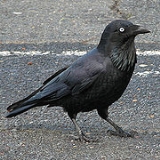
Australian Raven

Encyclopedia
The Australian Raven is the largest Australia
n member of the genus
Corvus and one of three Australian species commonly known as ravens. It is a more slender bird than the Common Raven
of the Northern Hemisphere but is otherwise similar. It has all-black plumage, beak and legs with a white iris, as do the other Corvus members in Australia and some species from the islands to the north. It is distinguished by its prominent throat hackles and grey bases of its black feathers. It is omnivorous, has adapted well to urban environments and is a common city bird in Sydney and Canberra.
and Thomas Horsfield
in 1827; its specific epithet coronoides "crow-shaped" is derived from the Greek
corone/κορονη "crow" and eidos/ειδος "shape" or "form". The two naturalists regarded the Australian Raven as very similar in appearance to the Carrion Crow
(C. corone) of Europe.
Although called a raven, its closest affinities lie with the other four species of Australian corvid, which include the Torresian Crow
and Little Crow as well as the Forest Raven
and Little Raven
.
Alternate names sometimes seen include Southern Raven, Southern Crow, and Kelly. It was called wugan by the local Eora
and Darug
inhabitants of the Sydney basin.
Two subspecies are recognised:
Intermediate birds are found in the Eyre Peninsula
, Gawler Ranges
and vicinity of Lake Eyre
in South Australia.
 Measuring 46–53 cm (18–21 in) in length with a 100 cm (40 in) wingspan and weighing around 650 g, the adult Australian Raven is an all black bird with black feet and beak and a white iris. The plumage is glossy with a blue-purple to blue-green sheen, greenish over the ear coverts, depending on light. The underparts are not glossy. Its throat feathers (hackles) are longer than those of other species. It can be distinguished from the two species of crow occurring in Australia by the grey base of the feathers, which is white in the latter species. Juveniles resemble adults, but have dark eyes, shorter throat hackles, and sometimes have a pink fleshy gape
.
The territorial call of the Australian Raven is a slow, high ah-ah-aaaah with the last note drawn out. It will use this call to communicate with other Australian Ravens in the area. The five Australian species are very difficult to tell apart, with the call being the easiest way to do so.
(the populations being connected by a narrow strip across the Nullarbor Plain
), but it is not found in the far north. It is found on some offshore islands such as Rottnest Island
. and Kangaroo Island
. The Australian Raven can be found in a wide range of natural and modified habitats. It requires available water and trees (or buildings) to roost in or perch on. Preferred habitats include eucalypt-dominated sclerophyll forest, and farmland adjacent to trees. It is also found in heath and mangroves. In areas where it occurs with the Little Raven
, it is restricted to more forested areas while the latter species prefers more open areas.
The Australian Raven has adapted very well to human habitation in some cities and is a common bird in Canberra
and Sydney
; in Melbourne it is replaced as the common corvid
by the Little Raven.
flowers.
A clutch can comprise 3–6 eggs, though usually 4 or 5 are laid. Measuring 45x30 mm (1¾x1¼ in), eggs are pale green or bluish-green splotched with darker olive, brown and blackish markings. Incubation
of the eggs is done solely by the female over roughly 20 days. Only one brood is raised per year. Fledged by 45 days and staying with parents for about four months after that.
Australia
Australia , officially the Commonwealth of Australia, is a country in the Southern Hemisphere comprising the mainland of the Australian continent, the island of Tasmania, and numerous smaller islands in the Indian and Pacific Oceans. It is the world's sixth-largest country by total area...
n member of the genus
Genus
In biology, a genus is a low-level taxonomic rank used in the biological classification of living and fossil organisms, which is an example of definition by genus and differentia...
Corvus and one of three Australian species commonly known as ravens. It is a more slender bird than the Common Raven
Common Raven
The Common Raven , also known as the Northern Raven, is a large, all-black passerine bird. Found across the northern hemisphere, it is the most widely distributed of all corvids...
of the Northern Hemisphere but is otherwise similar. It has all-black plumage, beak and legs with a white iris, as do the other Corvus members in Australia and some species from the islands to the north. It is distinguished by its prominent throat hackles and grey bases of its black feathers. It is omnivorous, has adapted well to urban environments and is a common city bird in Sydney and Canberra.
Taxonomy and naming
The Australian Raven was first described by Nicholas Aylward VigorsNicholas Aylward Vigors
Nicholas Aylward Vigors was an Irish zoologist and politician.Vigors was born at Old Leighlin, County Carlow. He studied at Trinity College, Oxford. He served in the army during the Peninsular War from 1809 to 1811. He then returned to Oxford, graduating with a B.A. in 1815 and in 1817 with an...
and Thomas Horsfield
Thomas Horsfield
Thomas Horsfield M. D. was an American physician and naturalist.Horsfield was born in Bethlehem, Pennsylvania, and studied medicine at the University of Pennsylvania. He was the grandson of Timothy Horsfield, Sr., a colonel and justice of the peace in Bethlehem, and a friend mentioned in Benjamin...
in 1827; its specific epithet coronoides "crow-shaped" is derived from the Greek
Ancient Greek
Ancient Greek is the stage of the Greek language in the periods spanning the times c. 9th–6th centuries BC, , c. 5th–4th centuries BC , and the c. 3rd century BC – 6th century AD of ancient Greece and the ancient world; being predated in the 2nd millennium BC by Mycenaean Greek...
corone/κορονη "crow" and eidos/ειδος "shape" or "form". The two naturalists regarded the Australian Raven as very similar in appearance to the Carrion Crow
Carrion Crow
The Carrion Crow is a member of the passerine order of birds and the crow family which is native to western Europe and eastern Asia.-Taxonomy:...
(C. corone) of Europe.
Although called a raven, its closest affinities lie with the other four species of Australian corvid, which include the Torresian Crow
Torresian Crow
The Torresian Crow , also occasionally called the Australian Crow or Papuan Crow in those respective countries, is an Australasian member of the crow genus...
and Little Crow as well as the Forest Raven
Forest Raven
The Forest Raven is a large species of the crow genus native to south-eastern Australia and Tasmania.-Description:The Forest Raven is 50–52 cm in length with glossy black plumage and a white iris. It has a proportionately larger bill and shorter tail than the other mainland corvid species and...
and Little Raven
Little Raven
The Little Raven is a species of the crow and raven family Corvidae, that is endemic to Australia. It has all-black plumage, beak and legs with a white iris, as do the other Corvus members in Australia and some species from the islands to the north.-Taxonomy:Although the Little Raven was first...
.
Alternate names sometimes seen include Southern Raven, Southern Crow, and Kelly. It was called wugan by the local Eora
Eora
The Eora are the Aboriginal people of the Sydney area, south to the Georges River, north to the Hawkesbury River, and west to Parramatta. The indigenous people used this word to describe where they came from to the British. "Eora" was then used by the British to refer to those Aboriginal people...
and Darug
Darug people
The Darug people are a language group of Indigenous Australians, who are traditional custodians of much of what is modern day Sydney. There is some dispute about the extent of the Darug nation. Some historians believe the coastal Eora people were a separate tribe to the Darug...
inhabitants of the Sydney basin.
Two subspecies are recognised:
- C. c. coronoides, the nominate subspecies, is found across most of eastern Australia
- C. c. perplexus occurs from the head of the Great Australian BightGreat Australian BightThe Great Australian Bight is a large bight, or open bay, off the central and western portions of the southern coastline of mainland Australia.-Extent:...
in South Australia westwards into Western Australia where its northern limits are Shark BayShark BayShark Bay is a World Heritage listed bay in Western Australia. The term may also refer to:* the locality of Shark Bay, now known as Denham* Shark Bay Marine Park* Shark Bay , a shark exhibit at Sea World, Gold Coast, Australia* Shire of Shark Bay...
and the mulga-eucalypt boundary line
Intermediate birds are found in the Eyre Peninsula
Eyre Peninsula
Eyre Peninsula is a triangular peninsula in South Australia. It is bounded on the east by Spencer Gulf, the west by the Great Australian Bight, and the north by the Gawler Ranges. It is named after explorer Edward John Eyre who explored some of it in 1839-1841. The coastline was first explored by...
, Gawler Ranges
Gawler Ranges
The Gawler Ranges are a range of stoney hills in South Australia to the north of Eyre Peninsula. The Eyre Highway skirts the south of the ranges. The Gawler Ranges National Park and Gawler Ranges Conservation Reserve are in the ranges north of Wudinna...
and vicinity of Lake Eyre
Lake Eyre
Lake Eyre is the lowest point in Australia, at approximately below sea level, and, on the rare occasions that it fills, it is the largest lake in Australia and 18th largest in the world...
in South Australia.
Description
Gape
In bird anatomy, the gape is the interior of the open mouth of a bird and the gape flange is the region where the two mandibles join together, at the base of the beak...
.
The territorial call of the Australian Raven is a slow, high ah-ah-aaaah with the last note drawn out. It will use this call to communicate with other Australian Ravens in the area. The five Australian species are very difficult to tell apart, with the call being the easiest way to do so.
Distribution and habitat
The Australian Raven is common throughout south-eastern Australia, and southern Western AustraliaWestern Australia
Western Australia is a state of Australia, occupying the entire western third of the Australian continent. It is bounded by the Indian Ocean to the north and west, the Great Australian Bight and Indian Ocean to the south, the Northern Territory to the north-east and South Australia to the south-east...
(the populations being connected by a narrow strip across the Nullarbor Plain
Nullarbor Plain
The Nullarbor Plain is part of the area of flat, almost treeless, arid or semi-arid country of southern Australia, located on the Great Australian Bight coast with the Great Victoria Desert to its north. It is the world's largest single piece of limestone, and occupies an area of about...
), but it is not found in the far north. It is found on some offshore islands such as Rottnest Island
Rottnest Island
Rottnest Island is located off the coast of Western Australia, near Fremantle. It is called Wadjemup by the Noongar people, meaning "place across the water". The island is long, and at its widest point with a total land area of . It is classified as an A Class Reserve and is managed by the...
. and Kangaroo Island
Kangaroo Island
Kangaroo Island is Australia's third-largest island after Tasmania and Melville Island. It is southwest of Adelaide at the entrance of Gulf St Vincent. Its closest point to the mainland is off Cape Jervis, on the tip of the Fleurieu Peninsula in the state of South Australia. The island is long...
. The Australian Raven can be found in a wide range of natural and modified habitats. It requires available water and trees (or buildings) to roost in or perch on. Preferred habitats include eucalypt-dominated sclerophyll forest, and farmland adjacent to trees. It is also found in heath and mangroves. In areas where it occurs with the Little Raven
Little Raven
The Little Raven is a species of the crow and raven family Corvidae, that is endemic to Australia. It has all-black plumage, beak and legs with a white iris, as do the other Corvus members in Australia and some species from the islands to the north.-Taxonomy:Although the Little Raven was first...
, it is restricted to more forested areas while the latter species prefers more open areas.
The Australian Raven has adapted very well to human habitation in some cities and is a common bird in Canberra
Canberra
Canberra is the capital city of Australia. With a population of over 345,000, it is Australia's largest inland city and the eighth-largest city overall. The city is located at the northern end of the Australian Capital Territory , south-west of Sydney, and north-east of Melbourne...
and Sydney
Sydney
Sydney is the most populous city in Australia and the state capital of New South Wales. Sydney is located on Australia's south-east coast of the Tasman Sea. As of June 2010, the greater metropolitan area had an approximate population of 4.6 million people...
; in Melbourne it is replaced as the common corvid
Corvidae
Corvidae is a cosmopolitan family of oscine passerine birds that contains the crows, ravens, rooks, jackdaws, jays, magpies, treepies, choughs and nutcrackers. The common English names used are corvids or the crow family , and there are over 120 species...
by the Little Raven.
Behaviour
In rural areas a single breeding pair and their brood will occupy about a square kilometre territory, whilst in urban areas over ten times as many ravens can search for food in the same square kilometre.Diet
Food consists of carrion, insects, seeds, fruit, small reptiles, nestlings and eggs. The preference ratio is 34% carrion, 42% invertebrates and 24% plant material. Food is taken mainly from the ground but will occasionally feed in trees. Ravens have adapted well to eating rubbish and scraps in urban areas, such as school playgrounds. In one isolated study they were observed feeding on nectar from eucalyptEucalypt
Eucalypts are woody plants belonging to three closely related genera:Eucalyptus, Corymbia and Angophora.In 1995 new evidence, largely genetic, indicated that some prominent Eucalyptus species were actually more closely related to Angophora than to the other eucalypts; they were split off into the...
flowers.
Reproduction
Breeding season is from July to September. Ravens always nest in tall trees, never near to the ground as some species do. Nests are generally large and untidy, consisting of a bowl or platform of sticks lined with grasses, barks, and feathers.A clutch can comprise 3–6 eggs, though usually 4 or 5 are laid. Measuring 45x30 mm (1¾x1¼ in), eggs are pale green or bluish-green splotched with darker olive, brown and blackish markings. Incubation
Avian incubation
Incubation refers to the process by which certain oviparous animals hatch their eggs, and to the development of the embryo within the egg. The most vital factor of incubation is the constant temperature required for its development over a specific period. Especially in domestic fowl, the act of...
of the eggs is done solely by the female over roughly 20 days. Only one brood is raised per year. Fledged by 45 days and staying with parents for about four months after that.
Relationship with humans
The Australian Raven is frequently blamed for the loss of young lambs or kids. Scientific observation in the country's southeast showed that the killing of healthy lambs was rare but that sick animals were predisposed to being attacked.External links
- An Australian Raven call (two birds)
- Australian Raven videos, photos & sounds on the Internet Bird Collection
- Australian Raven series (photos)
- Australian Raven (photo)
- A photo of Australian Ravens feeding on carrion

