
See Also

Atlantic Wall

The Atlantic Wall was an extensive system of coastal fortification Coastal artillery

Coastal artillery is the branch of armed forces [i] concerned with operating mobile anti-ship artillery [i] ... 

s built by the German Germany

Germany , officially the Federal Republic of Germany , is a country [i] in central Europe [i]. ... 

 Third Reich Nazi Germany

Nazi Germany, or the Third Reich, refers to Germany in the years 1933 to 1945, when it was governe... 

 during World War II World War II

World War II, or the Second World War, was a worldwide [i] conflict [i] fought betwe ... 

 along the western coast of Europe Western Europe

Western Europe is mainly a socio-political concept coined [i], forged and used during the Cold War [i]. ... 

  in order to defend against an anticipated Anglo-American invasion of the continent from Great Britain Great Britain

Great Britain is an island lying off the northwestern coast of mainland Europe [i] and to the east of Ireland [i] ... 

. Fritz Todt Fritz Todt

Fritz Todt was a German [i] engineer and senior Nazi [i] figure, the founder of Organisation Todt [i] ... 

, who had designed the Siegfried Line Siegfried Line

The original Siegfried line was a line of defensive forts and tank defenses built by Germany [i] as a se ... 

  along the Franco France

France, officially the French Republic, is a country [i] whose metropolitan territory [i] ... 

-German border, was the chief engineer employed in the design and construction of the wall's major fortifications. Thousands of forced laborers were impressed to construct these permanent fortifications along the Dutch Netherlands

The Netherlands is the Europe [i]an part of the Kingdom of the Netherlands [i] , which is formed ... 

, Belgian Belgium

The Kingdom of Belgium is a country in northwest Europe [i] bordered by the Netherlands [i] ... 

 and French coasts facing the English Channel English Channel

The English Channel is the part of the Atlantic Ocean [i] that separates the island [i] of Great Britain [i] ... 

.

Discussions

  Discussion Features

   Ask a question about 'Atlantic Wall'

   Start a new discussion about 'Atlantic Wall'

   Answer questions about 'Atlantic Wall'

   'Atlantic Wall' discussion forum

Timeline

1944   Battle of Normandy Battle of Normandy

The Battle of Normandy was fought in 1944 [i] between Nazi Germany [i] in Western Europe [i] and the in ... 

 begins - ''Operation Overlord'', code named D-Day D-Day

In English military [i] parlance, D-Day is a term often used to denote the day on which a combat attack ... 

, commences with the landing of 155,000 Allied troops on the beaches of Normandy Normandy

Normandy is a geographical region in northern France [i]. ... 

 in France France

France, officially the French Republic, is a country [i] whose metropolitan territory [i] ... 

. The allied soldiers quickly break through the Atlantic Wall and push inland in the largest amphibious military Military

A military or military force has seen many different incarnations throughout time.... 

 operation in history. It also weakens Nazi Germany Nazi Germany

Nazi Germany, or the Third Reich, refers to Germany in the years 1933 to 1945, when it was governe... 

 hold on Europe Europe

Europe is one of the seven traditional continent [i]s of the Earth [i]. ... 

.


Encyclopedia


The Atlantic Wall was an extensive system of coastal fortification Coastal artillery

Coastal artillery is the branch of armed forces [i] concerned with operating mobile anti-ship artillery [i] ... 

s built by the German Germany

Germany , officially the Federal Republic of Germany , is a country [i] in central Europe [i]. ... 

 Third Reich Nazi Germany

Nazi Germany, or the Third Reich, refers to Germany in the years 1933 to 1945, when it was governe... 

 during World War II World War II

World War II, or the Second World War, was a worldwide [i] conflict [i] fought betwe ... 

 along the western coast of Europe Western Europe

Western Europe is mainly a socio-political concept coined [i], forged and used during the Cold War [i]. ... 

  in order to defend against an anticipated Anglo-American invasion of the continent from Great Britain Great Britain

Great Britain is an island lying off the northwestern coast of mainland Europe [i] and to the east of Ireland [i] ... 

.

Fritz Todt Fritz Todt

Fritz Todt was a German [i] engineer and senior Nazi [i] figure, the founder of Organisation Todt [i] ... 

, who had designed the Siegfried Line Siegfried Line

The original Siegfried line was a line of defensive forts and tank defenses built by Germany [i] as a se ... 

  along the Franco France

France, officially the French Republic, is a country [i] whose metropolitan territory [i] ... 

-German border, was the chief engineer employed in the design and construction of the wall's major fortifications. Thousands of forced laborers were impressed to construct these permanent fortifications along the Dutch Netherlands

The Netherlands is the Europe [i]an part of the Kingdom of the Netherlands [i] , which is formed ... 

, Belgian Belgium

The Kingdom of Belgium is a country in northwest Europe [i] bordered by the Netherlands [i] ... 

 and French coasts facing the English Channel English Channel

The English Channel is the part of the Atlantic Ocean [i] that separates the island [i] of Great Britain [i] ... 

.

Early in 1944, Field Marshal Erwin Rommel Erwin Rommel

Erwin Johannes Eugen Rommel was one of the most distinguished German [i] Field Marshals [i] ... 

 was assigned to improve the defenses of the Wall. Rommel believed the existing coastal fortification Fortification

Fortifications are military [i] construction [i]s and building [i]s designed for defense [i] in ... 

s were entirely inadequate, and he immediately began strengthening them. Under his direction, a string of reinforced concrete Reinforced concrete

Reinforced concrete, also called ferroconcrete in some countries, is concrete [i] in which reinfor ... 

 pillboxes were built along the beaches, or sometimes slightly inland, to house machine gun Machine gun

A machine gun is a fully-automatic [i] mounted or portable firearm [i], usually design ... 

s, antitank guns Anti-tank warfare

Anti tank refers to any method of combating military armored fighting vehicle [i]s, notably tank [i]s. ... 

, and light artillery. Minefields Land mine

A land mine is a type of self-contained explosive [i] device which is placed onto or into the ground, ex ... 

 and antitank obstacles were planted on the beaches themselves, and underwater obstacles and mine Naval mine

A naval mine is a self-contained explosive [i] device placed in water to destroy ship [i]s or submarine [i] ... 

s were planted in the waters just off shore. The intent was to destroy the Allied landing craft Landing craft

Landing craft are boats [i] and seagoing vehicles used to convey a landing force [i] from the sea t ... 

 before they could even unload.

By the time of the invasion, the Germans had laid almost 6 million mines in northern France. More gun emplacements and minefields extended inland, along the roads leading out from the beaches. In likely landing spots for glider Glider

Gliders are heavier-than-air aircraft [i] primarily intended for unpowered flight. See also gliding [i] ... 

s and parachutists Paratrooper

Paratroopers are soldier [i]s trained in parachuting [i] and generally operate as part of an airborne force [i] ... 

, the Germans emplaced slanted poles, which the troops called Rommelspargel , and low-lying river and estuarine areas were permanently flooded.

One of Germany's most clear-sighted Field Marshals, Rommel firmly believed that the invasion would have to be stopped at the beach itself, or the situation would otherwise inevitably lead to the defeat of Germany.

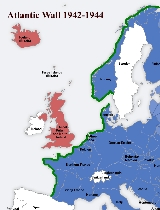
The defensive wall Defensive wall

A defensive wall is a fortification [i] used to defend a city from potential aggressors. ... 

 was never completed; consisting primarily of batteries, bunker Bunker

A bunker is a defensive military fortification.... 

s, and minefields Land mine

A land mine is a type of self-contained explosive [i] device which is placed onto or into the ground, ex ... 

, which during 1942-1944 stretched from the French France

France, officially the French Republic, is a country [i] whose metropolitan territory [i] ... 

-Spanish Spain

Spain, officially the Kingdom of Spain , is a Europe [i]an parliamentary monarchy [i].... 

 border into Norway Norway

Insert non-formatted text here
... 

. A number of the bunker Bunker

A bunker is a defensive military fortification.... 

s are still present, for example near Scheveningen Scheveningen

[i]
[i]
... 

, The Hague The Hague

The Hague is the third-largest city in the Netherlands [i] after Amsterdam [i] and Rotterdam [i] ... 

, and in Normandy Normandy

Normandy is a geographical region in northern France [i]. ... 

. After WWII some bunkers sank into the sand and there were noneffective efforts by governments to blow up these bunkers.

The Channel Islands Channel Islands

The Channel Islands are a group of British-dependent [i] island [i]s off the coast of Normandy [i] ... 

 were heavily fortified, particularly the island of Alderney Alderney

Alderney is the most northerly of the Channel Islands [i] and a British crown dependency [i]. ... 

 which is the closest to France. Hitler had decreed that 10% of the steel and concrete used in the Atlantic Wall go to the Channel Islands, because of the propaganda value of controlling British territory. Despite the mooting of Operation Constellation et al, the Allies bypassed the islands for this reason and did not try to liberate them when they liberated Normandy. The islands' German garrisons did not surrender until 9 May 1945 - one day after the rest of the German armed forces. The German garrison on Alderney did not surrender until the 16 May.

External links