


Astrological aspect

Encyclopedia
In astrology
, an aspect is an angle
the planets
make to each other in the horoscope
, and also to the ascendant
, midheaven
, descendant
, lower midheaven
, and other points of astrological interest. Aspects are measured by the angular distance in degrees and minutes of ecliptic longitude
between two points, as viewed from Earth. According to astrological tradition, they indicate the timing of transitions and developmental changes in the lives of people and affairs relative to the Earth.
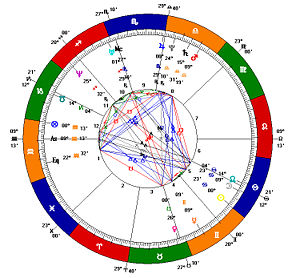
As an example, if an astrologer
creates a horoscope
that shows the apparent positions of the celestial bodies at the time of a person's birth (a natal chart
), and the angular distance between Mars and Venus is 92° of arc, the chart is said to have the aspect "Venus square Mars" with an orb
of 2° (i.e., it is 2° away from being an exact square; a square is a 90° aspect). The more exact that an aspect is, the stronger or more dominant it is said to be in shaping character or manifesting change.
s, were considered to be either favorable (benefic
) or unfavorable (malefic
). Modern usage places less emphasis on these fatalistic distinctions.
The more recent approach to astrological aspects places more emphasis on psychology and tendencies.
The German
schools of Uranian astrology
and its derivative Cosmobiology
have attempted to take a different approach to the aspects, largely divorced from the traditional use of signs
and houses. In the process, they have come to some conclusions that are different from traditional astrology about the power and effect of the various types of aspects. Among the Uranian astrologers, the term 'aspect' is even sometimes avoided, to separate their observations from the traditional views of astrology. The introduction by Cosmobiology of manifold planetary midpoints, mainly through the publication Reinhold Ebertin's
The Combination of Stellar Influences
, has gained wide acceptance among astrologers, but the "formula" points of Uranian/Hamburg Astrology has earned less acceptance.
The writings of Françoise and Michel Gauquelin
on the significance of planetary configurations in the astrological chart suggested that the semisquare and sesquiquadrate, which are traditionally considered as "minor" aspects, might in fact be relatively "major".
A list of aspects below presents their angular values and a recommended orb for each aspect. The orbs are subject to variation, depending on the need for detail and personal preferences.
in the 1st Century, AD. These aspects are the conjunction (approx. 0-10°), sextile (60°), square (90°), trine (120°), and opposition (180°). It is important to note that different astrologers and separate astrological systems/traditional utilize differing orbs (the degree of separation between exactitude) when calculating and using the aspects, though almost all use a larger orb for a conjunction when compared to the other aspects. The major aspects are those that can be used to divide 360 evenly and are divisible by 10 (with the exception of the semi-sextile).
 A conjunction (abrv. Con) is an angle of approximately 0-10°. An orb
of approximately 10° is usually considered a conjunction, however if neither the Sun or Moon is involved, some consider the conjunction to be a separation (orb) of only about 0±08°. This is said to be the most powerful aspect, intensifying the effects of the involved planets mutually — and being a major point in the chart.
 A sextile
(abrv. SXt or Sex) is an angle of 60° (1/6 of the 360° ecliptic
, or 1/2 of a trine [120°]). A separation (orb) of 60±04° is considered a sextile. The sextile has been traditionally said to be similar in influence to the trine, but of less significance. It indicates ease of communication between the two elements involved, with compatibility and harmony between them, but only provides opportunity, requiring effort to gain its benefits. See information on the semisextile below.
According to Sue Tompkins: http://www.astroknowlogy.com/questions/what-is-a-sextile-in-astrology
 A square (abrv. SQr or Squ) is an angle of 90° (1/4 of the 360° ecliptic, or 1/2 of an opposition [180°]). An orb
of somewhere between 5° and 10° is usually allowed. As with the trine and the sextile, in the square, it is usually the outer or superior planet that has an effect on the inner or inferior
one. Basically, the square's energy is similar to that of a trine but it is intensified to such an extent that the energy is said to be stressful. For example, Mercury
square Saturn
indicates practicality and prudence with thoughts and communication, concentrating on practical matters. It is also indicative of caution in planning and other mental tasks. However, the square between those planets indicates mental restraint, excessive censoring of communication and overemphasis on trivial details. It also indicates pessimism and a stilted and fearful approach to life. The square is said to indicate strain, tension, frustration, inhibitions, disruption and inner conflict. However, it can become a source of energy and activation to a person determined to overcome limitations, presenting challenges to achievement and an opportunity to develop strength of character. See the information on the semisquare and sesquiquadrate below. The square is also sometimes known as the quartile.
 A trine (abrv. Tri) is an angle of 120° (1/3 of the 360° ecliptic). A separation (orb) of 120±04° is considered a trine. The trine indicates harmony, and ease of expression, with the two elements reinforcing each other. The trine is a source of artistic and creative talent, which is innate. The nature of the trine is that of the fire signs (Aries to Leo and or Aries to Sagittarius) and is thus inspirational. The trine has been traditionally assumed to be extremely beneficial, providing ease even if undeserved, but it can be a 'line of least resistance' to a person of weak character. Too many trines are said to make a person weak and unable to cope with adversity.
 An opposition (abrv. Opp) is an angle of 180° (1/2 of the 360° ecliptic). An orb
of somewhere between 5° and 10° is usually allowed. Oppositions are said to be the second most powerful aspect. It resembles the conjunction although the difference between them is that the opposition causes exaggeration as it is not unifying like the conjunction but instead exalted. So the fact that the opposition creates a dynamic and exalted energy between the planets involved isn't as clearly negative as for instance the square, but it can be indicative of tension, conflict or confrontation, due to the polarity between the two signs involved if not channeled constructively. If channeled constructively however the individual may use it as a creative and energetic power source. The Sun and Moon are in opposition monthly during the full moon
.
/astrologer
Johannes Kepler
in the 16th Century AD, were long considered to be of relatively secondary importance, although many modern astrologers are not in agreement with this. These included the quincunx (150°), semisquare (45°), sesquiquadrate (135°), semisextile (30°), quintile (72°), and biquintile (144°).
More progressive research-oriented schools like Cosmobiology
or Uranian astrology
(Hamburg School of Astrology
) consider the semisquare and sesquiquadrate to be relatively "major" aspects while the traditional sextile (60°) and trine (120°) are thought to be relatively "minor" in influence — this based on current research rather than historical documents or beliefs. Astrologers using Cosmobiology and Uranian/Hamburg Astrology work with many more minor aspects than were used prior to 1970, i.e. multiples of 15° (15°, 75°, 105°, & 165°) and multiples of 22.5° (22.5°, 67.5°, 112.5°, & 157.5°).
The sextile and quincunx are considered as the 'border' aspects in-between major and minor ones. Most of the astrologers consider the sextile (60°) as major aspect, while quite a noticeable group uses the quincunx aspect (150°) as major, only a very small minority considers the semi-sextile (30°) as a major aspect. All major aspects, along with these three 'border' aspects, are called the 'Ptolemaic aspect
s'.
 The quincunx
(or inconjunct, abrv. Inc) is an angle of 150°, which is five-twelfths of the 360° ecliptic. A separation of 150±2° is considered a quincunx. The quincunx is said to be of moderate but somewhat unpredictable influence, bringing strain. It indicates difficulty and stress, due to incompatible elements being forced together. It can mean an area of self neglect in a person's life (especially health), or obligations being forced on a person. This aspect is also sometimes called the inconjunct, though this usage is technically incorrect. A quincunx is thought to be one of the most difficult aspects to work with because it will not allow for retreat. There’s no backing down when it comes to this aspect because you can’t just think your way out of it, you have to take action on those thoughts. The quincunx will challenge you to trust your own intuition. Significance of a quincunx aspect
 The semi-square
(abrv. SSq) is an angle of 45° (1/2 of a square [90°]). A separation of 45±2° is considered a semisquare. This aspect is considered a weaker version of the square and indicates somewhat difficult circumstance. It is sometimes known as the octile or semiquartile. A semisquare reveals an area of inflexibility. There may be obstacles keeping one from changing and adapting to new or different situations. The semisquare is teaching persistence and patience. Significance of a semi-square aspect
 The sesquiquadrate (abrv. Ses) is an angle of 135° (a square [90°] + a semisquare [45°]). A separation of 135±2° is considered a sesquiquadrate; it indicates somewhat stressful conditions. it is considered similar in influence to the semisquare. The sesquiquadrate is sometimes called a sesquisquare, square-and-a-half, quartile-and-a-half, and/or trioctile. Unlike the square, which eventually brings solutions through practical experience, the semi-squares and sesquidradrates often point to issues, problems and energies that are irresolvable, and that we must learn to live with and cope with.Meaning of a sesquiquadrate aspect
 The semi-sextile (abrv. SSx) is an angle of 30° (1/2 of a sextile [60°]). A separation of 30±2° is considered a semisextile. It is the basis of all the major aspects aside from the conjunction and the quintile. This aspect signifies a moderate rapport with the involved planets, where they both support the cause of the other but might not have enough of a realistic understanding of that same cause to contribute much. It will be important pragmatic effort be taken to reconcile this issue and create results. Alternate names include confinis and inconjunct.
 The quintile
(abrv. QNt or Qui) is an angle of 72°, i.e. the angle for a regular pentagon
. A separation of 72±2° is considered a quintile. This aspect is considered somewhat similar to a semisextile (moderately beneficial), but effort is not needed to reap its benefits. Indicates talent and vaguely fortunate circumstances. Quintiles have been also linked to great creativity, and, being a 5th harmonic, also to a need for freedom and change. Significance of a quintile aspect
 The biquintile (abrv. BQt or BQn) is an angle of 144° (a quintile [72°] x 2 = 144°). A separation of 144±2° is considered a biquintile. This is considered similar to a quintile.
Most of the work on septiles has been undertaken by John Addey, Charles Harvey, Mike Harding and David Hamblin. In general, septile symbolism is associated with inspiration, visionary experiences, and connection with divinity. “is related to the inflowing of inspiration, of some kind of ‘higher vision’ which comes from perceiving the unity….It is traditionally associated with religious and mystical experience, and with sacrifice to some higher ideal." Influence of Septile Aspect
use only the semioctile and its multiple aspects, including the sesquioctile, quasquiquadrate (112.5°, or 112°30'), and septemsedecimal (157.5°, or 157°30') claiming that they are not "minor."
consider multiples of the quattuorvigintile, including the squile, squine, and quindecile, aspects.
) are two other aspects, which refer to degrees of declination
above or below the ecliptic
. They are considered strong influences, though not much research has gone into studying these particular aspects.
Astrology
Astrology consists of a number of belief systems which hold that there is a relationship between astronomical phenomena and events in the human world...
, an aspect is an angle
Angle
In geometry, an angle is the figure formed by two rays sharing a common endpoint, called the vertex of the angle.Angles are usually presumed to be in a Euclidean plane with the circle taken for standard with regard to direction. In fact, an angle is frequently viewed as a measure of an circular arc...
the planets
Planets in astrology
Planets in astrology have a meaning different from the modern astronomical understanding of what a planet is. Before the age of telescopes, the night sky was thought to consist of two very similar components: fixed stars, which remained motionless in relation to each other, and wandering stars, ,...
make to each other in the horoscope
Horoscope
In astrology, a horoscope is a chart or diagram representing the positions of the Sun, Moon, planets, the astrological aspects, and sensitive angles at the time of an event, such as the moment of a person's birth. The word horoscope is derived from Greek words meaning "a look at the hours" In...
, and also to the ascendant
Ascendant
The ascendant , or rising sign, is the zodiacal sign and degree that was ascending on the eastern horizon at the specific time and location of an event. According to astrological theory, celestial phenomena reflect or determine human activity on the principle of 'as above so below'...
, midheaven
Midheaven
The midheaven is a point of definition in the ecliptic coordinate system. It aims to find the part of the ecliptic that corresponds to the highest point in a celestial object's apparent daily traverse of the visible sky, midway between its ascension on the eastern horizon and descension on the...
, descendant
Descendant (astrology)
In astrology, the descendant is the point directly opposite, or 180 degrees away from the ascendant. The descendant forms the cusp of the seventh house of the horoscope and refers to partners or relationships. The descendant is ruled by the seventh sign of the zodiac, Libra, and its ruler planet,...
, lower midheaven
Imum Coeli
In astrology, the Imum Coeli , IC, is the point in space where the ecliptic crosses the meridian in the north, exactly opposite the Midheaven...
, and other points of astrological interest. Aspects are measured by the angular distance in degrees and minutes of ecliptic longitude
Ecliptic
The ecliptic is the plane of the earth's orbit around the sun. In more accurate terms, it is the intersection of the celestial sphere with the ecliptic plane, which is the geometric plane containing the mean orbit of the Earth around the Sun...
between two points, as viewed from Earth. According to astrological tradition, they indicate the timing of transitions and developmental changes in the lives of people and affairs relative to the Earth.
As an example, if an astrologer
Astrologer
An astrologer practices one or more forms of astrology. Typically an astrologer draws a horoscope for the time of an event, such as a person's birth, and interprets celestial points and their placements at the time of the event to better understand someone, determine the auspiciousness of an...
creates a horoscope
Horoscope
In astrology, a horoscope is a chart or diagram representing the positions of the Sun, Moon, planets, the astrological aspects, and sensitive angles at the time of an event, such as the moment of a person's birth. The word horoscope is derived from Greek words meaning "a look at the hours" In...
that shows the apparent positions of the celestial bodies at the time of a person's birth (a natal chart
Natal chart
In astrology, a natal chart is a stylized map of the universe with the "native" at the center. It is calculated for the exact time and location of the native's birth for the purposes of gaining insight into the native's personality and potential...
), and the angular distance between Mars and Venus is 92° of arc, the chart is said to have the aspect "Venus square Mars" with an orb
Orb (astrology)
In astrology, the orb is how much an angle made by two points differs from the exactness of an aspect. A trine, for instance, is 120 degrees. If two points were 123 degrees apart, they would be said to be in a trine with an orb of 3 degrees...
of 2° (i.e., it is 2° away from being an exact square; a square is a 90° aspect). The more exact that an aspect is, the stronger or more dominant it is said to be in shaping character or manifesting change.
Approach
In medieval astrology, certain aspects, like certain planetPlanet
A planet is a celestial body orbiting a star or stellar remnant that is massive enough to be rounded by its own gravity, is not massive enough to cause thermonuclear fusion, and has cleared its neighbouring region of planetesimals.The term planet is ancient, with ties to history, science,...
s, were considered to be either favorable (benefic
Benefic planet
In astrology, a benefic planet, or simply benefic, is considered to be very positive influence. Traditionally, Jupiter is considered to be the greater benefic, while Venus has been assigned the position of the lesser benefic...
) or unfavorable (malefic
Malefic planet
In astrology, a malefic planet, or simply malefic, is traditionally thought to bring bad luck and misfortune. Mars is considered the lesser malefic, while Saturn is the greater malefic. In modern astrology Uranus, Pluto and for some Ceres are also considered malefic.-See also:*Benefic...
). Modern usage places less emphasis on these fatalistic distinctions.
The more recent approach to astrological aspects places more emphasis on psychology and tendencies.
The German
Germany
Germany , officially the Federal Republic of Germany , is a federal parliamentary republic in Europe. The country consists of 16 states while the capital and largest city is Berlin. Germany covers an area of 357,021 km2 and has a largely temperate seasonal climate...
schools of Uranian astrology
Uranian astrology
Uranian astrology is a relatively recent methodological approach to astrology based on teachings of German surveyor/astrologer Alfred Witte , founder of the Hamburg School of Astrology. Witte revived and further developed the use of mathematical midpoints...
and its derivative Cosmobiology
Cosmobiology
Historically, the term 'Kosmobiologie' was used by the German medical astrologer Friedrich Feerhow and Swiss statistician Karl Krafft in a more general sense "to designate that branch of astrology working on scientific foundations and keyed to the natural sciences"....
have attempted to take a different approach to the aspects, largely divorced from the traditional use of signs
Astrological sign
Astrological signs represent twelve equal segments or divisions of the zodiac. According to astrology, celestial phenomena reflect or govern human activity on the principle of "as above, so below", so that the twelve signs are held to represent twelve basic personality types or characteristic modes...
and houses. In the process, they have come to some conclusions that are different from traditional astrology about the power and effect of the various types of aspects. Among the Uranian astrologers, the term 'aspect' is even sometimes avoided, to separate their observations from the traditional views of astrology. The introduction by Cosmobiology of manifold planetary midpoints, mainly through the publication Reinhold Ebertin's
Reinhold Ebertin
Dr. Reinhold Ebertin was a German physician and astrologer.-Life and work:Ebertin utilized the research on astrological midpoints of Hamburg School surveyor and astrologer Alfred Witte first published in 1928 in Witte's Regelwerk für Planetenbilder. Shortly after Witte's death in 1941, Ebertin...
The Combination of Stellar Influences
The Combination of Stellar Influences
The Combination of Stellar Influences is an astrological reference and research text first published in 1940 by the German astrologer Reinhold Ebertin, derived largely from material in the Rulebook for Planetary Pictures by Alfred Witte which was published in 1932 but was banned by the Third...
, has gained wide acceptance among astrologers, but the "formula" points of Uranian/Hamburg Astrology has earned less acceptance.
The writings of Françoise and Michel Gauquelin
Michel Gauquelin
Michel Gauquelin was a French psychologist and statistician. Along with his first wife Françoise Schneider-Gauquelin , he conducted statistical research in an attempt to develop a scientific basis for astrology.-Early interest:Although he was highly critical of certain areas of the art, Gauquelin...
on the significance of planetary configurations in the astrological chart suggested that the semisquare and sesquiquadrate, which are traditionally considered as "minor" aspects, might in fact be relatively "major".
A list of aspects below presents their angular values and a recommended orb for each aspect. The orbs are subject to variation, depending on the need for detail and personal preferences.
Major aspects
The traditional major aspects are sometimes called Ptolemaic aspects since they were defined and used by PtolemyPtolemy
Claudius Ptolemy , was a Roman citizen of Egypt who wrote in Greek. He was a mathematician, astronomer, geographer, astrologer, and poet of a single epigram in the Greek Anthology. He lived in Egypt under Roman rule, and is believed to have been born in the town of Ptolemais Hermiou in the...
in the 1st Century, AD. These aspects are the conjunction (approx. 0-10°), sextile (60°), square (90°), trine (120°), and opposition (180°). It is important to note that different astrologers and separate astrological systems/traditional utilize differing orbs (the degree of separation between exactitude) when calculating and using the aspects, though almost all use a larger orb for a conjunction when compared to the other aspects. The major aspects are those that can be used to divide 360 evenly and are divisible by 10 (with the exception of the semi-sextile).
Conjunction
- See also Cazimi, Combust
A conjunction (abrv. Con) is an angle of approximately 0-10°. An orbOrb (astrology)
In astrology, the orb is how much an angle made by two points differs from the exactness of an aspect. A trine, for instance, is 120 degrees. If two points were 123 degrees apart, they would be said to be in a trine with an orb of 3 degrees...
of approximately 10° is usually considered a conjunction, however if neither the Sun or Moon is involved, some consider the conjunction to be a separation (orb) of only about 0±08°. This is said to be the most powerful aspect, intensifying the effects of the involved planets mutually — and being a major point in the chart.
Sextile — intermediate major/minor aspect
A sextileSextile
In astrology, a sextile is an astrological aspect that is made when two planets or other celestial bodies are 60 degrees apart. A sextile is considered to be highly benefic, being the sixth harmonic of the 360 degree zodiac...
(abrv. SXt or Sex) is an angle of 60° (1/6 of the 360° ecliptic
Ecliptic
The ecliptic is the plane of the earth's orbit around the sun. In more accurate terms, it is the intersection of the celestial sphere with the ecliptic plane, which is the geometric plane containing the mean orbit of the Earth around the Sun...
, or 1/2 of a trine [120°]). A separation (orb) of 60±04° is considered a sextile. The sextile has been traditionally said to be similar in influence to the trine, but of less significance. It indicates ease of communication between the two elements involved, with compatibility and harmony between them, but only provides opportunity, requiring effort to gain its benefits. See information on the semisextile below.
According to Sue Tompkins: http://www.astroknowlogy.com/questions/what-is-a-sextile-in-astrology
Square
A square (abrv. SQr or Squ) is an angle of 90° (1/4 of the 360° ecliptic, or 1/2 of an opposition [180°]). An orbOrb (astrology)
In astrology, the orb is how much an angle made by two points differs from the exactness of an aspect. A trine, for instance, is 120 degrees. If two points were 123 degrees apart, they would be said to be in a trine with an orb of 3 degrees...
of somewhere between 5° and 10° is usually allowed. As with the trine and the sextile, in the square, it is usually the outer or superior planet that has an effect on the inner or inferior
Inferior
Inferior means of lower station, rank, degree, or grade . It may also refer to:* Inferiority complex* An anatomical term of location* Inferior angle of the scapula, in the human skeleton...
one. Basically, the square's energy is similar to that of a trine but it is intensified to such an extent that the energy is said to be stressful. For example, Mercury
Mercury (planet)
Mercury is the innermost and smallest planet in the Solar System, orbiting the Sun once every 87.969 Earth days. The orbit of Mercury has the highest eccentricity of all the Solar System planets, and it has the smallest axial tilt. It completes three rotations about its axis for every two orbits...
square Saturn
Saturn
Saturn is the sixth planet from the Sun and the second largest planet in the Solar System, after Jupiter. Saturn is named after the Roman god Saturn, equated to the Greek Cronus , the Babylonian Ninurta and the Hindu Shani. Saturn's astronomical symbol represents the Roman god's sickle.Saturn,...
indicates practicality and prudence with thoughts and communication, concentrating on practical matters. It is also indicative of caution in planning and other mental tasks. However, the square between those planets indicates mental restraint, excessive censoring of communication and overemphasis on trivial details. It also indicates pessimism and a stilted and fearful approach to life. The square is said to indicate strain, tension, frustration, inhibitions, disruption and inner conflict. However, it can become a source of energy and activation to a person determined to overcome limitations, presenting challenges to achievement and an opportunity to develop strength of character. See the information on the semisquare and sesquiquadrate below. The square is also sometimes known as the quartile.
Trine
A trine (abrv. Tri) is an angle of 120° (1/3 of the 360° ecliptic). A separation (orb) of 120±04° is considered a trine. The trine indicates harmony, and ease of expression, with the two elements reinforcing each other. The trine is a source of artistic and creative talent, which is innate. The nature of the trine is that of the fire signs (Aries to Leo and or Aries to Sagittarius) and is thus inspirational. The trine has been traditionally assumed to be extremely beneficial, providing ease even if undeserved, but it can be a 'line of least resistance' to a person of weak character. Too many trines are said to make a person weak and unable to cope with adversity.Opposition
An opposition (abrv. Opp) is an angle of 180° (1/2 of the 360° ecliptic). An orbOrb (astrology)
In astrology, the orb is how much an angle made by two points differs from the exactness of an aspect. A trine, for instance, is 120 degrees. If two points were 123 degrees apart, they would be said to be in a trine with an orb of 3 degrees...
of somewhere between 5° and 10° is usually allowed. Oppositions are said to be the second most powerful aspect. It resembles the conjunction although the difference between them is that the opposition causes exaggeration as it is not unifying like the conjunction but instead exalted. So the fact that the opposition creates a dynamic and exalted energy between the planets involved isn't as clearly negative as for instance the square, but it can be indicative of tension, conflict or confrontation, due to the polarity between the two signs involved if not channeled constructively. If channeled constructively however the individual may use it as a creative and energetic power source. The Sun and Moon are in opposition monthly during the full moon
Full moon
Full moon lunar phase that occurs when the Moon is on the opposite side of the Earth from the Sun. More precisely, a full moon occurs when the geocentric apparent longitudes of the Sun and Moon differ by 180 degrees; the Moon is then in opposition with the Sun.Lunar eclipses can only occur at...
.
Minor aspects
The traditional minor aspects, introduced by the famed astronomerAstronomer
An astronomer is a scientist who studies celestial bodies such as planets, stars and galaxies.Historically, astronomy was more concerned with the classification and description of phenomena in the sky, while astrophysics attempted to explain these phenomena and the differences between them using...
/astrologer
Astrologer
An astrologer practices one or more forms of astrology. Typically an astrologer draws a horoscope for the time of an event, such as a person's birth, and interprets celestial points and their placements at the time of the event to better understand someone, determine the auspiciousness of an...
Johannes Kepler
Johannes Kepler
Johannes Kepler was a German mathematician, astronomer and astrologer. A key figure in the 17th century scientific revolution, he is best known for his eponymous laws of planetary motion, codified by later astronomers, based on his works Astronomia nova, Harmonices Mundi, and Epitome of Copernican...
in the 16th Century AD, were long considered to be of relatively secondary importance, although many modern astrologers are not in agreement with this. These included the quincunx (150°), semisquare (45°), sesquiquadrate (135°), semisextile (30°), quintile (72°), and biquintile (144°).
More progressive research-oriented schools like Cosmobiology
Cosmobiology
Historically, the term 'Kosmobiologie' was used by the German medical astrologer Friedrich Feerhow and Swiss statistician Karl Krafft in a more general sense "to designate that branch of astrology working on scientific foundations and keyed to the natural sciences"....
or Uranian astrology
Uranian astrology
Uranian astrology is a relatively recent methodological approach to astrology based on teachings of German surveyor/astrologer Alfred Witte , founder of the Hamburg School of Astrology. Witte revived and further developed the use of mathematical midpoints...
(Hamburg School of Astrology
Hamburg School of Astrology
The Hamburg School of Astrology originated in Hamburg, Germany, and revolved around the research and teachings of surveyor/astrologer/amateur astronomer Alfred Witte. The term Hamburg School of Astrology originated in 1923 at the Second German Astrological Congress in Leipzig, Germany, where the...
) consider the semisquare and sesquiquadrate to be relatively "major" aspects while the traditional sextile (60°) and trine (120°) are thought to be relatively "minor" in influence — this based on current research rather than historical documents or beliefs. Astrologers using Cosmobiology and Uranian/Hamburg Astrology work with many more minor aspects than were used prior to 1970, i.e. multiples of 15° (15°, 75°, 105°, & 165°) and multiples of 22.5° (22.5°, 67.5°, 112.5°, & 157.5°).
The sextile and quincunx are considered as the 'border' aspects in-between major and minor ones. Most of the astrologers consider the sextile (60°) as major aspect, while quite a noticeable group uses the quincunx aspect (150°) as major, only a very small minority considers the semi-sextile (30°) as a major aspect. All major aspects, along with these three 'border' aspects, are called the 'Ptolemaic aspect
Ptolemy
Claudius Ptolemy , was a Roman citizen of Egypt who wrote in Greek. He was a mathematician, astronomer, geographer, astrologer, and poet of a single epigram in the Greek Anthology. He lived in Egypt under Roman rule, and is believed to have been born in the town of Ptolemais Hermiou in the...
s'.
Quincunx — intermediate major/minor aspect
The quincunxQuincunx
A quincunx is a geometric pattern consisting of five points arranged in a cross, that is five coplanar points, four of them forming a square or rectangle and a fifth at its center...
(or inconjunct, abrv. Inc) is an angle of 150°, which is five-twelfths of the 360° ecliptic. A separation of 150±2° is considered a quincunx. The quincunx is said to be of moderate but somewhat unpredictable influence, bringing strain. It indicates difficulty and stress, due to incompatible elements being forced together. It can mean an area of self neglect in a person's life (especially health), or obligations being forced on a person. This aspect is also sometimes called the inconjunct, though this usage is technically incorrect. A quincunx is thought to be one of the most difficult aspects to work with because it will not allow for retreat. There’s no backing down when it comes to this aspect because you can’t just think your way out of it, you have to take action on those thoughts. The quincunx will challenge you to trust your own intuition. Significance of a quincunx aspect
Semi-square
The semi-squareSemi-square
In astrology, a semi-square is an astrological aspect that two planets make when they are 45° apart from each other. The semi-square is considered to be the 8th harmonic of the chart because it is one-eighth of the 360° circle that the zodiac resides in...
(abrv. SSq) is an angle of 45° (1/2 of a square [90°]). A separation of 45±2° is considered a semisquare. This aspect is considered a weaker version of the square and indicates somewhat difficult circumstance. It is sometimes known as the octile or semiquartile. A semisquare reveals an area of inflexibility. There may be obstacles keeping one from changing and adapting to new or different situations. The semisquare is teaching persistence and patience. Significance of a semi-square aspect
Sesquiquadrate
The sesquiquadrate (abrv. Ses) is an angle of 135° (a square [90°] + a semisquare [45°]). A separation of 135±2° is considered a sesquiquadrate; it indicates somewhat stressful conditions. it is considered similar in influence to the semisquare. The sesquiquadrate is sometimes called a sesquisquare, square-and-a-half, quartile-and-a-half, and/or trioctile. Unlike the square, which eventually brings solutions through practical experience, the semi-squares and sesquidradrates often point to issues, problems and energies that are irresolvable, and that we must learn to live with and cope with.Meaning of a sesquiquadrate aspectSemi-sextile
The semi-sextile (abrv. SSx) is an angle of 30° (1/2 of a sextile [60°]). A separation of 30±2° is considered a semisextile. It is the basis of all the major aspects aside from the conjunction and the quintile. This aspect signifies a moderate rapport with the involved planets, where they both support the cause of the other but might not have enough of a realistic understanding of that same cause to contribute much. It will be important pragmatic effort be taken to reconcile this issue and create results. Alternate names include confinis and inconjunct.Quintile
The quintileQuintile
Quintile may refer to:*Income quintiles, a division of households by income into five quantiles*Quintiles, a biotechnology research company based in the United States...
(abrv. QNt or Qui) is an angle of 72°, i.e. the angle for a regular pentagon
Pentagon
In geometry, a pentagon is any five-sided polygon. A pentagon may be simple or self-intersecting. The sum of the internal angles in a simple pentagon is 540°. A pentagram is an example of a self-intersecting pentagon.- Regular pentagons :In a regular pentagon, all sides are equal in length and...
. A separation of 72±2° is considered a quintile. This aspect is considered somewhat similar to a semisextile (moderately beneficial), but effort is not needed to reap its benefits. Indicates talent and vaguely fortunate circumstances. Quintiles have been also linked to great creativity, and, being a 5th harmonic, also to a need for freedom and change. Significance of a quintile aspect
Biquintile
The biquintile (abrv. BQt or BQn) is an angle of 144° (a quintile [72°] x 2 = 144°). A separation of 144±2° is considered a biquintile. This is considered similar to a quintile.7th-harmonic aspects
These aspects are based on the division of the circle of the zodiac by seven.Septile
The septile (abrv. Sep) is an angle of 51.428571°, or approximately 51°25'43", one-seventh of the circle of the zodiac. It is supposed to be aspected to have irrational relations between its constituent components but confer the hidden underlying nature and deeper destiny of them http://www.astrologyweekly.com/astrological-aspects/septile-7th-harmonic.php.Most of the work on septiles has been undertaken by John Addey, Charles Harvey, Mike Harding and David Hamblin. In general, septile symbolism is associated with inspiration, visionary experiences, and connection with divinity. “is related to the inflowing of inspiration, of some kind of ‘higher vision’ which comes from perceiving the unity….It is traditionally associated with religious and mystical experience, and with sacrifice to some higher ideal." Influence of Septile Aspect
Biseptile
The biseptile (abrv. BSp) is an angle of 102.857143°, or approximately 102°51'26", 2/7 of the zodiac circle. This aspect is considered the externalized septile.Triseptile
The triseptile (abrv. TSp) is an angle of 154.285714°, or approximately 154°17'09", 3/7 of the zodiac circle.9th-harmonic aspects
These aspects are based on the division of the circle of the zodiac by nine.Novile
The novile (abrv. Nov), also known as a nonagon, is an angle of 40°, one-ninth of the circle of the zodiac. The novile is said to represent a constriction between the aspects that can be unlocked and used as a catalyst to self-enhancement.Quadnovile
The quadnovile (abrv. QNv), also known as a quadrinovile, is an angle of 160°.10th-harmonic aspects
These aspects are based on the division of the circle of the zodiac by ten and are related to the 5th-harmonic aspects (the quintile and biquintile).Decile
The decile (abrv. Dec, symbol ⊥), also known as a semi-quintile, is an angle of 36°, one-tenth of the circle of the zodiac. This aspect is said to impart ability to help others http://www.zanestein.com/AstrologyFAQs.html. The energy of the deciles is such that it conveys order and structure. Mental ingenuity is at work here. Deciles are power and career indicators. They often bring strong technical insights and abilities. Deciles indicate special gifts that may be wasted or unappreciated. Self-improvement is needed to capitalize on this power. Significance of a decile aspectTridecile
The tridecile, or sesquiquintile, is an angle of 108°, which is supposed to confer a social creativity or the need for withdrawal and introspection needed for external originality. This aspect is also known as the quintile-and-a-half.Vigintile
The vigintile (abrv. Vig, symbol ∧), or semi-decile, is an angle of 18°, one-twentieth of the circle of the zodiac, or half a decile.11th-harmonic aspects
These aspects are based on the division of the circle of the zodiac by eleven.Undecile
The undecile (abrv. Und), also known as the undecim, is one-eleventh of the zodiac circle or an angle of 32.727272° (32°43'38"); in addition there are the biundecile (aka biundecim, 65.454545°, or 65°27'16"), the triundecile (aka triundecim, 98.181816°, or 98°10'55"), the quadriundecile (aka quadriundecima, 130.90909°, or 130°54'33") and the quinqueundecile (aka quinqueundecim, 163.636363°, or 163°38'11"), representing, respectively, two-elevenths, three-elevenths, four-elevenths, and five-elevenths of the zodiac circle. The undecile is said to be associated with social consciousness and the ability to reach beyond oneself for help.14th-harmonic aspects
These aspects are based on the division of the zodiac by fourteen and are related to the 7th-harmonic aspects (septile, biseptile and triseptile). They are said to have a sense of empowerment about them arising from the correct use of structure.Semiseptile
The semiseptile (which has also been called quattuordecimal, from the Latin word for fourteen, quattuordecim) is an angle of 25.714286° (or, in degree-minute-second format, 25°42'51"), one-fourteenth of the circle of the zodiac, or half a septile. It is said to have to do with giving up what one has completed in order to move on to the next cycle of activity.Tresemiseptile
The tresemiseptile, also known as the sesquiseptile, is an angle of 77.142858° (77°08'34"), three-fourteenths of the circle of the zodiac.Quinsemiseptile
The quinsemiseptile is an angle of 128.57143° (128°34'17"), , five-fourteenths of the circle of the zodiac.16th-harmonic aspects
These aspects are based on the division of the circle of the zodiac by sixteen and are related to the 8th-harmonic aspects (semisquare and sesquiquadrate). All are considered "hard" or "stress" aspects. Many Uranian astrologersUranian astrology
Uranian astrology is a relatively recent methodological approach to astrology based on teachings of German surveyor/astrologer Alfred Witte , founder of the Hamburg School of Astrology. Witte revived and further developed the use of mathematical midpoints...
use only the semioctile and its multiple aspects, including the sesquioctile, quasquiquadrate (112.5°, or 112°30'), and septemsedecimal (157.5°, or 157°30') claiming that they are not "minor."
Semioctile
The semioctile is an angle of 22.5° (22°30'), one-sixteenth of the circle of the zodiac.Sesquioctile
The sesquioctile is an angle of 67.5° (67°30'), or three-sixteenths of the zodiac circle, or a semisquare (octile) and a half.24th-harmonic aspects
These aspects are based on the division of the circle of the zodiac by twenty-four. Some Hamburg School astrologersHamburg School of Astrology
The Hamburg School of Astrology originated in Hamburg, Germany, and revolved around the research and teachings of surveyor/astrologer/amateur astronomer Alfred Witte. The term Hamburg School of Astrology originated in 1923 at the Second German Astrological Congress in Leipzig, Germany, where the...
consider multiples of the quattuorvigintile, including the squile, squine, and quindecile, aspects.
Squile
The squile is an angle of 75°, 5/24 of the zodiac circle or 2.5 signs, considered a hybrid between a square and a sextile. Kepler described as causing malice, treachery, passion or grief; relentless pursuit, potent personal influence.Astrological influence of squileSquine
The squine is an angle of 105°, 7/24 of the zodiac circle, considered a hybrid between a square and a trine.Quindecile
The quindecile (also known as the johndro or contraquindecile) is an angle of 165°. It is supposed to be associated with an unrelenting headstrong determination, with disruption and upheaval. Tyl’s usage of the 165 degree aspect reflects earlier work of Lorne Edward Johndro. At www.astrologycom.com, one finds the name “Johndro” to describe the 165 degree aspect, and it is also used in the Intrepid astrology software program, with the glyph (symbol) “J”. According to Noel Tyl, the quindecile, with rulership routings to be respected as well, suggests a burning point of focus, often a place of extreme concern and effort in the life, even to the point of upheaval, disruption, and obsessive mania. Quindecile AspectDeclinations
The parallel and antiparallel (or contraparallelContraparallel
In astrology, a contraparallel occurs when two planets or celestial bodies occupy the same degree, within 1 degree of orb, but the opposite declination. One planet will occupy a position north of the celestial equator and the other will occupy the same degree south of the celestial equator...
) are two other aspects, which refer to degrees of declination
Declination
In astronomy, declination is one of the two coordinates of the equatorial coordinate system, the other being either right ascension or hour angle. Declination in astronomy is comparable to geographic latitude, but projected onto the celestial sphere. Declination is measured in degrees north and...
above or below the ecliptic
Ecliptic
The ecliptic is the plane of the earth's orbit around the sun. In more accurate terms, it is the intersection of the celestial sphere with the ecliptic plane, which is the geometric plane containing the mean orbit of the Earth around the Sun...
. They are considered strong influences, though not much research has gone into studying these particular aspects.
- Parallel: same degree± 1-degree 12-minutes of arc. This is similar to a conjunction, but usually provides benefits.
- Contraparallel: opposite degree± 1-degree 12-minute of arc. Said to be similar to the opposition, but weaker.
See also
- Hard aspect (astrology)
- Soft aspect (astrology)
- Applying aspect (astrology)
- Conjunction
- Opposition
- CosmobiologyCosmobiologyHistorically, the term 'Kosmobiologie' was used by the German medical astrologer Friedrich Feerhow and Swiss statistician Karl Krafft in a more general sense "to designate that branch of astrology working on scientific foundations and keyed to the natural sciences"....
- Hamburg School of AstrologyHamburg School of AstrologyThe Hamburg School of Astrology originated in Hamburg, Germany, and revolved around the research and teachings of surveyor/astrologer/amateur astronomer Alfred Witte. The term Hamburg School of Astrology originated in 1923 at the Second German Astrological Congress in Leipzig, Germany, where the...
- Uranian astrologyUranian astrologyUranian astrology is a relatively recent methodological approach to astrology based on teachings of German surveyor/astrologer Alfred Witte , founder of the Hamburg School of Astrology. Witte revived and further developed the use of mathematical midpoints...
External links
- An articles on the use of the aspects
- Online Ephemeris from Khaldea.com -- 600BC to 2400AD—Calculated for MidnightMidnightMidnight is the transition time period from one day to the next: the moment when the date changes. In the Roman time system, midnight was halfway between sunset and sunrise, varying according to the seasons....
GMT; also with an Aspectarian included for years 1900 to 2005