


Asiento

Encyclopedia
The Asiento in the history of slavery
Slavery
Slavery is a system under which people are treated as property to be bought and sold, and are forced to work. Slaves can be held against their will from the time of their capture, purchase or birth, and deprived of the right to leave, to refuse to work, or to demand compensation...
refers to the permission given by the Spanish government
Spain
Spain , officially the Kingdom of Spain languages]] under the European Charter for Regional or Minority Languages. In each of these, Spain's official name is as follows:;;;;;;), is a country and member state of the European Union located in southwestern Europe on the Iberian Peninsula...
to other countries to sell people as slaves to the Spanish colonies, between the years 1543 and 1834. In British history, it usually refers to the contract between Spain and Great Britain created in 1713 that dealt with the supply of African slaves for the Spanish territories in the Americas. The British government passed its rights to the South Sea Company.
Meaning
The general meaning of asiento (from the Spanish verb sentar, to sit, and this from Latin sedere) in Spanish is "seat" or "settlement, establishment"; in a commercial context it means "contract, trading agreement." In the words of Georges ScelleGeorges Scelle
Georges Scelle was an international jurist and member of the United Nations International Law Commission....
, it is "a term in Spanish public law which designates every contract made for the purpose of public utility…between the Spanish government and private individuals." In Habsburg Spain
Habsburg Spain
Habsburg Spain refers to the history of Spain over the 16th and 17th centuries , when Spain was ruled by the major branch of the Habsburg dynasty...
, asientoes were a basic method of financing state expenditures: "Borrowing took two forms – long-term debt in the form of perpetual bonds (juros), and short-term loan contracts provided by bankers (asientos). Many asientoes were eventually converted or refinanced through juros."
Through an asiento, a trade relationship was established whereby a set of traders was given a monopoly
Monopoly
A monopoly exists when a specific person or enterprise is the only supplier of a particular commodity...
over that route and/or product. In this case, it refers specifically to a monopoly over the trade of slaves between Africa and the Americas. According to the Encyclopædia Britannica
Encyclopædia Britannica
The Encyclopædia Britannica , published by Encyclopædia Britannica, Inc., is a general knowledge English-language encyclopaedia that is available in print, as a DVD, and on the Internet. It is written and continuously updated by about 100 full-time editors and more than 4,000 expert...
, this asiento existed between the early 16th and mid 18th century.
Early trading
Initially, Portugal dominated the slave trade. Before the onset of the official asiento in 1595, the Spanish fiscal authorities gave individual asientoes to merchants, primarily from Portugal, to bring slaves to the Americas. For the 1560s most of these slaves were obtained in the Upper Guinea regions, especially in the Sierra Leone region where there were many wars associated with the Mane invasions. However, following the establishment of the Portuguese colony of AngolaAngola
Angola, officially the Republic of Angola , is a country in south-central Africa bordered by Namibia on the south, the Democratic Republic of the Congo on the north, and Zambia on the east; its west coast is on the Atlantic Ocean with Luanda as its capital city...
in 1575, and the gradual replacement of São Tome
São Tomé
-Transport:São Tomé is served by São Tomé International Airport with regular flights to Europe and other African Countries.-Climate:São Tomé features a tropical wet and dry climate with a relatively lengthy wet season and a short dry season. The wet season runs from October through May while the...
by Brazil
Brazil
Brazil , officially the Federative Republic of Brazil , is the largest country in South America. It is the world's fifth largest country, both by geographical area and by population with over 192 million people...
as the primary producers of sugar, Angolan interests came to dominate the trade, and it was Portuguese financiers and merchants who obtained the larger scale, comprehensive asiento that was established in 1595. Angolan dominance of the trade was pronounced after 1615 when the governors of Angola, starting with Bento Banha Cardoso, made alliance with Imbangala
Imbangala
The Imbangala or Mbangala were 17th century groups of Angolan warriors and marauders who founded the kingdom of Kasanje.-Origins of the Imbangala:...
mercenaries to wreak havoc on the local African powers. Many of these governors also held the contract of Angola as well as the asiento, thus insuring their interests. Shipping registers from Vera Cruz
Veracruz, Veracruz
Veracruz, officially known as Heroica Veracruz, is a major port city and municipality on the Gulf of Mexico in the Mexican state of Veracruz. The city is located in the central part of the state. It is located along Federal Highway 140 from the state capital Xalapa, and is the state's most...
and Cartagena
Cartagena, Colombia
Cartagena de Indias , is a large Caribbean beach resort city on the northern coast of Colombia in the Caribbean Coast Region and capital of Bolívar Department...
show that as many as 85% of the slaves arriving in Spanish ports were from Angola, brought by Portuguese ships. The earlier asiento period came to an end in 1640 when Portugal revolted
Portuguese Restoration War
Portuguese Restoration War was the name given by nineteenth-century 'romantic' historians to the war between Portugal and Spain that began with the Portuguese revolution of 1640 and ended with the Treaty of Lisbon . The revolution of 1640 ended the sixty-year period of dual monarchy in Portugal...
against Spain, though even then the Portuguese continued to supply Spanish colonies. In the 1650s Spain sought to enter the slave trade directly, sending ships to Angola to purchase slaves and toying with the idea of a military alliance with Kongo
Kingdom of Kongo
The Kingdom of Kongo was an African kingdom located in west central Africa in what are now northern Angola, Cabinda, the Republic of the Congo, and the western portion of the Democratic Republic of the Congo...
, the powerful African kingdom north of Angola. But these ideas were abandoned and the Spanish returned to Portuguese and then Dutch interests to supply slaves. Later in history, Britain and Holland dominated the slave trade. The slaves were sent mostly to the New World colonies
European colonization of the Americas
The start of the European colonization of the Americas is typically dated to 1492. The first Europeans to reach the Americas were the Vikings during the 11th century, who established several colonies in Greenland and one short-lived settlement in present day Newfoundland...
.
The best captains paid careful attention to the feeding of their slaves - primarily cornmeal mush, seasoned with peppers. In 1688 Aphra Behn
Aphra Behn
Aphra Behn was a prolific dramatist of the English Restoration and was one of the first English professional female writers. Her writing contributed to the amatory fiction genre of British literature.-Early life:...
published Oroonoko, one of the first pieces of antislavery literature.
South Sea Company
At the conclusion of the War of the Spanish SuccessionWar of the Spanish Succession
The War of the Spanish Succession was fought among several European powers, including a divided Spain, over the possible unification of the Kingdoms of Spain and France under one Bourbon monarch. As France and Spain were among the most powerful states of Europe, such a unification would have...
, the Treaty of Utrecht gave to Great Britain
Kingdom of Great Britain
The former Kingdom of Great Britain, sometimes described as the 'United Kingdom of Great Britain', That the Two Kingdoms of Scotland and England, shall upon the 1st May next ensuing the date hereof, and forever after, be United into One Kingdom by the Name of GREAT BRITAIN. was a sovereign...
a thirty-year asiento or contract, to furnish (supply) an unlimited number of slaves to the Spanish colonies and 500 tons of goods per year. This provided British traders and smugglers with potential inroads into the traditionally closed Spanish markets in America. Disputes connected with it led to the War of Jenkins' Ear
War of Jenkins' Ear
The War of Jenkins' Ear was a conflict between Great Britain and Spain that lasted from 1739 to 1748, with major operations largely ended by 1742. Its unusual name, coined by Thomas Carlyle in 1858, relates to Robert Jenkins, captain of a British merchant ship, who exhibited his severed ear in...
(1739).
Similar patents in the English system were the Virginia Company
Virginia Company
The Virginia Company refers collectively to a pair of English joint stock companies chartered by James I on 10 April1606 with the purposes of establishing settlements on the coast of North America...
, the Levant Company
Levant Company
The Levant Company, or Turkey Company, was an English chartered company formed in 1581, to regulate English trade with Turkey and the Levant...
and the Merchant Adventurers' patent of trade with the United Provinces (essentially concurrent with the modern day Netherlands). A detailed and well written overview of the English system is given by Robert Brenner
Robert Brenner
Robert P. Brenner is a professor of history and director of the Center for Social Theory and Comparative History at UCLA, editor of the socialist journal Against the Current, and editorial committee member of New Left Review...
in "Merchants and Revolution".
Holders of the Asiento
- 1595-1615 - Pedro Gomes Reinel.
- 1602-1610 - João Rodrigues Coutinho, succeeded by Gonçalo Vaz Coutinho.
- November 5, 1611 - Juan Alfonso de Molina Cano for António Fernandes de Elvas.
- January 24, 1615 - Melchor Maldonado.
- 1615-1621 - António Fernandes de Elvas.
- February 2, 1622 - Gaspar de Monteser for António Fernandes de Elvas.
- 1623-1625 - Miguel Rodrigues Lamego.
- 1631-1640? - Melchor Gómez Angel and Cristóvão Mendes de Sousa.
- July 5, 1662-1669 Domingo Grillo and Ambrosio Lomelín will ship 24,000 slaves in seven years, assisted by the Dutch West India Company from CuraçaoCuraçaoCuraçao is an island in the southern Caribbean Sea, off the Venezuelan coast. The Country of Curaçao , which includes the main island plus the small, uninhabited island of Klein Curaçao , is a constituent country of the Kingdom of the Netherlands...
and the Royal African CompanyRoyal African CompanyThe Royal African Company was a slaving company set up by the Stuart family and London merchants once the former retook the English throne in the English Restoration of 1660...
from Jamaica.- The asiento is ended because of mistrust.
- King Charles II of EnglandCharles II of EnglandCharles II was monarch of the three kingdoms of England, Scotland, and Ireland.Charles II's father, King Charles I, was executed at Whitehall on 30 January 1649, at the climax of the English Civil War...
tries to lay hands on the asiento.
- 1670-1675 António Garcia, a Portuguese (and Sebastian de Síliceo his guarantee).
- 1676-1679 Manuel Hierro de Castro, and Manuel José Cortizos, members of the Consulado de Sevilla. It is not longer accepted by the Spanish to buy slaves on Curaçao.
- [Señor. El Maestro Fray Juan de Castro, Religioso de la Orden de Santo Domingo, dize : Que por el año de 1678 hollandose en la Ciudad de Cádiz, le solicitaron D. Baltasar Coymans, y Pedro Bambelle de Nacion Olandeses, para la disposicion de un Asiento, que se auia de hazer para comerciar à Indias, haziendole grandes ofertas…y auian de ser Españoles los que le auian de hazer ; y reconociendo…que se trataua de adulterarel comercio…]"
- 1680 Juan Barroso del Pozo, a former assistant Coymans (?) and Nicolas Porcio, his Venetian son-in-law, became asentistas.
- 1682-1688 Juan Barroso del Pozo (-1683) and Nicolás Porcio succeeded in getting the asiento for 6.5 years. It was probably Porcio who encountered many financial difficulties in 1684 and was unable to make his payments to the crown, alleging that the local authorities in Cartagena were working against his interests.
- February 1685-1688 Balthasar Coymans (1652-1686). Coymans made an immediate payment towards some frigateFrigateA frigate is any of several types of warship, the term having been used for ships of various sizes and roles over the last few centuries.In the 17th century, the term was used for any warship built for speed and maneuverability, the description often used being "frigate-built"...
s for the Spanish navy being built in Amsterdam and an advance on the dues he would be liable for on goods imported to Spanish America.- Royal Order, signed 'El Rey', commanding Don Balthasar Coymans, Don Juan Barrosa & Don Nicolas Porzio to assemble ten Capuchin monks (Franciscan friars) from either Cadiz or Amsterdam for the purpose of sailing to the coast of Africa to buy slaves, to convert them to Christianity and sell them in the West Indies, 25 March 1685 Balthasar & Johan Coymans.
- Carta de Rodrigo Gómez a [Manuel Diego López de Zúñiga Mendoza Sotomayor, X] Duque de Béjar informando de la concesión de un asiento de negros en el Río de la Plata a favor de Baltasar Coymans y pide recomendaciones personales para que su hijo Pedro sea empleado en ese negocio. Menciona también a Gaspar de Rebolledo, Juan Pimentel como Gobernador de Buenos Aires y a [Carlos José Gutiérrez de los Ríos Roha, VI] Conde de Fernán-Núñez. Antwerp, 1685-04-17.
- July 1686. King Charles II of SpainCharles II of SpainCharles II was the last Habsburg King of Spain and the ruler of large parts of Italy, the Spanish territories in the Southern Low Countries, and Spain's overseas Empire, stretching from the Americas to the Spanish East Indies...
starts an investigation in to the legitimacy of the Asiento. The asiento with B. Coymans is annulled. - October 1686 The Dutch refuse to accept the "Junta de Asiento de Negros", a commission of dubious authority.
- There is a risk of war between France and Spain; JamaicaJamaicaJamaica is an island nation of the Greater Antilles, in length, up to in width and 10,990 square kilometres in area. It is situated in the Caribbean Sea, about south of Cuba, and west of Hispaniola, the island harbouring the nation-states Haiti and the Dominican Republic...
is becoming more important than CuraçaoCuraçaoCuraçao is an island in the southern Caribbean Sea, off the Venezuelan coast. The Country of Curaçao , which includes the main island plus the small, uninhabited island of Klein Curaçao , is a constituent country of the Kingdom of the Netherlands...
.
- 1687-1688 Jan Carçau, or Juan Carcán a former assistant of B. Coymans, takes over the asiento.
- March 1688 Jan Carçao is put in prison in Cádiz, accused of fraud. In June 1688 the commission delivered an opinion the Dutch must recognize its authority before discussions could proceed.
- 1688-October 1691 Nicolás Porcio.
- 1692-1695 Bernardo Francisco Marín de Guzmán
- 1695-1701 Manuel Ferreira de Carvalho representing the Real Companhia de Cacheu or Real Companhia da Guiné do Reino de Portugal.
- 1698 The Royal African Company loses her monopolyMonopolyA monopoly exists when a specific person or enterprise is the only supplier of a particular commodity...
.
- 1698 The Royal African Company loses her monopoly
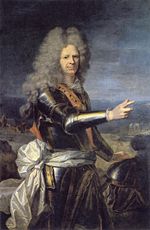
- 1701-1713 Jean du CasseJean du CasseJean Baptiste du Casse was a French Buccaneer and Admiral.In his youth, he was not allowed into the French Navy because his parents were Huguenots...
in name of the Compagnie de Guinée et de l’Assiente des Royaume de la France. - 1713-1750 South Sea Company.
- 1750-1764 ???
- 1765-1772 Miguel de Uriarte in name of Aguirre, Aristegui y Compañía, or Compañía Gaditana.
- 1773-1779 Aguirre, Aristegui y Compañía, or Compañía Gaditana.
Sources
- Goslinga, C.Ch. (1985) The Dutch in the Caribbean and in the Guianas 1680-1791.
- David Marley (ed.), Reales asientos y licencias para la introduccion de esclavos negros a la America Espagnola (1676–1789), ISBN 0-88653-009-1 (Windsor, Canada. 1985).
- Postma, J.M. (2008) The Dutch in the Atlantic Slave Trade, 1600-1815 Cambridge University Press