

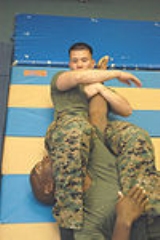
Armlock

Encyclopedia
An armlock in grappling
is a single or double joint lock
that hyperextends, hyperflexes or hyperrotates the elbow joint
and/or shoulder joint
. An armlock that hyperflexes or hyperrotates the shoulder joint is referred to as a shoulder lock, and an armlock that hyperextends the elbow joint is called an armbar. Depending on the joint flexibility
and integrity of a person, armlocks that hyperrotate the shoulder joint can also hyperrotate the elbow joint, and vice versa.
Obtaining an armlock requires effective use of full-body lever
age in order to initiate and secure a lock on the targeted arm, while preventing the opponent from escaping the lock. Therefore, performing an armlock is less problematic on the ground, from positions such as the mount
, side control
, or guard
. Armlocks are more difficult to perform when both combatants are standing up, though the stand-up variants are a focus in certain systems such as Chin Na
. Furthermore, a failed armlock can sometimes result in the opponent escaping and obtaining a dominant position
.
Armlocks, considered less dangerous techniques in combat sports allowing joint locks, are the most common joint locks used as submission holds. In training, the method of executing an armlock is generally slow and controlled to give the opponent time to submit
prior to any infliction of injury. However, in self-defense
applications, or when applied improperly or with excessive force, armlocks can cause muscle
, tendon
and ligament
damage, even dislocation
, or bone fracture
s.
 The juji-gatame (十字固, rendered as Ude-Hishigi-Juji-Gatame) also sometimes used interchangeably with the terms armbar or straight armbar is an official Kodokan Judo technique. The English word "bar" is used here to signify the opponent's extended arm, while the Japanese word "juji" (十字) refers to the armbar's visual resemblance to the number 10 as written in Kanji, 十. The word juji is also found in "juujika" (十字架), meaning a cross. In general, the practitioner secures an arm at the wrist of the opponent, trapping it by squeezing the knee
s together. The attacker's legs end up across the opponent's chest, with the arm held between the thighs, with the elbow pointing against the thigh or hips. By holding the opponent's wrist to the attacker's chest with the pinky finger on the sternum and the thumb facing up (arm semi supinated
or semi pronated
), the practitioner can easily extend the opponent's arm and hyperextend the opponent's elbow. The attacker can further increase the pressure on the elbow joint by arching their hips against the elbow. This technique is used in various grappling martial arts, including but not limited to; Brazilian jiu-jitsu
, Catch wrestling
, Judo
, Jujutsu
, Sambo
, Shoot wrestling
, and is one of the most common ways to win a match in mixed martial arts
competition.
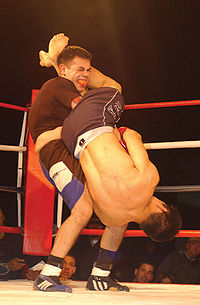
. By tightly holding the opponent's neck and arm, the practitioner places one of their shins against the opponents midsection, and leans up on the opponent; at the same time, the attacker swings the leg on the same side as the opponent's collar tie over the opponents head, into the typical juji-gatame position. (With a gi, it can be performed without needing to hold the neck.) If improperly performed, this technique will cause the opponent to escape the hold and gain an advantageous position, even the option of slamming the attacker to the ground. The flying armbar is considered to be one of the most visually spectacular joint locks, but it is uncommon because of the risk of losing position
.
technique using both of the practitioner’s arms isolate and to cause flexion
to the shoulder
, elbow
, and to a lesser extent the wrist
of the opponent. The technique is generally set in motion by the practitioner, using their same side hand, (i.e. to target the right hand he uses his own right hand) pinning the opponent's arm to the ground at the wrist, so that the elbow falls at a right angle
with the palm facing upwards. Subsequently, the practitioner will thread his opposite hand under the opponent’s bicep, reach through and grasp his own wrist, doing so creates the signature “figure four,” from which one name for this technique was derived, this also gives the practitioner a mechanical advantage over the opponent. To finish the submission the practitioner slides the wrist of the opponent toward the lower body, while simultaneously elevating the elbow and forearm, in a motion resembling using a paintbrush, creating opposition to the joints and causing the necessary flexion in the shoulder and elbow to cause significant pain, and damage if the opponent fails to submit. While it is feasible to execute this technique from several different positions, the most commonly utilized are the full mount and the side mount positions, most likely because these afford the greatest opportunity to isolate an opponent’s arm. This technique also has numerous variations with their own nomenclature, for instance depending on the rotational direction the arm, the addition of the word "reverse" signifying medial rotation as in reverse keylock or reverse ude-garami, in which case the usage of "keylock" indicates lateral rotation only.
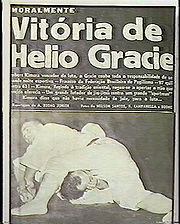 Kimura (Brazilian Jiu-Jitsu), chicken wing/double wristlock (wrestling
), or reverse keylock are terms used to specify a medial keylock known in judo as gyaku ude-garami (reverse arm entanglement) or simply as ude-garami. The application is similar to the americana, except that it is reversed. It needs some space behind the opponent to be effective, and can be applied from the side control or guard. Contrary to the americana, the opponent's wrist is grabbed with the hand on the same side, and the opposite arm is put behind the opponent's arm, again grabbing the attacker's wrist and forming a figure-four. By controlling the opponent's body and cranking the arm away from the attacker, pressure is put on the shoulder joint, and depending on the angle, also the elbow joint (in some variations the opponent's arm is brought behind their back, resulting in a finishing position resembling that of the hammerlock outlined below). The kimura was named after the judoka Masahiko Kimura
, who used it to defeat one of the founders of Brazilian Jiu-Jitsu, Hélio Gracie
.
Tsunetane Oda, a judo groundwork specialist who died in 1955, was shown on video to have demonstrated the technique.
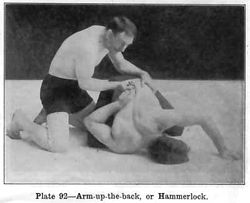 A hammerlock is a shoulder lock similar to the kimura lock where the opponent's arm is held bent against their back, and their hand forced upwards towards the neck, thereby applying pressure to the shoulder joint. The hammerlock is well-known as a pain compliance hold in law-enforcement where it is typically used from a stand-up position and is also utilized in the application of handcuffs
. It is also sometimes seen used as a submission hold in submission wrestling
arts. In physical assessments it is similar to the "Inferior Apley's Scratch" test that health practitioners may use for rotator cuff pathologies (Vizniak, 2009).
Grappling
Grappling refers to techniques, maneuvers, and counters applied to an opponent in order to gain a physical advantage, such as improving relative position, escaping, submitting, or injury to the opponent. Grappling is a general term that covers techniques used in many disciplines, styles and martial...
is a single or double joint lock
Joint lock
A Joint lock is a grappling technique involving manipulation of an opponent's joints in such a way that the joints reach their maximal degree of motion....
that hyperextends, hyperflexes or hyperrotates the elbow joint
Elbow
The human elbow is the region surrounding the elbow-joint—the ginglymus or hinge joint in the middle of the arm. Three bones form the elbow joint: the humerus of the upper arm, and the paired radius and ulna of the forearm....
and/or shoulder joint
Glenohumeral joint
The glenohumeral joint, or shoulder joint, is a multiaxial synovial ball and socket joint and involves articulation between the glenoid fossa of the scapula and the head of the humerus...
. An armlock that hyperflexes or hyperrotates the shoulder joint is referred to as a shoulder lock, and an armlock that hyperextends the elbow joint is called an armbar. Depending on the joint flexibility
Flexibility (anatomy)
Flexibility or limberness refers to the absolute range of movement in a joint or series of joints, and length in muscles that cross the joints. Flexibility is variable between individuals, particularly in terms of differences in muscle length of multi-joint muscles...
and integrity of a person, armlocks that hyperrotate the shoulder joint can also hyperrotate the elbow joint, and vice versa.
Obtaining an armlock requires effective use of full-body lever
Lever
In physics, a lever is a rigid object that is used with an appropriate fulcrum or pivot point to either multiply the mechanical force that can be applied to another object or resistance force , or multiply the distance and speed at which the opposite end of the rigid object travels.This leverage...
age in order to initiate and secure a lock on the targeted arm, while preventing the opponent from escaping the lock. Therefore, performing an armlock is less problematic on the ground, from positions such as the mount
Mount (grappling)
The mount, or mounted position, is a dominant ground grappling position, where one combatant sits on the other combatants torso with the face pointing towards the opponent's head. This is very favourable for the top combatant in several ways...
, side control
Side control
Side control is a dominant ground grappling position where the top combatant is lying perpendicularly over the face-up bottom combatant in such a way that the legs are free and he or she exerts considerable control over the combatant on the bottom...
, or guard
Guard (grappling)
The guard is a ground grappling position where one combatant has their back to the ground, while attempting to control the other combatant using the legs...
. Armlocks are more difficult to perform when both combatants are standing up, though the stand-up variants are a focus in certain systems such as Chin Na
Chin Na
Chin Na or Qinna is a Chinese term describing techniques used in the Chinese martial arts that control or lock an opponent's joints or muscles/tendons so he cannot move, thus neutralizing the opponent's fighting ability...
. Furthermore, a failed armlock can sometimes result in the opponent escaping and obtaining a dominant position
Grappling position
A grappling position refers to the positioning and holds of combatants engaged in grappling. Combatants are said to be in a neutral position if neither is in a more favourable position. If one party has a clear advantage such as in the mount they are said to be in a "dominant position"...
.
Armlocks, considered less dangerous techniques in combat sports allowing joint locks, are the most common joint locks used as submission holds. In training, the method of executing an armlock is generally slow and controlled to give the opponent time to submit
Submission (combat sport term)
A submission is a combat sports term for yielding to the opponent, and hence resulting in an immediate defeat...
prior to any infliction of injury. However, in self-defense
Self-defense
Self-defense, self-defence or private defense is a countermeasure that involves defending oneself, one's property or the well-being of another from physical harm. The use of the right of self-defense as a legal justification for the use of force in times of danger is available in many...
applications, or when applied improperly or with excessive force, armlocks can cause muscle
Muscle
Muscle is a contractile tissue of animals and is derived from the mesodermal layer of embryonic germ cells. Muscle cells contain contractile filaments that move past each other and change the size of the cell. They are classified as skeletal, cardiac, or smooth muscles. Their function is to...
, tendon
Tendon
A tendon is a tough band of fibrous connective tissue that usually connects muscle to bone and is capable of withstanding tension. Tendons are similar to ligaments and fasciae as they are all made of collagen except that ligaments join one bone to another bone, and fasciae connect muscles to other...
and ligament
Ligament
In anatomy, the term ligament is used to denote any of three types of structures. Most commonly, it refers to fibrous tissue that connects bones to other bones and is also known as articular ligament, articular larua, fibrous ligament, or true ligament.Ligament can also refer to:* Peritoneal...
damage, even dislocation
Dislocation (medicine)
Joint dislocation, or luxation , occurs when bones in a joint become displaced or misaligned. It is often caused by a sudden impact to the joint. The ligaments always become damaged as a result of a dislocation...
, or bone fracture
Bone fracture
A bone fracture is a medical condition in which there is a break in the continuity of the bone...
s.
Juji-gatame
Knee
The knee joint joins the thigh with the leg and consists of two articulations: one between the fibula and tibia, and one between the femur and patella. It is the largest joint in the human body and is very complicated. The knee is a mobile trocho-ginglymus , which permits flexion and extension as...
s together. The attacker's legs end up across the opponent's chest, with the arm held between the thighs, with the elbow pointing against the thigh or hips. By holding the opponent's wrist to the attacker's chest with the pinky finger on the sternum and the thumb facing up (arm semi supinated
Supination
Supination is a position of either the forearm or foot; in the forearm when the palm faces anteriorly, or faces up . Supination in the foot occurs when a person appears "bow-legged" with their weight supported primarily on the anterior of their feet.The hand is supine in the anatomical position...
or semi pronated
Pronation
In anatomy, pronation is a rotational movement of the forearm at the radioulnar joint, or of the foot at the subtalar and talocalcaneonavicular joints. For the forearm, when standing in the anatomical position, pronation will move the palm of the hand from an anterior-facing position to a...
), the practitioner can easily extend the opponent's arm and hyperextend the opponent's elbow. The attacker can further increase the pressure on the elbow joint by arching their hips against the elbow. This technique is used in various grappling martial arts, including but not limited to; Brazilian jiu-jitsu
Brazilian Jiu-Jitsu
Brazilian Jiu-Jitsu is a martial art, combat sport, and a self defense system that focuses on grappling and especially ground fighting...
, Catch wrestling
Catch wrestling
Catch wrestling is a style of folk wrestling that was developed and popularised in the late 19th century by the wrestlers of traveling carnivals who incorporated submission holds, or "hooks", into their wrestling to increase their effectiveness against their opponents...
, Judo
Judo
is a modern martial art and combat sport created in Japan in 1882 by Jigoro Kano. Its most prominent feature is its competitive element, where the object is to either throw or takedown one's opponent to the ground, immobilize or otherwise subdue one's opponent with a grappling maneuver, or force an...
, Jujutsu
Jujutsu
Jujutsu , also known as jujitsu, ju-jitsu, or Japanese jiu-jitsu, is a Japanese martial art and a method of close combat for defeating an armed and armored opponent in which one uses no weapon, or only a short weapon....
, Sambo
Sambo (martial art)
Sambo is a Russian martial art and combat sport. The word "SAMBO" is an acronym for SAMooborona Bez Oruzhiya, which literally translates as "self-defense without weapons". Sambo is relatively modern since its development began in the early 1920s by the Soviet Red Army to improve their hand to hand...
, Shoot wrestling
Shoot wrestling
Shoot wrestling is a combat sport that has its origins in Japan's professional wrestling circuit of the 1970s. Professional wrestlers of that era attempted to utilize more realistic or "full contact" moves in their matches to increase their excitement...
, and is one of the most common ways to win a match in mixed martial arts
Mixed martial arts
Mixed Martial Arts is a full contact combat sport that allows the use of both striking and grappling techniques, both standing and on the ground, including boxing, wrestling, Brazilian jiu-jitsu, muay Thai, kickboxing, karate, judo and other styles. The roots of modern mixed martial arts can be...
competition.
Flying armbar
The flying armbar is a version of the juji-gatame that is performed from a stand-up position. Without a gi, it is typically applied when the opponent has a collar tieCollar tie
Collar tie is a grappling clinch hold that is used to control the opponent. It is performed from the front of the opponent by grabbing the opponent by the collar, behind the neck, or behind the trapezius muscle. A collar tie using one hand is called a single collar tie, and a collar tie with both...
. By tightly holding the opponent's neck and arm, the practitioner places one of their shins against the opponents midsection, and leans up on the opponent; at the same time, the attacker swings the leg on the same side as the opponent's collar tie over the opponents head, into the typical juji-gatame position. (With a gi, it can be performed without needing to hold the neck.) If improperly performed, this technique will cause the opponent to escape the hold and gain an advantageous position, even the option of slamming the attacker to the ground. The flying armbar is considered to be one of the most visually spectacular joint locks, but it is uncommon because of the risk of losing position
Grappling position
A grappling position refers to the positioning and holds of combatants engaged in grappling. Combatants are said to be in a neutral position if neither is in a more favourable position. If one party has a clear advantage such as in the mount they are said to be in a "dominant position"...
.
Helicopter Armbar
The Helicopter armbar is a little different version of the armbar, which is also used by Wrestling and Jiu Jitsu. When the attacker stands in front of the opponent, he grabs both of his arms and falls backwards, causing the opponent to lean forward. Then the attacker puts his feet on the opponent's stomach or hips and lifts him up with his feet. The attacker will drop the opponent beside him, and perform the armbar.Sankaku-gatame
The sankaku-gatame or "triangular armlock" is a juji-gatame performed from the sankaku position. Originating from Judo it is normally used when the shime (strangle) is not working. It's an effective competition technique due to the fact that the opponent's arm became exposed while defending the sankaku-jime and their attention is focused in stopping the strangle.Elbow lock
An elbow lock is a type of joint lock that hyperflexes or hyperrotates the elbow joint. An elbow lock is applied by forcing the arm beyond its normal range of elbow-wise movement, which can be done through a variety of ways. Typically, the body is controlled from moving by using a pinning hold, and the arm is then pulled, pushed or twisted.Keylock
The keylock, (also known as the figure-four armlock, bent armlock, paintbrush, americana, or ude-garami/arm entanglement in Judo.) is a grapplingGrappling
Grappling refers to techniques, maneuvers, and counters applied to an opponent in order to gain a physical advantage, such as improving relative position, escaping, submitting, or injury to the opponent. Grappling is a general term that covers techniques used in many disciplines, styles and martial...
technique using both of the practitioner’s arms isolate and to cause flexion
Flexion
In anatomy, flexion is a position that is made possible by the joint angle decreasing. The skeletal and muscular systems work together to move the joint into a "flexed" position. For example the elbow is flexed when the hand is brought closer to the shoulder...
to the shoulder
Shoulder
The human shoulder is made up of three bones: the clavicle , the scapula , and the humerus as well as associated muscles, ligaments and tendons. The articulations between the bones of the shoulder make up the shoulder joints. The major joint of the shoulder is the glenohumeral joint, which...
, elbow
Elbow
The human elbow is the region surrounding the elbow-joint—the ginglymus or hinge joint in the middle of the arm. Three bones form the elbow joint: the humerus of the upper arm, and the paired radius and ulna of the forearm....
, and to a lesser extent the wrist
Wrist
In human anatomy, the wrist is variously defined as 1) the carpus or carpal bones, the complex of eight bones forming the proximal skeletal segment of the hand;...
of the opponent. The technique is generally set in motion by the practitioner, using their same side hand, (i.e. to target the right hand he uses his own right hand) pinning the opponent's arm to the ground at the wrist, so that the elbow falls at a right angle
Right angle
In geometry and trigonometry, a right angle is an angle that bisects the angle formed by two halves of a straight line. More precisely, if a ray is placed so that its endpoint is on a line and the adjacent angles are equal, then they are right angles...
with the palm facing upwards. Subsequently, the practitioner will thread his opposite hand under the opponent’s bicep, reach through and grasp his own wrist, doing so creates the signature “figure four,” from which one name for this technique was derived, this also gives the practitioner a mechanical advantage over the opponent. To finish the submission the practitioner slides the wrist of the opponent toward the lower body, while simultaneously elevating the elbow and forearm, in a motion resembling using a paintbrush, creating opposition to the joints and causing the necessary flexion in the shoulder and elbow to cause significant pain, and damage if the opponent fails to submit. While it is feasible to execute this technique from several different positions, the most commonly utilized are the full mount and the side mount positions, most likely because these afford the greatest opportunity to isolate an opponent’s arm. This technique also has numerous variations with their own nomenclature, for instance depending on the rotational direction the arm, the addition of the word "reverse" signifying medial rotation as in reverse keylock or reverse ude-garami, in which case the usage of "keylock" indicates lateral rotation only.
Kimura (Gyaku ude-garami)
Wrestling
Wrestling is a form of grappling type techniques such as clinch fighting, throws and takedowns, joint locks, pins and other grappling holds. A wrestling bout is a physical competition, between two competitors or sparring partners, who attempt to gain and maintain a superior position...
), or reverse keylock are terms used to specify a medial keylock known in judo as gyaku ude-garami (reverse arm entanglement) or simply as ude-garami. The application is similar to the americana, except that it is reversed. It needs some space behind the opponent to be effective, and can be applied from the side control or guard. Contrary to the americana, the opponent's wrist is grabbed with the hand on the same side, and the opposite arm is put behind the opponent's arm, again grabbing the attacker's wrist and forming a figure-four. By controlling the opponent's body and cranking the arm away from the attacker, pressure is put on the shoulder joint, and depending on the angle, also the elbow joint (in some variations the opponent's arm is brought behind their back, resulting in a finishing position resembling that of the hammerlock outlined below). The kimura was named after the judoka Masahiko Kimura
Masahiko Kimura
was a Japanese judoka who is widely considered one of the greatest judoka of all time. Kimura was born on September 10, 1917 in Kumamoto, Japan...
, who used it to defeat one of the founders of Brazilian Jiu-Jitsu, Hélio Gracie
Hélio Gracie
Hélio Gracie was a Brazilian martial artist who, together with his brother Carlos Gracie, founded the martial art of Gracie Jiu-Jitsu, known internationally as Brazilian Jiu-Jitsu...
.
Shoulder lock
The "Shoulder Lock" is a technique used as a method of upper body restraint. It should not be confused with a choke because the lock does not block or interferes with the flow of air or oxygen to the brain. The application is executed by applying pressure between the radial bone and shoulder.Omoplata (sankaku-garami/ude-garami)
The omoplata (referred to in Judo as ude-garami or sankaku-garami, 三角緘, "triangular entanglement" or ashi-garami, "leg entanglement") is also a commonly featured shoulder lock in Brazilian Jiu-Jitsu. The locking mechanism is similar to the kimura lock, but instead of using a figure-four, it is applied using a leg. The omoplata can be applied from the guard, by placing one leg under the opponent's armpit and turning 180 degrees in the direction of that leg, so that the leg moves over the back of the opponent and entangles the opponent's arm. By controlling the opponent's body and pushing the arm perpendicularly away from the opponents back, pressure can be put on the opponent's shoulder. It is also possible to put pressure on the elbow joint by bending the leg entangling the arm, and twisting it in a specific manner. Though an effective lock, it is more difficult than other armlocks to successfully apply. The technique called a monoplata is a similar armlock that resembles juji gatame or spiderweb position yet has a mechanism like a omoplata.Tsunetane Oda, a judo groundwork specialist who died in 1955, was shown on video to have demonstrated the technique.
Hammerlock
Handcuffs
Handcuffs are restraint devices designed to secure an individual's wrists close together. They comprise two parts, linked together by a chain, a hinge, or rigid bar. Each half has a rotating arm which engages with a ratchet that prevents it from being opened once closed around a person's wrist...
. It is also sometimes seen used as a submission hold in submission wrestling
Submission wrestling
Submission wrestling or Combat wrestling in Japan, is a formula of competition and a general term describing the aspect of martial arts and combat sports that focus on clinch and ground fighting with the aim of obtaining a submission using submission holds...
arts. In physical assessments it is similar to the "Inferior Apley's Scratch" test that health practitioners may use for rotator cuff pathologies (Vizniak, 2009).
See also
- For armlocks involving a separating motion of the elbow joint, see Biceps slicer.
- LeglockLeglockA leglock is a joint lock that is directed at joints of the leg such as the ankle, knee or hip joint. A leglock which is directed at joints in the foot is sometimes referred to as a foot lock and a lock at the hip as a hip lock...
- Small joint manipulationSmall joint manipulationSmall joint manipulation, in grappling, refers to twisting, pulling or bending fingers or toes to cause joint locks in the various joints in those appendages...
- Spinal lockSpinal lockA spinal lock is a multiple joint lock applied to the spinal column, which is performed by forcing the spine beyond its normal ranges of motion. This is typically done by bending or twisting the head or upper body into abnormal positions...
- WristlockWristlockA Wristlock is a joint lock primarily affecting the wrist-joint and possibly the radioulnar joints through rotation of the hand. A wristlock is typically applied by grabbing the opponent's hand, and bending and/or twisting it. Wristlocks are very common in martial arts such as Aikido, Hapkido and...