

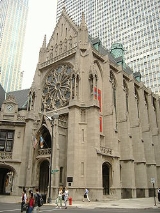
Archbishop Quigley Preparatory Seminary

Encyclopedia
Archbishop Quigley Preparatory Seminary was an American
seminary
preparatory school
administered by the Roman Catholic Archdiocese of Chicago
for young men
considering the priesthood
. Located in downtown Chicago
, Illinois
at 103 East Chestnut Street, adjacent to Loyola University Chicago
's Water Tower
campus, it closed on June 22, 2007, and became the Archbishop Quigley Center, the pastoral center and headquarters of the Archdiocese after renovations ending November 19, 2008. Between 1961 and 1990, the seminary was split into two campuses: Quigley South and Quigley North, with Quigley North housed at the original building. The south campus was closed in 1990, with all seminary operations returning to the original building.
The predecessor of the school, Cathedral College of the Sacred Heart, was founded in 1905. Cardinal George Mundelein announced plans in 1916 for the building of a preparatory seminary at Rush
and Chestnut Streets in downtown Chicago, and named the school in honor of his predecessor, Archbishop James Edward Quigley
.
Echoing the educational theories of Johann Wolfgang Goethe, Cardinal Mundelein surrounded Quigley students with great architectural beauty:
Quigley's Chapel of St. James, with stained glass modeled after Sainte-Chapelle
in Paris, was dedicated upon the seventy-fifth anniversary of the Archdiocese of Chicago and the twenty-fifth anniversary of Mundelein's priestly ordination on June 10, 1920. Designed by the architecture firm of Gustav Steinbeck of New York and Zachary Taylor Davis
, with stained glass by Robert Giles of the John J. Kinsella Company of Chicago, it has been listed on the National Register of Historic Places since 1996. The American Institute of Architects
Guide to Chicago has termed the stained glass of the Quigley Chapel "dazzling."
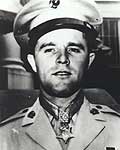
The Quigley seminaries have educated almost 2,500 priests, two cardinals, over forty-one bishops, two Vatican II periti, separate recipients of the Medal of Honor
and the Presidential Medal of Freedom
, the Order of Merit of the Republic of Poland, and, in sports, two members of the Basketball Hall of Fame
.
The site of the new seminary at Wabash, then Cass Avenue and Superior Street, was opened on October 2, 1905, upon Purcell's return, and named Cathedral College of the Sacred Heart. Following the European seminary practice of being sited in the midst of the city center of ministry, it also followed the practice of school on Saturday, with Thursday off. No tuition was charged for the first 52 freshmen recruited and admitted upon the nomination of their pastor. Nine other priests, all with either Irish or German surnames, served as the faculty. It became the established tradition of Chicago's minor seminaries that financial want should not prevent a seminarian from attending.
Quigley purchased land on the far West Side of Chicago, in today's Austin
neighborhood, for a future major seminary, and a site at Addison Street and Sheridan Road
for a larger minor seminary, since Cathedral College had quickly grown to encompass three buildings. Chicago's rapid expansion made the Austin site unsuitable for a major seminary, and Quigley sold the property to the city for its present use as a portion of the beautiful Columbus Park
, later designed by the noted landscape architect Jens Jensen
. Quigley's health failed before he could put his plan of seminary development in motion, but at an ecclesiastical event in the Eastern United States prior to his death, Quigley providentially spent an afternoon with George Mundelein, then auxiliary bishop of Brooklyn
, describing his plans in detail. Quigley died on July 10, 1915, but his successor Mundelein expanded upon Quigley's vision and put it into action. Upon his being named Archbishop, Mundelein boarded a train on February 7, 1916, with a delegation from his new archdiocese, and headed to Chicago, where he was installed as archbishop two days later.
Within a few weeks, on "the feast of the Holy Apostles Phillip and James, 1916," Mundelein wrote to the priests of Chicago:
Earlier in 1916, Mundelein had purchased a half block of land on Rush Street from Pearson to Chestnut Streets, and later sold the Addison and Sheridan property for $600,000, with a profit of $160,000, in April, 1917, with the profit going to build the new Quigley Seminary, and the principal being reserved for the planned new major seminary. With the ground broken in November, 1916 and a cornerstone laid at the corner of Pearson and Rush on September 16, 1917, classes were first held at school's current location in September 1918.
Carrying on a precedent established in 1905 in Cathedral College under rector Rev. Francis Andrew "Doc" Purcell (Msgr. in 1922), also Quigley Seminary's first rector, the new "Quigley Memorial Preparatory Seminary" was established with a five-year program of study (which continued until 1961), but like Cathedral College as a day school, so that Quigley students "would never lose contact with their heritage, their families, their Church."
By 1922, Quigley Seminary was already overcrowded, with over 600 students in a building designed to hold 500. A west wing of the building, this time in the Flemish-Gothic style, was begun in March, 1925 and completed amazingly by December, 1925, increasing the capacity of the school another 500."
Msgr. Purcell established the school newspaper, The Candle, its yearbook, Le Petit Seminaire, the Cathedral Choristers (a boys' choir which sang at Sunday Masses at Holy Name Cathedral
), catechists (who served at parishes), the Beadsmen (who gathered after school and at breaks to pray the Rosary), and the primacy of basketball among Quigley Seminary's intramural and interscholastic sports. By the end of his tenure as rector in 1931, Quigley faculty had grown from ten at Cathedral College in 1905 to forty-two, and the student body had grown from fifty-two in 1905 to 1,030. Quigley's priest faculty were expected to live in the parishes of the Archdiocese, so as to keep a parish and priestly connection.
Msgr. Purcell was succeeded as rector in 1931 by Msgr. Philip Francis Mahoney, who according to the Archdiocesan history, changed little established by Purcell, and whose poor health led to his resignation during the 1934-35 academic year. Mundelein then met with the Quigley faculty and asked for their prayerful individual and confidential recommendations for the rector's position. During the next faculty meeting, Cardinal Mundelein named as Quigley's third rector the faculty choice, Rev. Malachy P. Foley. Msgr. Foley urged Quigley faculty to earn graduate degrees, regularly met personally with students both to praise and correct, expected classroom professionalism, and, according to Archdiocesan historian Msgr. Harry Koenig's account, "maintained Quigley as a seminary that saw itself as second to no other high school."
, Joseph Goebbels
, and Hermann Göring
for using the pretext of "immorality" and sexual scandals to attack Catholic religious orders, organizations, and German Catholic schools, which at the time educated two million children, saying:
Nazi minister Goebbels, labeled a "crooked minister of propaganda" in the same speech by Mundelein, responded furiously within days at a mass rally with 18,000 attendants, demanding that the Vatican discipline Mundelein, which it refused to do. Nazi attacks on German Catholic institutions intensified, and 200 Catholic newspapers were shut down. In Philadelphia, the International Brotherhood of Painters, Paperhangers, and Decorators for their part took exception to the Cardinal's classification of Hitler as a "paperhanger" in any case, despite Mundelein's remarks "he was not a very good one."
Mundelein similarly championed Quigley, and personally recruited Catholic families to send their sons into the priesthood, including Frederick and Reynold Henry Hillenbrand
, sons of the dentist who treated Mundelein's niece, and later treated Mundelein himself. In a January 2, 1938 speech to 2,000 members of the Holy Name Society at Holy Name Cathedral, Chicago
, Mundelein said:
Chicago's poor and working people comprised many immigrant groups, and Mundelein used his seminaries to break down ethnic barriers among the clergy. Ethnic groups fought back, and demanded concessions from Mundelein to preserve their identity. One such concession was that Quigley students of Polish descent had to learn Polish, a practice that continued from Mundelein's day until 1960.
near the end of his thirty-one years of service to Quigley as professor and rector in 1955, began a formal study for expansion of the school, and stepped aside so a younger man could lead it. The vigorous and athletic Msgr. Martin M. Howard, another Quigley graduate and professor, fluent in classical languages and Spanish, was named rector on May 18, 1955, by Cardinal Samuel Stritch.
According to Msgr. Koenig's account, Msgr. Howard faced the task of fitting four years of high school and two years of college into Quigley's five-year curriculum with a "Sulpician language-school model" of seminary inherited from Msgr. Purcell a half-century previous. With frequent faculty consultation, Howard participated in plans with Cardinal Stritch to convert Quigley to a four-year program, build a second Quigley near Chicago's south suburbs, establish a four-year free-standing college seminary, and shorten the program at St. Mary of the Lake Seminary in Mundelein, Illinois
to four years of graduate study. In the mean time, the Archdiocese rented the Ogden School at 39 West Chestnut from the Chicago Board of Education as Quigley's "Annex" to better accommodate the overflow of Quigley's 1,300 students.
, which opened in 1961, with Msgr. Howard named as its first rector. The original Quigley classes of 1960 and 1961 graduated in Spring, 1961, with the new Chicago college seminary, later to be called Niles College
, opening that Fall.
Cardinal Meyer dedicated the Quigley South Chapel of the Sacred Heart (so named to hearken to the original Chicago minor seminary, Cathedral College of the Sacred Heart), its 40 acres (16.2 ha) campus, and new facilities for its 869 students on September 13, 1962. For a short period in the early 1960s, both Quigley campuses held joint events, including graduations, in order to instill among the students the spirit of sharing one school.
Msgr. John P. O'Donnell (Q' 41) was named rector of the newly named Quigley Preparatory Seminary North at the original Chestnut Street location in 1961. Msgr. O'Donnell encouraged his faculty to seek degrees from many universities, and he himself earned a PhD from Loyola University and a master's degree from the University of Notre Dame
, in addition to earlier master's and licentiate degrees from St. Mary of the Lake Seminary. Cardinal Meyer continued the practice of appointing priests to Quigley on the theory that "young seminarians needed a good number of priest-models to make an intelligent decision about their vocations." In 1965, Msgr. O'Donnell also led Quigley North in earning accreditation from the North Central Association of Colleges and Schools
and took steps to make Advanced Placement classes available for students, an action mirrored at Quigley South, the year that Archbishop John Patrick Cody was named to succeed Cardinal Meyer, who had succumbed to cancer on April 9. Quigley North faced for the first time a problem of declining enrollment, seeing its freshman class decline from 256 in 1962 to 130 in 1967. Declining enrollments brought both Quigley seminaries to consider further changes.
In 1966, Cardinal Cody instituted a Chicago seminary system-wide change abolishing the Thursday day off and Saturday school day, which had for decades separated Chicago seminarians and seminary faculty from participating in Saturday social activities, while Quigley faculty voted to alter their own dress code requiring a cassock, in place of other clerical attire. Seminary policies prohibiting seminarian participation in co-educational activities and organizations were also revised in that same year. In 1968, dress codes for both Quigley seminaries requiring a suit coat and tie for students were revised to fit the seasons of the year, and the Quigley seminaries made the necessary arrangements so that Quigley students could join the National Honor Society
. After a year-long self-study of the entire Chicago archdiocesan seminary system in 1969, assisted by the Arthur D. Little
Company of Boston, Cardinal Cody announced in 1970 a new admissions policy for the Quigley seminaries, which expanded beyond Cardinal Mundelein's original requirement in 1916 that Quigley students be "educated with those who only look forward to that same great work in life, the priestly field of labor." Boys from two categories would, as of 1971, be admitted to Quigley, "(a.) ... who have indicated a desire for the priesthood and who meet the requirements of admissions, and (b.) ... who, in the judgment of parish priests, have the kind of character, ability, and temperament which might lead to the personal discovery of a vocation in the priesthood." The new policy also indicated that Quigley North and South should "emphasize the fact that they are contemporary seminaries primarily concerned with the development and encouragement of vocations to the priesthood," and that "a vigorous campaign should be begun, especially on the part of priests, to enroll qualified students."
neighborhood. This site sequestered one building in the AGO complex to house and board students from the hinterland of Chicago, Monday through Fridays, during the academic school calendar. All four Quigley classes were represented in these six years. The Vianney priest faculty included Frs. Barnum and Devereaux, who lived at Vianney full time. Laymen, typically Loyola University students, were offered room and board in exchange for limited duties of moderating the daily activities of residence life, provide curfew enforcement and supervision of the hall members. The suburbs and exurbs were represented: Maywood, Gurnee, Hoffman Estates, Olympia Fields, Waukegan, Oak Park, River Grove, Park Ridge and Skokie. The dorm life was regimented by the priests, providing a general wake up call at 6:30 AM, Chapel service at 7 AM, followed by breakfast, hot or cold, prepared by a cook. Classes began at 8:45 AM. The CTA was the student's "green and cream limousine." The 155 Devon, 151 Sheridan 147 Express and L trains sped the students to Michigan Avenue and Chestnut. Curfew for returning to the hall was 5:30 PM for dinner. Study hours were 6-8 PM, followed by an evening Chapel service, then free time until "lights out" at 10-10:30 PM. A public phone was supplied. Chapel service was a reading of the day's Scriptures and minutes of silent contemplation. An amenity at AGO was a pristine full basketball court (once used by the Chicago Bulls prior to Michael Jordan's arrival) which was perfect for recreation and exercise after a full day's scholastic endeavor. Underclass students were 2 to a room and the Upperclass students were given single rooms. Only one student, Jeff Calabrese of Gurnee, was to have completed all 4 years of education while living at Vianney Hall from the Fall of 1982-Spring of 1986.
The residence life included a compulsory chore night: Thursday evening. Laundry, showers and lavatory, kitchen, and recreation areas, etc., were cleaned and repaired from the week's use. The residence opportunity facilitated a true '"'college prep" atmosphere. Students, as young as 14, were encouraged to care for one's self with limited supervision. To live in the city's North side, travel its Gold Coast, be schooled in a castle feet from the Mag Mile without daily parental imperatives was an accelerated track to young adulthood, save a Vocation's consideration. However, due to financial strains coupled to limited Niles College of Loyola enrollment from the roster of Vianney Hall, the experiment was abandoned. The opportunity for residence life was eliminated in 1987.
Some students chose to live in nearby parishes or commit to the lengthy commute. In all, some 20-30 youth spent a portion of their QN careers as residence of Vianney. Remarkably, this annex of QN was barely recognized by the student body as a whole or by faculty. Its mention, existence and mission were somewhat "conspicuous by absence." The progressive creation of a dormitory system to augment vocations was vanguard, and Quigley's only departure from the day-school model established by Cardinal Mundelein. When Jeff Calabrese mentions that he "lived at high school," he still conjures up New England wealthy and upper middle class institutions' sole ability to afford this option: live at school. Yet humble Quigley North took courage of its conviction and supplied the avenue for this unique and counter-cultural stance to house its students.
, but many of the protesters later joined in supporting the combined Archbishop Quigley Seminary. The Quigley South campus was purchased for the new location of St. Rita High School
(originally located at 63rd Street and Claremont Avenue). The reorganized Archbishop Quigley Preparatory Seminary would go on to earn national recognition from US News and World Report in 1999 as one of 96 outstanding high schools in America.
During the period 1984–1993, Quigley graduated an average of 5.5 students per year who completed the remaining eight years leading to ordination. As of the Fall of 2006, with an enrollment of 183 students, Quigley was the largest of the seven remaining preparatory seminaries in the country.
Daily attendance at Mass was required of Quigley students for the greater part of the 20th century, following Cardinal Mundelein's letter of 1916 and John Paul II's 1979 direction quoted above, but the practice declined during the early 90s, when a weekly Mass was instituted. However, when Rev. Peter Sneig was appointed rector in 2001, per Cardinal George's decision, prayer was the centerpiece of Quigley once again. Since academic school year of 2000-01, Mass had been an integral part of spiritual growth, being required three days a week with Monday morning prayer and Friday afternoon prayer to begin and end each week.
The Archdiocese announced on September 19, 2006 that Quigley's doors would be shut at the end of the school year in June 2007.
After one year of renovation the site was to become home to the new archdiocesan Pastoral Center, containing the offices of the archbishop's curia and relative church bodies, with a "Quigley Scholars" program being established to support priestly vocations among high school boys.
On June 15, 2007, (the feast of the Sacred Heart of Jesus) Quigley closed its door to students at the end of the 2007 academic year.
United States
The United States of America is a federal constitutional republic comprising fifty states and a federal district...
seminary
Seminary
A seminary, theological college, or divinity school is an institution of secondary or post-secondary education for educating students in theology, generally to prepare them for ordination as clergy or for other ministry...
preparatory school
University-preparatory school
A university-preparatory school or college-preparatory school is a secondary school, usually private, designed to prepare students for a college or university education...
administered by the Roman Catholic Archdiocese of Chicago
Roman Catholic Archdiocese of Chicago
The Archdiocese of Chicago was established as a diocese in 1843 and as an Archdiocese in 1880. It serves more than 2.3 million Catholics in Cook and Lake counties in Northeastern Illinois, a geographic area of 1,411 square miles. The Archdiocese is divided into six vicariates and 31 deaneries...
for young men
Single-sex education
Single-sex education, also known as single-gender education, is the practice of conducting education where male and female students attend separate classes or in separate buildings or schools. The practice was predominant before the mid-twentieth century, particularly in secondary education and...
considering the priesthood
Priesthood (Catholic Church)
The ministerial orders of the Catholic Church include the orders of bishops, deacons and presbyters, which in Latin is sacerdos. The ordained priesthood and common priesthood are different in function and essence....
. Located in downtown Chicago
Chicago
Chicago is the largest city in the US state of Illinois. With nearly 2.7 million residents, it is the most populous city in the Midwestern United States and the third most populous in the US, after New York City and Los Angeles...
, Illinois
Illinois
Illinois is the fifth-most populous state of the United States of America, and is often noted for being a microcosm of the entire country. With Chicago in the northeast, small industrial cities and great agricultural productivity in central and northern Illinois, and natural resources like coal,...
at 103 East Chestnut Street, adjacent to Loyola University Chicago
Loyola University Chicago
Loyola University Chicago is a private Jesuit research university located in Chicago, Illinois, United States. Founded by the Society of Jesus in 1870 under the title St...
's Water Tower
Chicago Water Tower
The Chicago Water Tower is a contributing property in the Old Chicago Water Tower District landmark district. It is located at 806 North Michigan Avenue along the Magnificent Mile shopping district in the Near North Side community area of Chicago, Illinois...
campus, it closed on June 22, 2007, and became the Archbishop Quigley Center, the pastoral center and headquarters of the Archdiocese after renovations ending November 19, 2008. Between 1961 and 1990, the seminary was split into two campuses: Quigley South and Quigley North, with Quigley North housed at the original building. The south campus was closed in 1990, with all seminary operations returning to the original building.
The predecessor of the school, Cathedral College of the Sacred Heart, was founded in 1905. Cardinal George Mundelein announced plans in 1916 for the building of a preparatory seminary at Rush
Rush Street (Chicago)
Rush Street is predominantly a northbound one-way street in the Near North Side community area of Chicago in Cook County, Illinois, United States...
and Chestnut Streets in downtown Chicago, and named the school in honor of his predecessor, Archbishop James Edward Quigley
James Edward Quigley
James Edward Quigley was a Canadian-born prelate of the Roman Catholic Church. He served as Bishop of Buffalo, New York and Archbishop of Chicago .-Biography:...
.
Echoing the educational theories of Johann Wolfgang Goethe, Cardinal Mundelein surrounded Quigley students with great architectural beauty:
"This will unquestionably be the most beautiful building here in Chicago, not excluding the various buildings of the University of ChicagoUniversity of ChicagoThe University of Chicago is a private research university in Chicago, Illinois, USA. It was founded by the American Baptist Education Society with a donation from oil magnate and philanthropist John D. Rockefeller and incorporated in 1890...
."
Quigley's Chapel of St. James, with stained glass modeled after Sainte-Chapelle
Sainte-Chapelle
La Sainte-Chapelle is the only surviving building of the Capetian royal palace on the Île de la Cité in the heart of Paris, France. It was commissioned by King Louis IX of France to house his collection of Passion Relics, including the Crown of Thorns - one of the most important relics in medieval...
in Paris, was dedicated upon the seventy-fifth anniversary of the Archdiocese of Chicago and the twenty-fifth anniversary of Mundelein's priestly ordination on June 10, 1920. Designed by the architecture firm of Gustav Steinbeck of New York and Zachary Taylor Davis
Zachary Taylor Davis
Zachary Taylor Davis was the architect of several major Chicago buildings, including St. Ambrose Old Comiskey Park , Wrigley Field , Mount Carmel High School , and St...
, with stained glass by Robert Giles of the John J. Kinsella Company of Chicago, it has been listed on the National Register of Historic Places since 1996. The American Institute of Architects
American Institute of Architects
The American Institute of Architects is a professional organization for architects in the United States. Headquartered in Washington, D.C., the AIA offers education, government advocacy, community redevelopment, and public outreach to support the architecture profession and improve its public image...
Guide to Chicago has termed the stained glass of the Quigley Chapel "dazzling."
The Quigley seminaries have educated almost 2,500 priests, two cardinals, over forty-one bishops, two Vatican II periti, separate recipients of the Medal of Honor
Medal of Honor
The Medal of Honor is the highest military decoration awarded by the United States government. It is bestowed by the President, in the name of Congress, upon members of the United States Armed Forces who distinguish themselves through "conspicuous gallantry and intrepidity at the risk of his or her...
and the Presidential Medal of Freedom
Presidential Medal of Freedom
The Presidential Medal of Freedom is an award bestowed by the President of the United States and is—along with thecomparable Congressional Gold Medal bestowed by an act of U.S. Congress—the highest civilian award in the United States...
, the Order of Merit of the Republic of Poland, and, in sports, two members of the Basketball Hall of Fame
Basketball Hall of Fame
The Naismith Memorial Basketball Hall of Fame, located in Springfield, Massachusetts, United States, honors exceptional basketball players, coaches, referees, executives, and other major contributors to the game of basketball worldwide...
.
Early history
Archbishop James E. Quigley began plans for a minor seminary in Chicago in July 1903, shortly after his installation. Only 417 diocesan and 149 order priests then served Chicago's 252 parishes, with a city population nearing 1.7 million, and with the archdiocese's then boundaries extending across northern Illinois. Quigley recruited Rev. Francis Andrew Purcell to head the new minor seminary, and dispatched him to the College Propaganda Fide in Rome to earn a doctorate in divinity.The site of the new seminary at Wabash, then Cass Avenue and Superior Street, was opened on October 2, 1905, upon Purcell's return, and named Cathedral College of the Sacred Heart. Following the European seminary practice of being sited in the midst of the city center of ministry, it also followed the practice of school on Saturday, with Thursday off. No tuition was charged for the first 52 freshmen recruited and admitted upon the nomination of their pastor. Nine other priests, all with either Irish or German surnames, served as the faculty. It became the established tradition of Chicago's minor seminaries that financial want should not prevent a seminarian from attending.
Quigley purchased land on the far West Side of Chicago, in today's Austin
Austin, Chicago
Austin, located on the West Side of Chicago, Illinois, is the largest of the city's 77 officially defined community areas, followed by Lake View. Its eastern boundary is the Belt Railway located just east of Cicero Avenue. Its northernmost border is the Milwaukee District/West Line...
neighborhood, for a future major seminary, and a site at Addison Street and Sheridan Road
Sheridan Road
Sheridan Road is a major north-south thoroughfare that leads from Diversey Parkway in Chicago, Illinois, north to the Illinois-Wisconsin border and beyond to Racine. Throughout most of its run, it is the easternmost north-south through street, closest to Lake Michigan...
for a larger minor seminary, since Cathedral College had quickly grown to encompass three buildings. Chicago's rapid expansion made the Austin site unsuitable for a major seminary, and Quigley sold the property to the city for its present use as a portion of the beautiful Columbus Park
Columbus Park (Chicago)
Columbus Park, located on the west side of Chicago, Illinois in the Austin neighborhood, is bounded by West Adams Street, South Austin Boulevard, South Central Avenue, and the Eisenhower Expressway, to which it lost nine acres when the expressway was constructed. The remnant park is part of the...
, later designed by the noted landscape architect Jens Jensen
Jens Jensen (landscape architect)
Jens Jensen was a Danish-American landscape architect.-Early life:Jens Jensen was born near Dybbøl in Slesvig, Denmark, in 1860, to a wealthy farming family. For the first nineteen years of his life he lived on his family's farm, which cultivated his love for the natural environment...
. Quigley's health failed before he could put his plan of seminary development in motion, but at an ecclesiastical event in the Eastern United States prior to his death, Quigley providentially spent an afternoon with George Mundelein, then auxiliary bishop of Brooklyn
Roman Catholic Diocese of Brooklyn
The Roman Catholic Diocese of Brooklyn, which includes territory that was previously part of the Roman Catholic Archdiocese of New York, was established as a separate diocese in 1853 when the City of Brooklyn was separate from New York City....
, describing his plans in detail. Quigley died on July 10, 1915, but his successor Mundelein expanded upon Quigley's vision and put it into action. Upon his being named Archbishop, Mundelein boarded a train on February 7, 1916, with a delegation from his new archdiocese, and headed to Chicago, where he was installed as archbishop two days later.
Within a few weeks, on "the feast of the Holy Apostles Phillip and James, 1916," Mundelein wrote to the priests of Chicago:
"It is for this reason that in several of the dioceses of the country, the bishops have established the more modern form of the preparatory seminary, where the young boy selected from among his companions by the pastor or confessor, who discerns in him the probable signs of a vocation, the piety, application and intelligence which is required for the candidate for the holy priesthood, even while remaining in the sacred circle of the home and under the watchful eye of a pious mother, is placed apart and educated with those who only look forward to that same great work in life, the priestly field of labor, keeping daily before his mind the sublime vocation of the priesthood, preserving him pure and pious by constant exhortation, by daily assistance at the Holy Sacrifice and by frequent reception of the sacraments."
"The buildings are to be in the early French Gothic style of architecture and by reason of the distinct individuality and prominent location, will form a place of interest, not only to visitors, but to all lovers of the City Beautiful. The group will be composed of a main college building, and two ornate wings will be one the chapel, the other the library and gymnasium."
Earlier in 1916, Mundelein had purchased a half block of land on Rush Street from Pearson to Chestnut Streets, and later sold the Addison and Sheridan property for $600,000, with a profit of $160,000, in April, 1917, with the profit going to build the new Quigley Seminary, and the principal being reserved for the planned new major seminary. With the ground broken in November, 1916 and a cornerstone laid at the corner of Pearson and Rush on September 16, 1917, classes were first held at school's current location in September 1918.
Carrying on a precedent established in 1905 in Cathedral College under rector Rev. Francis Andrew "Doc" Purcell (Msgr. in 1922), also Quigley Seminary's first rector, the new "Quigley Memorial Preparatory Seminary" was established with a five-year program of study (which continued until 1961), but like Cathedral College as a day school, so that Quigley students "would never lose contact with their heritage, their families, their Church."
By 1922, Quigley Seminary was already overcrowded, with over 600 students in a building designed to hold 500. A west wing of the building, this time in the Flemish-Gothic style, was begun in March, 1925 and completed amazingly by December, 1925, increasing the capacity of the school another 500."
Msgr. Purcell established the school newspaper, The Candle, its yearbook, Le Petit Seminaire, the Cathedral Choristers (a boys' choir which sang at Sunday Masses at Holy Name Cathedral
Holy Name Cathedral, Chicago
Holy Name Cathedral, formally the Cathedral of the Holy Name, is the seat of the Roman Catholic Archdiocese of Chicago, one of the largest Roman Catholic dioceses in the United States. It is also the parish church of the Archbishop of Chicago...
), catechists (who served at parishes), the Beadsmen (who gathered after school and at breaks to pray the Rosary), and the primacy of basketball among Quigley Seminary's intramural and interscholastic sports. By the end of his tenure as rector in 1931, Quigley faculty had grown from ten at Cathedral College in 1905 to forty-two, and the student body had grown from fifty-two in 1905 to 1,030. Quigley's priest faculty were expected to live in the parishes of the Archdiocese, so as to keep a parish and priestly connection.
Msgr. Purcell was succeeded as rector in 1931 by Msgr. Philip Francis Mahoney, who according to the Archdiocesan history, changed little established by Purcell, and whose poor health led to his resignation during the 1934-35 academic year. Mundelein then met with the Quigley faculty and asked for their prayerful individual and confidential recommendations for the rector's position. During the next faculty meeting, Cardinal Mundelein named as Quigley's third rector the faculty choice, Rev. Malachy P. Foley. Msgr. Foley urged Quigley faculty to earn graduate degrees, regularly met personally with students both to praise and correct, expected classroom professionalism, and, according to Archdiocesan historian Msgr. Harry Koenig's account, "maintained Quigley as a seminary that saw itself as second to no other high school."
Mundelein's "Paperhanger" Speech and His Impact on Quigley
Perhaps the most memorable event in Quigley Seminary's history came on Tuesday, May 18, 1937, when Cardinal Mundelein, speaking to 500 priests at Quigley during a quarterly diocesan conference, lashed out at Nazi leaders Adolf HitlerAdolf Hitler
Adolf Hitler was an Austrian-born German politician and the leader of the National Socialist German Workers Party , commonly referred to as the Nazi Party). He was Chancellor of Germany from 1933 to 1945, and head of state from 1934 to 1945...
, Joseph Goebbels
Joseph Goebbels
Paul Joseph Goebbels was a German politician and Reich Minister of Propaganda in Nazi Germany from 1933 to 1945. As one of Adolf Hitler's closest associates and most devout followers, he was known for his zealous oratory and anti-Semitism...
, and Hermann Göring
Hermann Göring
Hermann Wilhelm Göring, was a German politician, military leader, and a leading member of the Nazi Party. He was a veteran of World War I as an ace fighter pilot, and a recipient of the coveted Pour le Mérite, also known as "The Blue Max"...
for using the pretext of "immorality" and sexual scandals to attack Catholic religious orders, organizations, and German Catholic schools, which at the time educated two million children, saying:
The fight is to take the children away from us. If we show no interest in this matter now, if we shrug our shoulders and mutter, 'Maybe there is some truth in it, or maybe it is not our fight;' if we don't back up our Holy Father (Pope Pius XIPope Pius XIPope Pius XI , born Ambrogio Damiano Achille Ratti, was Pope from 6 February 1922, and sovereign of Vatican City from its creation as an independent state on 11 February 1929 until his death on 10 February 1939...
) when we have a chance, well when our turn comes we, too, will be fighting alone. . . . Perhaps you will ask how it is that a nation of sixty million people, intelligent people, will submit in fear to an alien, an Austrian paperhanger, and a poor one at that I am told, and a few associates like Goebbels and Göring who dictate every move of the people's lives...
Nazi minister Goebbels, labeled a "crooked minister of propaganda" in the same speech by Mundelein, responded furiously within days at a mass rally with 18,000 attendants, demanding that the Vatican discipline Mundelein, which it refused to do. Nazi attacks on German Catholic institutions intensified, and 200 Catholic newspapers were shut down. In Philadelphia, the International Brotherhood of Painters, Paperhangers, and Decorators for their part took exception to the Cardinal's classification of Hitler as a "paperhanger" in any case, despite Mundelein's remarks "he was not a very good one."
Mundelein similarly championed Quigley, and personally recruited Catholic families to send their sons into the priesthood, including Frederick and Reynold Henry Hillenbrand
Reynold Henry Hillenbrand
Reynold Henry Hillenbrand was a seminal American Roman Catholic Church leader in the Liturgical Movement, Chicago priest and seminary rector,...
, sons of the dentist who treated Mundelein's niece, and later treated Mundelein himself. In a January 2, 1938 speech to 2,000 members of the Holy Name Society at Holy Name Cathedral, Chicago
Holy Name Cathedral, Chicago
Holy Name Cathedral, formally the Cathedral of the Holy Name, is the seat of the Roman Catholic Archdiocese of Chicago, one of the largest Roman Catholic dioceses in the United States. It is also the parish church of the Archbishop of Chicago...
, Mundelein said:
Our place is beside the poor, behind the working man. They are our people; they build our churches, they occupy our pews, their children crowd our schools, our priests come from their sons. They look to us for leadership, but they look to us, too, for support.
Chicago's poor and working people comprised many immigrant groups, and Mundelein used his seminaries to break down ethnic barriers among the clergy. Ethnic groups fought back, and demanded concessions from Mundelein to preserve their identity. One such concession was that Quigley students of Polish descent had to learn Polish, a practice that continued from Mundelein's day until 1960.
1940s to 1950s
The Quigley-educated rector and faculty member, Msgr. John W. Schmid, followed Msgr. Foley as the fourth rector in 1944, and expanded the language curriculum, sending professors (Quigley faculty were called "professors" or "profs" for short) to study in Mexico, Canada, and Europe, and added sciences and physical education as requirements. Schmid, seeing the student body of Quigley growing to 1,300near the end of his thirty-one years of service to Quigley as professor and rector in 1955, began a formal study for expansion of the school, and stepped aside so a younger man could lead it. The vigorous and athletic Msgr. Martin M. Howard, another Quigley graduate and professor, fluent in classical languages and Spanish, was named rector on May 18, 1955, by Cardinal Samuel Stritch.
According to Msgr. Koenig's account, Msgr. Howard faced the task of fitting four years of high school and two years of college into Quigley's five-year curriculum with a "Sulpician language-school model" of seminary inherited from Msgr. Purcell a half-century previous. With frequent faculty consultation, Howard participated in plans with Cardinal Stritch to convert Quigley to a four-year program, build a second Quigley near Chicago's south suburbs, establish a four-year free-standing college seminary, and shorten the program at St. Mary of the Lake Seminary in Mundelein, Illinois
Mundelein, Illinois
Mundelein is a village in Lake County, Illinois, in the United States. As of the 2010 census, the village population was 31,064.-History:The community now known as Mundelein has been inhabited since at least 1650, when the Potowatami Indians were known to have been trading with French fur traders....
to four years of graduate study. In the mean time, the Archdiocese rented the Ogden School at 39 West Chestnut from the Chicago Board of Education as Quigley's "Annex" to better accommodate the overflow of Quigley's 1,300 students.
Late 1950s to 1970s
Before Cardinal Stritch could complete the plan for the second Quigley, he died in Rome on May 27, 1958. At the direction of his successor, Cardinal Albert Gregory Meyer, a former seminary rector and Milwaukee archbishop named archbishop of Chicago on September 19, 1958, the seminary built a new high school, Quigley Preparatory Seminary South, at 77th Street and Western AvenueWestern Avenue (Chicago)
Western Avenue is the longest continuous street within the city of Chicago at in length. Western Avenue extends south as a continuous road to the Dixie Highway at Sibley Boulevard in Dixmoor, giving the road a total length of . However, Western Avenue extends intermittently through the...
, which opened in 1961, with Msgr. Howard named as its first rector. The original Quigley classes of 1960 and 1961 graduated in Spring, 1961, with the new Chicago college seminary, later to be called Niles College
Saint Joseph College Seminary
Saint Joseph College Seminary is a college of Loyola University Chicago and the Roman Catholic Archdiocese of Chicago.Saint Joseph College Seminary, formerly Niles College Seminary at Loyola University, is the undergraduate or college seminary for the Archdiocese of Chicago...
, opening that Fall.
Cardinal Meyer dedicated the Quigley South Chapel of the Sacred Heart (so named to hearken to the original Chicago minor seminary, Cathedral College of the Sacred Heart), its 40 acres (16.2 ha) campus, and new facilities for its 869 students on September 13, 1962. For a short period in the early 1960s, both Quigley campuses held joint events, including graduations, in order to instill among the students the spirit of sharing one school.
Msgr. John P. O'Donnell (Q' 41) was named rector of the newly named Quigley Preparatory Seminary North at the original Chestnut Street location in 1961. Msgr. O'Donnell encouraged his faculty to seek degrees from many universities, and he himself earned a PhD from Loyola University and a master's degree from the University of Notre Dame
University of Notre Dame
The University of Notre Dame du Lac is a Catholic research university located in Notre Dame, an unincorporated community north of the city of South Bend, in St. Joseph County, Indiana, United States...
, in addition to earlier master's and licentiate degrees from St. Mary of the Lake Seminary. Cardinal Meyer continued the practice of appointing priests to Quigley on the theory that "young seminarians needed a good number of priest-models to make an intelligent decision about their vocations." In 1965, Msgr. O'Donnell also led Quigley North in earning accreditation from the North Central Association of Colleges and Schools
North Central Association of Colleges and Schools
The North Central Association of Colleges and Schools , also known as the North Central Association, is a membership organization, consisting of colleges, universities, and schools in 19 U.S. states, that is engaged in educational accreditation...
and took steps to make Advanced Placement classes available for students, an action mirrored at Quigley South, the year that Archbishop John Patrick Cody was named to succeed Cardinal Meyer, who had succumbed to cancer on April 9. Quigley North faced for the first time a problem of declining enrollment, seeing its freshman class decline from 256 in 1962 to 130 in 1967. Declining enrollments brought both Quigley seminaries to consider further changes.
In 1966, Cardinal Cody instituted a Chicago seminary system-wide change abolishing the Thursday day off and Saturday school day, which had for decades separated Chicago seminarians and seminary faculty from participating in Saturday social activities, while Quigley faculty voted to alter their own dress code requiring a cassock, in place of other clerical attire. Seminary policies prohibiting seminarian participation in co-educational activities and organizations were also revised in that same year. In 1968, dress codes for both Quigley seminaries requiring a suit coat and tie for students were revised to fit the seasons of the year, and the Quigley seminaries made the necessary arrangements so that Quigley students could join the National Honor Society
National Honor Society
The National Honor Society is a recognition program for high school students in grades 10-12 in the United States and in several other countries...
. After a year-long self-study of the entire Chicago archdiocesan seminary system in 1969, assisted by the Arthur D. Little
Arthur D. Little
Arthur D. Little is an international management consulting firm originally headquartered in Boston, Massachusetts, United States, and formally incorporated by that name in 1909 by Arthur Dehon Little, an MIT chemist who had discovered acetate. Arthur D. Little pioneered the concept of contracted...
Company of Boston, Cardinal Cody announced in 1970 a new admissions policy for the Quigley seminaries, which expanded beyond Cardinal Mundelein's original requirement in 1916 that Quigley students be "educated with those who only look forward to that same great work in life, the priestly field of labor." Boys from two categories would, as of 1971, be admitted to Quigley, "(a.) ... who have indicated a desire for the priesthood and who meet the requirements of admissions, and (b.) ... who, in the judgment of parish priests, have the kind of character, ability, and temperament which might lead to the personal discovery of a vocation in the priesthood." The new policy also indicated that Quigley North and South should "emphasize the fact that they are contemporary seminaries primarily concerned with the development and encouragement of vocations to the priesthood," and that "a vigorous campaign should be begun, especially on the part of priests, to enroll qualified students."
John Paul II's 1979 Address to Chicago Seminarians at Quigley South
On October 5, 1979, Pope John Paul II visited Quigley South, giving three speeches—one to the bishops of the United States, one to the sick, and one to the minor seminarians of both Quigley schools, to whom he said:Dear seminarians,
I extend a special greeting to all of you who are present here today. I want you to know that you have a special place in my thoughts and prayers.
Dear sons in Christ: Be strong in your faith--faith in Christ and His Church, faith in all that the Father has revealed and accomplished through His Son and the Holy Spirit.
During your years in the minor seminary, you have the privilege of studying and deepening your understanding of the faith. Since Baptism you have lived the faith, aided by your parents, your brothers and sisters, and the whole Christian community. And yet today I call upon you to live by faith even more profoundly. For it is faith in God which makes the essential difference in your lives and in the life of every priest.
Be faithful in your daily prayers; they will keep your faith alive and vibrant.
Study the faith diligently so that your knowledge of Christ will continually increase.
And nourish your faith each day at Mass, for in the Eucharist you have the source and greatest expression of our faith.
God bless you.
John Paul II added, "See how important you are--The Pope comes to visit you!"
1981–1987 Vianney Hall Experiment
To appeal to suburban enrollment, Quigley North, under the leadership of then Rector Rev. Donald Cusack, established in 1981 an off-campus residence hall called St. John Vianney Hall on the grounds of Angel Guardian Orphanage (AGO) at 2001 West Devon in Chicago's Rogers ParkRogers Park, Chicago
Rogers Park is one of the 77 Chicago community areas on the far north side of Chicago, Illinois, and is also the name of the Chicago neighborhood that constitutes most of the community area...
neighborhood. This site sequestered one building in the AGO complex to house and board students from the hinterland of Chicago, Monday through Fridays, during the academic school calendar. All four Quigley classes were represented in these six years. The Vianney priest faculty included Frs. Barnum and Devereaux, who lived at Vianney full time. Laymen, typically Loyola University students, were offered room and board in exchange for limited duties of moderating the daily activities of residence life, provide curfew enforcement and supervision of the hall members. The suburbs and exurbs were represented: Maywood, Gurnee, Hoffman Estates, Olympia Fields, Waukegan, Oak Park, River Grove, Park Ridge and Skokie. The dorm life was regimented by the priests, providing a general wake up call at 6:30 AM, Chapel service at 7 AM, followed by breakfast, hot or cold, prepared by a cook. Classes began at 8:45 AM. The CTA was the student's "green and cream limousine." The 155 Devon, 151 Sheridan 147 Express and L trains sped the students to Michigan Avenue and Chestnut. Curfew for returning to the hall was 5:30 PM for dinner. Study hours were 6-8 PM, followed by an evening Chapel service, then free time until "lights out" at 10-10:30 PM. A public phone was supplied. Chapel service was a reading of the day's Scriptures and minutes of silent contemplation. An amenity at AGO was a pristine full basketball court (once used by the Chicago Bulls prior to Michael Jordan's arrival) which was perfect for recreation and exercise after a full day's scholastic endeavor. Underclass students were 2 to a room and the Upperclass students were given single rooms. Only one student, Jeff Calabrese of Gurnee, was to have completed all 4 years of education while living at Vianney Hall from the Fall of 1982-Spring of 1986.
The residence life included a compulsory chore night: Thursday evening. Laundry, showers and lavatory, kitchen, and recreation areas, etc., were cleaned and repaired from the week's use. The residence opportunity facilitated a true '"'college prep" atmosphere. Students, as young as 14, were encouraged to care for one's self with limited supervision. To live in the city's North side, travel its Gold Coast, be schooled in a castle feet from the Mag Mile without daily parental imperatives was an accelerated track to young adulthood, save a Vocation's consideration. However, due to financial strains coupled to limited Niles College of Loyola enrollment from the roster of Vianney Hall, the experiment was abandoned. The opportunity for residence life was eliminated in 1987.
Some students chose to live in nearby parishes or commit to the lengthy commute. In all, some 20-30 youth spent a portion of their QN careers as residence of Vianney. Remarkably, this annex of QN was barely recognized by the student body as a whole or by faculty. Its mention, existence and mission were somewhat "conspicuous by absence." The progressive creation of a dormitory system to augment vocations was vanguard, and Quigley's only departure from the day-school model established by Cardinal Mundelein. When Jeff Calabrese mentions that he "lived at high school," he still conjures up New England wealthy and upper middle class institutions' sole ability to afford this option: live at school. Yet humble Quigley North took courage of its conviction and supplied the avenue for this unique and counter-cultural stance to house its students.
1980s to 2007
While in 1983, Quigley North Rector Rev. Thomas Franzman could report that "45% of our seniors headed on to Niles College [Seminary]," by December 1989, facing declining enrollment and a reduction in the number of Quigley graduates completing studies for the priesthood, the Archdiocese announced the closure of both Quigley North and Quigley South as of June 1990, combining both schools into Archbishop Quigley Seminary at the original downtown site for the 1990 Fall term. For several weeks in early 1990, Quigley students and alumni from both institutions picketed the mansion of Cardinal Joseph Bernardin and published a full-page ad in the Chicago Sun-TimesChicago Sun-Times
The Chicago Sun-Times is an American daily newspaper published in Chicago, Illinois. It is the flagship paper of the Sun-Times Media Group.-History:The Chicago Sun-Times is the oldest continuously published daily newspaper in the city...
, but many of the protesters later joined in supporting the combined Archbishop Quigley Seminary. The Quigley South campus was purchased for the new location of St. Rita High School
St. Rita of Cascia High School
St. Rita of Cascia High School is an all-male Roman Catholic high school located on the southwest side of Chicago, Illinois, United States. It is located in the Roman Catholic Archdiocese of Chicago and is operated by the Order of Saint Augustine...
(originally located at 63rd Street and Claremont Avenue). The reorganized Archbishop Quigley Preparatory Seminary would go on to earn national recognition from US News and World Report in 1999 as one of 96 outstanding high schools in America.
During the period 1984–1993, Quigley graduated an average of 5.5 students per year who completed the remaining eight years leading to ordination. As of the Fall of 2006, with an enrollment of 183 students, Quigley was the largest of the seven remaining preparatory seminaries in the country.
Daily attendance at Mass was required of Quigley students for the greater part of the 20th century, following Cardinal Mundelein's letter of 1916 and John Paul II's 1979 direction quoted above, but the practice declined during the early 90s, when a weekly Mass was instituted. However, when Rev. Peter Sneig was appointed rector in 2001, per Cardinal George's decision, prayer was the centerpiece of Quigley once again. Since academic school year of 2000-01, Mass had been an integral part of spiritual growth, being required three days a week with Monday morning prayer and Friday afternoon prayer to begin and end each week.
The Archdiocese announced on September 19, 2006 that Quigley's doors would be shut at the end of the school year in June 2007.
After one year of renovation the site was to become home to the new archdiocesan Pastoral Center, containing the offices of the archbishop's curia and relative church bodies, with a "Quigley Scholars" program being established to support priestly vocations among high school boys.
On June 15, 2007, (the feast of the Sacred Heart of Jesus) Quigley closed its door to students at the end of the 2007 academic year.
Culture and Traditions
- BeadleBeadleBeadle, sometimes spelled "bedel," is a lay official of a church or synagogue who may usher, keep order, make reports, and assist in religious functions; or a minor official who carries out various civil, educational, or ceremonial duties....
-- during the Days of the Giants, the student in a Latin classroom designated by the professor to exact discipline and to pass back graded papers, usually the student with the second highest grades in a marking period, but sometimes a student creatively chosen by the professor to motivate the student or the class. - Beadsmen—an organization of Quigley students who prayed the Rosary in the chapel together and did service projects. Quigley students up until the 1970s were required to pray the Rosary daily.
- Big Brother Little Brother Program- For a period of time, Quigley would pair a member of the senior class with an incoming freshman in order for them to become familiar with the school.
- Candle—the Quigley, and after 1961, the Quigley North student newspaper
- Cards—See "Give me your card." Said to a group of students committing some disciplinary infraction, such as smoking. The prof would hold out his hand, and simply say to the students, "Cards," or "Cards, please," and the offending students would hand over their demerit cards.
- Cathedral Choristers—the boys' choir of Chicago's Holy Name Cathedral populated by Quigley and later Quigley North students during the Days of the Giants. Each entering Bennie was screened at orientation for singing ability, and if he could sing and his voice had not yet changed, his membership in the Cathedral Choristers was mandatory. If his voice had fully changed, he was assigned to the Schola or Glee Club. Founded originally as the St. George Choral Society in 1918, they became the Cardinal's Cathedral Choristers in 1931. The Choristers recorded "Carols of the Nations," which was a Christmas program performed at the Cathedral and at Quigley until the Choristers were disbanded in 1980.
- Chapel—often referring to daily Mass, morning prayer, and afternoon prayer at Archbishop Quigley.
- Christmas Wreath Toss—During the traditional QN/AQ faculty tree trimming party, usually the first week of Advent, faculty members would take turns in tossing a wreath onto the arm of the statue of John Cardinal Newman in the faculty lounge (aka Tutor Room). If the wreath lands on Cardinal Newman's head or hangs off his finger, the toss is invalid. Often, it will take up to 4-5 rounds before wreath is properly rested on Cardinal Newman's arm.
- The Crow's Nest—located on the 3½ floor northeast staircase of Quigley, the highest office in altitude at 103 E. Chestnut. Fr. William Sheridan long resided in that office. His own name is carved on the wood of the door. The entrance to Memorial Hall is found through this office. During the 1960s this room served as the Le Petite Seminaire yearbook office, and was for a time called "Gilligan's Island" after Rev. John Gilligan, the yearbook moderator.
- Daily Mass—attendance at daily Mass in the early morning hours at one's home parish was required of Quigley students up until the 1970s.
- Days of the Giants—an expression by older Quigley graduates about a past Golden Age in which the school's discipline and performance standards were higher, thus making the students of that era smarter, tougher, holier, better than any given present cohort of students, based upon a Scriptural reference to Genesis 6:4, "At that time the NephilimNephilimThe Nephilim are the offspring of the "sons of God" and the "daughters of men" in Genesis 6:4, or giants who inhabit Canaan in Numbers 13:33. A similar word with different vowel-sounds is used in Ezekiel 32:27 to refer to dead Philistine warriors....
(giants) appeared on earth (as well as later), after the sons of heaven had intercourse with the daughters of man, who bore them sons. They were the heroes of old, the men of renown." - Day off—Traditionally, if the bishop came to visit Quigley for Mass, students could receive the rest of the day off of school, according to his personal prerogative. In latter years of the institution Auxiliary Bishop Jakubowski (an alumnus), particularly, liked to uphold this tradition by announcing at the end of Mass his grant of a "day off" of school (to be given at some later date as determined by the rector.) This practice earned him great affection from students who would, then, beg every other bishop visiting Quigley (including all auxiliaries who might pass through, the cardinal archbishop of Chicago, and visiting prelates from other dioceses) for the same, usually without success. Cardinal George did also eventually offer this privilege to students, at least on one occasion
- Demerit—25 demerits in a semester lead to a student's expulsion, 60 in a year likewise.
- Demerit Card—A card which totes 25 spots, 5 of which lead to a JUG, 25 of which lead to an expulsion. Often referred to in Monopoly terms such as 'Go to Jail' on 25, and Free Parking at 15 (a suspension).
- Lenten Lob—during the season of Lent at Archbishop Quigley, tournaments were held to raise money for the Catholic Missions. Two key events are the Money Jars and the Lob. For the money jars, each class including faculty would have their own jar to collect/add money. At the end of Lent, the class with the most money wins; however, only quarters at to your amount while any other currency deducts from your total. The Lob is when students & faculty have to "lob" balls from different parts of the gymnasium balcony to a bucket on the floor of the gym. Depending on the location and the type of ball used, each class (plus faculty) gains points. At the end of Lent, the points and the money jar are added together to determine the winner.
- Lenten Tournament—an intramural basketball tournament held both at Quigley and at off-site locations, such as the former Chicago Fire Department gymnasium at Navy PierNavy PierNavy Pier is a long pier on the Chicago shoreline of Lake Michigan. It is located in the Streeterville neighborhood of the Near North Side community area. The pier was built in 1916 at a cost of $4.5 million, equivalent to $ today. It was a part of the Plan of Chicago developed by architect and...
, during the Days of the Giants. - Memorial Hall—the east attic where students and faculty sneaked up and signed their names and class year. Earliest records indicates students from the class of 1918 and 1919, all four initials etched in stone. The rest have been signed in chalk with last name and graduation year. Memorial Hall can be accessed through the Crow's Nest.
- Mission Party—a festive after-school event, usually on a Wednesday when Thursday was a free day, with card games, open gym and pool, movies, and refreshments, with funds raised going to benefit the Catholic Missions.
- Mission Walk—The mission walk was to raise money for the Catholic missions, where students walk from Quigley to Mundelein Seminary, a total of approx 55 miles (88.5 km). Students are to fund raise money for each mile they walk. From the early 1990s to the early 2000s, the mission walk was a two day event where students departed from Quigley on Friday morning and walk north to Mundelien. It is often tradition for the students who participate to stop by the Cardinal's residence before continuing on. The walk ended in the afternoon on Saturday. It is often tradition that the last mile the participants ran. After 2003, the mission walk was limited to Wrigley Field.
- No girls—Quigley students were forbidden up to the point of expulsion from the seminary to date or to participate in clubs with girls without prior approval until 1966.
- Pastor's signature—during the Days of the Giants, a pastor's letter of recommendation was required for a student to enter Quigley, and pastors as well as parents during the Days of the Giants were required to sign the student's report card at final marking periods. The report card included both grades and demerit totals, so obtaining the pastor's actual signature was a moment of reckoning.
- Schola, or Schola Cantorum—a small group of Quigley students with mature voices trained in Gregorian ChantGregorian chantGregorian chant is the central tradition of Western plainchant, a form of monophonic liturgical music within Western Christianity that accompanied the celebration of Mass and other ritual services...
, who would sing at Quigley or at Holy Name Cathedral during the Days of the Giants. - Sparks—The official newspaper of Quigley North in its later years. Supposedly stems from an underground newspaper of the 70's called "Sparks from the Candle".
- The Talon—The official student newspaper of Archbishop Quigley from 1990 to the present.
- Thursday off, Saturday on—Quigley students went to school on Saturdays and had Thursday off up until 1966. On Thursdays, Quigley students would often go together to the nearest parish gym, which would sometimes be opened for their exclusive use. Parish priests would often also take Thursdays off, and sometimes join the seminarians in recreation.
Bishops
- Alfred Leo AbramowiczAlfred Leo AbramowiczAlfred Leo Abramowicz was a Roman Catholic Chicago auxiliary bishop who served as Director of the Catholic League for Religious Assistance to Poland from 1960–1995, working as a principal US fund-raising and organizational contact for the Catholic Church in Poland and for the Polish Solidarity...
(Q '37) was an Auxiliary Bishop of Chicago who served as Director of the Catholic League for Religious Assistance to Poland (1960–95). He was the principal US fundraising and organizational contact for the Solidarity movement. He was awarded the Order of Merit of the Republic of Poland. - Romeo Roy BlanchetteRomeo Roy BlanchetteRomeo Roy Blanchette was an American clergyman of the Roman Catholic Church. He served as Bishop of Joliet from 1966 to 1979.-Biography:...
(Q '31) was Bishop of Joliet (1966–79). - Edward K. Braxton (QS '62) is the Bishop of Belleville (2005–present) and former Bishop of Lake CharlesRoman Catholic Diocese of Lake CharlesThe Roman Catholic Diocese of Lake Charles , is a particular church located in southwest Louisiana . It is a fairly new diocese of the Roman Catholic Church, being founded on January 29, 1980. It is suffragan to the Archdiocese of New Orleans.The diocese is administered from the city of Lake...
(2000–05). - William E. Cousins (Q '21) served as Archbishop of Milwaukee (1958–71).
- Edward Egan (Q '51) is a CardinalCardinal (Catholicism)A cardinal is a senior ecclesiastical official, usually an ordained bishop, and ecclesiastical prince of the Catholic Church. They are collectively known as the College of Cardinals, which as a body elects a new pope. The duties of the cardinals include attending the meetings of the College and...
who served as Bishop of BridgeportRoman Catholic Diocese of BridgeportThe Roman Catholic Diocese of Bridgeport is located in the south western part of the state of Connecticut, and its boundaries are the same as that of Fairfield County, Connecticut. There are 87 parishes in the diocese. Its cathedral is St. Augustine in Bridgeport.The current bishop is The Most...
(1988–2000) and Archbishop of New York CityRoman Catholic Archdiocese of New YorkThe Roman Catholic Archdiocese of New York covers New York, Bronx, and Richmond counties in New York City , as well as Dutchess, Orange, Putnam, Rockland, Sullivan, Ulster, and Westchester counties in New York state. There are 480 parishes...
(2000–09). - Thomas Joseph GradyThomas Joseph GradyThomas Joseph Grady was an American prelate of the Roman Catholic Church. He was the second Bishop of Orlando from 1974 to 1989, having previously served as an auxiliary bishop of the Archdiocese of Chicago from 1967 to 1974.-Biography:Thomas Grady was born in Chicago, Illinois, the son of a...
, (Q '32) was the director of the Basilica of the National Shrine of the Immaculate ConceptionBasilica of the National Shrine of the Immaculate ConceptionThe Basilica of the National Shrine of the Immaculate Conception is a prominent Latin Rite Catholic basilica located in Washington, D.C., honoring the Blessed Virgin Mary as Our Lady of the Immaculate Conception, the Patroness of the United States...
(1956–67) and Bishop of OrlandoRoman Catholic Diocese of OrlandoThe Roman Catholic Diocese of Orlando is a Roman Catholic diocese in Florida. It was established on June 18, 1968. Prior to that the Central Florida area was part of the Diocese of St. Augustine. Today the diocese encompasses nine counties including Orange, Osceola, Seminole, Marion, Lake,...
(1974–89). - Wilton D. GregoryWilton D. GregoryWilton Daniel Gregory is an African American clergyman of the Roman Catholic Church. He is the sixth and current Archbishop of Atlanta, having previously served as Bishop of Belleville and Auxiliary Bishop of Chicago...
(QS '65) is the Archbishop of AtlantaRoman Catholic Archdiocese of AtlantaThe Roman Catholic Archdiocese of Atlanta is an ecclesiastical territory or diocese of the Roman Catholic Church in the southeastern United States. It is composed of the northern counties of the state of Georgia and is led by a prelate archbishop, who is also pastor of the mother church, the...
(2005–present). He was the Bishop of Belleville (1994–2004) and president of the United States Conference of Catholic BishopsUnited States Conference of Catholic BishopsThe United States Conference of Catholic Bishops is the episcopal conference of the Catholic Church in the United States. Founded in 1966 as the joint National Conference of Catholic Bishops and United States Catholic Conference, it is composed of all active and retired members of the Catholic...
(2001–04).
- Raymond Peter HillingerRaymond Peter HillingerRaymond Peter Hillinger was an American prelate of the Roman Catholic Church. He served as Bishop of Rockford and Auxiliary Bishop of Chicago .-Biography:...
(Q '26) was Bishop of RockfordRoman Catholic Diocese of RockfordThe Roman Catholic Diocese of Rockford is an ecclesiastical territory or diocese of the Roman Catholic Church in the northern Illinois region of the United States. The prelate is a bishop serving as pastor of the motherchurch, the Cathedral of Saint Peter in the City of Rockford...
(1954–56) and auxiliary bishop of Chicago (1956–71). - Francis J. KaneFrancis J. KaneFrancis Joseph Kane is an American prelate of the Roman Catholic Church. He currently serves as an auxiliary bishop of the Archdiocese of Chicago.-Early life and education:...
(Q '61) is an Auxiliary Bishop of Chicago (2003–present). - John Richard KeatingJohn Richard KeatingJohn Richard Keating was an American clergyman of the Roman Catholic Church. He served as Bishop of Arlington from 1983 until his death in 1998.-Biography:...
(Q '52) was the Bishop of ArlingtonRoman Catholic Diocese of ArlingtonThe Roman Catholic Diocese of Arlington is a diocese of the Roman Catholic Church in the southern United States. The Diocese of Arlington comprises 68 located in the 21 northern-most counties within the Commonwealth of Virginia, including the Northern Virginia counties of Arlington, Clarke,...
(1983–98). - James Patrick KeleherJames Patrick KeleherJames Patrick Keleher was an American prelate of the Roman Catholic Church. He served as Bishop of Belleville and Archbishop of Kansas City .-Early life and education:...
(Q '51) is the former Archbishop of Kansas City (1993–2005) and Bishop of Belleville (1984–93). - Gerald Frederick KicanasGerald Frederick KicanasGerald Frederick Kicanas is an American prelate of the Roman Catholic Church. He is the seventh and current Bishop of Tucson.-Biography:...
(Q '60) is the Bishop of TucsonRoman Catholic Diocese of TucsonThe Roman Catholic Diocese of Tucson is an ecclesiastical territory or diocese of the Roman Catholic Church in the southwestern region of the United States. It comprises nine counties of the state of Arizona, making it the fifth largest diocese in the continental United States in terms of area...
(2003–present), served as Vice President of the United States Conference of Catholic BishopsUnited States Conference of Catholic BishopsThe United States Conference of Catholic Bishops is the episcopal conference of the Catholic Church in the United States. Founded in 1966 as the joint National Conference of Catholic Bishops and United States Catholic Conference, it is composed of all active and retired members of the Catholic...
(2007–2010), and as Chair of Catholic Relief ServicesCatholic Relief ServicesCatholic Relief Services is the international humanitarian agency of the Catholic community in the United States. Founded in 1943 by the U.S. bishops, the agency provides assistance to 130 million people in more than 90 countries and territories in Africa, Asia, Latin America, the Middle East and...
(2010-). - Jerome Edward ListeckiJerome Edward ListeckiJerome Edward Listecki is an American archbishop of the Roman Catholic Church. He was an auxiliary bishop of the Archdiocese of Chicago before serving as Bishop of La Crosse . He was named Archbishop of Milwaukee by Pope Benedict XVI on November 14, 2009...
(QS '67) is the Archbishop of MilwaukeeRoman Catholic Archdiocese of MilwaukeeThe Archdiocese of Milwaukee is a Roman Catholic archdiocese headquartered in Milwaukee, Wisconsin in the United States. It encompasses the City of Milwaukee, as well as the counties of Dodge, Fond du Lac, Kenosha, Milwaukee, Ozaukee, Racine, Sheboygan, Walworth, Washington and Waukesha, all...
(2010–present). He was formerly the Bishop of La CrosseRoman Catholic Diocese of La CrosseThe Roman Catholic Diocese of La Crosse covers an area of west-central Wisconsin, including the city of La Crosse and 19 counties: Adams, Buffalo, Chippewa, Clark, Crawford, Dunn, Eau Claire, Jackson, Juneau, La Crosse, Marathon, Monroe, Pepin, Pierce, Portage, Richland, Trempealeau, Vernon, and...
(2004–09). - Timothy Joseph LyneTimothy Joseph LyneTimothy Joseph Lyne is an American Bishop of the Roman Catholic Church.Lyne was born in Chicago, Illinois and was ordained a priest in Chicago, Illinois on May 1, 1943. He was appointed to the Archdiocese of Chicago as an Auxiliary bishop as well as Titular bishop of Vamalla on October 31, 1983...
(Q '37) is a retired Auxiliary Bishop of Chicago (1983–95).
- John R. ManzJohn R. ManzJohn Raymond Manz is an American prelate of the Roman Catholic Church. He currently serves as an Auxiliary Bishop and Episcopal Vicar of the Archdiocese of Chicago.-Biography:...
(QN '63) is an Auxiliary Bishop of Chicago (1993–present). - Paul Casimir Marcinkus (Q '40) was an archbishop who served in a number of positions in the VaticanVatican CityVatican City , or Vatican City State, in Italian officially Stato della Città del Vaticano , which translates literally as State of the City of the Vatican, is a landlocked sovereign city-state whose territory consists of a walled enclave within the city of Rome, Italy. It has an area of...
, most notably as head of the Istituto per le Opere di Religione (the "Vatican Bank"; 1971–89). - John L. MayJohn L. MayJohn Lawrence May was an American clergyman of the Roman Catholic Church. He served as Bishop of Mobile and Archbishop of St. Louis .-Early life and education:...
(Q '40) was the Bishop of MobileRoman Catholic Archdiocese of MobileThe Archdiocese of Mobile is a Roman Catholic archdiocese comprising the lower 28 counties of Alabama. It is the metropolitan seat of the Province of Mobile, which includes the suffragan bishopric sees of the Diocese of Biloxi, the Diocese of Jackson, and the Diocese of Birmingham in Alabama...
(1969–80) and Archbishop of St. Louis (1980–92). - Thomas J. Murphy (Q '51) was the Bishop of Great Falls-BillingsRoman Catholic Diocese of Great Falls-BillingsThe Diocese of Great Falls-Billings is the Catholic diocese of eastern Montana, established in 1904.Pope Pius X erected the "Diocese of Great Falls" on May 18, 1904, by dividing the Diocese of Helena, which previously comprised the entire state....
(1978–87) and Archbishop of SeattleRoman Catholic Archdiocese of SeattleThe Archdiocese of Seattle is an archdiocese of the Roman Catholic Church in the U.S. state of Washington. Headquartered in Seattle, the archdiocese encompasses all counties in the state west of the Cascade Range. Its cathedral is St. James Cathedral, and its present archbishop is J...
(1991–97). - Cletus F. O'DonnellCletus F. O'DonnellCletus Francis O'Donnell was the second bishop of the Roman Catholic Diocese of Madison, in Madison, Wisconsin.Born in Waukon, Iowa, he was ordained to the priesthood on May 3, 1941, for the Archdiocese of Chicago...
(Q '35) was Bishop of MadisonRoman Catholic Diocese of MadisonThe Diocese of Madison, Wisconsin, is the Roman Catholic Diocese for the southwest corner of Wisconsin. It comprises Columbia, Dane, Grant, Green, Green Lake, Iowa, Jefferson, LaFayette, Marquette, Rock and Sauk counties. The area of the diocese is approximately...
(1967–92). - Thomas J. PaprockiThomas J. PaprockiThomas John Paprocki is an American prelate of the Roman Catholic Church. He currently serves as Bishop of Springfield in Illinois since his appointment by Pope Benedict XVI on 20 April 2010. From 2003 until his appointment he served as an auxiliary bishop of the Archdiocese of Chicago...
(QS '70) is the Bishop of SpringfieldRoman Catholic Diocese of Springfield in IllinoisThe Roman Catholic Diocese of Springfield in Illinois is an ecclesiastical territory or diocese of the Roman Catholic Church in the south central Illinois region of the United States...
(2010–present). - Ernest John PrimeauErnest John PrimeauErnest John Primeau was an American prelate of the Roman Catholic Church. He served as Bishop of Manchester from 1960 to 1974....
(Q '28) was Bishop of ManchesterBishop of ManchesterThe Bishop of Manchester is the Ordinary of the Church of England Diocese of Manchester in the Province of York.The current bishop is the Right Reverend Nigel McCulloch, the 11th Lord Bishop of Manchester, who signs Nigel Manchester. The bishop's official residence is Bishopscourt, Bury New Road,...
(1960–74). - George J. RassasGeorge J. RassasGeorge James Rassas is an American prelate of the Roman Catholic Church. He currently serves as an auxiliary bishop of the Archdiocese of Chicago.-Early life and ministry:...
(Q '61) is an Auxiliary Bishop of Chicago (2005–present). - Edward James SlatteryEdward James SlatteryEdward James Slattery is an American prelate of the Roman Catholic Church. He is the third and current bishop of Tulsa.-Early life:...
(Q '59) is the Bishop of TulsaRoman Catholic Diocese of TulsaThe Roman Catholic Diocese of Tulsa is a particular church of the Latin Rite of the Roman Catholic Church in the eastern region of the U.S. state of Oklahoma. Its ecclesiastical territory includes all of 31 counties in eastern Oklahoma, including the most populous county of the group, Tulsa County...
(1993–present). - John George Vlazny (Q '55) is the Archbishop of PortlandRoman Catholic Archdiocese of PortlandThe Archdiocese of Portland in Oregon is an archdiocese of the Roman Catholic Church in the Pacific Northwest region of the United States. It encompasses the western part of the state of Oregon, from the summit of the Cascades to the Pacific Ocean...
, and former Bishop of WinonaRoman Catholic Diocese of WinonaThe Diocese of Winona is the Roman Catholic diocese which ministers to the people of southern Minnesota. The diocese includes Blue Earth, Cottonwood, Dodge, Faribault, Fillmore, Freeborn, Houston, Jackson, Martin, Mower, Murray, Nobles, Olmsted, Pipestone, Rock, Steele, Wabasha, Waseca, Watonowan,...
(1987–97). - Aloysius John WycisloAloysius John WycisloAloysius John Wycisło was the 8th bishop of the Roman Catholic Diocese of Green Bay, Wisconsin. He served from 1968 to 1983 after serving as an auxiliary bishop in the Roman Catholic Archdiocese of Chicago.-Background:...
(Q '28) was Bishop of Green BayRoman Catholic Diocese of Green BayThe Roman Catholic Diocese of Green Bay was established on March 3, 1868 by Pope Pius IX. It covers the city of Green Bay as well as Brown, Calumet, Door, Florence, Forest, Kewaunee, Langlade, Manitowoc, Marinette, Menominee, Oconto, Outagamie, Shawano, Waupaca, Waushara, and Winnebago counties,...
(1968–83). During WWIIWorld War IIWorld War II, or the Second World War , was a global conflict lasting from 1939 to 1945, involving most of the world's nations—including all of the great powers—eventually forming two opposing military alliances: the Allies and the Axis...
and into the 1950s, he helped to establish refugee camps in the Middle East, India, and Africa, and later worked coordinating aid throughout Eastern and Western Europe.
Other Clergy
- George H. Clements (Q '50) is a priest best known for starting programs such as One Church-One Child, One Church-One Addict and One Church-One Inmate. He was the first Roman Catholic priest in the United States to adopt a child.
- Daniel CoughlinDaniel CoughlinFr. Daniel P. Coughlin STL served as the 59th Chaplain of the United States House of Representatives from March 23, 2000, to April 14, 2011. He was the first Roman Catholic priest to serve in that position, and the process that led to his selection included some controversy...
(Q '53) is the Chaplain of the United States House of RepresentativesChaplain of the United States House of RepresentativesThe election of William Linn as Chaplain of the House on May 1, 1789, continued the tradition established by the Continental Congresses of each day's proceedings opening with a prayer by a chaplain. The early Chaplains alternated duties with their Senate counterparts on a weekly basis, covering the...
(2000–present); the first Roman Catholic to hold that position. - Monsignor John Joseph "Jack" EganJohn Joseph EganMonsignor John Joseph Egan was an American Roman Catholic priest and social activist. After initially studying business at DePaul University, he transferred to Archbishop Quigley Preparatory Seminary, completing his studies under the visionary rector Msgr. Reynold Henry Hillenbrand at the...
(Q '37) was an author and social and civil rights activist who marched with Rev. Dr. Martin Luther King, Jr. De Paul University's Egan Urban Center is named for him. - Rev. Andrew M. Greeley (Q '47) was an author, journalist, and sociologist perhaps best known as a columnist for the Chicago Sun-TimesChicago Sun-TimesThe Chicago Sun-Times is an American daily newspaper published in Chicago, Illinois. It is the flagship paper of the Sun-Times Media Group.-History:The Chicago Sun-Times is the oldest continuously published daily newspaper in the city...
.
- Monsignor George G. HigginsGeorge G. HigginsMsgr. George Gilmary Higgins was a renowned labor activist. He is known as the "labor priest," and has been a moving force in the Roman Catholic church's support for the late Cesar Chavez and his union movement....
, (Q '34) was an author and civil rights activist. In 2000 he received both the Pacem in Terris AwardPacem in Terris AwardThe Pacem in Terris Peace and Freedom Award is a Catholic peace award which has been given annually since 1964, in commemoration of the 1963 encyclical letter "Pacem in Terris" of Pope John XXIII...
and the Presidential Medal of FreedomPresidential Medal of FreedomThe Presidential Medal of Freedom is an award bestowed by the President of the United States and is—along with thecomparable Congressional Gold Medal bestowed by an act of U.S. Congress—the highest civilian award in the United States...
. - Monsignor Reynold Henry HillenbrandReynold Henry HillenbrandReynold Henry Hillenbrand was a seminal American Roman Catholic Church leader in the Liturgical Movement, Chicago priest and seminary rector,...
(Q '24) was a Quigley professor and leader in the Liturgical MovementLiturgical MovementThe Liturgical Movement began as a movement of scholarship for the reform of worship within the Roman Catholic Church. It has grown over the last century and a half and has affected many other Christian Churches, including the Church of England and other Churches of the Anglican Communion, and some...
. As rector of University of St. Mary of the Lake from 1936–1944, he served as mentor to several activist priests called "Hilly's Men". mentor to "Specialized Catholic Action" and social action movements, - Richard Morrisroe (Q '57) was a priest and civil rights worker wounded during the 1965 murder of Jonathan Myrick DanielsJonathan Myrick DanielsJonathan Myrick Daniels was an Episcopal seminarian, killed for his work in the American civil rights movement. His death helped galvanize support for the civil rights movement within the Episcopal church. He is regarded as a martyr in the Episcopal church...
. - Rev. John J. Nicola, (Q '48) was a technical advisor to the film The ExorcistThe Exorcist (film)The Exorcist is a 1973 American horror film directed by William Friedkin, adapted from the 1971 novel of the same name by William Peter Blatty and based on the exorcism case of Robbie Mannheim, dealing with the demonic possession of a young girl and her mother’s desperate attempts to win back her...
. - Michael PflegerMichael PflegerMichael Louis Pfleger is a social activist in Chicago, Illinois and a Roman Catholic priest.-Background:A German American from the South Side of Chicago, Pfleger attended Archbishop Quigley Preparatory Seminary South, Loyola University and the University of Saint Mary of the Lake. He was ordained...
(QS '67) is a pastor and civil rights activist.
Secular
- Edward M. BurkeEd BurkeEdward M. Burke is alderman of the 14th Ward of the City of Chicago. A member of the Democratic Party, he was first elected to the Chicago City Council in 1969, and represents part of the city's Southwest Side. Burke has been called Chicago's "most powerful alderman" by the Chicago Sun-Times...
(Q '61) is a Chicago alderman; the longest continuously serving alderman in the history of the Chicago City CouncilChicago City CouncilThe Chicago City Council is the legislative branch of the government of the City of Chicago in Illinois. It consists of 50 aldermen elected from 50 wards to serve four-year terms...
. - Michael Edward Harper (QS '76) is a former NBA center-forward with the Portland Trail BlazersPortland Trail BlazersThe Portland Trail Blazers, commonly known as the Blazers, are an American professional basketball team based in Portland, Oregon. They play in the Northwest Division of the Western Conference in the National Basketball Association . The Trail Blazers originally played their home games in the...
(1980–82). - John JordanJohn Jordan (basketball)John Jordan was an American basketball player and coach, best known for coaching the University of Notre Dame's men's basketball team from 1951 to 1964....
(Q '29) was the mens basketball coachNotre Dame Fighting Irish men's basketballThe Notre Dame Fighting Irish men's basketball team is the intercollegiate men's basketball program representing the University of Notre Dame in Notre Dame, Indiana, United States. The program competes in the Big East Conference of NCAA Division I. The school holds two national championships in...
at the University of Notre DameUniversity of Notre DameThe University of Notre Dame du Lac is a Catholic research university located in Notre Dame, an unincorporated community north of the city of South Bend, in St. Joseph County, Indiana, United States...
(1951–64). - John H. LeimsJohn H. LeimsCaptain John Harold Leims was a Marine who earned the Medal of Honor as a second lieutenant on Iwo Jima for his heroic actions on March 7, 1945.-Early years:...
was a U.S. MarineUnited States Marine CorpsThe United States Marine Corps is a branch of the United States Armed Forces responsible for providing power projection from the sea, using the mobility of the United States Navy to deliver combined-arms task forces rapidly. It is one of seven uniformed services of the United States...
awarded the Medal of HonorMedal of HonorThe Medal of Honor is the highest military decoration awarded by the United States government. It is bestowed by the President, in the name of Congress, upon members of the United States Armed Forces who distinguish themselves through "conspicuous gallantry and intrepidity at the risk of his or her...
for service during the Battle of Iwo JimaBattle of Iwo JimaThe Battle of Iwo Jima , or Operation Detachment, was a major battle in which the United States fought for and captured the island of Iwo Jima from the Empire of Japan. The U.S...
(attended Quigley, later graduated from St. George High School in Evanston, IL). - Harry Lennix (QS '83) is a television and film actor.
- Michael McCaskeyMichael McCaskeyMichael McCaskey was the Chairman of the Chicago Bears in the National Football League.-Biography:McCaskey, son of current Bears principal owner Virginia Halas McCaskey, is the oldest grandchild of George Halas and became president of the Bears in 1983 after Halas' death. McCaskey held that post...
is the former chairman of the Chicago BearsChicago BearsThe Chicago Bears are a professional American football team based in Chicago, Illinois. They are members of the North Division of the National Football Conference in the National Football League...
(attended Quigley, later graduated from Notre Dame College Prep in Niles). - Ray MeyerRay MeyerRaymond Joseph Meyer was an American men's collegiate basketball coach from Chicago, Illinois. He was well-known for coaching at DePaul University from 1942 to 1984, compiling a 724–354 record...
was the head men's basketball coachDePaul Blue Demons men's basketballThe DePaul Blue Demons Men's Basketball program is the NCAA Division I intercollegiate men's basketball program of DePaul University in Chicago, Illinois...
at DePaul UniversityDePaul UniversityDePaul University is a private institution of higher education and research in Chicago, Illinois. Founded by the Vincentians in 1898, the university takes its name from the 17th century French priest Saint Vincent de Paul...
(1942–84). He was inducted into the Basketball Hall of FameBasketball Hall of FameThe Naismith Memorial Basketball Hall of Fame, located in Springfield, Massachusetts, United States, honors exceptional basketball players, coaches, referees, executives, and other major contributors to the game of basketball worldwide...
in 1979 (attended, and later graduated from St. Patrick High SchoolSt. Patrick High School (Chicago)St. Patrick High School is an all male college preparatory Catholic high school located in the Portage Park neighborhood on the northwest side of Chicago, Illinois. Opened in 1861, it is among the oldest continuously open high schools in the Chicago area...
). - George MikanGeorge MikanGeorge Lawrence Mikan, Jr. , nicknamed Mr. Basketball, was an American professional basketball player for the Chicago American Gears of the National Basketball League and the Minneapolis Lakers of the NBL, the Basketball Association of America and the National Basketball Association...
(Q' 41) was a Hall of FameBasketball Hall of FameThe Naismith Memorial Basketball Hall of Fame, located in Springfield, Massachusetts, United States, honors exceptional basketball players, coaches, referees, executives, and other major contributors to the game of basketball worldwide...
basketball player (1946–56), best known for his time with the Minneapolis LakersLos Angeles LakersThe Los Angeles Lakers are an American professional basketball team based in Los Angeles, California. They play in the Pacific Division of the Western Conference in the National Basketball Association...
. He was named the greatest player of basketball's first 50 years, and one of the 50 Greatest Players in NBA History. - Antonio Munoz (QS '82) is an Illinois State SenatorIllinois SenateThe Illinois Senate is the upper chamber of the Illinois General Assembly, the legislative branch of the government of the state of Illinois in the United States. The body was created by the first state constitution adopted in 1818. The Illinois Senate is made up of 59 senators elected from...
(1999–present). - Richard PhelanRichard Phelan (politician)Richard J. Phelan is a politician from the US state of Illinois. Phelan is noted for his service as Cook County Board President from 1990-1994.-References:...
(Q '55) was an attorney who served as special counsel for the US House investigation of former Speaker Jim WrightJim WrightJames Claude Wright, Jr. , usually known as Jim Wright, is a former Democratic U.S. Congressman from Texas who served 34 years in the U.S. House of Representatives and was the Speaker of the House from 1987 to 1989.-Early life:...
and President of the Cook County BoardCook County Board of CommissionersThe Cook County Board of Commissioners is a legislative body made up of 17 commissioners who are elected by district for four year terms. Cook County, which includes the City of Chicago, is the nation's second largest county with a population of 5.2 million residents...
. - Martin SandovalMartin SandovalMartin A. Sandoval is a Democratic member of the Illinois Senate, representing the 12th District since 2003.- Early life :Sandoval was born in The Back of the Yards, a neighborhood on Chicago’s Southwest Side...
(QS '82) is an Illinois State Senator (2003–present). - Dan SavageDan SavageDaniel Keenan "Dan" Savage is an American author, media pundit, journalist and newspaper editor. Savage writes the internationally syndicated relationship and sex advice column Savage Love. Its tone is frank in its discussion of sexuality, often humorous, and hostile to social conservatives, as in...
(ca. QN '82, not listed on official lists of graduates in Quigley alumni directory) is a sex columnist and author of Savage LoveSavage LoveSavage Love is a syndicated sex-advice column by Dan Savage. The column appears weekly in several dozen newspapers, mainly free newspapers in the US and Canada, but also newspapers in Europe and Asia...
. - Lawrence SuffredinLarry SuffredinLarry Suffredin is Commissioner for the 13th district of Cook County, Illinois, which he has served since 2003.- Early life :Suffredin's father, Lawrence J. Suffredin Sr., entered the Army in 1942 and served until 1945, with combat service in Africa and Europe. Lawrence J. Suffredin Sr...
(QN '65) is an attorney and Cook County Commissioner (2003–present). - Ed ZottiEd ZottiEd Zotti is credited as being the "editor and confidant" of Cecil Adams, the pseudonym of the writer of the nationally syndicated column The Straight Dope...
(aka Cecil AdamsCecil AdamsCecil Adams is a name, possibly a pseudonym, designating the American author of The Straight Dope, a popular question and answer column published in The Chicago Reader since 1973. Ed Zotti is Adams' current editor....
) (QN '69) is an editor, columnist and author best known for his column The Straight Dope.
External links
- Archbishop Quigley Preparatory Seminary website
- Friends of The Windows at St. James Chapel at Archbishop Quigley Preparatory Seminary website
- YouTube videos of Archbishop Quigley Preparatory Seminary of 2006–2007
- Photos of Quigley May 2007 shortly before its closing
- A Pictoral Tour of Quigley, Spring 2007