
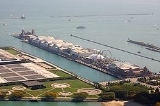
Navy Pier is a 3300 feet (1,005.8 m) long
pierA pier is a raised structure, including bridge and building supports and walkways, over water, typically supported by widely spread piles or pillars...
on the
ChicagoChicago is the largest city in the US state of Illinois. With nearly 2.7 million residents, it is the most populous city in the Midwestern United States and the third most populous in the US, after New York City and Los Angeles...
shoreline of
Lake MichiganLake Michigan is one of the five Great Lakes of North America and the only one located entirely within the United States. It is the second largest of the Great Lakes by volume and the third largest by surface area, after Lake Superior and Lake Huron...
. It is located in the
StreetervilleStreeterville is a neighborhood in the Near North Side community area of Chicago, Illinois, United States, north of the Chicago River in Cook County...
neighborhood of the
Near North SideThe Near North Side is one of 77 well-defined community areas of Chicago, Illinois, United States. It is located north and east of the Chicago River, just north of the central business district . To its east is Lake Michigan and its northern boundary is the 19th-century city limit of Chicago,...
community areaCommunity areas in Chicago refers to the work of the Social Science Research Committee at University of Chicago which has unofficially divided the City of Chicago into 77 community areas. These areas are well-defined and static...
. The pier was built in 1916 at a cost of
$The United States dollar , also referred to as the American dollar, is the official currency of the United States of America. It is divided into 100 smaller units called cents or pennies....
4.5 million, equivalent to $ today. It was a part of the
Plan of ChicagoThe Burnham Plan is a popular name for the 1909 Plan of Chicago, co-authored by Daniel Burnham and Edward H. Bennett. It recommended an integrated series of projects including new and widened streets, parks, new railroad and harbor facilities, and civic buildings...
developed by architect and city planner
Daniel BurnhamDaniel Hudson Burnham, FAIA was an American architect and urban planner. He was the Director of Works for the World's Columbian Exposition in Chicago. He took a leading role in the creation of master plans for the development of a number of cities, including Chicago and downtown Washington DC...
and his associates. As
Municipal Pier #2 (Municipal Pier #1 was never built), Navy Pier was planned and built to serve as a mixed-purpose piece of public infrastructure. Its primary purpose was as a cargo facility for
lake freighterLake freighters, or Lakers, are bulk carrier vessels that ply the Great Lakes. The best known was the , the most recent and largest major vessel to be wrecked on the Lakes. These vessels are traditionally called boats, although classified as ships. In the mid-20th century, 300 lakers worked the...
s, and
warehouseA warehouse is a commercial building for storage of goods. Warehouses are used by manufacturers, importers, exporters, wholesalers, transport businesses, customs, etc. They are usually large plain buildings in industrial areas of cities and towns. They usually have loading docks to load and unload...
s were built up and down the pier. However, the pier was also designed to provide docking space for passenger excursion steamers, and in the pre-
air conditioningAn air conditioner is a home appliance, system, or mechanism designed to dehumidify and extract heat from an area. The cooling is done using a simple refrigeration cycle...
era parts of the pier, especially its outermost tip, were designed to serve as cool places for public gathering and entertainment. The pier even had its own
streetcarA tram is a passenger rail vehicle which runs on tracks along public urban streets and also sometimes on separate rights of way. It may also run between cities and/or towns , and/or partially grade separated even in the cities...
. Today, Navy Pier is Chicago's number one tourist attraction.
Construction
Construction began in 1914 under the leadership of
Charles Sumner FrostCharles Sumner Frost was an American architect.Born in Lewiston, Maine, Frost was first a draftsman in Boston, and a graduate of the Massachusetts Institute of Technology. While working in Boston he worked for the firm of Peabody and Stearns. He moved to Chicago in 1 882. There he began a...
and took two years, at a total cost of $4.5 million. When it opened to the public in 1916, it was the largest pier in the world. The Pier was built both to handle shipping and as an entertainment site. The original
Burnham PlanThe Burnham Plan is a popular name for the 1909 Plan of Chicago, co-authored by Daniel Burnham and Edward H. Bennett. It recommended an integrated series of projects including new and widened streets, parks, new railroad and harbor facilities, and civic buildings...
proposed five piers, but only one was commissioned. In 1917-18, during World War I the pier housed many soldiers, the Red Cross, and Home Defense units. In years to follow the pier expanded to have its own streetcar line, a theater, and an emergency room. In 1927 the pier was officially named Navy Pier in honor of the Naval personnel that served there during the war.
First use: Pier
Even as Chicago Municipal Pier was being built, mass-produced
carsAn automobile, autocar, motor car or car is a wheeled motor vehicle used for transporting passengers, which also carries its own engine or motor...
and
truckA truck or lorry is a motor vehicle designed to transport cargo. Trucks vary greatly in size, power, and configuration, with the smallest being mechanically similar to an automobile...
s were beginning to wreak havoc on the package freight and passenger steamboat industries of
Lake MichiganLake Michigan is one of the five Great Lakes of North America and the only one located entirely within the United States. It is the second largest of the Great Lakes by volume and the third largest by surface area, after Lake Superior and Lake Huron...
. The pier proved to be much more successful as a public gathering place. By the late 1930s, the pier was described as a summer playground, with recreational facilities that included picnicking areas, dining pavilions, a dance hall, auditorium, and children's playground. During the 1950s, it is estimated that an average of 3.2 million visitors frequented the pier annually, with peak attendance for the "Pageant of Progress". This decade is sometimes called the pier's "Golden Age".
During
World War IIWorld War II, or the Second World War , was a global conflict lasting from 1939 to 1945, involving most of the world's nations—including all of the great powers—eventually forming two opposing military alliances: the Allies and the Axis...
the pier returned to serious marine purposes, as the city leased the pier to the
U.S. NavyThe United States Navy is the naval warfare service branch of the United States Armed Forces and one of the seven uniformed services of the United States. The U.S. Navy is the largest in the world; its battle fleet tonnage is greater than that of the next 13 largest navies combined. The U.S...
as a training center. The Navy's air group training arm docked a pair of converted flattops at the pier, the
USS WolverineUSS Wolverine was a freshwater aircraft carrier of the United States Navy during World War II. She had been converted from a paddlewheeler coal-burning steamer to be used for advanced training for naval aviators in carrier take-offs and landings....
and the
USS Sable (IX-81)USS Sable was a training ship of the United States Navy during World War II. Originally built as the Greater Buffalo, a sidewheel excursion steamer, she was converted in 1942 to a freshwater aircraft carrier to be used on the Great Lakes. She was used for advanced training for naval aviators in...
, to use as freshwater training
carriersAn aircraft carrier is a warship designed with a primary mission of deploying and recovering aircraft, acting as a seagoing airbase. Aircraft carriers thus allow a naval force to project air power worldwide without having to depend on local bases for staging aircraft operations...
. During this period, some 60,000 sailors and 15,000 pilots, including
President George H. W. BushGeorge Herbert Walker Bush is an American politician who served as the 41st President of the United States . He had previously served as the 43rd Vice President of the United States , a congressman, an ambassador, and Director of Central Intelligence.Bush was born in Milton, Massachusetts, to...
, trained at the pier.
Second use: College classroom
With the war over, Navy Pier went to the
University of IllinoisThe University of Illinois is a system of public universities in Illinois consisting of three campuses: Urbana-Champaign, Chicago, and Springfield. Across its three campuses, the University of Illinois enrolls about 70,000 students. It had an operating budget of $4.17 billion in 2007.-System:The...
, which used the facility beginning in 1946 for a two-year undergraduate program to educate returning veterans. During its University of Illinois days, Navy Pier was also the site of a string of public events. The International Exhibitions of the early 1960s drew attractions from around the world, including circus and folkloric dance acts, arts and crafts, and international cuisine. In 1965, the University moved to the
Chicago CircleThe University of Illinois at Chicago, or UIC, is a state-funded public research university located in Chicago, Illinois, United States. Its campus is in the Near West Side community area, near the Chicago Loop...
campus, and the pier again fell into disuse.
Third use: Public gathering place
From 1965–1989, Navy Pier was considered underutilized.
In 1976, Navy Pier began its third life as an area for public exhibits, when the East Buildings (furthest into Lake Michigan) were opened as exhibition halls. Special events including music and arts festivals (
ChicagoFestChicagoFest was a summer music festival in the city of Chicago,started in 1978 by Mayor Michael Bilandic. It was held annually at Navy Pier, and lasted for roughly two weeks. It featured sixteen separate stages, each sponsored by a national retail brand and a media sponsor compatible to the stage's...
was one) began to draw crowds to the pier despite its aging infrastructure.
From 1979 to 1987, a submarine, the
USS SilversidesUSS Silversides is a Gato-class submarine, the first ship of the United States Navy to be named for the silversides, a small fish marked with a silvery stripe along each side of its body....
, was docked at Navy Pier.
In 1989, the
Metropolitan Pier and Exposition AuthorityThe Metropolitan Pier and Exposition Authority, commonly known as McPier or MPEA, is a corporation that was created by the Illinois General Assembly in 1989 from the Metropolitan Fair and Exposition Authority by the "Metropolitan Pier and Exposition Authority Act". It owns and manages several...
took control over the pier. Major renovation and construction followed in the 1990s at a cost of US$200 million. As rebuilt in the 1990s, the pier's layout included fast-food kiosks, shops, a ballroom, a concert stage, and convention exhibition halls.
Centerpiece attractions include a
Ferris wheelA Ferris wheel is a nonbuilding structure consisting of a rotating upright wheel with passenger cars attached to the rim in such a way that as the wheel turns, the cars are kept upright, usually by gravity.Some of the largest and most modern Ferris wheels have cars mounted on...
, an
IMAXIMAX is a motion picture film format and a set of proprietary cinema projection standards created by the Canadian company IMAX Corporation. IMAX has the capacity to record and display images of far greater size and resolution than conventional film systems...
theater, the
Chicago Shakespeare TheaterChicago Shakespeare Theater is a non-profit, professional theater company located at Navy Pier in Chicago, Illinois. Its more than six hundred annual performances performed 48 weeks of the year include its critically acclaimed Shakespeare series, its World's Stage touring productions, and youth...
, Amazing Chicago's Funhouse Maze, the
Chicago Children's MuseumThe Chicago Children's Museum is located at Navy Pier in Chicago, Illinois. It was founded in 1982 by The Junior League of Chicago who were responding to programming cutbacks in the Chicago Public Schools...
, the
Smith Museum of Stained Glass WindowsThe Smith Museum of Stained Glass Windows is a permanent exhibition which opened in February 2000 at Chicago’s Navy Pier entertainment complex. It is the first American museum dedicated solely to the art of stained glass windows....
, and at the entrance to Navy Pier is a statue of
Oak ParkOak Park, Illinois is a suburb bordering the west side of the city of Chicago in Cook County, Illinois, United States. It is the twenty-fifth largest municipality in Illinois. Oak Park has easy access to downtown Chicago due to public transportation such as the Chicago 'L' Blue and Green lines,...
comedian
Bob NewhartGeorge Robert Newhart , known professionally as Bob Newhart, is an American stand-up comedian and actor. Noted for his deadpan and slightly stammering delivery, Newhart came to prominence in the 1960s when his album of comedic monologues The Button-Down Mind of Bob Newhart was a worldwide...
, sponsored by the
TV LandTV Land is an American cable television network launched on April 29, 1996. It is owned by MTV Networks, a division of Viacom, which also owns Paramount Pictures, and networks such as MTV and Nickelodeon...
network.
The pier now features a large front lawn showcasing numerous larger-than-life public art sculptures and an interactive animated fountain created by
WETWET , also known as WET Design, is a water feature design firm based in Los Angeles, California, founded in 1983 by former Disney Imagineers Mark Fuller, Melanie Simon, and Alan Robinson...
(of Fountains of Bellagio fame). The pier continues to be used as an embarkation point for tour and excursion boats and is a popular place to watch lakefront events, including the annual Air and Water airshow and the parade of lighted and decorated boats during Chicago's Venetian Night festival.
The pier and its grounds encompass more than 50 acres (202,343 m²) of parks, gardens, shops, restaurants and other shore entertainment. Navy Pier contains 170,000 total square feet of exhibition space, 50000 square feet (4,645.2 m²) of reception space and 48000 square feet (4,459.3 m²) of meeting room space.
Attractions
Navy Pier attractions include sightseeing tours from companies such as Seadog Ventures, Shoreline Sightseeing cruises and Water Taxi service, and the Tall Ship
Windy. There are also dinner cruises by Entertainment Cruises, on their ships the
Spirit of Chicago,
The Odyssey II, and the
Mystic Blue. Other attractions include rides like the Ferris wheel along with many seasonal festivals for Halloween and Christmas. The pier has fireworks on Wednesday and Saturday nights during the summer and Saturday nights during the fall.
The popular Strictly Sail boat show and Chicago Flower and Garden Show are held at the Pier as well as many other fairs and expositions throughout the year. Also a part of Navy Pier is the Children's Museum with many different exhibits and activities for both children and adults to enjoy while visiting the museum. The pier also has an IMAX theater, and the
Smith Museum of Stained Glass WindowsThe Smith Museum of Stained Glass Windows is a permanent exhibition which opened in February 2000 at Chicago’s Navy Pier entertainment complex. It is the first American museum dedicated solely to the art of stained glass windows....
, many of which were salvaged from Chicago mansions.
An anchor from the naval vessel
USS Chicago (CA-136)USS Chicago was a Baltimore class heavy cruiser laid down on 28 July 1943 at Philadelphia, Pennsylvania, USA, by the Philadelphia Navy Yard. Launched on 20 August 1944 she was sponsored by Mrs. Edward J. Kelly, wife of the Mayor of Chicago, Illinois, and commissioned at the Philadelphia Navy Yard...
is on display at the far end of the pier
Future plans
On January 13, 2006, the Metropolitan Pier and Exposition Authority released plans for a major renovation of the pier which would include a
monorailA monorail is a rail-based transportation system based on a single rail, which acts as its sole support and its guideway. The term is also used variously to describe the beam of the system, or the vehicles traveling on such a beam or track...
, a 260 feet (79 m) spokeless
Ferris wheelA Ferris wheel is a nonbuilding structure consisting of a rotating upright wheel with passenger cars attached to the rim in such a way that as the wheel turns, the cars are kept upright, usually by gravity.Some of the largest and most modern Ferris wheels have cars mounted on...
, a
roller coasterThe roller coaster is a popular amusement ride developed for amusement parks and modern theme parks. LaMarcus Adna Thompson patented the first coasters on January 20, 1885...
, floating hotel, and an 80000 square feet (7,432.2 m²) water park with a
Great LakesThe Great Lakes are a collection of freshwater lakes located in northeastern North America, on the Canada – United States border. Consisting of Lakes Superior, Michigan, Huron, Erie, and Ontario, they form the largest group of freshwater lakes on Earth by total surface, coming in second by volume...
theme. The plan would include nearly double the current parking and a replacement theater with a greater capacity. At the time of the announcement, a price tag of $2 billion was announced. No concrete progress was made on those proposals, as the financial condition of the Pier suffered with the recession.
Following the reorganization of the agency that runs Navy Pier and McCormick Place, a new study was commissioned to reinvigorate the upgrade process. The new study, by the Urban Land Institute, was released on November 11, 2010, and recommends a more modest set of enhancements aimed at retaining the Pier's role as a public space, rather than turning it into a theme park. Suggested elements include a concert venue, an enlarged Chicago Shakespeare Festival space, new restaurants, a renovated commercial area around the Pier's entrance, and additional park-like features to bring people closer to the lake. If the Children's Museum moves, the plan also suggests replacing it with another attraction focused on children. More grandiose possibilities, including the enlarged Ferris wheel and a hotel, are mentioned as more remote possibilities.
Gallery
External links