
The
Museum of Fine Arts in Boston,
MassachusettsThe Commonwealth of Massachusetts is a state in the New England region of the northeastern United States of America. It is bordered by Rhode Island and Connecticut to the south, New York to the west, and Vermont and New Hampshire to the north; at its east lies the Atlantic Ocean. As of the 2010...
, is one of the largest museums in the United States, attracting over one million visitors a year. It contains over 450,000 works of art, making it one of the most comprehensive collections in the Americas. It is also
the 54th most visited art museum in the world, as of 2010.
The museum was founded in 1870 and its current location dates to 1909. In addition to its curatorial undertakings, the museum is affiliated with an art academy, the
School of the Museum of Fine ArtsThe School of the Museum of Fine Arts, Boston is an undergraduate and graduate college located in Boston, Massachusetts, dedicated to the visual arts. It is affiliated with the Museum of Fine Arts, Boston and offers undergraduate and graduate degree programs in partnership with Tufts University...
, and a sister museum, the
Nagoya/Boston Museum of Fine ArtsThe is an art museum located in Nagoya, Japan.- History :It is the sister museum of the Museum of Fine Arts, Boston and was established in partnership with the Foundation for the Arts, Nagoya partly to help bring the treasures of the MFA's collection, particularly those of types rarely exhibited...
, in Nagoya, Japan. The current director of the museum is
Malcolm RogersMalcolm Rogers CBE is a British-born art curator who has served as the director of the Museum of Fine Arts, Boston since 1994. In this role he has brought both extensive popularity and controversy to the museum....
.
History
1870–1909
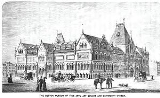
The Museum was founded in 1870 and opened in 1876, with a large portion of its collection taken from the Boston Athenaeum Art Gallery.
Francis Davis MilletFrancis Davis Millet was an American painter, sculptor, and writer who died in the sinking of the on April 15, 1912.-Early life:Francis Davis Millet was born in Mattapoisett, Massachusetts...
was instrumental in starting the Art School attached to the Museum and getting
Emil Otto GrundmannProfessor Emil Otto Grundmann , was a German painter who studied in Antwerp under Baron Hendrik Leys , and in Düsseldorf before moving to America where he became a noted painter. He was the first Director of the School of the Museum of Fine Arts, Boston, an appointment in which Francis Davis...
(1844–1890) appointed as its first director.
Originally located in a highly ornamented brick Gothic Revival building designed by
John Hubbard SturgisJohn Hubbard Sturgis was an American architect active in the Boston area.Sturgis was born in Macau, China, the son of Russell Sturgis , a wealthy Boston merchant active in the China trade. After attending Boston Latin School, he travelled extensively in Europe when his father became a partner in...
and
Charles BrighamCharles Brigham , was a prominent American architect.- Life :Born, raised, and educated in Watertown, Massachusetts, he apprenticed to the Boston architect Gridley J.F. Bryant. Brigham served as a sergeant in the Union Army during the American Civil War, then began work for John Hubbard Sturgis...
, located on
Copley SquareCopley Square is a public square located in the Back Bay neighborhood of Boston, Massachusetts, named for the donor of the land on which it was developed. The square is named for John Singleton Copley, a famous portrait painter of the late 18th century and native of Boston. A bronze statue of...
in the Back Bay neighborhood of Boston. The Copley Square building was notable for its large-scale use of architectural terra cotta in the United States. The Museum moved to its current building in 1909 on Huntington Avenue, Boston's "Avenue of the Arts".
1909-2000s
The museum's present building was commenced in 1907, when museum trustees hired architect
Guy LowellGuy Lowell , American architect, was the son of Mary Walcott and Edward Jackson Lowell, and a member of Boston's well-known Lowell family....
to create a master plan for a museum that could be built in stages as funding was obtained for each phase. The first section of Lowell’s
neoclassicalNeoclassical architecture was an architectural style produced by the neoclassical movement that began in the mid-18th century, manifested both in its details as a reaction against the Rococo style of naturalistic ornament, and in its architectural formulas as an outgrowth of some classicizing...
design was completed in 1909, and featured a 500 feet (152.4 m)
façadeA facade or façade is generally one exterior side of a building, usually, but not always, the front. The word comes from the French language, literally meaning "frontage" or "face"....
of cut
graniteGranite is a common and widely occurring type of intrusive, felsic, igneous rock. Granite usually has a medium- to coarse-grained texture. Occasionally some individual crystals are larger than the groundmass, in which case the texture is known as porphyritic. A granitic rock with a porphyritic...
along Huntington Avenue, the grand
rotundaA rotunda is any building with a circular ground plan, sometimes covered by a dome. It can also refer to a round room within a building . The Pantheon in Rome is a famous rotunda. A Band Rotunda is a circular bandstand, usually with a dome...
, and the associated exhibition galleries. Mrs. Robert Dawson Evans then funded the entire cost of building the next section of the museum’s master plan. This wing along the
Back Bay FensThe Back Bay Fens, most commonly called simply The Fens, is a parkland and urban wild in Boston, Massachusetts, in the United States.Designed by Frederick Law Olmsted to serve as a link in the Emerald Necklace park system, the Fens gives its name to the Fenway-Kenmore neighborhood, and thereby to...
, opened in 1915 and houses painting galleries. From 1916 through 1925,
John Singer SargentJohn Singer Sargent was an American artist, considered the "leading portrait painter of his generation" for his evocations of Edwardian era luxury. During his career, he created roughly 900 oil paintings and more than 2,000 watercolors, as well as countless sketches and charcoal drawings...
created the art that lines the rotunda and the associated
colonnadeIn classical architecture, a colonnade denotes a long sequence of columns joined by their entablature, often free-standing, or part of a building....
. Numerous additions enlarged the building throughout the years including the Decorative Arts Wing in 1968 and the Norma Jean Calderwood Garden Court and Terrace in 1997. This wing now houses the museum's cafe, restaurant, and gift shop as well as exhibition space.
The libraries at the Museum of Fine Arts house an extensive collection of 320,000 items. The
William Morris HuntWilliam Morris Hunt , American painter, was born at Brattleboro, Vermont to Jane Maria Hunt and Hon. Jonathan Hunt, who raised one of the preeminent families in American art...
Memorial Library is named in honor of the Vermont native and Boston painter and arts teacher, many of whose works are in the museum's permanent collection. Among the museum's holdings of Hunt's canvases is the 1866
Italian Peasant Boy.
2000s expansion
In the mid-2000s, the museum embarked on a major renovation project that has included the construction of a new Art of the Americas Wing, showcasing art from North, South, and Central America. The expansion included redesigned and expanded education facilities, and extensive renovations of its European and Classical galleries, visitor services, and conservation facilities. The entire expansion increased the size of the MFA by 28% with an additional 133500 square feet (12,402.6 m²) of space.
Art of the Americas Wing
The Art of the Americas Wing was designed in a restrained, contemporary style by the London architectural firm of
Foster and PartnersFoster + Partners is an architectural firm based in London. The practice is led by its founder and Chairman, Norman Foster, and has constructed many high-profile glass-and-steel buildings....
, under the directorship of Thomas T. Difraia. CBT/Childs Bertman Tseckares Architects of Boston was the project's Architect of Record.
Many of the wing's 53 galleries are dedicated to individual artists or artistic movements, including
pre-ColumbianThe pre-Columbian era incorporates all period subdivisions in the history and prehistory of the Americas before the appearance of significant European influences on the American continents, spanning the time of the original settlement in the Upper Paleolithic period to European colonization during...
arts,
MayaThe Maya is a Mesoamerican civilization, noted for the only known fully developed written language of the pre-Columbian Americas, as well as for its art, architecture, and mathematical and astronomical systems. Initially established during the Pre-Classic period The Maya is a Mesoamerican...
ceramics, Native North American art, African-American artists, the colonial portraiture of
John Singleton CopleyJohn Singleton Copley was an American painter, born presumably in Boston, Massachusetts, and a son of Richard and Mary Singleton Copley, both Irish. He is famous for his portrait paintings of important figures in colonial New England, depicting in particular middle-class subjects...
and
Gilbert StuartGilbert Charles Stuart was an American painter from Rhode Island.Gilbert Stuart is widely considered to be one of America's foremost portraitists...
, the silverware of
Paul ReverePaul Revere was an American silversmith and a patriot in the American Revolution. He is most famous for alerting Colonial militia of approaching British forces before the battles of Lexington and Concord, as dramatized in Henry Wadsworth Longfellow's poem, Paul Revere's Ride...
, the
Hudson River SchoolThe Hudson River School was a mid-19th century American art movement embodied by a group of landscape painters whose aesthetic vision was influenced by romanticism...
of landscape painting,
photographyPhotography is the art, science and practice of creating durable images by recording light or other electromagnetic radiation, either electronically by means of an image sensor or chemically by means of a light-sensitive material such as photographic film...
, and works by
John Singer SargentJohn Singer Sargent was an American artist, considered the "leading portrait painter of his generation" for his evocations of Edwardian era luxury. During his career, he created roughly 900 oil paintings and more than 2,000 watercolors, as well as countless sketches and charcoal drawings...
. In the latter gallery, Sargent's "
The Daughters of Edward Darley BoitThe Daughters of Edward Darley Boit is a painting by John Singer Sargent. The painting depicts four young girls, the daughters of Edward Darley Boit, in their family's Paris apartment. It was painted in 1882 and is now exhibited in the new Art of the Americas Wing of the Museum of Fine Arts in...
" is symmetrically flanked by the tall ceramic vases depicted in the painting. The wing's glass-walled outer hallways display several sculptures from the Museum's collection, including the original
Bacchante and Infant Faun sculpted by
Frederick William MacMonniesFrederick William MacMonnies was the best known expatriate American sculptor of the Beaux-Arts school, as successful and lauded in France as he was in the United States...
for the garden court of the
Boston Public LibraryThe Boston Public Library is a municipal public library system in Boston, Massachusetts, United States. It was the first publicly supported municipal library in the United States, the first large library open to the public in the United States, and the first public library to allow people to...
.
Groundbreaking for the Art of the Americas Wing, which features art from North, South, and Central America, took place in 2006; In the process, the present garden courtyard was transformed into a climate-controlled year-round glass enclosure. Landscape architects
Gustafson Guthrie Nichol redesigned the Huntington Avenue and Fenway entrances, gardens, access roads, and interior courtyards.
The wing opened November 20, 2010, with free admission to the public. Mayor
Thomas MeninoThomas Michael "Tom" Menino is the mayor of Boston, Massachusetts, United States and the city's first Italian-American mayor...
declared it "Museum of Fine Arts Day," and more than 13,500 attended the festive opening. The day kicked off in the wing's enclosed glass-walled court with an
ASLASL is a common initialism for American Sign Language, and may also refer to:*Above sea level, altitude measurement*Adobe Source Libraries, a set of open source software libraries by Adobe...
-interpreted speech by
Malcolm RogersMalcolm Rogers CBE is a British-born art curator who has served as the director of the Museum of Fine Arts, Boston since 1994. In this role he has brought both extensive popularity and controversy to the museum....
. He spoke from the second-floor landing of the cantilevered glass staircase that accesses the wing's three levels of galleries. “Our goal through this project is to make the MFA more accessible," said Rogers. “This is your museum."
Collection and exhibits
Some highlights of the MFA's collection include:
- Egypt
Egypt , officially the Arab Republic of Egypt, Arabic: , is a country mainly in North Africa, with the Sinai Peninsula forming a land bridge in Southwest Asia. Egypt is thus a transcontinental country, and a major power in Africa, the Mediterranean Basin, the Middle East and the Muslim world...
ian artifactAn artifact or artefact is "something made or given shape by man, such as a tool or a work of art, esp an object of archaeological interest"...
s including sculptures, sarcophagiA sarcophagus is a funeral receptacle for a corpse, most commonly carved or cut from stone. The word "sarcophagus" comes from the Greek σαρξ sarx meaning "flesh", and φαγειν phagein meaning "to eat", hence sarkophagus means "flesh-eating"; from the phrase lithos sarkophagos...
, and jewelry.
- French impressionist
Impressionism was a 19th-century art movement that originated with a group of Paris-based artists whose independent exhibitions brought them to prominence during the 1870s and 1880s...
and post-impressionist works including Paul GauguinEugène Henri Paul Gauguin was a leading French Post-Impressionist artist. He was an important figure in the Symbolist movement as a painter, sculptor, print-maker, ceramist, and writer...
's Where Do We Come From? What Are We? Where Are We Going?Where Do We Come From? What Are We? Where Are We Going? is one of Paul Gauguin's most famous paintings. Gauguin inscribed the original French title in the upper left corner: D'où Venons Nous / Que Sommes Nous / Où Allons Nous. The inscription the artist wrote on his canvas has no question mark, no...
as well as works by Manet-MANET as an abbreviation:*MANET is a mobile ad hoc network, a self-configuring mobile wireless network.*MANET database or Molecular Ancestry Network, bioinformatics database-People with the surname Manet:*Édouard Manet, a 19th-century French painter....
, RenoirPierre-Auguste Renoir was a French artist who was a leading painter in the development of the Impressionist style. As a celebrator of beauty, and especially feminine sensuality, it has been said that "Renoir is the final representative of a tradition which runs directly from Rubens to...
, Degas, Monet, Van Gogh, Cézanne and many others.
- 18th and 19th century American art, including many works by John Singleton Copley
John Singleton Copley was an American painter, born presumably in Boston, Massachusetts, and a son of Richard and Mary Singleton Copley, both Irish. He is famous for his portrait paintings of important figures in colonial New England, depicting in particular middle-class subjects...
, Winslow HomerWinslow Homer was an American landscape painter and printmaker, best known for his marine subjects. He is considered one of the foremost painters in 19th century America and a preeminent figure in American art....
and John Singer SargentJohn Singer Sargent was an American artist, considered the "leading portrait painter of his generation" for his evocations of Edwardian era luxury. During his career, he created roughly 900 oil paintings and more than 2,000 watercolors, as well as countless sketches and charcoal drawings...
.
- Extensive collection of Chinese painting
Chinese painting is one of the oldest continuous artistic traditions in the world. The earliest paintings were not representational but ornamental; they consisted of patterns or designs rather than pictures. Early pottery was painted with spirals, zigzags, dots, or animals...
, calligraphy and imperial Chinese artChinese art is visual art that, whether ancient or modern, originated in or is practiced in China or by Chinese artists or performers. Early so-called "stone age art" dates back to 10,000 BC, mostly consisting of simple pottery and sculptures. This early period was followed by a series of art...
, including some of the most treasured paintings in Chinese history.
- The largest museum collection of Japanese works under one roof in the world outside of Japan, including the Edward S. Morse
Edward Sylvester Morse was an American zoologist and orientalist.-Early life:Morse was born in Portland, Maine as the son of a Congregationalist preacher. His mother, who did not share her husband's religious beliefs, encouraged her son's interest in the sciences...
collection of 5,000 pieces of Japanese potteryJapanese pottery and porcelain , one of the country's oldest art forms, dates back to the Neolithic period...
.
- the Gund Gallery which hosts temporary exhibits while a Japanese garden
, that is, gardens in traditional Japanese style, can be found at private homes, in neighborhood or city parks, and at historical landmarks such as Buddhist temples, Shinto shrines and old castles....
provides a quiet, contemplative space outside the museum itself.
More Collection Highlights
- Art of Asia
Asia is the world's largest and most populous continent, located primarily in the eastern and northern hemispheres. It covers 8.7% of the Earth's total surface area and with approximately 3.879 billion people, it hosts 60% of the world's current human population...
, OceaniaOceania is a region centered on the islands of the tropical Pacific Ocean. Conceptions of what constitutes Oceania range from the coral atolls and volcanic islands of the South Pacific to the entire insular region between Asia and the Americas, including Australasia and the Malay Archipelago...
, and AfricaAfrica is the world's second largest and second most populous continent, after Asia. At about 30.2 million km² including adjacent islands, it covers 6% of the Earth's total surface area and 20.4% of the total land area...
- Art of Europe
Europe is, by convention, one of the world's seven continents. Comprising the westernmost peninsula of Eurasia, Europe is generally 'divided' from Asia to its east by the watershed divides of the Ural and Caucasus Mountains, the Ural River, the Caspian and Black Seas, and the waterways connecting...
- Art of the Americas
The Americas, or America , are lands in the Western hemisphere, also known as the New World. In English, the plural form the Americas is often used to refer to the landmasses of North America and South America with their associated islands and regions, while the singular form America is primarily...
- Art of the Ancient World
- Contemporary Art
Contemporary art can be defined variously as art produced at this present point in time or art produced since World War II. The definition of the word contemporary would support the first view, but museums of contemporary art commonly define their collections as consisting of art produced...
- Musical instrument
A musical instrument is a device created or adapted for the purpose of making musical sounds. In principle, any object that produces sound can serve as a musical instrument—it is through purpose that the object becomes a musical instrument. The history of musical instruments dates back to the...
s
- Prints, Drawings, and Photographs
- Textile
A textile or cloth is a flexible woven material consisting of a network of natural or artificial fibres often referred to as thread or yarn. Yarn is produced by spinning raw fibres of wool, flax, cotton, or other material to produce long strands...
and FashionFashion, a general term for a currently popular style or practice, especially in clothing, foot wear, or accessories. Fashion references to anything that is the current trend in look and dress up of a person...
Arts
The Museum also maintains one of the largest on-line art catalogs in the world at http://www.mfa.org, with information about over 346,000 items from its collection available on-line, many with an accompanying photograph.
As a result of the ongoing expansion of the museum, a number of standing exhibits are still in storage.
Notable Curators
- Sylvester Rosa Koehler
Sylvester Rosa Koehler was an author, and the first curator of prints at the Museum of Fine Arts, Boston....
(1837–1900) First Curator of Prints
- Fitzroy Carrington
Fitzroy Carrington was an American editor, born at Surbiton, Surrey, England. He was educated at Victoria College, Jersey, and came to the United States in 1886....
(born 1869) Curator of prints
- William George Constable
William George Constable William George Constable William George Constable (born Derby, England, 27 October 1887, died Cambridge, Massachusetts, 3 February 1976, was an art historian and gallery director.-Education:...
(1887–1976), Curator
- Ernest Fenollosa
Ernest Francisco Fenollosa was an American professor of philosophy and political economy at Tokyo Imperial University...
(1853–1908) – Curator of Oriental Art (1890–1896)
- Okakura Kakuzō
was a Japanese scholar who contributed to the development of arts in Japan. Outside of Japan, he is chiefly remembered today as the author of The Book of Tea.-Biography:...
(1863–1913) – Curator of Oriental Art (1904–1913)
- Ananda Coomaraswamy
Ananda Kentish Coomaraswamy was a Ceylonese philosopher and metaphysician, as well as a pioneering historian and philosopher of Indian art, particularly art history and symbolism, and an early interpreter of Indian culture to the West...
(1877–1947) – Curator of Oriental Art
- Robert Treat Paine (d. 1965) – Curator of Japanese Art (1963–1965)
- Jonathan Leo Fairbanks
Jonathan Leo Fairbanks is an American artist and expert of American arts and antiques. Fairbanks created the American decorative arts and sculpture department at the Museum of Fine Arts, Boston, and served as the department’s Curator from 1970-1999.Fairbanks is the son of the American sculptor,...
(1933-present)- Katharine Lane Weems Curator of American Decorative Arts and Sculpture (1970-1999)
- Anne Nishimura Morse (1956–present)-William and Helen Pounds Senior Curator of Japanese Art (1985–present)
Visiting
The MFA is open seven days a week. Admission to the museum is charged at most times, but is by donation on Wednesdays after 4 p.m. Admission includes a free repeat visit within ten days. The museum is open late, until 9:45 p.m., on Wednesdays, Thursdays and Fridays. Children under 17 are admitted free, except during school hours. The MFA's University Membership program offers area college students free admission with a valid college photo ID.
External links