

Araucaria angustifolia

Encyclopedia
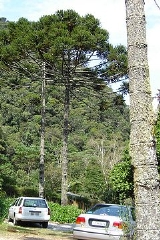
Araucaria angustifolia, the Paraná pine or Brazilian pine , is a species in the conifer
genus Araucaria
. Covering an original area of 233000 km², it is native to southern Brazil (sometimes found in high-altitude areas of southern Minas Gerais
, southern Rio de Janeiro
and in the east and south of São Paulo
, but more typically in the states of Paraná
, Santa Catarina
and Rio Grande do Sul
), according to a study made by the Brazilian researcher, Maack, the original area of occurrence represented 36,67% of the Paraná state (73088 km²), 60,13% of the Santa Catarina state (57332 km ), 21,6% of the São Paulo state (53613 km²) and 17,38% of the Rio Grande do Sul state (48968 km²); it is found too, in the northeast of Argentina
(Misiones
and Corrientes
) and locally in Paraguay
(Alto Paraná
), growing in low mountains at altitudes of 500–1800 meters.
It is an evergreen
tree growing to 40 m tall and 1 m trunk diameter. The leaves are thick, tough and scale like, triangular, 3–6 cm long, 5–10 mm broad at the base, and with razor-sharp edges and tip. They persist 10 to 15 years, so cover most of the tree except for the trunk and older branches.
 It is usually dioecious
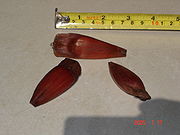
, with the male and female cones
on separate trees. The male (pollen) cones are oblong, 60 cm long at first, expanding to 10–18 cm long by 15–25 mm broad at pollen release. Like all conifers it is wind pollinated. The female cones (seed), which mature in autumn about 18 months after pollination, are globose, large, 18–25 cm diameter, and hold about 100–150 seeds. The cones disintegrate at maturity to release the approximately 5 cm long nut
-like seeds, which are then dispersed by animals, notably the Azure Jay
, Cyanocorax caeruleus.
It is closely related to Araucaria araucana
from further southwest in South America, differing most conspicuously in the narrower leaves.
It prefers well drained, slightly acidic soil
but will tolerate almost any soil type provided drainage is good. It requires a subtropical climate with abundant rainfall, tolerating occasional frosts down to about −5 °C to -20°C . It is a popular garden tree in subtropical areas, planted for its unusual effect of the thick, 'reptilian' branches with a very symmetrical appearance.
The seeds, similar to large pine nut
s, are edible, and are extensively harvested in southern Brazil (Paraná
, Santa Catarina
and Rio Grande do Sul
States), a habit particularly important for the region's small population of Native Americans
. The seeds, called pinhão piˈɲɐ̃w̃ are popular as a winter snack. The city of Lages
, in Santa Catarina state, holds a popular pinhão fair, in which hot wine and boiled araucaria seeds are consumed. In Brazil, 3,400 tonne
s of seeds are collected annually which, combined with extensive logging
, seriously threatens the regeneration of the species.
The seeds are very important for the native animals. Several mammals and birds eat pinhão, and it has an important ecological role in Ombrophilous Mixed Forests (a sub-type of the Brazilian Atlantic Forest).
Although the common names in various languages refer to the species as a "pine", it is not a true pine
.
Pinophyta
The conifers, division Pinophyta, also known as division Coniferophyta or Coniferae, are one of 13 or 14 division level taxa within the Kingdom Plantae. Pinophytes are gymnosperms. They are cone-bearing seed plants with vascular tissue; all extant conifers are woody plants, the great majority being...
genus Araucaria
Araucaria
Araucaria is a genus of evergreen coniferous trees in the family Araucariaceae. There are 19 extant species in the genus, with a highly disjunct distribution in New Caledonia , Norfolk Island, eastern Australia, New Guinea, Argentina, Chile, and southern Brazil.-Description:Araucaria are mainly...
. Covering an original area of 233000 km², it is native to southern Brazil (sometimes found in high-altitude areas of southern Minas Gerais
Minas Gerais
Minas Gerais is one of the 26 states of Brazil, of which it is the second most populous, the third richest, and the fourth largest in area. Minas Gerais is the Brazilian state with the largest number of Presidents of Brazil, the current one, Dilma Rousseff, being one of them. The capital is the...
, southern Rio de Janeiro
Rio de Janeiro (state)
Rio de Janeiro is one of the 27 states of Brazil.Rio de Janeiro has the second largest economy of Brazil behind only São Paulo state.The state of Rio de Janeiro is located within the Brazilian geopolitical region classified as the Southeast...
and in the east and south of São Paulo
São Paulo (state)
São Paulo is a state in Brazil. It is the major industrial and economic powerhouse of the Brazilian economy. Named after Saint Paul, São Paulo has the largest population, industrial complex, and economic production in the country. It is the richest state in Brazil...
, but more typically in the states of Paraná
Paraná (state)
Paraná is one of the states of Brazil, located in the South of the country, bordered on the north by São Paulo state, on the east by the Atlantic Ocean, on the south by Santa Catarina state and the Misiones Province of Argentina, and on the west by Mato Grosso do Sul and the republic of Paraguay,...
, Santa Catarina
Santa Catarina (state)
Santa Catarina is a state in southern Brazil with one of the highest standards of living in Latin America. Its capital is Florianópolis, which mostly lies on the Santa Catarina Island. Neighbouring states are Rio Grande do Sul to the south and Paraná to the north. It is bounded on the east by...
and Rio Grande do Sul
Rio Grande do Sul
Rio Grande do Sul is the southernmost state in Brazil, and the state with the fifth highest Human Development Index in the country. In this state is located the southernmost city in the country, Chuí, on the border with Uruguay. In the region of Bento Gonçalves and Caxias do Sul, the largest wine...
), according to a study made by the Brazilian researcher, Maack, the original area of occurrence represented 36,67% of the Paraná state (73088 km²), 60,13% of the Santa Catarina state (57332 km ), 21,6% of the São Paulo state (53613 km²) and 17,38% of the Rio Grande do Sul state (48968 km²); it is found too, in the northeast of Argentina
Argentina
Argentina , officially the Argentine Republic , is the second largest country in South America by land area, after Brazil. It is constituted as a federation of 23 provinces and an autonomous city, Buenos Aires...
(Misiones
Misiones Province
Misiones is one of the 23 provinces of Argentina, located in the northeastern corner of the country in the Mesopotamiсa region. It is surrounded by Paraguay to the northwest, Brazil to the north, east and south, and Corrientes Province of Argentina to the southwest.- History :The province was...
and Corrientes
Corrientes Province
Corrientes is a province in northeast Argentina, in the Mesopotamia region. It is surrounded by : Paraguay, the province of Misiones, Brazil, Uruguay, and the provinces of Entre Rios, Santa Fe and Chaco.-History:...
) and locally in Paraguay
Paraguay
Paraguay , officially the Republic of Paraguay , is a landlocked country in South America. It is bordered by Argentina to the south and southwest, Brazil to the east and northeast, and Bolivia to the northwest. Paraguay lies on both banks of the Paraguay River, which runs through the center of the...
(Alto Paraná
Alto Paraná Department
Alto Paraná is a department in Paraguay. The capital is Ciudad del Este .The Alto Paraná department has experienced tremendous economic and population growth in the past 50 years...
), growing in low mountains at altitudes of 500–1800 meters.
It is an evergreen
Evergreen
In botany, an evergreen plant is a plant that has leaves in all seasons. This contrasts with deciduous plants, which completely lose their foliage during the winter or dry season.There are many different kinds of evergreen plants, both trees and shrubs...
tree growing to 40 m tall and 1 m trunk diameter. The leaves are thick, tough and scale like, triangular, 3–6 cm long, 5–10 mm broad at the base, and with razor-sharp edges and tip. They persist 10 to 15 years, so cover most of the tree except for the trunk and older branches.
Plant sexuality
Plant sexuality covers the wide variety of sexual reproduction systems found across the plant kingdom. This article describes morphological aspects of sexual reproduction of plants....
, with the male and female cones
Conifer cone
A cone is an organ on plants in the division Pinophyta that contains the reproductive structures. The familiar woody cone is the female cone, which produces seeds. The male cones, which produce pollen, are usually herbaceous and much less conspicuous even at full maturity...
on separate trees. The male (pollen) cones are oblong, 60 cm long at first, expanding to 10–18 cm long by 15–25 mm broad at pollen release. Like all conifers it is wind pollinated. The female cones (seed), which mature in autumn about 18 months after pollination, are globose, large, 18–25 cm diameter, and hold about 100–150 seeds. The cones disintegrate at maturity to release the approximately 5 cm long nut
Nut (fruit)
A nut is a hard-shelled fruit of some plants having an indehiscent seed. While a wide variety of dried seeds and fruits are called nuts in English, only a certain number of them are considered by biologists to be true nuts...
-like seeds, which are then dispersed by animals, notably the Azure Jay
Azure Jay
The Azure Jay is a passeriform bird of the crow family Corvidae. It is found in the Atlantic Forest, especially with Araucaria angustifolia, in south-eastern Brazil , far eastern Paraguay and far north-eastern Argentina...
, Cyanocorax caeruleus.
It is closely related to Araucaria araucana
Araucaria araucana
Araucaria araucana is an evergreen tree growing to tall with a trunk diameter. The tree is native to central and southern Chile, western Argentina and south Brazil. Araucaria araucana is the hardiest species in the conifer genus Araucaria...
from further southwest in South America, differing most conspicuously in the narrower leaves.
It prefers well drained, slightly acidic soil
Soil
Soil is a natural body consisting of layers of mineral constituents of variable thicknesses, which differ from the parent materials in their morphological, physical, chemical, and mineralogical characteristics...
but will tolerate almost any soil type provided drainage is good. It requires a subtropical climate with abundant rainfall, tolerating occasional frosts down to about −5 °C to -20°C . It is a popular garden tree in subtropical areas, planted for its unusual effect of the thick, 'reptilian' branches with a very symmetrical appearance.
The seeds, similar to large pine nut
Pine nut
Pine nuts are the edible seeds of pines . About 20 species of pine produce seeds large enough to be worth harvesting; in other pines the seeds are also edible, but are too small to be of great value as a human food....
s, are edible, and are extensively harvested in southern Brazil (Paraná
Paraná (state)
Paraná is one of the states of Brazil, located in the South of the country, bordered on the north by São Paulo state, on the east by the Atlantic Ocean, on the south by Santa Catarina state and the Misiones Province of Argentina, and on the west by Mato Grosso do Sul and the republic of Paraguay,...
, Santa Catarina
Santa Catarina (state)
Santa Catarina is a state in southern Brazil with one of the highest standards of living in Latin America. Its capital is Florianópolis, which mostly lies on the Santa Catarina Island. Neighbouring states are Rio Grande do Sul to the south and Paraná to the north. It is bounded on the east by...
and Rio Grande do Sul
Rio Grande do Sul
Rio Grande do Sul is the southernmost state in Brazil, and the state with the fifth highest Human Development Index in the country. In this state is located the southernmost city in the country, Chuí, on the border with Uruguay. In the region of Bento Gonçalves and Caxias do Sul, the largest wine...
States), a habit particularly important for the region's small population of Native Americans
Indigenous peoples in Brazil
The Indigenous peoples in Brazil comprise a large number of distinct ethnic groups who inhabited the country prior to the European invasion around 1500...
. The seeds, called pinhão piˈɲɐ̃w̃ are popular as a winter snack. The city of Lages
Lages
Lages, formerly Lajens, is a Brazilian town located in the central part of the state of Santa Catarina, in the region known in Portuguese as "Planalto Serrano"....
, in Santa Catarina state, holds a popular pinhão fair, in which hot wine and boiled araucaria seeds are consumed. In Brazil, 3,400 tonne
Tonne
The tonne, known as the metric ton in the US , often put pleonastically as "metric tonne" to avoid confusion with ton, is a metric system unit of mass equal to 1000 kilograms. The tonne is not an International System of Units unit, but is accepted for use with the SI...
s of seeds are collected annually which, combined with extensive logging
Logging
Logging is the cutting, skidding, on-site processing, and loading of trees or logs onto trucks.In forestry, the term logging is sometimes used in a narrow sense concerning the logistics of moving wood from the stump to somewhere outside the forest, usually a sawmill or a lumber yard...
, seriously threatens the regeneration of the species.
The seeds are very important for the native animals. Several mammals and birds eat pinhão, and it has an important ecological role in Ombrophilous Mixed Forests (a sub-type of the Brazilian Atlantic Forest).
Although the common names in various languages refer to the species as a "pine", it is not a true pine
Pine
Pines are trees in the genus Pinus ,in the family Pinaceae. They make up the monotypic subfamily Pinoideae. There are about 115 species of pine, although different authorities accept between 105 and 125 species.-Etymology:...
.