

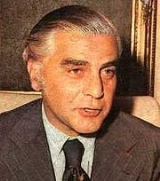
Antonio Cafiero

Encyclopedia
Antonio Francisco Cafiero (born September 12, 1922) is an Argentine
Justicialist Party
politician.
. He joined Catholic Action
in 1938, and enrolled at the University of Buenos Aires
, becoming President of the Students' Association. He graduated as an accountant
in 1944, and earned a Doctor in Economic Sciences in 1948, teaching in the discipline as a professor from 1952 to 1984. Cafiero became a militant Peronist from the October 17, 1945, mass demonstrations
in support of populist leader Juan Perón
, and entered public service in 1952 as Minister of Foreign Trade in the latter's administration, serving until 1954. He married the former Ana Goitía, and they had ten children.
Cafiero held offices in the National Justicialist Movement from 1962, as well as in different institutions within the Justicialist Party
at the national level and in Buenos Aires Province
. Following the return of Peronists to power in the 1973 elections
, Cafiero was appointed Secretary of Commerce in Perón's last term (1974). Following Perón's death and his replacement by his wife, Vice-President Isabel Perón, he was appointed Federal Interventor
of Mendoza Province
(1974–1975), and as Ambassador to the European Economic Community
and Belgium
(1975). Cafiero was appointed Economy Minister
in August. He grappled with the aftermath of the June 1975 Rodrigazo
, economic shock treatment enacted by a predecessor, with no success, and he was dismissed in February 1976, serving briefly as Ambassador to the Holy See
(until the March 1976 coup).
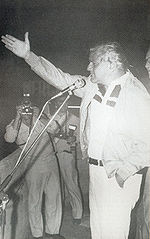 He founded the Movement for Unity, Solidarity and Organization in September 1982, a reformist faction of the Justicialist Party
, ahead of the 1983 return of democracy
. The group, known as Renovación Peronista (Peronist Renewal), was defeated in the party's September 1983 nominating convention, however, by more conservative figures supported by Lorenzo Miguel
of the Steelworkers' Union. Cafiero was elected to the Argentine Chamber of Deputies
in 1985, and in 1987, Governor of Buenos Aires Province
. Elected President of the Justicialist Party National Council, he ran in the May 1988 primary election
for the upcoming presidential campaign. He failed to regain the support of the CGT
, or to sway delegates from the smaller provinces, and lost to Carlos Menem
, who subsequently won the 1989 general election
.
Menem appointed Cafiero Ambassador to Chile
in 1992, and Cafiero returned to elected office as a Senator
in 1993. He took part in the convention negotiating the 1994 amendment of the Argentine Constitution, which allowed for Menem's re-election. The amended Argentine Constitution included article 129, which guaranteed Buenos Aires
greater self-governance. The Indentente (appointed Mayor) was replaced by a Jefe de Gobierno (elected Mayor), and the city council by the Buenos Aires City Legislature
. Shortly before the historic, June 30, 1996, elections to these posts, however, Senator Cafiero succeeded in limiting the city's autonomy by advancing National Law 24.588, which reserved control of the Argentine Federal Police (the federally-administered city force), the Port of Buenos Aires
and other faculties to the national government
. The controversial bill, popularly known afterward as Ley Cafiero (the "Cafiero Law") was signed in 1996 by President Menem, remaining a sticking point between successive Presidents (most of whom have been Peronist) and Buenos Aires Mayors (none of whom have been).
Cafiero was re-elected as Senator in 2001. The aging lawmaker, who had severe hearing loss by then, took leave to act as Cabinet Chief during the transitional presidency of Eduardo Camaño
(2001–02), returning to the Senate and retiring in 2005.
Cafiero was formally accused in 2006, along with Isabel Perón and several of her former ministers, of involvement in the forced disappearance
of a minor in 1976. President Isabel Perón and her cabinet had signed decrees on October 6, 1975, ordering "military and security operations that may be needed to annihilate subversive elements throughout the territory of the country" (see Dirty War
for historical context). Cafiero, during the Trial of the Juntas in 1985, had stated that the government believed that common police tactics were not enough to combat the guerrillas, and that he learned of the human rights violations committed then only after the coup d'état that ousted Isabel Perón on March 24, 1976.
Cafiero has served as President of COPPPAL
, the Permanent Conference of Political Parties of Latin America and the Caribbean, since 2005.
Cafiero lost his wife of fifty years, Ana Goitía, in 1994. His son, Juan Pablo Cafiero
, was appointed as Ambassador to the Holy See in 2008. He had been a national deputy
for the Peronists
and for FrePaSo, Minister for Social Development under Presidents Fernando de la Rúa
and Eduardo Duhalde
, and as Minister of Security for Buenos Aires Province. Another son, Mario Cafiero, served as a National Deputy from 1997 to 2005.
Argentina
Argentina , officially the Argentine Republic , is the second largest country in South America by land area, after Brazil. It is constituted as a federation of 23 provinces and an autonomous city, Buenos Aires...
Justicialist Party
Justicialist Party
The Justicialist Party , or PJ, is a Peronist political party in Argentina, and the largest component of the Peronist movement.The party was led by Néstor Kirchner, President of Argentina from 2003 to 2007, until his death on October 27, 2010. The current Argentine president, Cristina Fernández de...
politician.
Biography
Cafiero was born in Buenos AiresBuenos Aires
Buenos Aires is the capital and largest city of Argentina, and the second-largest metropolitan area in South America, after São Paulo. It is located on the western shore of the estuary of the Río de la Plata, on the southeastern coast of the South American continent...
. He joined Catholic Action
Catholic Action
Catholic Action was the name of many groups of lay Catholics who were attempting to encourage a Catholic influence on society.They were especially active in the nineteenth century in historically Catholic countries that fell under anti-clerical regimes such as Spain, Italy, Bavaria, France, and...
in 1938, and enrolled at the University of Buenos Aires
University of Buenos Aires
The University of Buenos Aires is the largest university in Argentina and the largest university by enrollment in Latin America. Founded on August 12, 1821 in the city of Buenos Aires, it consists of 13 faculties, 6 hospitals, 10 museums and is linked to 4 high schools: Colegio Nacional de Buenos...
, becoming President of the Students' Association. He graduated as an accountant
Accountant
An accountant is a practitioner of accountancy or accounting , which is the measurement, disclosure or provision of assurance about financial information that helps managers, investors, tax authorities and others make decisions about allocating resources.The Big Four auditors are the largest...
in 1944, and earned a Doctor in Economic Sciences in 1948, teaching in the discipline as a professor from 1952 to 1984. Cafiero became a militant Peronist from the October 17, 1945, mass demonstrations
Loyalty Day (Argentina)
The Loyalty Day is a commemoration day in Argentina. It remembers October 17, 1945, when a massive labour demonstration at the Plaza de Mayo demanded the liberation of Juan Perón, who was jailed in Martín García island...
in support of populist leader Juan Perón
Juan Perón
Juan Domingo Perón was an Argentine military officer, and politician. Perón was three times elected as President of Argentina though he only managed to serve one full term, after serving in several government positions, including the Secretary of Labor and the Vice Presidency...
, and entered public service in 1952 as Minister of Foreign Trade in the latter's administration, serving until 1954. He married the former Ana Goitía, and they had ten children.
Cafiero held offices in the National Justicialist Movement from 1962, as well as in different institutions within the Justicialist Party
Justicialist Party
The Justicialist Party , or PJ, is a Peronist political party in Argentina, and the largest component of the Peronist movement.The party was led by Néstor Kirchner, President of Argentina from 2003 to 2007, until his death on October 27, 2010. The current Argentine president, Cristina Fernández de...
at the national level and in Buenos Aires Province
Buenos Aires Province
The Province of Buenos Aires is the largest and most populous province of Argentina. It takes the name from the city of Buenos Aires, which used to be the provincial capital until it was federalized in 1880...
. Following the return of Peronists to power in the 1973 elections
Argentine general election, March 1973
The first Argentine general election of 1973 was held on 11 March. Voters chose both the President and their legislators and with a turnout of 85.5%, it produced the following results:-President:...
, Cafiero was appointed Secretary of Commerce in Perón's last term (1974). Following Perón's death and his replacement by his wife, Vice-President Isabel Perón, he was appointed Federal Interventor
Federal intervention
Federal intervention is an attribution of the federal government of Argentina, by which it takes control of a province in certain extreme cases. Intervention is declared by the President with the assent of the National Congress...
of Mendoza Province
Mendoza Province
The Province of Mendoza is a province of Argentina, located in the western central part of the country in the Cuyo region. It borders to the north with San Juan, the south with La Pampa and Neuquén, the east with San Luis, and to the west with the republic of Chile; the international limit is...
(1974–1975), and as Ambassador to the European Economic Community
European Economic Community
The European Economic Community The European Economic Community (EEC) The European Economic Community (EEC) (also known as the Common Market in the English-speaking world, renamed the European Community (EC) in 1993The information in this article primarily covers the EEC's time as an independent...
and Belgium
Belgium
Belgium , officially the Kingdom of Belgium, is a federal state in Western Europe. It is a founding member of the European Union and hosts the EU's headquarters, and those of several other major international organisations such as NATO.Belgium is also a member of, or affiliated to, many...
(1975). Cafiero was appointed Economy Minister
Minister of Economy of Argentina
The Minister of Economy is the head of the Ministry of Economy and Production of Argentina, concerned with finance and monetary matters. The position within the Government of Argentina is analogous to the finance ministers of some countries and the United States Treasury Secretary...
in August. He grappled with the aftermath of the June 1975 Rodrigazo
Rodrigazo
Rodrigazo is the name given to a group of economic policies announced in Argentina on June 4, 1975, and their immediate aftermath. The name Rodrigazo stems from the fact that the policies were announced and implemented by Celestino Rodrigo, the Minister of Economy of Argentina appointed by...
, economic shock treatment enacted by a predecessor, with no success, and he was dismissed in February 1976, serving briefly as Ambassador to the Holy See
Holy See
The Holy See is the episcopal jurisdiction of the Catholic Church in Rome, in which its Bishop is commonly known as the Pope. It is the preeminent episcopal see of the Catholic Church, forming the central government of the Church. As such, diplomatically, and in other spheres the Holy See acts and...
(until the March 1976 coup).
Justicialist Party
The Justicialist Party , or PJ, is a Peronist political party in Argentina, and the largest component of the Peronist movement.The party was led by Néstor Kirchner, President of Argentina from 2003 to 2007, until his death on October 27, 2010. The current Argentine president, Cristina Fernández de...
, ahead of the 1983 return of democracy
Argentine general election, 1983
The Argentine general election of 1983 was held on 30 October and marked the return of Democracy after the 1976's dictatorship self-known as National Reorganization Process...
. The group, known as Renovación Peronista (Peronist Renewal), was defeated in the party's September 1983 nominating convention, however, by more conservative figures supported by Lorenzo Miguel
Lorenzo Miguel
Lorenzo Miguel was a prominent Argentine labor leader closely associated with the steelworkers' union.-Early life and his rise in the UOM:...
of the Steelworkers' Union. Cafiero was elected to the Argentine Chamber of Deputies
Argentine Chamber of Deputies
The Chamber of Deputies is the lower house of the Argentine National Congress. This Chamber holds exclusive rights to create taxes, to draft troops, and to accuse the President, the ministers and the members of the Supreme Court before the Senate....
in 1985, and in 1987, Governor of Buenos Aires Province
Governor of Buenos Aires Province
The governor of the Buenos Aires province is a citizen of the Buenos Aires Province of Argentina, holding the office of governor for the corresponding period. The governor is elected alongside a vice-governor. It must not be confused with the Mayor of Buenos Aires, as the city of Buenos Aires is a...
. Elected President of the Justicialist Party National Council, he ran in the May 1988 primary election
Primary election
A primary election is an election in which party members or voters select candidates for a subsequent election. Primary elections are one means by which a political party nominates candidates for the next general election....
for the upcoming presidential campaign. He failed to regain the support of the CGT
General Confederation of Labour (Argentina)
The General Confederation of Labour of the Argentine Republic is a national trade union centre of Argentina founded on September 27, 1930, as the result of the merge of the USA and the COA trade union centres...
, or to sway delegates from the smaller provinces, and lost to Carlos Menem
Carlos Menem
Carlos Saúl Menem is an Argentine politician who was President of Argentina from 1989 to 1999. He is currently an Argentine National Senator for La Rioja Province.-Early life:...
, who subsequently won the 1989 general election
Argentine general election, 1989
The Argentine general election of 1989 was held on 14 May. Voters chose both the President and their legislators and with a turnout of 85.3%, it produced the following results:-President:aAbstentions.-Argentine Congress:...
.
Menem appointed Cafiero Ambassador to Chile
Argentina-Chile relations
Argentina–Chile relations refers to interstate relations between the Republic of Chile and the Argentine Republic. Argentina and Chile share the world's third-longest international border, which is long and runs from north to the south along the Andes mountains...
in 1992, and Cafiero returned to elected office as a Senator
Argentine Senate
The Argentine Senate is the upper house of the Argentine National Congress. It has 72 senators: three for each province and three for the Autonomous City of Buenos Aires...
in 1993. He took part in the convention negotiating the 1994 amendment of the Argentine Constitution, which allowed for Menem's re-election. The amended Argentine Constitution included article 129, which guaranteed Buenos Aires
Buenos Aires
Buenos Aires is the capital and largest city of Argentina, and the second-largest metropolitan area in South America, after São Paulo. It is located on the western shore of the estuary of the Río de la Plata, on the southeastern coast of the South American continent...
greater self-governance. The Indentente (appointed Mayor) was replaced by a Jefe de Gobierno (elected Mayor), and the city council by the Buenos Aires City Legislature
Buenos Aires City Legislature
The Buenos Aires City Legislature is a central part of the Government of the City of Buenos Aires, as well as an architectural landmark in the city's Montserrat section.-History:...
. Shortly before the historic, June 30, 1996, elections to these posts, however, Senator Cafiero succeeded in limiting the city's autonomy by advancing National Law 24.588, which reserved control of the Argentine Federal Police (the federally-administered city force), the Port of Buenos Aires
Port of Buenos Aires
The Port of Buenos Aires is the principal maritime port in Argentina. Operated by the Administración General de Puertos , a State enterprise, it is the leading transshipment point for the foreign trade of Argentina....
and other faculties to the national government
Government of Argentina
The government of Argentina, functioning within the framework of a federal system, is a presidential representative democratic republic. The President of Argentina is both head of state and head of government. Executive power is exercised by the President. Legislative power is vested in both the...
. The controversial bill, popularly known afterward as Ley Cafiero (the "Cafiero Law") was signed in 1996 by President Menem, remaining a sticking point between successive Presidents (most of whom have been Peronist) and Buenos Aires Mayors (none of whom have been).
Cafiero was re-elected as Senator in 2001. The aging lawmaker, who had severe hearing loss by then, took leave to act as Cabinet Chief during the transitional presidency of Eduardo Camaño
Eduardo Camaño
Eduardo Oscar Camaño is an Argentine Justicialist Party politician. He was acting head of the executive branch of the country for two days between December 31, 2001 and January 1, 2002....
(2001–02), returning to the Senate and retiring in 2005.
Cafiero was formally accused in 2006, along with Isabel Perón and several of her former ministers, of involvement in the forced disappearance
Forced disappearance
In international human rights law, a forced disappearance occurs when a person is secretly abducted or imprisoned by a state or political organization or by a third party with the authorization, support, or acquiescence of a state or political organization, followed by a refusal to acknowledge the...
of a minor in 1976. President Isabel Perón and her cabinet had signed decrees on October 6, 1975, ordering "military and security operations that may be needed to annihilate subversive elements throughout the territory of the country" (see Dirty War
Dirty War
The Dirty War was a period of state-sponsored violence in Argentina from 1976 until 1983. Victims of the violence included several thousand left-wing activists, including trade unionists, students, journalists, Marxists, Peronist guerrillas and alleged sympathizers, either proved or suspected...
for historical context). Cafiero, during the Trial of the Juntas in 1985, had stated that the government believed that common police tactics were not enough to combat the guerrillas, and that he learned of the human rights violations committed then only after the coup d'état that ousted Isabel Perón on March 24, 1976.
Cafiero has served as President of COPPPAL
COPPPAL
The Permanent Conference of Political Parties of Latin America and the Caribbean , or COPPPAL, is an international forum of political parties in Latin America and the Caribbean.-Overview:...
, the Permanent Conference of Political Parties of Latin America and the Caribbean, since 2005.
Cafiero lost his wife of fifty years, Ana Goitía, in 1994. His son, Juan Pablo Cafiero
Juan Pablo Cafiero
Juan Pablo Cafiero is an Argentine politician and the Argentine Ambassador to the Vatican since 2008. He has served as a National Deputy and government minister, and is the son of Peronist grandee Antonio Cafiero.In his youth, Cafiero was an activist in the Peronist Youth and headed the...
, was appointed as Ambassador to the Holy See in 2008. He had been a national deputy
Argentine Chamber of Deputies
The Chamber of Deputies is the lower house of the Argentine National Congress. This Chamber holds exclusive rights to create taxes, to draft troops, and to accuse the President, the ministers and the members of the Supreme Court before the Senate....
for the Peronists
Justicialist Party
The Justicialist Party , or PJ, is a Peronist political party in Argentina, and the largest component of the Peronist movement.The party was led by Néstor Kirchner, President of Argentina from 2003 to 2007, until his death on October 27, 2010. The current Argentine president, Cristina Fernández de...
and for FrePaSo, Minister for Social Development under Presidents Fernando de la Rúa
Fernando de la Rúa
Fernando de la Rúa is an Argentine politician. He was president of the country from December 10, 1999 to December 21, 2001 for the Alliance for Work, Justice and Education ....
and Eduardo Duhalde
Eduardo Duhalde
-External links:...
, and as Minister of Security for Buenos Aires Province. Another son, Mario Cafiero, served as a National Deputy from 1997 to 2005.