


Antidoron

Encyclopedia
Byzantine Rite
The Byzantine Rite, sometimes called the Rite of Constantinople or Constantinopolitan Rite is the liturgical rite used currently by all the Eastern Orthodox Churches, by the Greek Catholic Churches , and by the Protestant Ukrainian Lutheran Church...
. It comes from the remains of the loaves
Loaf
A loaf is a shape, usually rounded or oblong, mass of food. It may refer to a bread, or meatloaf.The term "loaf" sometimes refers to "head" from the rhyming slang "loaf of bread" ....
of bread (prosphora
Prosphora
A prosphoron is a small loaf of leavened bread used in Orthodox Christian and Greek Catholic liturgies. The plural form is prosphora...
) from which portions are cut for consecration
Consecration
Consecration is the solemn dedication to a special purpose or service, usually religious. The word "consecration" literally means "to associate with the sacred". Persons, places, or things can be consecrated, and the term is used in various ways by different groups...
as the Eucharist
Eucharist
The Eucharist , also called Holy Communion, the Sacrament of the Altar, the Blessed Sacrament, the Lord's Supper, and other names, is a Christian sacrament or ordinance...
during the Divine Liturgy
Divine Liturgy
Divine Liturgy is the common term for the Eucharistic service of the Byzantine tradition of Christian liturgy. As such, it is used in the Eastern Orthodox and Eastern Catholic Churches. Armenian Christians, both of the Armenian Apostolic Church and of the Armenian Catholic Church, use the same term...
.
Orthodox Christianity
In the Orthodox ChurchEastern Orthodox Church
The Orthodox Church, officially called the Orthodox Catholic Church and commonly referred to as the Eastern Orthodox Church, is the second largest Christian denomination in the world, with an estimated 300 million adherents mainly in the countries of Belarus, Bulgaria, Cyprus, Georgia, Greece,...
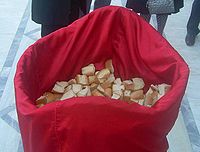
, blessed antidoron is distributed after every Divine Liturgy. During the Prothesis (Liturgy of Preparation, at which the wine and bread are prepared on the Table of Oblation), the priest will bless each prosphoron as he takes it up to remove particles and place them on the diskos (paten). The remainder of the prosphora is cut into fragments and kept aside in a bowl or salver
Salver
A salver is a flat tray of silver or other metal used for carrying or serving glasses, cups and dishes at table or for the presenting of a letter or card by a servant...
. In some jurisdictions it is the custom at the end of the Anaphora
Anaphora (liturgy)
The Anaphora is the most solemn part of the Divine liturgy, Mass, or other Christian Communion rite where the offerings of bread and wine are consecrated as the body and blood of Christ. This is the usual name for this part of the Liturgy in Eastern Christianity, but it is more often called the...
for the altar server
Altar server
An altar server is a lay assistant to a member of the clergy during a Christian religious service. An altar server attends to supporting tasks at the altar such as fetching and carrying, ringing the altar bell and so on....
to hand the bowl of antidoron to the priest
Priest
A priest is a person authorized to perform the sacred rites of a religion, especially as a mediatory agent between humans and deities. They also have the authority or power to administer religious rites; in particular, rites of sacrifice to, and propitiation of, a deity or deities...
who will make the Sign of the Cross
Sign of the cross
The Sign of the Cross , or crossing oneself, is a ritual hand motion made by members of many branches of Christianity, often accompanied by spoken or mental recitation of a trinitarian formula....
with it over the chalice
Chalice (cup)
A chalice is a goblet or footed cup intended to hold a drink. In general religious terms, it is intended for drinking during a ceremony.-Christian:...
and diskos during the hymn, It is Truly Meet.
In the Russian Orthodox tradition, some of the antidoron is placed on a tray together with ordinary wine and is consumed by the communicants immediately after they receive Holy Communion.
At the conclusion of the Liturgy, the antidoron is distributed to the faithful as thy come up to kiss the blessing cross
Blessing cross
A Blessing Cross is a hand cross held by a priest or bishop in Eastern Christianity when he gives a benediction. It is often made of precious metal and may be adorned with enamelwork, and precious or semi-precious gemstones...
. Antidoron is not considered a sacramental and is explicitly not consecrated during the Eucharist.
Because the antidoron is blessed, it must be consumed only when fasting. The canonical regulations of the Orthodox Church
Eastern Orthodox Church
The Orthodox Church, officially called the Orthodox Catholic Church and commonly referred to as the Eastern Orthodox Church, is the second largest Christian denomination in the world, with an estimated 300 million adherents mainly in the countries of Belarus, Bulgaria, Cyprus, Georgia, Greece,...
state that the antidoron should be consumed before leaving the church, and that it should not be distributed to unbelievers or to persons undergoing penance
Penance
Penance is repentance of sins as well as the proper name of the Roman Catholic, Orthodox Christian, and Anglican Sacrament of Penance and Reconciliation/Confession. It also plays a part in non-sacramental confession among Lutherans and other Protestants...
before absolution, but variances are allowed. For instance, it is the custom in many Orthodox parishes to distribute the antidoron to visitors and catechumens as a sign of fellowship, or to bring a few pieces home to a relative who could not attend liturgy.
On Bright Saturday in place of (or in addition to) the normal antidoron, the Paschal Artos is cut up and distributed at the end of the Liturgy.
Eastern Catholicism
In the Greek Catholic (Byzantine) churches of AustriaAustria
Austria , officially the Republic of Austria , is a landlocked country of roughly 8.4 million people in Central Europe. It is bordered by the Czech Republic and Germany to the north, Slovakia and Hungary to the east, Slovenia and Italy to the south, and Switzerland and Liechtenstein to the...
and Hungary
Hungary
Hungary , officially the Republic of Hungary , is a landlocked country in Central Europe. It is situated in the Carpathian Basin and is bordered by Slovakia to the north, Ukraine and Romania to the east, Serbia and Croatia to the south, Slovenia to the southwest and Austria to the west. The...
, the antidoron is presently given only on rare occasions during the year, chiefly on the Bright Saturday (Saturday in Easter week
Easter Week
Easter Week is the period of seven days from Easter Sunday through the Saturday following.-Western Church:In the Latin Rite of Roman Catholicism, Anglican and other Western churches, Easter Week is the week beginning with the Christian feast of Easter and ending a week later on Easter Saturday...
); while among the Greek (Roman) Catholics of Italy
Italy
Italy , officially the Italian Republic languages]] under the European Charter for Regional or Minority Languages. In each of these, Italy's official name is as follows:;;;;;;;;), is a unitary parliamentary republic in South-Central Europe. To the north it borders France, Switzerland, Austria and...
and Sicily
Sicily
Sicily is a region of Italy, and is the largest island in the Mediterranean Sea. Along with the surrounding minor islands, it constitutes an autonomous region of Italy, the Regione Autonoma Siciliana Sicily has a rich and unique culture, especially with regard to the arts, music, literature,...
it is usually given only on Holy Thursday, the Feast of the Assumption, that of Saint Nicolas of Myra, and at certain week-day masses in Lent
Lent
In the Christian tradition, Lent is the period of the liturgical year from Ash Wednesday to Easter. The traditional purpose of Lent is the preparation of the believer – through prayer, repentance, almsgiving and self-denial – for the annual commemoration during Holy Week of the Death and...
; although according to some local customs it is given on other days. In other Eastern Catholic Churches of the Byzantine Rite it is distributed as in the Orthodox churches.
History
The earliest historical reference to this custom are in fact found in the Western Church. It is mentioned in the 118th letter of St. Augustine to Januarius (now known as the 54th letter in the new order), and in the canons of a local council in GaulGaul
Gaul was a region of Western Europe during the Iron Age and Roman era, encompassing present day France, Luxembourg and Belgium, most of Switzerland, the western part of Northern Italy, as well as the parts of the Netherlands and Germany on the left bank of the Rhine. The Gauls were the speakers of...
in the seventh century. Originally it was a substitute, or solatium
Solatium
Solatium is a form of compensation for emotional rather than physical or financial harm.- Scots law :It is used in Scots law mainly to denote reparation for pain and suffering in personal injury cases...
for such of the faithful as were not properly prepared to receive Holy Communion
Eucharist
The Eucharist , also called Holy Communion, the Sacrament of the Altar, the Blessed Sacrament, the Lord's Supper, and other names, is a Christian sacrament or ordinance...
or were unable to get to the Eucharistic Sacrifice. If they could not partake of the real Body of Jesus Christ, for instance because of not having fulfilled the obligatory fast or for being in a state of mortal sin
Mortal sin
Mortal sins are in the theology of some, but not all Christian denominations wrongful acts that condemn a person to Hell after death. These sins are considered "mortal" because they constitute a rupture in a person's link to God's saving grace: the person's soul becomes "dead", not merely weakened...
, they had the consolation of partaking of the non-consecrated, liturgical bread which had been blessed and from which the portions for the real sacred consecration had been taken.
In the Eastern Church, mention of the antidoron began to appear about the ninth and tenth centuries. Germanius of Constantinople is the earliest Eastern author to mention it in his treatise, "The Explanation of the Liturgy", about the ninth century. Subsequent to him many writers of the Eastern Church (Balsamon
Theodore Balsamon
Theodore Balsamon was a canonist of the Greek Orthodox Church and 12th century Orthodox Patriarch of Antioch.Born in the second half of the 12th century at Constantinople; died there, after 1195...
, Colina, Pachemeros) have written on the custom of giving the antidoron.
While the practice of blessing and distributing antidoron still continues in the East, the practice was largely abandoned by the Western Church, and now only survives in the Roman Rite in the given in French churches and cathedrals after High Mass, as well as in certain churches of Lower Canada, and occasionally in Italy, on certain feasts (e.g. of Saint Hubert). A similar custom also survives among the Syria
Syria
Syria , officially the Syrian Arab Republic , is a country in Western Asia, bordering Lebanon and the Mediterranean Sea to the West, Turkey to the north, Iraq to the east, Jordan to the south, and Israel to the southwest....
n Christians (Christians of Saint Thomas) of the Malabar coast in India.
See also
- Liturgy of PreparationLiturgy of PreparationThe Liturgy of Preparation, also Prothesis or Proskomedia , is the name given in the Eastern Orthodox Church and the Byzantine-rite Eastern Catholic Churches to the act of preparing the bread and wine for the Eucharist...
- Table of Oblation
- Christmas wafer
Attribution