

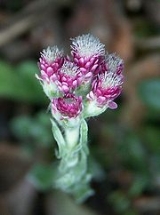
Antennaria dioica

Encyclopedia
Antennaria dioica is a flowering plant
in the family Asteraceae
. It is found in cool temperate regions of Europe
and Asia
, and also in North America
in Alaska
only.
It is a herbaceous
perennial plant
growing to 10–20 cm tall, with a rosette of basal spoon-shaped leaves
4 cm long, and 1 cm broad at their broadest near the apex; and smaller leaves arranged spirally up the flowering stems. The flower
s are produced in capitulae
(flowerheads) 6–12 mm diameter with pale pink ray florets and darker pink disc florets.
It is dioecious
, but can also reproduce without fertilisation. It is found in groups which can be all-female colonies, all-male colonies, and also mixed colonies. The male plants have whiter flowerheads than female plants.
Flowering plant
The flowering plants , also known as Angiospermae or Magnoliophyta, are the most diverse group of land plants. Angiosperms are seed-producing plants like the gymnosperms and can be distinguished from the gymnosperms by a series of synapomorphies...
in the family Asteraceae
Asteraceae
The Asteraceae or Compositae , is an exceedingly large and widespread family of vascular plants. The group has more than 22,750 currently accepted species, spread across 1620 genera and 12 subfamilies...
. It is found in cool temperate regions of Europe
Europe
Europe is, by convention, one of the world's seven continents. Comprising the westernmost peninsula of Eurasia, Europe is generally 'divided' from Asia to its east by the watershed divides of the Ural and Caucasus Mountains, the Ural River, the Caspian and Black Seas, and the waterways connecting...
and Asia
Asia
Asia is the world's largest and most populous continent, located primarily in the eastern and northern hemispheres. It covers 8.7% of the Earth's total surface area and with approximately 3.879 billion people, it hosts 60% of the world's current human population...
, and also in North America
North America
North America is a continent wholly within the Northern Hemisphere and almost wholly within the Western Hemisphere. It is also considered a northern subcontinent of the Americas...
in Alaska
Alaska
Alaska is the largest state in the United States by area. It is situated in the northwest extremity of the North American continent, with Canada to the east, the Arctic Ocean to the north, and the Pacific Ocean to the west and south, with Russia further west across the Bering Strait...
only.
It is a herbaceous
Herbaceous
A herbaceous plant is a plant that has leaves and stems that die down at the end of the growing season to the soil level. They have no persistent woody stem above ground...
perennial plant
Perennial plant
A perennial plant or simply perennial is a plant that lives for more than two years. The term is often used to differentiate a plant from shorter lived annuals and biennials. The term is sometimes misused by commercial gardeners or horticulturalists to describe only herbaceous perennials...
growing to 10–20 cm tall, with a rosette of basal spoon-shaped leaves
Leaf
A leaf is an organ of a vascular plant, as defined in botanical terms, and in particular in plant morphology. Foliage is a mass noun that refers to leaves as a feature of plants....
4 cm long, and 1 cm broad at their broadest near the apex; and smaller leaves arranged spirally up the flowering stems. The flower
Flower
A flower, sometimes known as a bloom or blossom, is the reproductive structure found in flowering plants . The biological function of a flower is to effect reproduction, usually by providing a mechanism for the union of sperm with eggs...
s are produced in capitulae
Inflorescence
An inflorescence is a group or cluster of flowers arranged on a stem that is composed of a main branch or a complicated arrangement of branches. Strictly, it is the part of the shoot of seed plants where flowers are formed and which is accordingly modified...
(flowerheads) 6–12 mm diameter with pale pink ray florets and darker pink disc florets.
It is dioecious
Plant sexuality
Plant sexuality covers the wide variety of sexual reproduction systems found across the plant kingdom. This article describes morphological aspects of sexual reproduction of plants....
, but can also reproduce without fertilisation. It is found in groups which can be all-female colonies, all-male colonies, and also mixed colonies. The male plants have whiter flowerheads than female plants.