

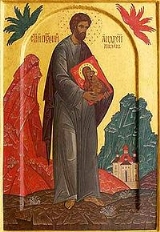
Andrei Rublev

Encyclopedia
Andrei Rublev is considered to be the greatest medieval
Russia
n painter
of Orthodox
icon
s and fresco
es.
under Nikon of Radonezh
, who became hegumen
after the death of Sergii Radonezhsky (1392).
The first mention of Rublev is in 1405 when he decorated icon
s and fresco
s for the Cathedral of the Annunciation
of the Moscow Kremlin
in company with Theophanes the Greek
and Prokhor
of Gorodets
. His name was the last of the list of masters as the junior both by rank and by age. Theophanes was an important Byzantine
master who moved to Russia, and is considered to have trained Rublev.
 Chronicles tell us that in 1408 he painted (together with Daniil Cherni
) the Assumption Cathedral in Vladimir
and in 1425–1427 the Cathedral of St. Trinity in the Trinity-St. Sergius Lavra. After Daniil's death Andrei came to Moscow's Andronikov Monastery where he painted his last work, the frescoes of the Savior Cathedral.
He is also believed to have painted at least one of the miniatures
in the Khitrovo Gospels
.
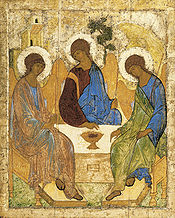
The only work authenticated as entirely his is the icon of the Trinity
, ca. 1410 (shown at right), currently in the Tretyakov Gallery
, Moscow
. It is based upon an earlier icon known as the "Hospitality of Abraham" (illustrating ). Rublev removed the figures of Abraham
and Sarah
from the scene, and through a subtle use of composition and symbolism changed the subject to focus on the Mystery
of the Trinity.
In Rublev's art two traditions are combined: the highest asceticism
and the classic harmony of Byzantine
mannerism. The characters of his paintings are always peaceful and calm. After some time his art came to be perceived as the ideal of Church painting and of Orthodox iconography
.
Andrei died at Andronikov Monastery on 29 January 1430 (this date is still questionable). His work has influenced many different artists including Dionisy. At the Stoglavi Sobor (1551) Rublev's icon style was announced as a model for church painting. He was canonized a saint
in 1988 by the Russian Orthodox Church
. The church celebrates his feast day on 29 January and 4 July.
on 29 January.
Since 1959 the Andrei Rublev Museum has been open at the Andronnikov Monastery, displaying the art of his works and his epoch.
In 1966, Andrei Tarkovsky
made his celebrated film Andrei Rublev
, loosely based on the artist's life and "the first (and perhaps only) film produced under the Soviets to treat the artist as a world-historic figure and the rival religion of Christianity as an axiom of Russia’s historical identity" during a turbulent period in the history of Russia
.
Medieval art
The medieval art of the Western world covers a vast scope of time and place, over 1000 years of art history in Europe, and at times the Middle East and North Africa...
Russia
Russia
Russia or , officially known as both Russia and the Russian Federation , is a country in northern Eurasia. It is a federal semi-presidential republic, comprising 83 federal subjects...
n painter
Painting
Painting is the practice of applying paint, pigment, color or other medium to a surface . The application of the medium is commonly applied to the base with a brush but other objects can be used. In art, the term painting describes both the act and the result of the action. However, painting is...
of Orthodox
Eastern Orthodox Church
The Orthodox Church, officially called the Orthodox Catholic Church and commonly referred to as the Eastern Orthodox Church, is the second largest Christian denomination in the world, with an estimated 300 million adherents mainly in the countries of Belarus, Bulgaria, Cyprus, Georgia, Greece,...
icon
Icon
An icon is a religious work of art, most commonly a painting, from Eastern Christianity and in certain Eastern Catholic churches...
s and fresco
Fresco
Fresco is any of several related mural painting types, executed on plaster on walls or ceilings. The word fresco comes from the Greek word affresca which derives from the Latin word for "fresh". Frescoes first developed in the ancient world and continued to be popular through the Renaissance...
es.
Biography
There is little information about his life. It is not known where he was born. Andrei Rublev probably lived in the Trinity-St. Sergius Lavra near MoscowMoscow
Moscow is the capital, the most populous city, and the most populous federal subject of Russia. The city is a major political, economic, cultural, scientific, religious, financial, educational, and transportation centre of Russia and the continent...
under Nikon of Radonezh
Radonezh
Radonezh , formerly known as Gorodok is a historic village in Moscow Oblast, Russia, located about from Sergiyev Posad.The old town of Radonezh is known to have existed since the first half of the 14th century, when it belonged to Ivan Kalita. In 1328, he settled there many captives from Rostov,...
, who became hegumen
Hegumen
Hegumen, hegumenos, igumen, or ihumen is the title for the head of a monastery of the Eastern Orthodox Church or Eastern Catholic Churches, similar to the one of abbot. The head of a convent of nuns is called hegumenia or ihumenia . The term means "the one who is in charge", "the leader" in...
after the death of Sergii Radonezhsky (1392).
The first mention of Rublev is in 1405 when he decorated icon
Icon
An icon is a religious work of art, most commonly a painting, from Eastern Christianity and in certain Eastern Catholic churches...
s and fresco
Fresco
Fresco is any of several related mural painting types, executed on plaster on walls or ceilings. The word fresco comes from the Greek word affresca which derives from the Latin word for "fresh". Frescoes first developed in the ancient world and continued to be popular through the Renaissance...
s for the Cathedral of the Annunciation
Cathedral of the Annunciation
The Cathedral of the Annunciation is a Russian Orthodox church dedicated to the Annunciation of the Theotokos. It is located on the southwest side of Cathedral Square of the Moscow Kremlin in Russia, where it connects directly to the main building of the complex of the Grand Kremlin Palace,...
of the Moscow Kremlin
Moscow Kremlin
The Moscow Kremlin , sometimes referred to as simply The Kremlin, is a historic fortified complex at the heart of Moscow, overlooking the Moskva River , Saint Basil's Cathedral and Red Square and the Alexander Garden...
in company with Theophanes the Greek
Theophanes the Greek
Theophanes the Greek was a Byzantine Greek artist and one of the greatest icon painters, or iconographers, of Muscovite Russia, and was noted as the teacher and mentor of the great Andrei Rublev.-Life and work:Theophanes was born in the capital of the Byzantine Empire, Constantinople...
and Prokhor
Prokhor
Prokhor from Gorodets was a medieval Russian icon-painter, thought to have been the teacher of Andrei Rublev....
of Gorodets
Gorodets
Gorodets is a town and the administrative center of Gorodetsky District of Nizhny Novgorod Oblast, Russia, located on the left bank of the Volga River, northwest of Nizhny Novgorod...
. His name was the last of the list of masters as the junior both by rank and by age. Theophanes was an important Byzantine
Byzantine art
Byzantine art is the term commonly used to describe the artistic products of the Byzantine Empire from about the 5th century until the Fall of Constantinople in 1453....
master who moved to Russia, and is considered to have trained Rublev.
Daniil Chyorny
Daniil Chyorny was a Russian iconographer.Together with his companion Andrei Rublev and other painters, Daniil Chyorny worked at the Assumption Cathedral in Vladimir and Trinity Cathedral in the Troitse-Sergiyeva Lavra in Sergiyev Posad . Some icons for these cathedrals are believed to have been...
) the Assumption Cathedral in Vladimir
Assumption Cathedral in Vladimir
Dormition Cathedral in Vladimir used to be a mother church of medieval Russia in the 13th and 14th centuries...
and in 1425–1427 the Cathedral of St. Trinity in the Trinity-St. Sergius Lavra. After Daniil's death Andrei came to Moscow's Andronikov Monastery where he painted his last work, the frescoes of the Savior Cathedral.
He is also believed to have painted at least one of the miniatures
Miniature (illuminated manuscript)
The word miniature, derived from the Latin minium, red lead, is a picture in an ancient or medieval illuminated manuscript; the simple decoration of the early codices having been miniated or delineated with that pigment...
in the Khitrovo Gospels
Khitrovo Gospels
The Khitrovo Gospels is a Russian illuminated Gospel Book from the late 14th or early 15th century. The book has numerous similarities to the Koshka Gospels, Kiev Psalter of 1397, and other East Slavic manuscripts of the 1390s....
.
The only work authenticated as entirely his is the icon of the Trinity
Trinity (Andrei Rublev)
Trinity is a Holy Trinity Icon, believed to be created by Russian painter Andrei Rublev in the XV century. It is his most famous work, as well regarded as one of the highest achievements of Russian art. Trinity depicts the three angels who visited Abraham at the oak of Mamre Trinity is a Holy...
, ca. 1410 (shown at right), currently in the Tretyakov Gallery
Tretyakov Gallery
The State Tretyakov Gallery is an art gallery in Moscow, Russia, the foremost depository of Russian fine art in the world.The gallery's history starts in 1856 when the Moscow merchant Pavel Mikhailovich Tretyakov acquired works by Russian artists of his day with the aim of creating a collection,...
, Moscow
Moscow
Moscow is the capital, the most populous city, and the most populous federal subject of Russia. The city is a major political, economic, cultural, scientific, religious, financial, educational, and transportation centre of Russia and the continent...
. It is based upon an earlier icon known as the "Hospitality of Abraham" (illustrating ). Rublev removed the figures of Abraham
Abraham
Abraham , whose birth name was Abram, is the eponym of the Abrahamic religions, among which are Judaism, Christianity and Islam...
and Sarah
Sarah
Sarah or Sara was the wife of Abraham and the mother of Isaac as described in the Hebrew Bible and the Quran. Her name was originally Sarai...
from the scene, and through a subtle use of composition and symbolism changed the subject to focus on the Mystery
Sacred Mysteries
The term sacred mysteries generally denotes the area of supernatural phenomena associated with a divinity or a religious ideology.-Pre-Christian religious mysteries:...
of the Trinity.
In Rublev's art two traditions are combined: the highest asceticism
Asceticism
Asceticism describes a lifestyle characterized by abstinence from various sorts of worldly pleasures often with the aim of pursuing religious and spiritual goals...
and the classic harmony of Byzantine
Byzantine art
Byzantine art is the term commonly used to describe the artistic products of the Byzantine Empire from about the 5th century until the Fall of Constantinople in 1453....
mannerism. The characters of his paintings are always peaceful and calm. After some time his art came to be perceived as the ideal of Church painting and of Orthodox iconography
Iconography
Iconography is the branch of art history which studies the identification, description, and the interpretation of the content of images. The word iconography literally means "image writing", and comes from the Greek "image" and "to write". A secondary meaning is the painting of icons in the...
.
Andrei died at Andronikov Monastery on 29 January 1430 (this date is still questionable). His work has influenced many different artists including Dionisy. At the Stoglavi Sobor (1551) Rublev's icon style was announced as a model for church painting. He was canonized a saint
Saint
A saint is a holy person. In various religions, saints are people who are believed to have exceptional holiness.In Christian usage, "saint" refers to any believer who is "in Christ", and in whom Christ dwells, whether in heaven or in earth...
in 1988 by the Russian Orthodox Church
Russian Orthodox Church
The Russian Orthodox Church or, alternatively, the Moscow Patriarchate The ROC is often said to be the largest of the Eastern Orthodox churches in the world; including all the autocephalous churches under its umbrella, its adherents number over 150 million worldwide—about half of the 300 million...
. The church celebrates his feast day on 29 January and 4 July.
Legacy
Andrei Rublev is honored with a feast day on the liturgical of the Episcopal Church in the United States of AmericaCalendar of saints (Episcopal Church in the United States of America)
The veneration of saints in the Episcopal Church is a continuation of an ancient tradition from the early Church which honors important people of the Christian faith. The usage of the term "saint" is similar to Roman Catholic and Orthodox traditions. Those in the Anglo-Catholic tradition may...
on 29 January.
Since 1959 the Andrei Rublev Museum has been open at the Andronnikov Monastery, displaying the art of his works and his epoch.
In 1966, Andrei Tarkovsky
Andrei Tarkovsky
Andrei Arsenyevich Tarkovsky was a Soviet and Russian filmmaker, writer, film editor, film theorist, theatre and opera director, widely regarded as one of the finest filmmakers of the 20th century....
made his celebrated film Andrei Rublev
Andrei Rublev (film)
Andrei Rublev , also known as The Passion According to Andrei, is a 1966 Russian film directed by Andrei Tarkovsky from a screenplay written by Andrei Konchalovsky and Andrei Tarkovsky. The film is loosely based on the life of Andrei Rublev, the great 15th century Russian icon painter...
, loosely based on the artist's life and "the first (and perhaps only) film produced under the Soviets to treat the artist as a world-historic figure and the rival religion of Christianity as an axiom of Russia’s historical identity" during a turbulent period in the history of Russia
History of Russia
The history of Russia begins with that of the Eastern Slavs and the Finno-Ugric peoples. The state of Garðaríki , which was centered in Novgorod and included the entire areas inhabited by Ilmen Slavs, Veps and Votes, was established by the Varangian chieftain Rurik in 862...
.
Sources
- Andrei RublevAndrei Rublev (film)Andrei Rublev , also known as The Passion According to Andrei, is a 1966 Russian film directed by Andrei Tarkovsky from a screenplay written by Andrei Konchalovsky and Andrei Tarkovsky. The film is loosely based on the life of Andrei Rublev, the great 15th century Russian icon painter...
, a 1966 film by Andrei TarkovskyAndrei TarkovskyAndrei Arsenyevich Tarkovsky was a Soviet and Russian filmmaker, writer, film editor, film theorist, theatre and opera director, widely regarded as one of the finest filmmakers of the 20th century....
loosely based on the painter's life. - Mikhail V. Alpatov, Andrey Rublev, Moscow: Iskusstvo, 1972.
- Gabriel Bunge, The Rublev Trinity, transl. Andrew Louth, St. Vladimir's Seminary Press, Crestwood, New York, 2007.
- Sergius Golubtsov, Voplosh’enie bogoslovskih idey v tvorchestve prepodobnogo Andreya Rubleva [The realization of theological ideas in creative works of Andrey Rublev]. Bogoslovskie trudy 22, 20–40, 1981.
- Troitca Andreya Rubleva [The Trinity of Andrey RublevTrinity (Andrei Rublev)Trinity is a Holy Trinity Icon, believed to be created by Russian painter Andrei Rublev in the XV century. It is his most famous work, as well regarded as one of the highest achievements of Russian art. Trinity depicts the three angels who visited Abraham at the oak of Mamre Trinity is a Holy...
], Gerold I. Vzdornov (ed.), Moscow: Iskusstvo 1989. - Viktor N. Lazarev, The Russian IconRussian iconsThe use and making of icons entered Kievan Rus' following its conversion to Orthodox Christianity in 988 AD. As a general rule, these icons strictly followed models and formulas hallowed by Byzantine art, led from the capital in Constantinople...
: From Its Origins to the Sixteenth Century, Gerold I. Vzdornov (ed.). Collegeville, MN: Liturgical Press, 1997. - Priscilla Hunt, Andrei Rublev’s Old Testament Trinity Icon in Cultural Context, The Trinity-Sergius Lavr in Russian History and Culture: Readings in Russian Religious Culture, vol. 3, ed. Deacon Vladimir Tsurikov, (Jordanville, NY: Holy Trinity Seminary Press, 2006), 99-122.(See on-line at phslavic.com)
- Priscilla Hunt, Andrei Rublev’s Old Testament Trinity Icon: Problems of Meaning, Intertextuality, and Transmission, Symposion: A Journal of Russian (Religious) Thought, ed. Roy Robson, 7-12 (2002–2007), 15-46 (See on-line at www.phslavic.com)
- Konrad Onasch, Das Problem des Lichtes in der Ikonomalerei Andrej Rublevs. Zur 600–Jahrfeier des grossen russischen Malers, vol. 28. Berlin: Berliner byzantinische Arbeiten, 1962.
- Konrad Onasch, Das Gedankenmodell des byzantisch–slawischen Kirchenbaus. In Tausend Jahre Christentum in Russland, Karl Christian Felmy et al. (eds.), 539–543. Go¨ ttingen: Vandenhoeck und Ruprecht, 1988.
- Eugeny N. Trubetskoi, Russkaya ikonopis'. Umozrenie w kraskah. Wopros o smysle vizni w drewnerusskoj religioznoj viwopisi [Russian icon painting. Colourful contemplation. Question of the meaning of life in early Russian religious painting], Moscow: Beliy Gorod, 2003 [1916].
- Georgij Yu. Somov, Semiotic systemity of visual artworks: Case study of The Holy Trinity by Rublev, SemioticaSemioticaSemiotica is an academic journal covering semiotics. It is the official journal of the International Association for Semiotic Studies.-Publication:Since 2000, the journal publishes five issues per year. It is published in English and French....
166 (1/4), 1-79, 2007.
External links
- Andrey Rublev Official Web Site
- Rublev at the Russian Art Gallery
- Selected works by Andrei Rublev: icons, frescoes and miniatures
- "The Deesis painted by Andrey Rublev" from the Annunciation Church of the Moscow Kremlin - article by Dr. Oleg G. Uliyanov
- Historical documentation on Andrei Rublev, compiled by Robert Bird
- The Andrei Rublev Museum of Ancient Russian Art – Guide to visiting the museum
- Venerable Andrew Rublev the Iconographer Orthodox icon and synaxarion
- Gallery of Rublev's works